Kansas Refuge Machine Rules
A Kansas refuge can look like open riding country, but public access does not automatically include ATV or UTV access. The rules depend on who manages the land and which roads are open. Before unloading, identify the refuge, confirm its current vehicle rules, and make sure your route stays on an approved road or in an authorized area.
First identify who manages the refuge
“Refuge” can refer to different kinds of protected land in Kansas. A tract may be part of a Kansas Department of Wildlife and Parks wildlife area, a federal National Wildlife Refuge, or another public property with its own manager. The word on a map or sign is not enough to tell you which rules apply.
Start by checking the agency responsible for the exact property. Look at the official property map and posted signs, and contact the managing office if the map does not make vehicle access clear. A general Kansas rule or a nearby property’s access policy does not necessarily apply to that refuge.
This matters because vehicle access is often controlled by the property manager, not just by statewide ATV and UTV laws. An ATV that is titled correctly may still be prohibited on a particular refuge road. A state park permit, city tag, or permission to hunt does not automatically authorize riding there.
| What you need to know | Why it matters |
|---|---|
| The land manager | State, federal, and other public properties may set different access rules. |
| The specific open roads | A road may be open to some vehicles, closed seasonally, or restricted by signs. |
| The machine class | ATV, UTV, golf cart, and other vehicles may not be treated alike. |
| Your reason for access | Hunting, fishing, service work, and recreation may have different conditions. |
| Current closures | Weather, habitat protection, fire risk, or management work can affect access. |
On Kansas Department of Wildlife and Parks properties, do not assume that a wildlife area is an OHV riding area. Some properties may allow motor vehicles on designated roads while prohibiting travel across fields, habitat, or other off-road ground. The practical starting point is Kansas Wildlife Area Machine Rules, then verify the rules for the particular property.
Federal refuges have their own management rules as well. A road that appears on a public map may not be open to public motorized travel, and access can be limited to particular routes or purposes. Check the refuge’s current visitor information before you tow a machine there. When the property is federal, state-level rules do not replace the refuge’s rules.
Where you may ride and where you may not
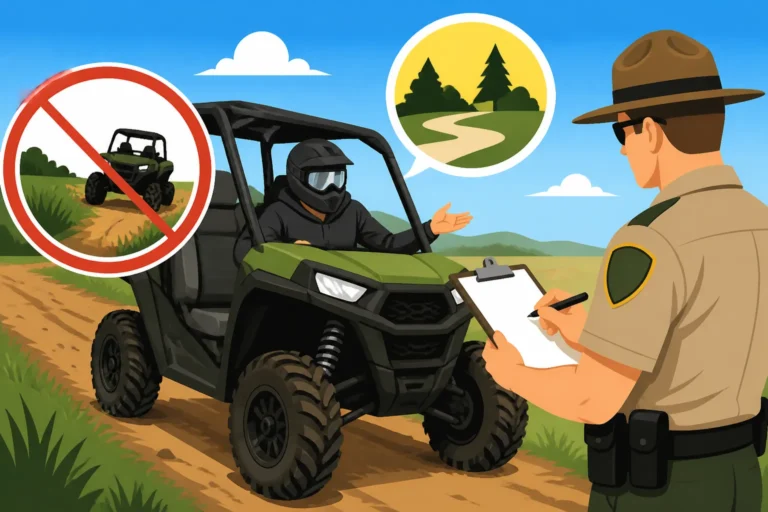
The safest working assumption is that a machine may be used only where the property manager clearly allows it. On a refuge where motorized access is limited to designated roads, stay on those roads. Do not treat a two-track, field edge, levee, service track, or mowed strip as an approved route just because it looks passable.
A road can also be open to ordinary vehicles without being open to every off-road machine. Check for signs identifying vehicle restrictions, seasonal closures, or routes limited to authorized users. If the rules do not clearly say that ATVs or UTVs are allowed, ask before riding rather than relying on another visitor’s interpretation.
Going around a gate or driving beside a closed road does not make the route legal. Nor does a short detour to avoid mud, reach a hunting spot, or retrieve equipment necessarily count as permitted travel. Leaving an approved route can damage vegetation, disturb wildlife, and create access problems for other visitors. It may also lead to a citation or loss of access.
Distinguish between these activities:
- Driving to an open parking area: Usually different from riding recreationally around the property. Confirm that your vehicle and the route are allowed.
- Traveling on an authorized road: Follow signs, closures, speed restrictions, and any limits on vehicle type or purpose.
- Riding off-road: Do not assume it is allowed. It generally requires explicit authorization for that property and location.
- Using a machine for a specific access need: A special access provision may exist, but you need to confirm its scope with the manager.
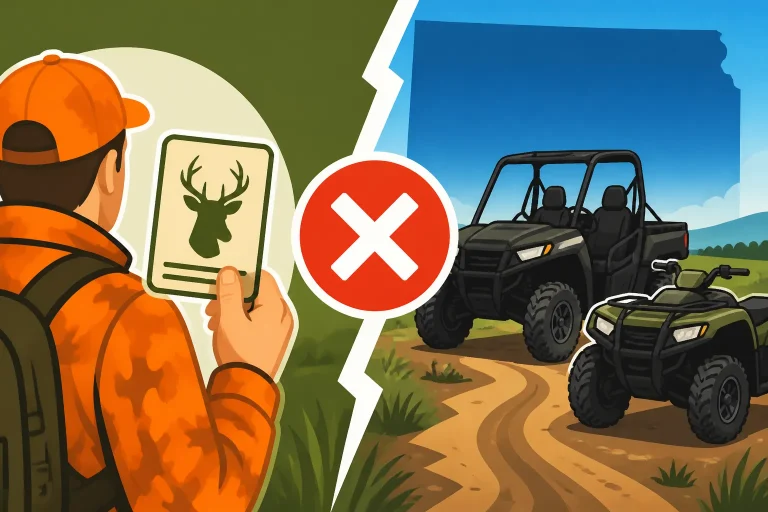
A hunting license or permission to hunt does not by itself give you permission to operate an ATV across refuge ground. Public hunting access and motor-vehicle access are separate questions. For related access issues, see Kansas Hunting Land Access by Machine and Kansas Walk-In Hunting Access Rules. If you are using a machine to retrieve game, check the property rules rather than assuming that the purpose creates an exception.
Also keep the machine’s legal class in view. Kansas distinguishes among several kinds of off-road vehicles, and the classification can affect requirements elsewhere. A vehicle described casually as a “UTV” might not fit the category you expect. Four Off-Road Classes Kansas Law Treats Differently explains why identifying the machine matters, while How Kansas Law Defines a Nonhighway Vehicle covers the classification question.
Permits, hunting access, and other rules
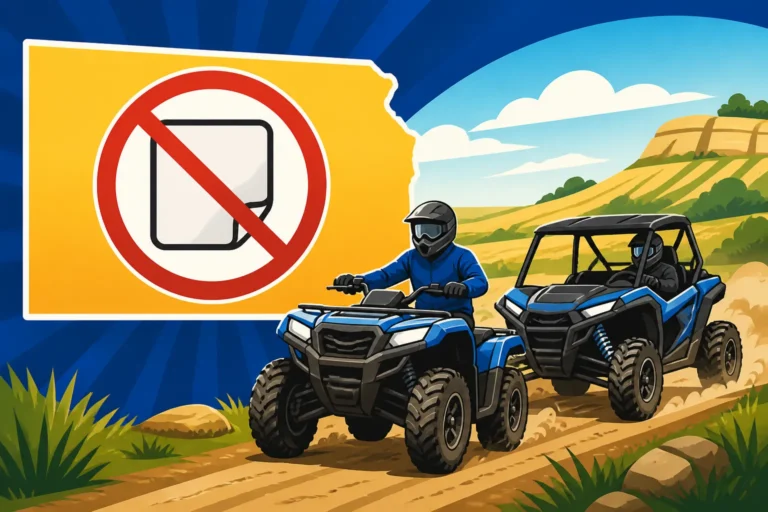
Kansas does not have a general state OHV trail sticker that grants permission to ride across refuges. That does not mean every public property is free of permits or access conditions. Property-specific requirements still apply, and a permit intended for one purpose does not necessarily authorize another.
For example, a permit associated with state park roads is not a pass for riding on a wildlife area or refuge. Kansas park rules generally concern access to designated park roads and areas, not unrestricted trail riding. See Kansas Park Permit vs Trail Permit and Kansas Department Road Riding Rules for the distinction between a permit and where a machine may actually travel.
If your visit involves hunting, fishing, camping, or another regulated activity, check those rules separately from vehicle access. You may need to meet requirements for the activity even if your machine is allowed on an access road. Conversely, having the right activity permit does not override a road closure or an off-road restriction.
Before you leave home, answer these questions:
- Which agency manages the exact property? Use the property name and map location, not just a nearby town or lake.
- Are ATVs or UTVs allowed at all? Do not infer permission from the presence of a road or parking lot.
- Which routes are open? Confirm whether the approved route is open to your machine and purpose.
- Are there seasonal or temporary closures? Check close to your trip, especially after severe weather or during sensitive management periods.
- Do other activity rules apply? Review hunting, fishing, camping, and access conditions independently.
- What must you carry or display? Ask whether proof of ownership, a permit, or other documentation is required.
Rules can change for a particular refuge even when the broader state rule has not changed. A closure notice, gate, or posted sign should be treated as current direction for that location. If a sign conflicts with an old map, stop and confirm with the land manager before proceeding.
A practical check before you unload
A short phone call or property-specific check can prevent a wasted trip and an avoidable violation. When you contact the manager, give the property name, the type of machine, and what you plan to do. Ask whether you can drive to the area, which roads you may use, whether you may leave those roads, and whether any closures or permits apply.
Be specific about the machine. “Off-road vehicle” may not answer whether the property allows your ATV, side-by-side, or golf cart. If the machine has a wide stance, unusual seating, or a configuration that could affect its legal class, describe it accurately. For classification context, see Why the Manufacturer Decides Your Title Class.
At the property, read signs at entrances and intersections rather than relying only on directions saved before the trip. Keep the vehicle on the route you confirmed, park only in permitted areas, and do not move barriers. If a route is closed or unclear, choose another authorized destination instead of testing the boundary.
It also helps to keep basic ownership and machine information accessible. A title is useful evidence of ownership, but it is not a riding permit and does not make a machine street legal. Kansas does not issue an annual OHV registration tag for general trail use, but that fact does not create access rights on refuge land. See Kansas Has No OHV Registration and Having a Title Does Not Make an ATV Street Legal for how those separate issues fit together.
If you are visiting from another state, do not assume that a sticker or registration from home grants access on Kansas refuge property. Confirm the property’s requirements directly, including any rules for visiting riders. Kansas Rules for an Out-of-State Machine addresses the broader state question, but the land manager still controls access to its property.
The useful rule is simple: identify the manager, verify that your specific machine and purpose are allowed, and follow only the routes the property has opened. When the answer is uncertain, do not ride until you have confirmation. Refuge access is not the same as an OHV trail system, and a machine’s title or general permission to hunt does not substitute for property-specific authorization.
Disclaimer
This article is for general informational purposes only and does not constitute professional advice. Laws, prices and regulations vary by location and change over time. Consult a qualified professional for guidance on your specific situation.