Why the Manufacturer Decides Your Title Class
It’s a common scenario: you’ve just invested in a brand-new ATV or UTV, or maybe you found a fantastic deal on a used one, and you’re excited to get it titled and hit the trails or put it to work. But then you hear about different "title classes" in Kansas, and suddenly you’re wondering if your machine is an ATV, a UTV, or something else entirely. The truth is, how your off-road machine is legally classified in Kansas isn't up to you, or even the dealership in many cases. It almost always comes down to how the manufacturer designed and built the machine in the first place. This guide will help you understand why the manufacturer’s original intent and design are the bedrock of its Kansas title classification.
Understanding Kansas's Off-Road Vehicle Classifications
Navigating the world of off-road vehicle titles in Kansas can feel a bit like trying to solve a puzzle with missing pieces. You might have friends with different machines, all called "UTVs" casually, but when it comes to the official paperwork, their titles read differently. This isn't just bureaucratic red tape; it's a reflection of how the state categorizes these machines, largely based on their original design specifications from the factory.
The "Nonhighway Vehicle" Catch-All
For most of us, when we think of an ATV or a side-by-side, we immediately recognize it as something meant for off-road adventures or heavy-duty farm work, not cruising down I-70. Kansas law generally bundles these machines into a broad category called "nonhighway vehicles." This umbrella term simply means they are not intended or legal for regular road use. It’s a crucial distinction, setting them apart from cars, trucks, and motorcycles that receive traditional highway vehicle titles and license plates. [How Kansas Law Defines a Nonhighway Vehicle] goes into this in more detail.
However, just because something is a nonhighway vehicle doesn't mean it all falls into one simple box. Within this category, Kansas has several distinct classifications, each with its own set of rules and requirements for titling. The challenge for new owners is understanding which specific classification their machine belongs to, and that often boils down to the paperwork issued by the manufacturer.
Specific Categories and Their Manufacturer Distinctions
Kansas law recognizes several specific types of nonhighway vehicles, and the manufacturer plays a starring role in defining which category your machine falls into. These distinctions aren't arbitrary; they’re based on measurable design characteristics.
- All-Terrain Vehicles (ATVs): These are the classic "quads" you typically think of. Manufacturers design them for a single rider or, in some cases, a single passenger behind the operator. Key characteristics defined by the factory include handlebars for steering, a seat designed to be straddled by the operator, and an engine with specific displacement limits. The manufacturer's certificate of origin (MCO) will explicitly state "ATV" and list these characteristics. For an in-depth look, check out [Kansas Titles ATVs as Nonhighway Vehicles].
- Recreational Utility Terrain Vehicles (UTVs): This is where it gets a bit more nuanced. While often lumped together with WSUVs, recreational UTVs are primarily designed by manufacturers for recreational purposes – trail riding, hunting, or general utility tasks that don't quite fit the specific "work-site" criteria. They typically have side-by-side seating, a steering wheel, and a larger engine than most ATVs. The manufacturer might label these broadly as "UTV" on the MCO, which generally leads to a nonhighway vehicle title that doesn't specify it as a WSUV.
- Work-Site Utility Vehicles (WSUVs): This is a unique Kansas classification that's heavily dependent on manufacturer design. To qualify as a WSUV, a machine must meet several specific criteria from the factory: it must be less than 48 inches wide [Kansas WSUV Width of 48 Inches], weigh more than 800 pounds unladen [Kansas WSUV Weight Over 800 Pounds], have four or more nonhighway tires, and be designed primarily for work-site purposes. The manufacturer's intent is paramount here. If the factory didn't build it with these specifications, it simply won't qualify. You can read more about this in [Kansas Work-Site Utility Vehicles Explained] and [What Makes a Side-by-Side a Work-Site Utility Vehicle].
- Golf Carts and Micro Utility Trucks: These are also considered nonhighway vehicles, and again, their classification hinges on their original manufacturer design. A golf cart is specifically manufactured for operation on golf courses for sporting purposes. Micro utility trucks, on the other hand, are small, highway-legal vehicles designed for utility work, often at low speeds. The manufacturer's specifications—such as the vehicle's top speed, seating arrangement, and overall construction—dictate whether it gets titled as one of these specific types.
The important takeaway here is that you can’t simply declare your machine a WSUV or a golf cart if the manufacturer didn't build it to those precise specifications. The physical characteristics and the accompanying documentation from the factory are the foundation of its official classification.
How Manufacturer Design Shapes Classification
When you walk into a Kansas County Treasurer's office to title your off-road machine, the clerk isn't going to make an arbitrary decision about what kind of vehicle you have. They rely on established legal definitions and, crucially, the documentation that comes directly from the manufacturer. This is where the rubber meets the road—literally.
Key Design Elements Dictated by the Factory
The manufacturer's engineers and designers make choices that fundamentally determine how a machine will be classified under Kansas law. These aren't aftermarket modifications; these are the core components and specifications of the vehicle as it rolls off the assembly line.
- Steering Mechanism: Does it have handlebars like a motorcycle or a steering wheel like a car? This is a primary differentiator. ATVs universally have handlebars, while UTVs, WSUVs, golf carts, and micro utility trucks feature steering wheels. This design choice by the manufacturer is fixed.
- Seating Arrangement: Is the machine designed for the operator to straddle a saddle seat, or does it offer side-by-side bench or bucket seating? ATVs, by definition, have straddle seats. UTVs and WSUVs are characterized by their side-by-side seating. This impacts passenger capacity and safety, and it's a fundamental design decision.
- Width and Weight: For specific classifications like the Work-Site Utility Vehicle (WSUV), the manufacturer's design for the vehicle's width and its unladen (empty) weight are critical. Kansas law sets a maximum width of 48 inches and a minimum weight of 800 pounds for a WSUV. If a manufacturer builds a side-by-side that is 50 inches wide, it simply cannot be titled as a WSUV, regardless of its primary use. It becomes a general nonhighway vehicle.
- Engine Size and Power: While not always a direct titling factor for classification between ATV/UTV, engine size and power output are manufacturer choices that define the machine's capability and often its intended use. This can indirectly influence whether it's perceived as a recreational UTV versus a heavy-duty utility machine, although the legal definitions rely more on physical dimensions.
- Intended Purpose: Though sometimes subjective, the manufacturer's overall design language often conveys the machine's primary purpose. Is it built for high-speed sport riding, or is it equipped with a large cargo bed and a heavy-duty suspension for hauling and towing? While owners might use their machines for various tasks, the initial design provides the framework.
Why it Matters at the County Treasurer's Office
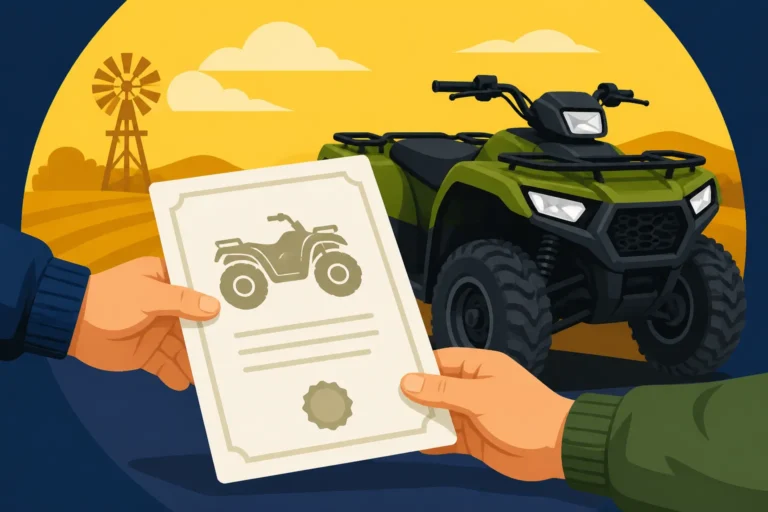
When you go to title your machine, the most critical piece of documentation is the Manufacturer's Certificate of Origin (MCO), sometimes called a Manufacturer's Statement of Origin (MSO). This document is like the birth certificate for your off-road vehicle. It’s issued by the factory and details all the core specifications and, most importantly, the manufacturer's designation of what the vehicle is.
The county treasurer's office clerks are trained to follow Kansas statutes. They look at the MCO to determine the machine's legal classification. If the MCO from the factory states "All-Terrain Vehicle," that's what it will be titled as. If it says "Utility Vehicle" or "Work-Site Utility Vehicle," they will title it accordingly, provided it meets any other statutory requirements (like the WSUV dimensions).
Think of it this way: a manufacturer selling a side-by-side will design it to specific industry standards and then declare its type on the MCO. [Taking an MCO to the County Treasurer's Window] is a great resource to learn what to expect. This MCO is what guides the titling process, not your personal interpretation or how you plan to use it. Even if you use a standard recreational UTV exclusively on a work site, if the manufacturer didn't build it to WSUV specifications and denote it as such on the MCO, it won't receive a WSUV title.
When a Machine Doesn't Fit Neatly
Occasionally, you might encounter a machine, especially an older or highly customized one, where the classification isn't immediately obvious, or the MCO is lost. In these situations, the county treasurer's office will often rely on the visual characteristics of the machine and compare them against the statutory definitions. They might ask for a physical inspection or require additional affidavits. For example, if you're trying to title a side-by-side as a WSUV but the MCO is missing, you'll need to demonstrate, through its physical attributes, that it meets the 48-inch width and 800-pound weight requirements. In cases where original paperwork is lost or vague, services like LawDepot can help you generate a bill of sale or affidavit to support your claim of ownership and description, but they cannot change the fundamental classification determined by the machine's factory design.
The Practical Implications for Owners
Understanding that the manufacturer dictates your off-road machine's title class isn't just an academic exercise; it has very real, practical implications for you as an owner in Kansas. From the titling process itself to where and how you can legally operate your machine, the initial classification is paramount.
Titling Differences and Requirements
The specific title class your machine falls into directly impacts the paperwork you’ll need and the process you’ll follow at the county treasurer’s office.
- Nonhighway Title: Most ATVs and recreational UTVs receive a standard [Kansas's Nonhighway Title Explained]. This title confirms ownership but explicitly states the machine is not for highway use. The fee is minimal [What the $10 Nonhighway Title Fee Covers], but the key is that it's a non-highway title.
- Work-Site Utility Vehicle Title: If your side-by-side meets the strict manufacturer-defined criteria for a WSUV (less than 48 inches wide, over 800 pounds, specific seating, etc.), it will receive a specific WSUV title. This classification allows for certain limited road use under specific conditions that other nonhighway vehicles don't get. This is why [Titling a Side-by-Side in Kansas] often involves more careful scrutiny to ensure it truly meets the WSUV definition.
- Golf Cart/Micro Utility Truck Titles: These machines also have their own distinct titling processes reflective of their manufacturer-defined purpose and characteristics.
The specific MCO or equivalent documentation from the manufacturer is the foundation of all these titling processes. If you buy a used machine and the seller doesn’t have the MCO, you might need a bill of sale or other documentation to prove ownership, but the inherent classification of the machine itself, based on its design, will remain unchanged. Using a template from a service like LawDepot for a bill of sale can help ensure you have the proper legal documentation for ownership transfer, even if the MCO is missing.
Road Use Restrictions and Compliance
This is where the manufacturer’s initial classification becomes incredibly important for your daily use. Kansas has very specific rules about where different nonhighway vehicles can and cannot be operated, especially on public roads.
- ATVs and Recreational UTVs: Generally, these machines are prohibited from operation on public streets and highways in Kansas. There are very limited exceptions, such as crossing a highway, certain agricultural purposes, or within city limits where a local ordinance specifically allows it. You cannot simply decide to drive your ATV on a county road because you think it's safe; the law, based on its manufacturer classification, restricts this. You’ll want to review [Kansas ATV Road Rules Under 8-15,100] for a comprehensive breakdown.
- Work-Site Utility Vehicles (WSUVs): Because of their specific manufacturer design and title class, WSUVs often have slightly more permissive, though still restricted, road use rules. These machines are typically allowed on specific public roads if they meet certain equipment requirements and are operated under specific conditions, often related to their work-site function. This is a direct consequence of their unique classification.
- Golf Carts and Micro Utility Trucks: These also have their own distinct road use regulations, often allowing limited street use in areas with lower speed limits, again, all tied back to how the manufacturer designed and categorized them.
If you mistakenly title a recreational UTV as a WSUV (which is unlikely if the county treasurer is doing their job correctly, but mistakes can happen, especially with homemade documentation), you could face legal penalties for operating a misclassified vehicle on the road. It’s crucial that the title accurately reflects the manufacturer’s design to ensure you comply with all operating laws. If you are unsure about the proper classification, consulting with your [Kansas County Treasurers Handle Titles] office is always the best first step.
The Importance of the MCO for Future Sales and Compliance
Beyond initial titling and road use, the manufacturer’s original documentation and the resulting title class have long-term implications.
- Resale Value and Ease: When you sell your machine, having a clear, accurate title that matches the machine’s manufacturer-defined characteristics makes the process much smoother. Buyers are more confident knowing the machine is correctly documented. If you’re selling a machine that had a lost MCO, ensuring you have a proper bill of sale, perhaps using a template from LawDepot, and a clear title in hand will expedite the sale.
- Insurance and Liability: While Kansas does not have a statewide mandatory insurance law for ATVs, some cities require it for UTVs if they are permitted on city streets. Your insurance provider will also classify your machine based on its manufacturer specifications. An ATV will be insured as an ATV, a UTV as a UTV, and so on. Misclassification could create issues with coverage in the event of an accident.
In essence, the manufacturer acts as the primary authority in defining what your off-road machine is from a legal standpoint in Kansas. All subsequent actions, from titling to where you can legally ride, stem from this initial classification. So, when you're considering a purchase, remember that the factory's design choices are setting the stage for your entire ownership experience.
Here's a quick reference table to summarize how manufacturer design influences Kansas title classification:
| Feature/Category | All-Terrain Vehicle (ATV) | Recreational Utility Terrain Vehicle (UTV) | Work-Site Utility Vehicle (WSUV) | Golf Cart | Micro Utility Truck |
|---|---|---|---|---|---|
| Steering | Handlebars | Steering Wheel | Steering Wheel | Steering Wheel | Steering Wheel |
| Seating | Straddle Seat (1-2 riders) | Side-by-Side (2+ riders) | Side-by-Side (2+ riders) | Side-by-Side (2-4 riders) | Side-by-Side (2+ riders) |
| Width (Manufacturer) | Varies | Varies | Under 48 inches | Varies | Varies |
| Weight (Manufacturer) | Varies | Varies | Over 800 lbs unladen | Varies | Varies |
| Primary Purpose (Manufacturer) | Sport/Recreation | Recreation/Light Utility | Work-site tasks | Golf course/leisure | Street-legal utility |
| Kansas Title Type | Nonhighway Vehicle (ATV) | Nonhighway Vehicle (UTV) | Nonhighway Vehicle (WSUV) | Nonhighway Vehicle (Golf Cart) | Nonhighway Vehicle (Micro UT) |
| Typical Road Use | Generally Prohibited (few exceptions) | Generally Prohibited (few exceptions) | Limited Road Use (specific conditions) | Limited Road Use (low speed, local ord.) | Limited Road Use (local ord.) |
Disclaimer
This article is for general informational purposes only and does not constitute professional advice. Laws, prices and regulations vary by location and change over time. Consult a qualified professional for guidance on your specific situation.