Is a Spark Arrester Required at a Kansas Park?
A spark arrester can be easy to overlook when you’re packing an ATV or UTV for a Kansas ride. Whether you need one depends less on a statewide permit and more on the rules at the specific riding area. Here’s how to check before you haul your machine, what equipment may qualify, and what to do if the answer is unclear.
The short answer: check the riding area’s rules
There isn’t one answer that safely applies to every Kansas park. A facility may require spark arresters for certain machines or riding areas, while another may set different equipment rules. The operator’s current rules—not another park’s policy, a friend’s experience, or a permit from elsewhere—are what matter for your visit.
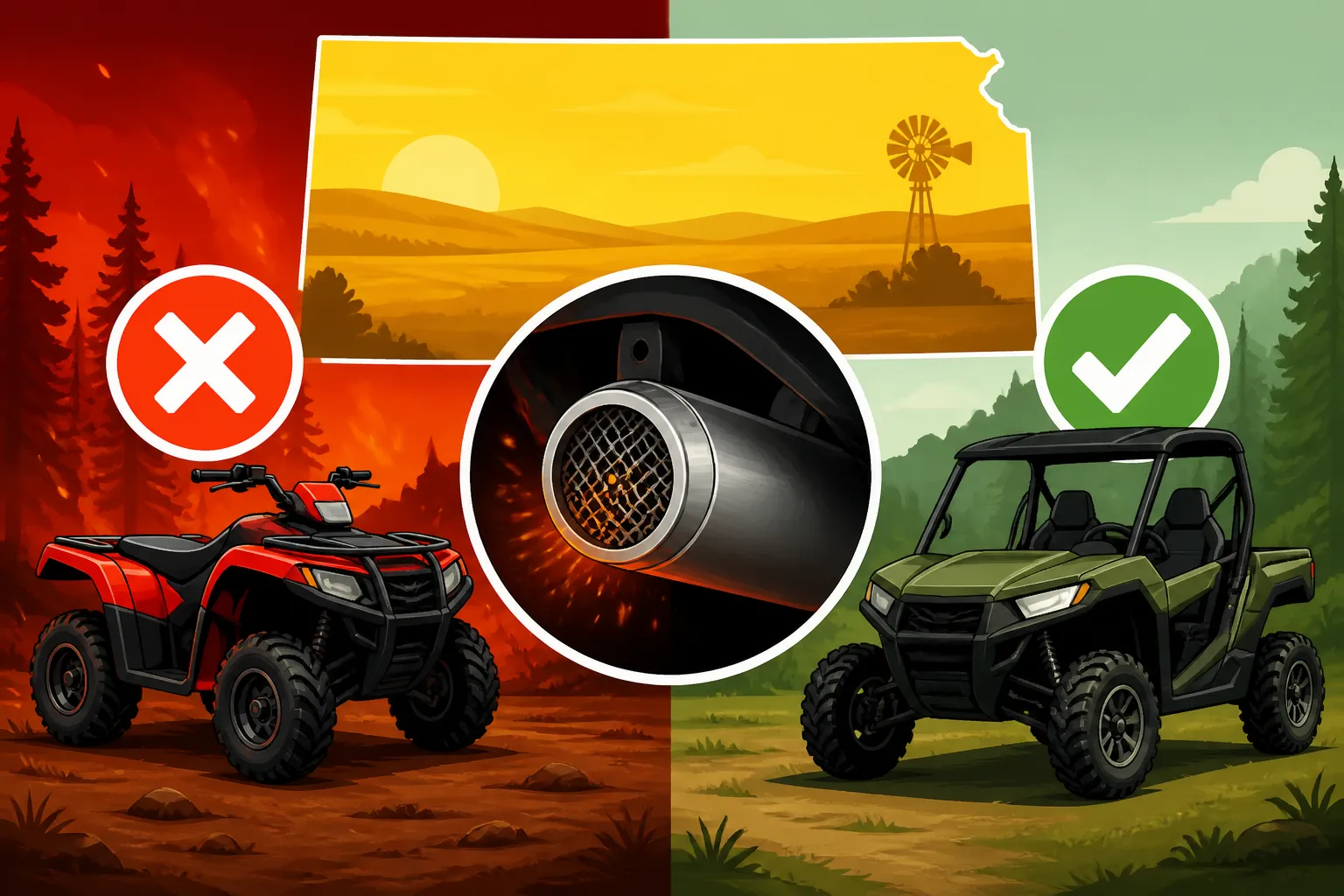
A spark arrester is an exhaust-system device designed to reduce the chance that hot particles leave the exhaust and start a fire. It is not the same thing as a muffler. A machine can have a muffler and still lack a spark arrester, and a spark arrester does not necessarily make an exhaust quiet enough to meet a park’s sound rules.
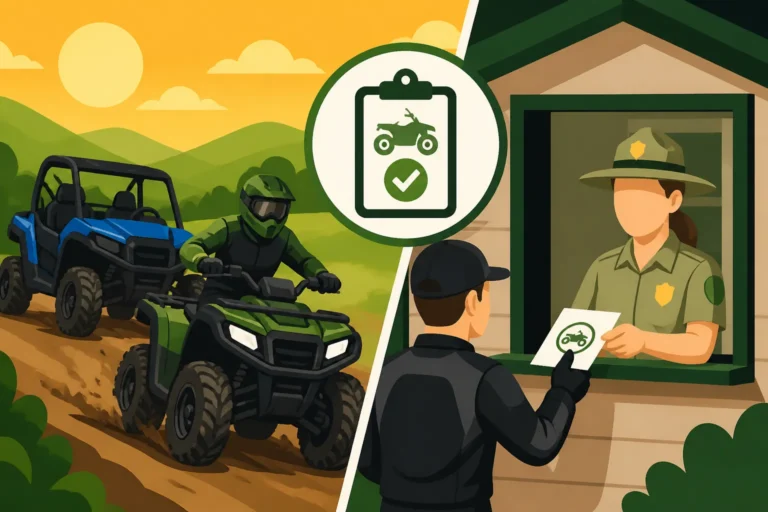
The requirement is separate from permits and reciprocity. Kansas has no state OHV permit, but that doesn’t mean every facility accepts every machine or that equipment rules disappear. A facility can set its own conditions for entry. For the permit distinction, see Kansas Has No State OHV Permit and Kansas Park Permit vs Trail Permit.
Before traveling, check the riding area’s official rules or contact the operator directly. Ask whether a spark arrester is required for your machine and, if so, what type or marking they accept. If the rule is not clear, get an answer before loading up.
| What to check | Why it matters |
|---|---|
| Whether the facility requires a spark arrester | Rules can differ between riding areas |
| Whether the requirement applies to your machine | The policy may cover ATVs, UTVs, dirt bikes, or all off-road vehicles |
| What type of arrester is accepted | A facility may require a particular design or approval marking |
| Whether sound limits also apply | A spark arrester and a quiet exhaust are different things |
| Whether the rule has changed | Online summaries and old trip reports may be out of date |
How rules can differ between Kansas riding areas
Kansas riders use a mix of public land, Corps-managed areas, and private parks. Those properties do not necessarily share the same operating rules. Even when two places allow similar types of vehicles, their entry requirements, permitted riding areas, and equipment checks can differ.
Private parks set their own entry conditions
Private parks can establish rules for equipment, riders, passengers, noise, and conduct. A posted rule or waiver may address spark arresters directly, or the park may include equipment requirements in a broader inspection policy. Read the facility’s current rules before you leave, rather than relying on a post describing a past visit.
For example, check the facility-specific rules for Kansas Rocks Park Rules for Riders and Kansas Syracuse Dunes Park Rules. These are useful reminders that one private park’s requirements should not be assumed to apply at another. The same goes for age limits, helmets, sound checks, and other conditions. Kansas Private Park Waivers and Rules explains why it pays to review the rules before signing in.
Public land rules may be tied to the property and activity
A recreation area on public land may have rules set by the agency or land manager responsible for that property. Don’t assume that a state park road rule, a local riding-area policy, and a private park rule are interchangeable. Kansas state parks do not operate OHV trails, which is one reason it helps to identify exactly where you plan to ride. See Kansas State Parks Have No OHV Trails.
Corps-managed riding areas also have their own local information to check. A general statement about access or fees does not answer every question about machine equipment. Before you travel, confirm the rules for the particular area and the route or activity you have in mind. Kansas Corps Areas That Charge Nothing can help distinguish the access setting, but it should not replace a check of current facility rules.
Permits do not settle equipment questions
A permit, pass, or proof of ownership does not automatically show that your machine meets a park’s equipment requirements. Likewise, a permit issued by another state should not be treated as proof that a Kansas park will accept your setup. Requirements for entry and equipment are separate questions.
When planning a visit, check both sides:
- What access authorization, if any, is needed?
- What machine and safety equipment does the facility require?
That distinction is especially helpful when comparing a public riding area with a private park. For practical planning before a longer drive, Kansas Trail Conditions Before You Tow is also worth reviewing.
How to check whether your machine has a spark arrester
Don’t judge by appearance alone. Exhaust components can look similar from the outside, and a stock muffler does not necessarily confirm that an arrester is present or that it meets a particular park’s rule.
Check the owner’s manual and exhaust information
Start with the owner’s manual and the manufacturer’s information for your exact machine and exhaust system. Look for wording that identifies a spark arrester, not just a muffler or a noise-reduction feature. If the exhaust has been modified, the original machine documentation may no longer describe the installed parts.
A removable screen or insert may be part of an exhaust system, but whether it is the right part depends on the machine and the park’s requirements. Avoid assuming that any mesh screen, generic insert, or aftermarket muffler counts. Ask the facility what it accepts if the rule calls for a specific standard or marking.
Inspect the exhaust without making risky assumptions
If the machine has a removable arrester, check the manual for the correct inspection and cleaning procedure. Soot or carbon buildup can restrict the exhaust, and a damaged or missing component may not provide the protection intended by the manufacturer. Let the exhaust cool before inspection and follow the manufacturer’s instructions.
If you cannot identify the component, ask a qualified repair shop or the machine’s dealer to check it. Don’t remove or modify exhaust parts to make the machine louder or to improve performance without understanding the consequences. A change can affect the machine’s safety, noise, emissions compliance, warranty, or eligibility under a park’s rules.
Treat product listings as a starting point, not proof
If you need a replacement part, match it to the machine’s make, model, year, and exhaust configuration. An online listing, including one on Amazon, is not by itself proof that the part fits or meets a park’s standard. Check the manufacturer’s specifications and confirm any required approval or marking with the facility.
Keep the part information or documentation available if the park asks about your setup. A receipt alone may not establish that the installed part is the right one, but clear product information can help resolve a question.
What to do before you tow to the park
A little checking can prevent a long drive that ends at the entrance. Use this process when the park’s rules are unclear or your machine has an aftermarket exhaust.
- Identify the exact riding area. Check the name and managing organization. Don’t rely on a broad search result for “Kansas ATV trails” when you are visiting a specific property.
- Read the current rules. Look for “spark arrester,” “spark arrestor,” “exhaust,” “fire prevention,” “sound,” and “equipment inspection.” Check for updates or special notices that may apply to your visit.
- Ask about your exact machine. Tell the operator whether it is an ATV, UTV, or dirt bike, and whether the exhaust is stock or modified. Ask whether the requirement applies to that vehicle.
- Ask what counts as compliant. If an arrester is required, ask whether a particular marking, design, or approval is expected. “It has a muffler” is not a reliable substitute for an answer.
- Check for other equipment rules. Ask about sound limits, helmets, flags, tires, or inspection procedures where relevant. Passing one equipment check does not automatically satisfy the others.
- Keep the answer with your trip information. Save the facility’s written rules or the response you received. If the answer was by phone, note who you spoke with and when.
- Recheck before departure. Rules and operating conditions can change. Confirm again if your visit is well after your initial planning or if the park has posted a closure or special notice.
If you reach the facility and discover the machine does not meet its requirements, don’t ride it in the restricted area or try to bypass an inspection. Ask whether there is a compliant way to use the facility, or postpone the ride until the machine is properly equipped. A park can deny entry under its own rules, and arriving with a permit or a machine that was accepted somewhere else may not change that decision.
The practical takeaway is straightforward: a spark arrester may be required at a Kansas riding area, but the answer depends on that facility’s current rules. Confirm the requirement with the operator, verify that the arrester is the correct component for your machine, and treat permits and equipment compliance as separate checks.
Disclaimer
This article is for general informational purposes only and does not constitute professional advice. Laws, prices and regulations vary by location and change over time. Consult a qualified professional for guidance on your specific situation.