Driving a Quad to Retrieve a Deer on Private Ground
Driving a quad to retrieve a deer on private ground in Kansas can seem straightforward, but permission to hunt does not automatically settle where you may ride or which rules apply. Before unloading, confirm access with the landowner, plan a route that stays on approved ground, and distinguish private-land use from travel on a public road.
Confirm permission and agree on the route
Start with the person who controls the property. Ask specifically whether you may use an ATV or UTV to reach the deer and bring it out. Permission to hunt, enter on foot, or park at the edge of a property is not necessarily permission to drive across it. If the property is leased, shared, or managed by someone other than the owner, clarify who can authorize vehicle access.
Be precise about the route. Identify the entry point, the area where you may drive, and the way back out. A map or a short walk-through can prevent confusion about field edges, gates, creek crossings, planted crops, or neighboring land. If the route crosses another person’s property, get that person’s permission too. A route that looks convenient on a map may not follow the boundaries the landowner expects you to respect.
Keep the machine on the agreed route and avoid creating new tracks through crops, wet ground, or sensitive areas. Close gates as instructed, watch for livestock and farm equipment, and do not assume that an existing track is open to recreational vehicle use. These are practical ways to protect the landowner’s property and keep access arrangements clear.
If a landowner gives permission verbally, repeat back what you understand: which machine you can use, where you can ride, and whether you can make more than one trip. For a shared property or a complicated route, written confirmation can help prevent misunderstandings. Kansas Landowner Permission Rules and Carrying a Landowner’s Letter in Your Pocket cover related access questions.
Permission to retrieve a deer on private ground should not be treated as permission to ride across nearby public land. Kansas does not have a statewide OHV trail permit system or general public-land trail pass, according to the Kansas Department of Wildlife and Parks. The department also says its state parks do not feature ATV or UTV trails, and off-road vehicle use is prohibited on state wildlife areas. Check the rules for the specific property rather than assuming a public parcel is an open route. Why a Hunting License Opens No Trails in Kansas explains why hunting access and trail access are separate issues.
Keep private-ground riding separate from public-road travel
A route across private ground and a route along a public road are not the same thing. If the deer is near a road, or your route to the property requires a public street, do not assume that the machine can use the road just because the trip is related to hunting or recovery. Road access depends on the applicable state law and, where relevant, local rules.
Kansas classifies standard ATVs and work-site utility vehicles as nonhighway vehicles rather than ordinary registered road vehicles. The Kansas Office of Revisor of Statutes defines an ATV as a motorized nonhighway vehicle, other than an electric-assisted bicycle, that is 55 inches or less wide, has a dry weight of 1,500 pounds or less, and travels on three or more nonhighway tires. A work-site utility vehicle is a different class: the Kansas Office of Revisor of Statutes defines it as at least 48 inches wide, over 800 pounds unladen including fuel and fluids, with four or more nonhighway tires, a steering wheel, and side-by-side seating for at least two people; that class excludes micro utility trucks.
That distinction matters if someone calls a side-by-side a “quad” casually. The machine’s design and legal class can affect which rules apply. Four Off-Road Classes Kansas Law Treats Differently and Why the Manufacturer Decides Your Title Class can help you identify what you have before you plan a trip.
Statewide, Kansas does not require annual standard vehicle registration for standard ATVs or work-site utility vehicles, according to the Kansas Department of Revenue Division of Vehicles. That exemption does not create general permission to ride on public roads. If a city allows a UTV on its streets under a local ordinance, the city may require a local permit or license and annual renewal, according to the same agency. Check with the city before using a public street, even for a short connection between private properties.
Do not use an interstate or the Kansas Turnpike as part of the route. Kansas law prohibits ATVs and work-site utility vehicles from operating on interstate highways, according to the Kansas Legislature. If any public-road travel is permitted in a particular situation, check the applicable equipment and operating rules first. For example, Kansas law requires an ATV on a public highway, street, or road between sunset and sunrise to have lights required for motorcycles, according to the Kansas State Legislature. The Kansas Office of Revisor of Statutes says headlights do not have to be illuminated at all times; the requirement to equip and use them applies to operation on public roads between sunset and sunrise.
For UTVs on roads where local rules authorize them, equipment requirements may be specific. Kansas law requires public-road motor vehicles to have a left-side mirror and another mirror inside at the center or on the right side, according to the Kansas Office of Revisor of Statutes. Local ordinances may also set equipment conditions for UTVs. Do not assume that equipment suitable for a private field is enough for a street. Kansas Rules for Riding Farm Ground and Kansas Rules for Riding a County Road address the difference between off-road and road use.
Check the machine, title, and operator before loading
A machine used on private property still needs to be in suitable working condition. Check the tires, brakes, steering, throttle, fuel level, and lights before setting out. Carry a phone or other way to contact the landowner, and tell someone where you are going. A deer-retrieval trip may involve uneven ground, brush, mud, or limited visibility, so plan for a route the machine can handle without damaging the property or putting the rider at unnecessary risk.
A title is proof of ownership, not permission to cross land or a substitute for a road permit. In Kansas, off-road vehicles such as ATVs receive nonhighway titles through the local county treasurer’s office under the authority of the state revenue department, according to the Kansas Department of Revenue. When a nonhighway vehicle is sold or transferred, the purchaser must obtain a nonhighway certificate of title, according to the Kansas Office of Revisor of Statutes. The state does not require annual registration for standard ATVs and work-site utility vehicles, but those facts do not make a machine street legal.
If you recently bought the machine and still need ownership paperwork, the Kansas Department of Revenue says an application for a nonhighway title must be accompanied by a properly assigned certificate of title, a manufacturer’s statement of origin, or a bill of sale. Kansas Proof of Ownership on the Trail and What to Bring to the Treasurer’s Office to Title are useful if you are sorting out documents before riding.
Keep alcohol out of the plan. Kansas sets the legal blood alcohol concentration limit for operating an ATV, UTV, or other motor vehicle at 0.08% or more, according to the Kansas Legislature. A field ride can still involve hazards such as ditches, livestock, other hunters, and farm equipment. Treat the trip as vehicle operation and make sure the operator is able to ride safely.
| Before you leave | What to confirm |
|---|---|
| Land access | The person controlling the property agrees to ATV or UTV use, not only hunting or foot access. |
| Route | The entry point, permitted path, boundaries, gates, and return route are clear. |
| Machine class | You know whether the vehicle is an ATV, work-site utility vehicle, or another type. |
| Public-road connection | Any road use is allowed for that machine and complies with state and local rules. |
| Ownership records | The machine’s title or purchase documents are available if needed. |
| Operator and conditions | The rider is fit to operate, the machine is working properly, and the route is suitable. |
Retrieve the deer without creating a second problem
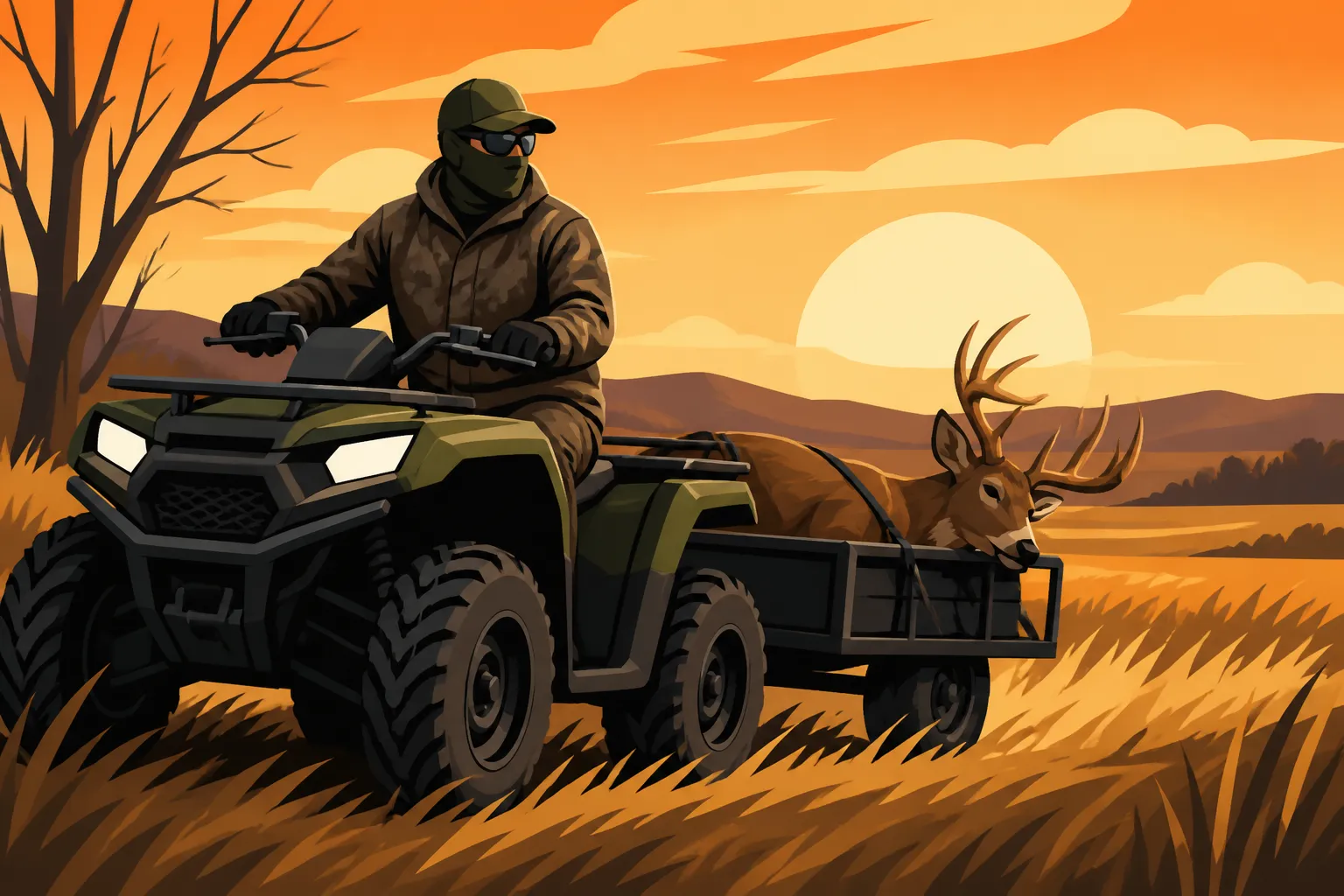
Before moving the deer, decide how to secure it and whether the machine can carry the load safely. Use the vehicle’s manufacturer guidance for loading and towing, and avoid carrying a load that blocks the operator’s view or interferes with steering, braking, or control. If the ground is steep, soft, or slippery, consider whether a different route or another method of recovery would be safer and less damaging to the property.
Take the route the landowner approved rather than cutting across the nearest open-looking field. Keep a safe distance from livestock, buildings, fences, and other people. If conditions have changed since permission was given—for example, the ground is too wet or farm work is underway—pause and ask before continuing. A short delay is preferable to getting stuck, damaging crops, or surprising someone working on the property.
If the trip involves a public road, stop and confirm that the machine may legally use that road before entering it. A deer-retrieval purpose does not by itself change a vehicle’s classification or authorize road use. Kansas says vehicles manufactured for off-road or nonhighway use cannot be made fully street-legal for general public-road operation, though limited exceptions may apply for certain roads or circumstances, according to the Kansas Highway Patrol. Local authorization and agricultural exceptions have their own conditions; do not infer that one applies to a particular retrieval trip without checking the relevant rule.
When the trip is over, leave the property as agreed. Close gates, take away any gear or debris, and let the landowner know you are off the property. If the route was difficult or conditions caused damage, be direct about it and discuss next steps rather than leaving the landowner to discover it later. Clear communication helps preserve access for future hunting and recovery.
If you are unsure whether the property is private, whether a route crosses public land, or whether a local street rule applies, pause and verify before riding. The Kansas Department of Wildlife and Parks’ Law Enforcement Division is responsible for enforcing regulations on state-managed public lands, but private-property permission and municipal road rules require checking with the relevant landowner or local authority. A waterproof document pouch, including one available through Amazon, can help keep a written permission note or ownership papers readable in wet field conditions; it does not replace permission or make an otherwise prohibited route lawful.
Sources
- Kansas Office of Revisor of Statutes — 8-1402a. "All-terrain vehicle" defined (checked November 2, 2026)
- Kansas Office of Revisor of Statutes — 8-1493. "Work-site utility vehicle" defined (checked November 2, 2026)
- Kansas Legislature — Chapter HB (checked November 2, 2026)
Disclaimer
This article is for general informational purposes only and does not constitute professional advice. Laws, prices and regulations vary by location and change over time. Consult a qualified professional for guidance on your specific situation.