Carrying a Landowner’s Letter in Your Pocket
A landowner’s letter can make an ATV or UTV ride on private Kansas property easier to explain, but it is not a road permit or a guarantee against a dispute. The useful version identifies who gave permission, which machine and property it covers, and what riding is allowed. Here’s how to make the letter clear—and understand what it cannot authorize.
What a Landowner’s Letter Does and Does Not Prove
Written permission gives you a record that a landowner or authorized manager allowed you to be on specified private property. That can help if a neighbor, property manager, or law enforcement officer asks why you are riding there. It can also prevent avoidable misunderstandings about which parcel, route, or activity the owner approved.
A letter is not a special Kansas ATV permit, however. It does not make a machine street legal, open a public trail, or override restrictions imposed by a city, county, state agency, or riding area. It also does not necessarily settle a disagreement about the owner’s authority over the land or the exact boundaries of the permission.
Written permission is especially useful when:
- You are riding on land owned by someone other than you or your household.
- The property has multiple entrances, parcels, tenants, or neighboring owners.
- You have permission to use only a particular route or area.
- You are riding with friends or family who may be asked to explain why they are there.
- The permission is temporary, seasonal, or tied to a specific activity.
- You are using a machine on land where hunting, farming, or other work is also happening.
A letter can document consent, but it cannot expand consent beyond what the landowner actually agreed to. If the owner gives permission for one rider to cross a field, that does not automatically authorize a group ride, repeated visits, overnight parking, or riding through a different parcel. Ask before assuming.
This distinction matters when a route runs beside a public road or crosses land you do not own. Permission to ride on a private field does not by itself authorize riding along a road shoulder or on a public right-of-way. Likewise, being allowed on one side of a fence does not mean you may cross the fence to reach a preferred trail. For boundaries and access details, see Getting Written Permission From a Landowner Before You Ride and Kansas Rules for Riding a Section Line.
A landowner’s letter is also different from a state or park permit. Public-land rules may restrict machines to designated roads or parking areas, while a private landowner controls access to their property subject to applicable law. A state permit, park pass, or out-of-state registration does not grant permission to enter private land. The reverse is true as well: private permission does not replace a permit or satisfy the rules of a public riding area.
| Situation | What the letter may help establish | What it does not authorize |
|---|---|---|
| Riding on a named private parcel | The owner consented to your presence within the stated scope | Riding on neighboring land or beyond the described route |
| Crossing private property to reach another area | Permission for the specific crossing, if clearly stated | Access to the destination if its owner has not agreed |
| Riding with a group | Permission for the named riders or an identified group, if stated | Adding unapproved riders or vehicles |
| Being stopped near the property | A clear explanation of the permission you were given | A ruling that the route or machine use is lawful |
| Riding on public land | Usually nothing, unless the agency has accepted the document for a specific purpose | Replacing public-land permits, closures, or posted restrictions |
| Riding on a road | Nothing beyond any separately applicable road authorization | Making an ATV or UTV street legal |
The safest approach is to treat the letter as evidence of permission, not as a universal pass. For more on the difference between access and land-use rules, see Kansas Hunting Land Access by Machine and Kansas Walk-In Hunting Access Rules. A parcel open for a specific public use may still have restrictions on motorized machines; do not infer ATV access from a hunting access sign or a permission given for a different activity.
What to Put in the Letter
There is no need to make the letter sound like a contract. The goal is to make the owner’s consent specific enough that another person can understand it without guessing. A short, signed note is usually more useful than a vague message saying “you can ride here,” especially if several parcels or riders are involved.
Ask the landowner or authorized manager to include:
- The owner or authorized person’s name and contact information. This gives a person checking the permission a way to verify it. If the person signing is a tenant, employee, or property manager, confirm that they have authority to allow motorized access.
- A description of the property. Use the street address, parcel description, farm or ranch name, or another clear identifier. If the property is large, note the permitted part of it.
- The permitted route or area. Identify where you may ride, where you may enter, and any roads, fields, gates, or trails that are off limits. A simple map attached to the letter can help when the boundary is hard to describe in words.
- The approved riders and machines. Name the riders when practical, or define the group clearly. List the ATV or UTV by make, model, color, or vehicle identification number if the owner wants that level of detail.
- The allowed activity. State whether the permission is for riding, crossing, farm work, checking livestock, or another purpose. Permission for one activity should not be treated as permission for another.
- The dates or time period. Include a start and end date, season, or clear condition for when permission applies. If the owner can revoke access, make sure you understand how they will notify you.
- Any conditions. Note speed limits, gate rules, quiet hours, passenger limits, routes to avoid, or requirements to stay away from livestock, crops, buildings, and equipment.
- The landowner’s signature and date. A dated signature makes it easier to distinguish current permission from an old note that may no longer apply.
An example of a clear scope would be: permission for two named riders to use a specified trail on a named property during a particular period, with instructions to close gates and avoid a pasture where cattle are present. The wording should reflect the actual agreement. Do not fill in details on the owner’s behalf or assume a signature covers conditions the owner never approved.
If the landowner prefers a text message or email, keep the original communication and make sure it clearly identifies the property, riders, and permitted activity. A screenshot can be useful, but it may not be enough if the message is vague or the person who sent it lacked authority. When access is important or the property arrangement is complicated, ask for a signed note or permission form. Kansas Landowner Permission Forms can help you think through what information to document.
A map is valuable when the property has several connected fields, a shared drive, or boundaries that are not obvious on the ground. Mark the authorized route and the areas to avoid, then confirm that the map matches the owner’s instructions. Do not rely on a phone map alone to decide where one parcel ends and another begins; maps can be incomplete, and fences or tracks do not always follow legal boundaries.
Before setting out, confirm that everyone in your group understands the same limits. Give each rider a copy of the permission or make sure they can access it on a phone. A letter kept only by the lead rider may not help a passenger or second vehicle explain the arrangement if the group becomes separated.
Check the Property, Route, and Other Rules
Permission is only one part of a lawful ride. Before unloading, make sure the landowner has authority to approve access and that the route does not quietly extend onto someone else’s property. A neighbor’s field, a public road, a ditch, a railroad crossing, or a trail across public land may have separate rules.
Clarify who controls access if the land is leased, rented, managed by a family member, or used by a farm operation. The person who lets you in may not be the person with authority to approve motorized riding. If the owner has a tenant, hunting lessee, or livestock operator, ask whether your riding could conflict with their use of the property. A letter from one person does not automatically resolve competing access arrangements.
Pay special attention to:
- Shared boundaries: A trail may cross several parcels even if it looks continuous.
- Gates and fences: Permission to enter does not necessarily mean you may cut a lock, leave a gate open, or cross a fence at an unapproved point.
- Livestock and crops: Ask where animals are kept and whether any fields are planted, wet, or being worked.
- Public roads and rights-of-way: A private-land letter does not make an adjacent road open to ATV or UTV travel.
- Public recreation areas: Confirm the agency’s current access rules, closures, and permit requirements separately.
- Other people’s permission: Each parcel may have a different owner or manager, so one person’s approval may not cover an entire route.
The same caution applies to hunting access. Permission to hunt, walk, retrieve game, or use a designated access area does not necessarily include permission to drive an ATV or UTV. Check the specific land-access conditions and ask the landowner before using a machine. See Kansas Walk-In Hunting Access Rules for the distinction between hunting access and motorized access, and Kansas Hunting Land Access by Machine for the machine-related question.
Do not assume that a machine’s registration, title, or trail sticker from another state settles access in Kansas. Those documents may help identify the machine or show compliance with another jurisdiction’s requirements, but they do not supply a Kansas landowner’s consent. Similarly, a landowner’s note is not a substitute for any required title or proof of ownership. For the separate ownership issue, see Kansas Proof of Ownership on the Trail.
If your route involves a county road or a town street, check the rules for that specific location and machine class. Permission from a nearby landowner does not authorize road travel. Kansas road rules can depend on the road, the type of vehicle, and local ordinances; a private-property letter cannot change those requirements. See Kansas Rules for Riding a Pasture for the private-land context, and review the applicable road rules separately before using a public route.
Carry and Use the Letter Carefully
Keep the letter with the machine, not tucked away at home. A paper copy can be easier to show when a phone battery is dead or there is no cell service. A clear photo or saved digital copy is a useful backup, especially if the paper gets wet or damaged. If the letter includes personal contact information, store it in a way that protects it from unnecessary exposure while still allowing you to show the relevant permission.
Make sure the copy is readable. The owner’s name, property description, dates, signature, and any map should be visible. If the letter is on multiple pages, keep them together. If permission changes, replace the old version rather than carrying conflicting notes.
When you ride, follow the written conditions exactly. Close gates as directed, stay on the approved route, keep away from livestock and buildings, and leave when the permitted time ends. Do not treat an unmarked track as an invitation to explore. If you reach a boundary or an unfamiliar spur, stop and check with the owner instead of guessing.
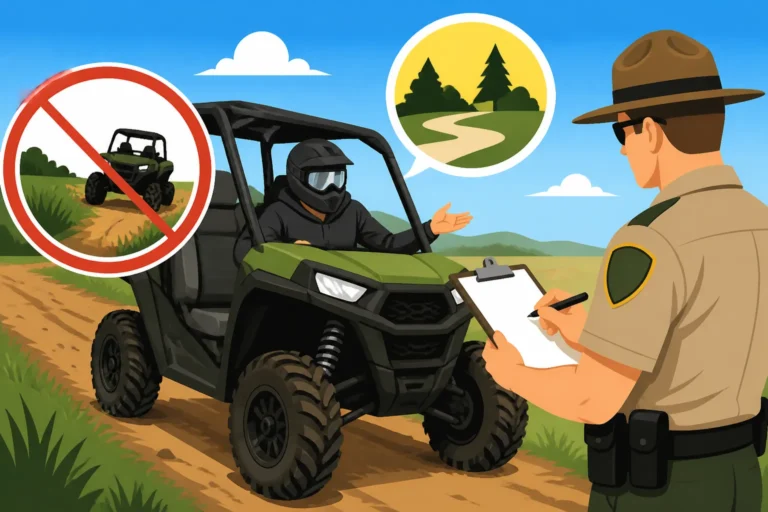
If someone asks why you are on the property, stay calm and explain the arrangement plainly. Show the letter if appropriate, identify the property and permitted route, and avoid arguing about boundaries or legal conclusions at the roadside. An officer or other person may still need to verify facts, and the letter does not guarantee that every question will end immediately. For practical preparation, see What a Deputy Asks at a Rural Traffic Stop.
If the owner cannot be reached and the letter is expired, unclear, or inconsistent with what you were told, do not assume you can continue. Pause the ride and seek clarification. If the owner withdraws permission, leave by the route they specify, unless doing so would create an immediate safety risk. Keeping the relationship respectful matters: private access depends on the owner’s willingness to allow it, and repeated boundary mistakes can end that access for everyone.
Before each ride, use this quick check:
- Is the permission current?
- Does it cover every rider and machine in the group?
- Are the parcel and route clear?
- Have you checked for closures, livestock, crops, or other hazards?
- Does the route stay off roads and neighboring property unless separately authorized?
- Does the letter match any additional rules for the area?
- Can every rider show the permission if the group separates?
A landowner’s letter works best when it is specific, current, and carried by the people who need it. It can make private-land access easier to explain, but good judgment still matters: stay within the agreed area, respect other applicable rules, and ask again whenever the permission or route is uncertain.
Disclaimer
This article is for general informational purposes only and does not constitute professional advice. Laws, prices and regulations vary by location and change over time. Consult a qualified professional for guidance on your specific situation.