Kansas Landowner Permission Rules
Kansas Landowner Permission Rules
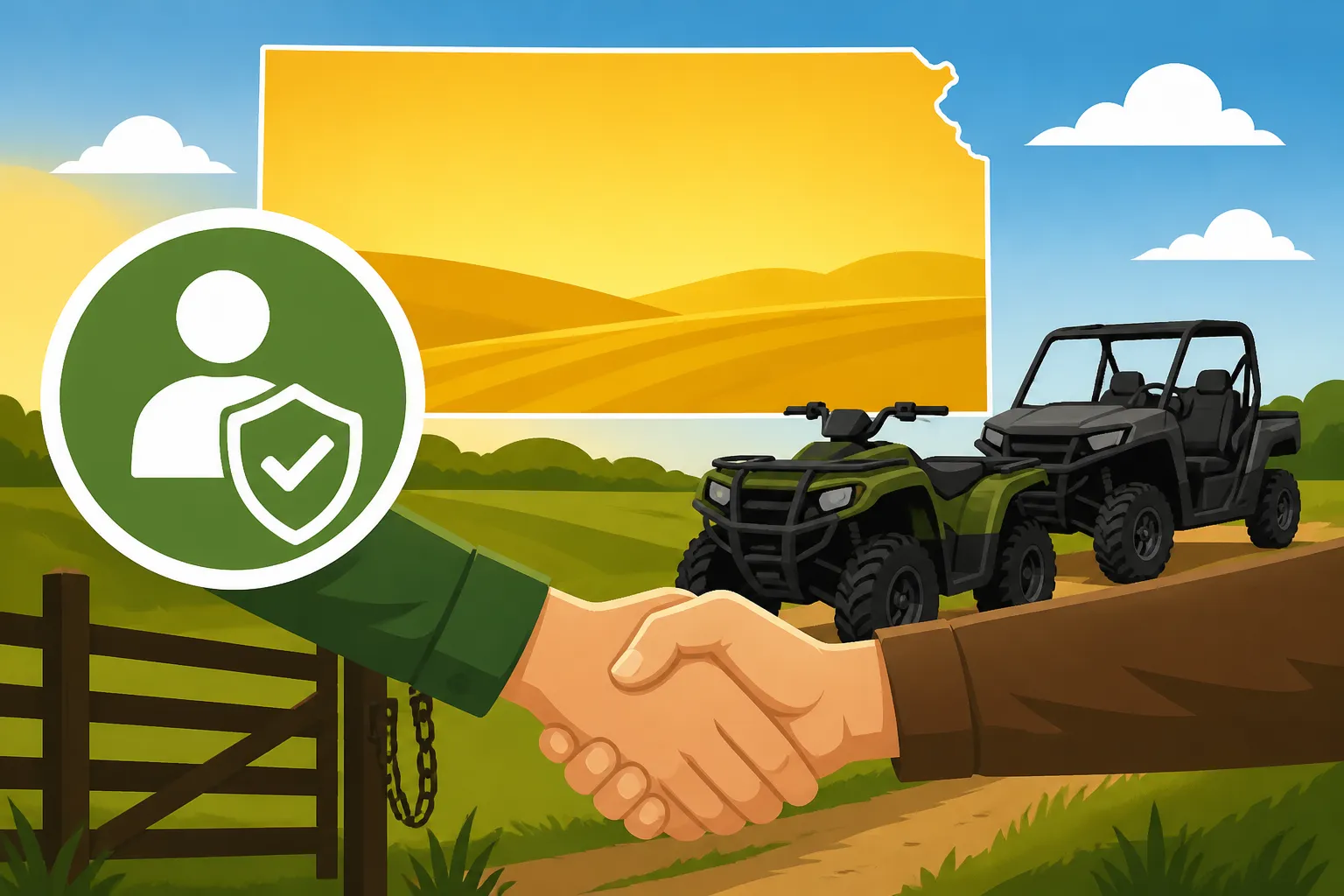
Finding a place to ride in Kansas can be harder than choosing a machine. A field, pasture, hunting lease, oil lease road, or farm lane may look accessible without being open to riders. The safest approach is to confirm who controls the land, get clear permission for the specific ride, and check whether separate rules apply to the route or activity.
What Landowner Permission Does and Does Not Allow
Private-property permission answers one important question: whether you may enter and ride on the land covered by that permission. It does not automatically settle every other question about where you can travel, what machine you can use, or what rules apply.
Start by separating three things that are easy to mix together:
- Access to land: Do you have permission from someone authorized to allow your entry?
- Permission for a particular use: Does that permission include riding an ATV or UTV, rather than only hunting, walking, or doing farm work?
- Rules for a route or location: Does the road, trail, public land, or riding area have separate restrictions?
A landowner can invite you onto a pasture but still expect you to stay off planted fields, avoid a creek crossing, or use only one designated track. A hunting lease may allow hunting but not recreational riding. Permission to ride on one parcel does not grant permission to cross a neighbor’s parcel to get there.
Likewise, permission on private ground does not make a public road legal for ATV or UTV travel. Road use is governed by separate state and local rules. For example, rules for riding farm ground differ from rules for riding a county road, and a city may have its own limits. See Kansas Rules for Riding Farm Ground and Kansas Rules for Riding a County Road before assuming that a route between two fields is open to your machine.
Permission should match the ride
When you ask, be specific about the activity. “Can I ride here?” may leave important details unclear. Explain whether you plan to ride:
- A particular ATV, UTV, or other machine
- Alone, with family, or as part of a group
- On a named trail, field edge, or farm road
- For recreation, farm work, hunting access, or another purpose
- During a certain season or time of day
- With a trailer, passenger, dog, or other equipment
A landowner may be comfortable with a farm machine traveling between buildings for work but not with a group ride across the property. A person may allow access during the day but not after dark. Clear terms reduce the chance that a misunderstanding becomes a trespass complaint, a damaged crop, or a strained relationship.
Permission is not a substitute for a permit
Private land and public land can have different access systems. Permission from a private landowner does not replace any permit or site-specific requirement that applies on public land. Conversely, a state permit for a particular road or park does not give you the right to cross private ground to reach it.
Kansas also has public access programs with their own restrictions. Do not assume that land enrolled for hunting access is open to recreational machine use. Review Kansas Walk-In Hunting Access Rules and Kansas Walk-In Hunting Land and Machines if the property is part of a hunting access program. Confirm the rules for the exact site and activity before unloading.
| Situation | What to confirm before riding |
|---|---|
| Private farm or ranch | Who can authorize access, where to ride, and which activities are allowed |
| Hunting lease | Whether the lease includes machine use and whether the landowner or leaseholder must approve it |
| Walk-in hunting access property | Whether machine travel is allowed under that site’s current rules |
| Oil lease or utility route | Who controls the route and whether the route is open to your machine |
| Public road crossing | Whether the road can be used or crossed by your type of machine |
| Private riding park | The park’s entry rules, machine limits, waiver, and operating restrictions |
How to Ask for Permission and Make It Clear
A short conversation can be enough for a familiar neighbor or a one-time trip, but it should cover the details that matter. For a group, recurring access, or a property with crops, livestock, gates, or active work, a written agreement is often more practical.
Identify the person with authority
The person who owns the land may not be the only person who controls access. A tenant, farm manager, hunting-lease holder, or business operator may have authority over some activities, but not necessarily all of them. Ask who can approve machine use rather than assuming the person who opened a gate can authorize the entire ride.
If the property is leased, permission from the owner may not answer whether the tenant has exclusive control of the area. If it is a hunting lease, the leaseholder may have rights to hunt without having the right to allow recreational riders. If several people share management, make sure the person giving permission is authorized to do so.
For land managed by a company or organization, use its established contact process. A casual “go ahead” from a worker may not be approval from the person responsible for the property.
Describe the route, not just the property
A parcel may have several fields, gates, access lanes, and neighboring boundaries. Tell the landowner where you want to ride and ask which route to use. If possible, refer to a map or walk the route together.
Clarify points such as:
- Which entrance to use and where to park or unload
- Whether to stay on an existing track or use a field edge
- Which gates may be opened and whether they must be closed
- Whether riding is allowed near livestock, buildings, crops, or equipment
- Whether you may cross a creek, ditch, or other boundary feature
- Where the property line is, especially where adjoining parcels look similar
- Whether a route is closed during planting, harvest, wet conditions, or hunting seasons
A property line may not be obvious from the seat of a machine. Do not use a worn track as proof that the route is approved or that it stays on the same owner’s land.
Put the agreement in writing when it helps
A written note, text message, or email can preserve what both sides agreed to. It need not be complicated. Include the date, the name of the person granting permission, the people or group allowed to ride, the permitted area or route, the allowed activity, and any conditions such as dates, gates, speed, or livestock precautions.
For repeat access, ask whether permission is for one ride or an ongoing arrangement, and whether it can be withdrawn. If circumstances change, check again. A new tenant, crop rotation, construction project, fire restriction, or livestock move can make an old route unsuitable.
Keep a copy accessible during the ride. A small waterproof document pouch, including one available through Amazon, can help protect a paper note from rain and mud, though a saved message on a phone may be enough if the property owner accepts that form. Carrying proof is useful for clarifying a misunderstanding; it does not override a landowner’s instruction to leave.
Use permission that is current and specific
A vague invitation from months ago may not cover a new group, a different machine, or a different purpose. Before each ride, check that access is still welcome, particularly if:
- The ride includes people the landowner has not met
- You plan to bring a UTV after previously using a small ATV
- You want to ride in a new area
- The land is under a hunting or agricultural lease
- The agreed access was tied to a specific date or event
- Conditions on the ground have changed
If permission is unclear, pause and ask. Do not treat silence, a familiar gate, or a prior visit as permission for a new trip.
Special Cases: Leases, Farms, Pastures, and Access Routes
Kansas properties often combine private ownership, leases, public access, and working roads. The main task is to identify who controls each part of the route and what use that person has approved.
Farm ground and ranch property
Agricultural land is working land, not simply open space. The route may pass close to crops, irrigation equipment, grain handling areas, livestock, or machinery. A landowner who allows access for a practical farm task may not be allowing recreational riding.
Ask whether the permission covers the exact purpose. If you are helping with farm work, agree on the route and the work-related use. If you are riding for recreation, say so directly. Do not assume that being a relative, neighbor, employee, or customer gives you unlimited access.
Field conditions matter. A track that seems firm from the roadside can rut quickly when wet. Avoid driving into planted or recently worked ground unless the landowner specifically directs you to do so. Ask before using a field edge, drainage area, or farm lane that could be damaged or needed for equipment.
For more on the distinction between private-ground access and other routes, see Kansas Rules for Riding Farm Ground.
Pastures and livestock
A pasture may have gates, fences, ponds, cattle guards, and animals that are not visible from the entrance. Ask where livestock are kept and whether the landowner wants you to avoid certain areas. Keep the machine under control, reduce noise where practical, and do not chase or crowd animals.
Never assume that an open gate means you can pass through. It may have been left open for livestock or farm traffic. Follow the owner’s instructions about gates: leave them as found only if told to do so, and close them securely when requested. If a gate is locked, marked, or obviously intended to restrict access, do not bypass it.
A pasture track can also cross land belonging to someone else. Ask about the full route, not just the field where you plan to ride. Kansas Rules for Riding a Pasture covers pasture riding considerations, while Kansas Trespass Law for Riders can help explain why access permission should never be assumed.
Hunting leases and seasonal access
A hunting lease does not necessarily include recreational ATV or UTV use. Lease terms may restrict who can enter, when they can enter, and how they may travel. A hunting leaseholder may be allowed to hunt but not to authorize unrelated rides. The landowner may also reserve access for farm work or other users.
Ask both what the lease permits and who can grant machine access. If a rider is using a machine to reach a hunting location, clarify that purpose and route instead of assuming that hunting access includes any kind of vehicle use. Separate rules may apply to the land, the season, and the particular access program.
If you see a sign or marking for walk-in hunting access, do not interpret it as general permission to ride. Check the relevant site rules and respect any restrictions on vehicles or motorized access.
Oil lease roads, utility routes, and other private lanes
An oil lease road or utility access route may look like an ordinary gravel road, but appearance does not establish public access. It could be controlled by a landowner, operator, utility, or another party. Ask who manages the road and whether your machine is allowed.
Even if you have permission to enter a property, the road may be covered by a separate agreement or may serve active operations. Stay clear of work sites, vehicles, equipment, and marked restricted areas. Do not block access needed by workers or emergency responders. For route-specific considerations, see Kansas Rules for Riding an Oil Lease Road.
Levees and drainage features can also have access rules beyond a landowner’s general invitation. Before riding one, find out who manages it and whether the route is open to motorized use. A landowner’s permission may not be enough if another agency, district, or operator controls the structure or access route. See Kansas Rules for Riding a Levee for more on that distinction.
Section-line roads and other public routes
A road or lane along a property boundary may be a public route, a private road, or a road subject to local restrictions. Do not infer its status from a map line, tire tracks, or the fact that a gate is open. Confirm who controls it and whether your ATV or UTV may use it.
Permission to ride on adjoining private land does not give permission to travel on a separate parcel, and a landowner cannot necessarily authorize use of a public road in a way that conflicts with road rules. Likewise, a public route does not automatically authorize riding into the fields beside it. For background on the distinction, see Kansas Rules for Riding a Section Line.
Protecting the Property and the People on It
A landowner’s permission is easier to maintain when riders treat it as a limited privilege rather than a blanket invitation. Good conduct also reduces the risk of injury, property damage, and conflict with other people using the land.
Follow the agreed route and conditions
Stay on the route the owner approved. Avoid creating new trails, widening a track, cutting across a field, or taking a shortcut around a wet spot unless the owner agrees. If a route is blocked or unsafe, turn around or ask for another route instead of improvising.
Respect limits on:
- Speed and riding direction
- Number of machines or riders
- Passenger use
- Time of day and dates
- Noise, stopping, and parking
- Firearms, hunting activity, or other recreation
- Areas near homes, barns, crops, or livestock
If permission is limited to a particular purpose, do not extend it to a different activity. A route approved for a farm task is not automatically a recreational trail.
Keep boundaries and gates under control
Before riding, confirm property boundaries at any point where the route approaches another owner’s land. Use a map or ask the landowner to identify the boundary. GPS displays and online maps can be useful for orientation, but they should not replace direct confirmation where access is uncertain.
Follow instructions about gates and fences. Do not cut, lift, or move a fence to make a route easier. Never leave a gate open if it is meant to contain animals, and do not assume that a gate should be closed if the owner has directed otherwise. When in doubt, stop and contact the owner.
Consider weather, crops, and active work
A route that is suitable in dry weather may become damaging after rain. Heavy machines can leave ruts that channel water or make a lane difficult to use. Ask whether the landowner wants riding postponed after rain, during planting, during harvest, or while work is underway.
Watch for machinery, workers, dogs, livestock, and people on foot. Farm operators may not expect recreational riders to appear, particularly around blind corners or busy work areas. Use extra caution near equipment and yield to people doing the work.
Plan for emergencies without assuming broad access
Know how to contact the owner and give an accurate location if someone is hurt or a machine becomes disabled. Ask in advance whether the owner wants to be notified if a gate, fence, or piece of equipment is damaged. Do not use another part of the property as a recovery route without permission unless an emergency makes immediate action necessary.
Riders should also consider insurance and machine requirements separately from land access. A landowner saying yes does not necessarily mean the rider has the coverage needed for the activity, or that a machine can be used on nearby public roads. Do You Need ATV Insurance in Kansas? discusses the separate insurance question.
A Practical Permission Checklist Before You Ride
Use this checklist before a one-time ride, a group outing, or regular access. It is deliberately straightforward: the goal is to leave no doubt about where you can go and what you can do.
- Identify the property and the person in control. Confirm whether the land is privately owned, leased, managed by an organization, or part of a public access program.
- Ask directly about machine use. State whether you will bring an ATV, UTV, or another machine and explain whether the ride is recreational, agricultural, hunting-related, or for another purpose.
- Confirm the exact route. Identify the entrance, track, field edge, parking area, gates, and any boundaries to avoid.
- Discuss who may come. Get approval for additional riders, passengers, guests, or an organized group. Do not treat permission for one person as permission for everyone.
- Agree on timing and conditions. Ask about permitted dates, hours, weather restrictions, seasonal closures, and whether the arrangement is one-time or ongoing.
- Ask about property-specific hazards. Check for livestock, crops, equipment, water crossings, fences, active work, hunting activity, and other users.
- Clarify any separate route rules. Determine whether an oil lease road, public road, levee, section line, or access-program property has its own restrictions.
- Keep a record of the agreement. Save a text or email, or carry a written note if that is the clearest record. Make sure the contact information is available.
- Reconfirm when circumstances change. A new route, new group, new machine, or changed land use is a good reason to ask again.
- Leave when permission ends or is withdrawn. Do not argue at the gate or continue riding while trying to settle the issue. Stop, leave the property, and resolve questions afterward.
A practical conversation can be as simple as: “I’d like to ride my ATV on the farm lane between the north entrance and the pasture gate on Saturday. It would be two machines and three people. Is that route and time okay, and are there any gates or areas we should avoid?” The exact wording is not important. The useful part is making the people, machines, location, purpose, and timing clear.
If the owner’s answer is conditional, repeat the conditions back to confirm you understood. If the answer is unclear, treat it as a reason to ask more questions, not as permission to choose your own interpretation.
What to do if permission is disputed
If someone on the property tells you to stop or leave, do so promptly and calmly. Do not rely on an old text, a neighbor’s directions, or a prior owner’s invitation as a reason to remain when the person currently controlling access objects. Once safely off the property, contact the person who granted permission and clarify what happened.
If you discover that a route crosses land you were not authorized to enter, turn around rather than continuing to the destination. If a public road or trail connects two areas, verify its status independently. Kansas Proof of Ownership on the Trail may also be useful for understanding what ownership documentation can and cannot establish during a ride.
Frequently Asked Questions
Does landowner permission make an ATV or UTV street legal?
No. Permission to ride on private property applies to the land and use that the landowner approved. Public-road use is a separate question governed by applicable state and local rules. Check the route and machine rules before traveling between properties on a road.
Is verbal permission enough?
A clear verbal agreement may be useful for a simple, one-time visit, but written confirmation can prevent confusion about the route, date, group, or permitted activity. For recurring or group access, keep a written record and confirm that it is still current.
Can a hunting leaseholder give permission to ride?
Not automatically. The lease may authorize hunting access without granting authority to approve recreational machine use. Ask who controls the property and whether the leaseholder has permission to allow the specific ride.
Can I ride on land enrolled for walk-in hunting access?
Do not assume so. Hunting access does not necessarily include recreational motorized access. Check the current rules for that specific property and activity before entering with a machine.
Does permission to ride on one property let me cross a neighboring field?
No. Permission applies only to the land and route that the authorized person approved. Ask separately before crossing another property, using a private lane, or entering a field outside the agreed area.
Disclaimer
This article is for general informational purposes only and does not constitute professional advice. Laws, prices and regulations vary by location and change over time. Consult a qualified professional for guidance on your specific situation.