Kansas Landowner Permission Forms
A landowner’s “yes” can mean different things: one rider on a field, a group using a pasture lane, or access only during a particular season. A written permission form helps prevent those assumptions from turning into a trespass dispute. Here’s what Kansas ATV and UTV riders should clarify, what to put in writing, and what landowner permission does not authorize.
What a Kansas landowner permission form does
For ordinary recreational riding on private land, a written permission form is best understood as a record of the landowner’s consent and its limits. It is not a statewide ATV permit, a vehicle registration, or a substitute for meeting other legal requirements. Kansas does not provide one universal permission form that riders must carry to use every private property.
A landowner can give permission orally, but written permission is easier to check later. It can document who was allowed on the property, which area they could use, and when permission applied. That clarity matters if the owner’s understanding differs from the rider’s, if a gate or boundary is unclear, or if someone else manages the property.
A permission form also does not automatically give a rider access to neighboring land, public roads, or land controlled by a different person. Permission applies only to the property and activities the person granting it has authority to approve. If you are unsure about the boundaries or who controls a route, ask before riding. For more on the basics, see Getting Written Permission From a Landowner Before You Ride and Kansas Landowner Permission Rules.
Permission is not a road-use authorization
A property owner can allow you to ride on their land, but that does not make every route leading to it legal to ride. A farm lane may connect to a public road, for example, and permission to use the lane does not by itself authorize riding on the road. Kansas road-use rules vary by vehicle type and location. Check the route separately with the relevant local authority; Kansas Rules for Riding a County Road explains why private-land consent and road access are separate questions.
Likewise, permission to ride does not make a machine street legal or replace any title, insurance, equipment, or local requirements that apply to it. A signed form can help show that a landowner agreed to let you use a particular area, but it is not proof that the machine may be operated everywhere else.
A form is not automatically a liability release
Some landowners may ask riders to sign a waiver or release. That is different from a basic permission note: a permission note records consent and conditions, while a waiver attempts to address legal responsibility for risks or injuries. A waiver’s effect depends on its wording and the applicable law. Do not assume that signing one removes every possible claim or makes unsafe conduct acceptable.
If you are organizing a group ride or charging participants, the situation may be more complicated than a family or friend riding with the owner’s consent. Consider getting legal advice before relying on a homemade waiver or permission form for an organized event.
What to include in written permission
A useful form is specific enough that a rider can follow it and the landowner can tell whether the agreed conditions were met. Keep the language plain. If a term could be interpreted two ways, ask the owner to clarify it before anyone unloads a machine.
| Form detail | What to clarify |
|---|---|
| Landowner or authorized contact | Who is giving permission and how to reach them |
| Property location | The address, parcel description, map, or clearly identified entrance |
| Authorized riders | Names of riders, or a clear description of who is included |
| Vehicles | Whether ATVs, UTVs, dirt bikes, or other machines are allowed |
| Permitted area | Which trails, fields, lanes, or marked sections may be used |
| Dates and times | When permission starts and ends, including any daily limits |
| Conditions | Speed, gates, passengers, pets, firearms, fires, or other restrictions |
| Signatures and date | Confirmation from the landowner or authorized representative and the rider |
The form does not need to be elaborate. The most important details are who has permission, where they may ride, when they may be there, and what conditions apply.
Identify the land and the allowed route
A street address may not make the authorized area obvious, especially on rural property with multiple entrances, fields, pastures, or adjoining parcels. A simple map marked by the landowner can help. It should identify the permitted area and, if relevant, prohibited areas or a route to avoid.
Do not assume that a track visible on a phone map is an approved trail. A path may cross a neighbor’s property, a crop field, a drainage area, or a place where livestock are kept. If the owner gives verbal directions, ask whether they can mark the route or confirm it in a message.
Include any access limits the owner cares about. That might mean using only a particular gate, not riding near a house, avoiding planted fields, staying away from livestock, or keeping clear of ponds and equipment. If the land changes with planting, harvest, hunting, or weather conditions, the permission should make clear that the owner can close an area or change the allowed route.
Name riders and vehicles clearly
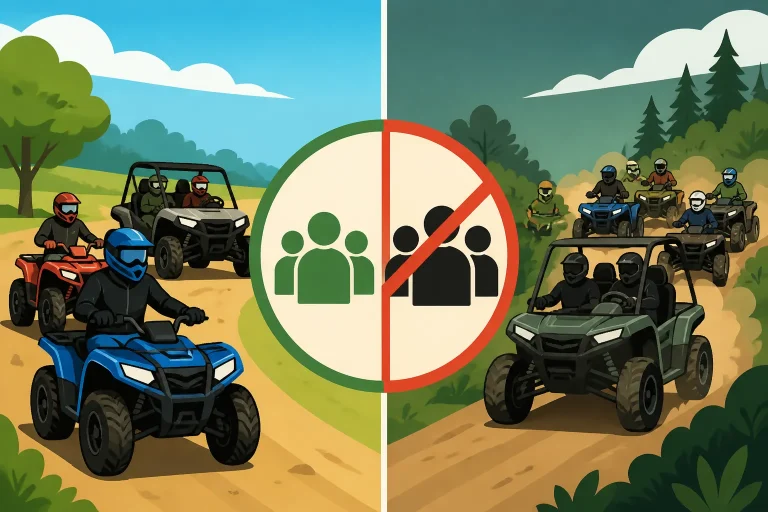
A form for one adult and one ATV may not cover a group of guests in several UTVs. List each rider when practical, or describe exactly who is covered, such as a named household or invited group. Ask before bringing additional people, passengers, or machines.
Record the type of machine permitted rather than relying on vague terms like “off-road vehicle” if the owner has specific limits. The owner may allow a small ATV but not a wider side-by-side, or may set limits on passenger capacity. Riders should not assume that permission for one machine extends to all vehicles. For help distinguishing vehicle categories, see Four Off-Road Classes Kansas Law Treats Differently.
Put the time period and conditions in writing
A one-time invitation should not be treated as standing permission for future visits. Write down the date or date range and any hours the owner has set. If access depends on a text message or a call before each visit, say so in the written record.
Use clear conditions, not vague phrases such as “be careful” or “stay out of trouble.” If the owner wants riders to keep to a marked trail, close gates, avoid riding after dark, or stop when livestock are present, record those instructions. Respect any later change in the owner’s instructions; an old signed form should not be treated as permission to ignore a new closure.
How to ask for permission and keep a useful record
Ask the person who controls access before riding, and describe the plan accurately. A request that says “just one machine for a short ride” is not the same as a plan for several vehicles, passengers, or a full-day gathering. Be clear about the number of riders, machine types, timing, route, and whether anyone will be camping or doing anything beyond riding.
A practical process is:
- Confirm who can grant access. The landowner may not be the person who manages a leased pasture, farm, or hunting property. Ask the owner or manager who has authority to approve recreational riding.
- Describe the full plan. Explain the number of riders, machines, date, intended route, and any passengers or guests.
- Ask about boundaries and restrictions. Confirm where you may ride, what areas are off limits, which entrance to use, and whether conditions could change.
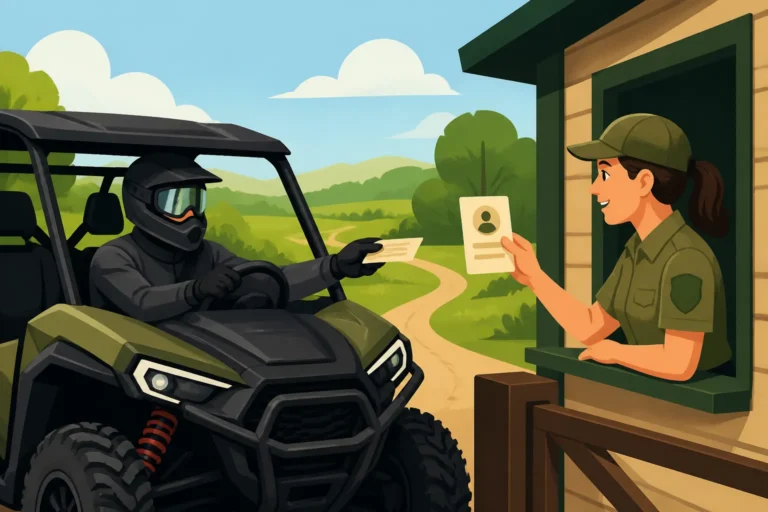
- Write down the agreement. Use a signed form, letter, or clear written message that records the owner’s consent and the agreed limits.
- Carry a copy and follow the conditions. Keep a paper or accessible digital copy, and make sure every rider understands the rules before entering the property.
- Check again if the plan changes. New riders, a different machine, a later date, or a changed route may require renewed permission.
A text message can be useful documentation if it clearly identifies the property, riders, dates, and permitted activity. It is less helpful if it says only “sure, come out sometime.” A signed document is not the only possible record, but specific, saved communications are easier to understand than a vague recollection.
Keep the form current. If the owner sells the property, changes who manages it, or withdraws permission, an old document may no longer reflect who controls access. Before each ride, confirm that the agreed area remains open and that the person who granted access still has authority to do so.
Permission should also be shared with everyone in the group. The person who asked the landowner should not assume that guests know where the boundary lies or which conditions apply. Explain the rules before the ride, not after someone has crossed into a restricted area.
Situations that need extra checks
Some land-use arrangements involve more than one person or more than one set of rules. In those cases, a basic permission note may not settle every question.
Leased farms and managed property
A tenant or farm manager may control some day-to-day access but not have authority to approve every recreational use. Ask who must approve the ride. If the property owner and the person farming it are different, get a clear answer before entering. The same caution applies to hunting leases, land held by a business, and property managed by someone on the owner’s behalf.
For farm use, separate permission to ride for recreation from permission to use a machine for farm work. They are not necessarily the same arrangement. See Kansas Machines Used Only on a Farm for a related distinction.
Hunting access and posted property
Permission to ride is not permission to hunt, and permission to hunt does not automatically include permission to ride an ATV or UTV. Ask separately about each activity, including driving to retrieve game, carrying firearms, or accessing a hunting area by machine. Kansas hunting access rules can have their own conditions; Kansas Walk-In Hunting Access Rules and Kansas Hunting Land Access by Machine cover issues that should not be assumed from a general riding agreement.
If signs, gates, or direct instructions indicate that an area is closed, do not treat a prior informal invitation as permission to cross the restriction. When there is uncertainty, contact the owner or manager and wait for a clear answer. Kansas Trespass Law for Riders provides more context on why access boundaries matter.
Youth riders and group rides
If children or teenagers will ride, tell the landowner who is coming and ask whether there are age, supervision, or passenger limits. A parent’s permission does not replace the landowner’s permission to use the property. Likewise, permission for a single family should not be stretched to cover a large group or an organized event.
For a group ride, record the organizer, expected number of participants, schedule, parking area, and any restrictions on guests. Ask whether the landowner wants participants to sign separate forms. Do not assume that a form signed by the organizer automatically covers every attendee.
Proof of ownership and machine paperwork
A landowner permission form shows consent to access land; it does not prove that you own the machine or that the machine’s paperwork is in order. Keep those records separate. If you need to show who owns a machine, see Kansas Proof of Ownership on the Trail. If you are unsure about titling, Kansas Nonhighway Title Requirements explains that separate process.
The safest form is the one that matches the actual agreement: the right people, the right property, the right dates, and clear limits. Ask before riding, confirm changes, and treat the landowner’s conditions as part of the permission—not as details to sort out after arrival.
Disclaimer
This article is for general informational purposes only and does not constitute professional advice. Laws, prices and regulations vary by location and change over time. Consult a qualified professional for guidance on your specific situation.