Kansas Ice Entry Point Rules
Kansas ice fishing can make an ATV or UTV useful for carrying people and gear, but access is not open-ended. The key rule is to use only a designated ice entry point; a nearby road, boat ramp or stretch of shoreline is not automatically an approved route. Here’s how to think through entry points, permits and out-of-state stickers before you unload.
What Kansas’s ice entry point rule means
When a Kansas area allows a machine to reach frozen water for ice fishing, riders must use the designated access point. The entry point is the approved route onto the ice, not a general invitation to drive across the shoreline wherever it looks convenient.
That distinction matters. A boat ramp may appear to offer an easy route, but unless it is identified as an approved ice entry point, do not assume you can use it for an ATV or UTV. The same applies to a beach, fishing access, maintenance road or gap in a fence. An accessible route is not necessarily an authorized one.
The practical starting point is to check the rules for the particular lake and access area you plan to visit. Look for signs at the entrance and at the designated point, and confirm current instructions with the managing office if the signs are unclear. An entry point at one lake does not establish a rule for other Kansas lakes.
The distinction between a public access road and an ice entry point is important, too. A vehicle may be allowed on a particular road or parking area without being allowed to leave that route and drive onto the ice. Kansas Ice Fishing Access by Machine and Designated Ramps Are the Only Way Onto the Ice cover that difference. For the broader rules that apply to machines used for ice fishing, see Kansas Ice Fishing Machine Rules.
| Situation | Safer way to interpret it |
|---|---|
| A sign identifies a designated ice entry point | Use that point and follow its posted instructions |
| A boat ramp or shoreline looks usable but is not identified for ice access | Don’t treat it as approved; check with the managing office |
| A park road is open to a machine | Stay on the authorized road unless separate instructions allow access onto the ice |
| Another lake allows ice access | Don’t assume the same permission applies at your destination |
| Ice looks solid from shore | Don’t treat appearance as confirmation that it can support a machine |
The designated route is only one part of permission to ride. You also need to follow any restrictions for the specific area, such as where machines may travel, when access is allowed and whether a permit applies. Machines on Frozen Water explains why permission for a machine to reach an ice-fishing area should not be read as permission to ride anywhere on frozen water.
Permits, stickers and out-of-state machines
Kansas does not require a statewide OHV permit or sticker for ordinary ATV and UTV riding. Visitors are not required to buy a Kansas statewide sticker, and a sticker from another state does not substitute for permission to use a particular access point. In that sense, reciprocity is not the main issue: there is no general Kansas OHV sticker requirement for a visiting rider to satisfy. See Kansas Has No State OHV Permit, Kansas Requires No Sticker of Visitors and Kansas Honors No Other State Sticker.
That does not mean every riding area is permit-free. A state park or other managed property can have its own requirements for vehicle use, and private parks set their own entry rules. A permit that applies to specified park roads does not automatically authorize riding onto ice, along a shoreline or on an undesignated route. Check exactly what a permit covers, rather than relying on the word “permit” or on a sticker you already have.
For a state park visit, contact the park office before you load up. Ask whether the machine may be used for ice-fishing access, which entry point is approved, and whether a permit is needed for the route you will take. Calling a State Park Office Before You Load Up is a useful place to start. The park’s instructions matter even if your machine is titled in Kansas or carries documentation from another state.
A machine’s title and registration status are separate from land-access permission. Having a title, a state sticker or proof of ownership does not grant access to every public property or ice entry point. Likewise, being a Kansas resident does not make an undesignated route permissible.
Before you travel, confirm these details for the exact destination:
- Whether machines are allowed for ice-fishing access at that location.
- Which point is designated for entering the ice.
- Whether a park or area permit applies to the approach road or parking area.
- Any posted hours or seasonal restrictions.
- Whether the access rules have changed because of conditions or maintenance.
If an office is closed, use posted signs and current official notices. If you cannot establish that a route is approved, do not ride onto the ice from it.
Ice safety and practical checks before riding
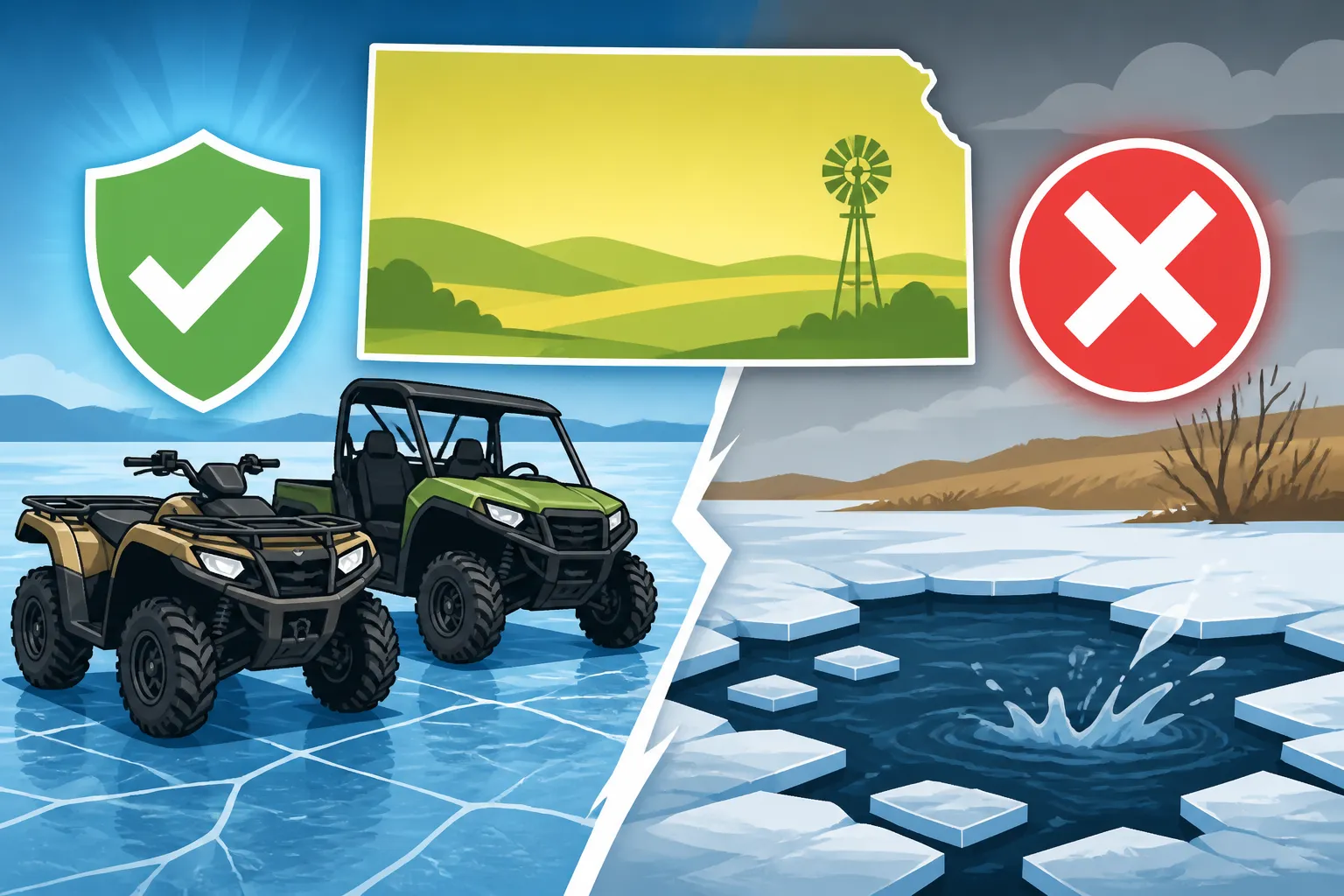
A designated entry point answers where you may enter; it does not tell you that the ice is safe. Ice thickness and strength can vary across a lake, and conditions can change with weather, currents, springs, water levels and other factors. A surface that supports a person near shore may not support a heavier machine farther out.
Do not assume that a machine can safely travel because another rider has already gone onto the ice. Nor should a route be treated as safe simply because it was open on a previous visit. Check current conditions with the managing office, observe closures and warnings, and avoid the ice when conditions are uncertain. The safest choice may be to leave the machine on shore and carry gear on foot, if that access is allowed.
A few steps can help prevent an access mistake:
- Confirm the lake and access point. Check the rules for the specific destination, not just a nearby park or lake.
- Identify the approved route. Follow signs and instructions to the designated ice entry point. Do not create a new path across the bank.
- Check permits and hours. Ask whether the road, parking area or other approach requires a separate permit, and when the area closes.
- Check ice conditions. Seek current local information and follow closures. If conditions are unclear, don’t take a machine onto the ice.
- Keep the machine within authorized areas. Permission to reach an ice-fishing location does not grant permission to ride around the lake or onto restricted ground.
- Plan your return. Check the area’s closing time and leave the ice and access area as required.
Also consider what you will do if the machine becomes stuck or cannot return by the same route. A recovery attempt can expose riders to even more risk, and driving farther across uncertain ice to find a better way out can make the situation worse. Carry essential cold-weather and emergency supplies, keep your group together, and let someone know where you are going.
If you use a trailer to bring the machine, remember that trailer requirements are separate from ice access. The rule that a Kansas ATV does not need a statewide OHV sticker does not tell you whether your trailer needs its own registration or tag. Check the relevant requirements before towing.
When to leave and what to ask before you go
Some locations set hours for machine access or require riders to be off the ice by a particular time. Do not assume that a lake’s general opening hours, a fishing schedule or a park’s gate hours automatically define the hours for riding a machine onto the ice. Confirm the applicable schedule for the specific access point. When You Must Be Off the Ice at Night addresses the need to check that timing rather than making assumptions.
Before departure, it can help to call the managing office and ask direct, specific questions:
- Is ATV or UTV access onto the ice currently allowed for ice fishing?
- Which entry point should a machine use?
- Is that point open today, and are there any closures or condition warnings?
- Does the route to the entry point require a park or area permit?
- Are there limits on machine travel or hours?
- Where should the machine be parked if ice access is not available?
Keep the answers tied to the exact property and route. General statements such as “machines are allowed” may refer only to roads or parking areas, not access onto frozen water. If the office’s answer conflicts with posted restrictions, follow the current posted restriction and ask for clarification before proceeding.
The simplest rule is also the most useful: use only the designated ice entry point, and treat access, permits and ice safety as separate questions. Kansas’s lack of a statewide OHV sticker requirement does not override local property rules, and a permitted route does not guarantee that the ice is safe for a machine.
Disclaimer
This article is for general informational purposes only and does not constitute professional advice. Laws, prices and regulations vary by location and change over time. Consult a qualified professional for guidance on your specific situation.