What Counts as an Agricultural Trip on a Highway
It's incredibly common for folks who own ATVs and UTVs in Kansas to scratch their heads over where they can and can't actually ride their machines, especially when it comes to public roads. One of the biggest areas of confusion revolves around the "agricultural trip" exception for highways. You might hear neighbors or friends mention it, but understanding what truly qualifies can feel like deciphering ancient hieroglyphs. This guide is here to clarify exactly what constitutes an agricultural trip on a highway in Kansas, helping you navigate the rules without unnecessary stress or potential penalties.
Understanding Kansas's General Ban on Off-Road Vehicles on Highways
Let's cut right to the chase: in Kansas, the general rule is that your ATV or UTV is not allowed on public roads and highways. This isn't a suggestion; it's the law. It’s a point of frustration for many owners who invest in these powerful and versatile machines, only to find their freedom of movement severely restricted. The temptation to just hop on the road for a quick run down to the next field or to a neighbor's place is strong, but understanding the underlying legal framework is crucial to avoid trouble.
The Baseline Rule: Why Your Quad Isn't Street Legal by Default
The core of the issue lies in how Kansas law categorizes ATVs and UTVs. They are generally considered "nonhighway vehicles," a classification that inherently means they are not designed or permitted for regular use on public roads. Even if you get a title for your ATV in Kansas – which you absolutely should, as outlined in [Kansas Titles ATVs as Nonhighway Vehicles] – that title is specifically a nonhighway title. It acknowledges your ownership and the machine's existence, but it doesn't magically transform your quad into a street-legal vehicle like a car or motorcycle.
Think about it this way: your title paper for a side-by-side or ATV in Kansas is a bit like having a deed for a plot of land that's zoned exclusively for farming. You own it, you can use it for its intended purpose (farming), but you can't suddenly decide to build a skyscraper on it without a change in zoning. Similarly, a nonhighway title confirms ownership for an off-road machine, but it doesn't rezone it for on-road use. This distinction is vital because many owners mistakenly believe that simply having a title means they've cleared all the legal hurdles. The reality is, the title is just one step in legally owning the machine; it has nothing to do with road legality. The manufacturer designs these machines for off-road environments, and the law reflects that intended use.
The Definition of "Highway" in Kansas Law
When we talk about "highways" in the context of Kansas ATV and UTV laws, it's easy to picture multi-lane interstates. However, the legal definition in Kansas is much broader than that. In fact, Kansas Statutes typically define "highway" (or "street" or "roadway") in a way that includes almost any publicly maintained way open to the public for vehicular travel. This means that many of those gravel county roads, paved state highways (even two-lane ones), and certainly major thoroughfares fall under this blanket definition.
So, when the law says ATVs and UTVs are generally prohibited on "highways," it's not just talking about I-70 or I-35. It's also talking about that quiet county road that runs by your farm, or the state highway that connects two small towns. This broad definition is why so many riders find themselves in a bind, as their nearest route between two points on their property, or between their property and a neighbor's, might involve a stretch of public road. Understanding this expansive definition is the first step in appreciating the narrowness of any exceptions, including the agricultural one. It’s about recognizing that even seemingly minor excursions onto what feels like a remote public road are subject to these overarching prohibitions. For more details on the general rules, you might want to check out [Kansas ATV Road Rules Under 8-15,100].
The Agricultural Exemption: A Narrow Path for Farm Use
Given the general prohibition, the agricultural exemption acts as a small, specific carve-out in Kansas law. It's not a free pass to drive your UTV or ATV anywhere as long as you're wearing a cowboy hat. This exemption is designed with a very clear purpose: to allow legitimate agricultural operations to function efficiently when minor road use is absolutely necessary. It recognizes the unique needs of farmers and ranchers in traversing their properties and managing their operations.
What the Law Actually Says About Agricultural Purposes
Kansas Statute 8-15,100 is the key provision here, and it’s important to understand its precise wording. It generally prohibits the operation of ATVs on public highways, but it makes an exception for an ATV "operated upon a public highway or street when such operation is incidental to the use of such all-terrain vehicle for agricultural purposes." The same language, or very similar, applies to utility vehicles that do not otherwise meet the definition of a work-site utility vehicle (WSUV).
The critical phrase here is "incidental to the use… for agricultural purposes." This means the road travel itself is not the primary activity; rather, it’s a necessary, secondary component of a larger farm task. It implies a direct, logical connection to active farming or ranching operations. The legislative intent behind this exemption was not to expand recreational riding, but to facilitate legitimate agricultural work. It's about enabling farmers to move their tools, inspect their fields, or transport small loads without having to load and unload their ATV onto a trailer for every short hop. The law wants to avoid creating undue burdens on agricultural producers, who often have land dispersed across road sections. This is the heart of [Kansas's Agricultural Exception for Road Use].
Practical Examples of Legitimate Agricultural Trips
When we talk about "incidental to agricultural purposes," what does that actually look like in the real world? Let's break down some scenarios that would likely qualify:
- Moving Between Fields: Imagine you have two hayfields separated by a county road, perhaps a mile apart. Driving your UTV, possibly with a small implement or bale spear, directly from one field to the other to continue baling or moving hay would generally be considered an agricultural trip. The road use is purely to facilitate the farming task.
- Checking Livestock or Fences: If your pastures are on opposite sides of a gravel road, using your ATV to quickly cross or travel a short distance along the road to check on cattle or inspect fence lines for damage is typically permissible. You're performing a core ranching duty, and the road is just a bridge.
- Transporting Tools or Supplies: Let's say you need to take a post-hole digger, some fence posts, or a bucket of mineral supplement from your barn to a specific section of pasture or field. If your ATV or UTV, especially a robust model with good cargo capacity or a sturdy hitch from SuperATV, is the most practical way to move these items, then a short trip on the highway to get them there would qualify. The journey is directly tied to an agricultural need.
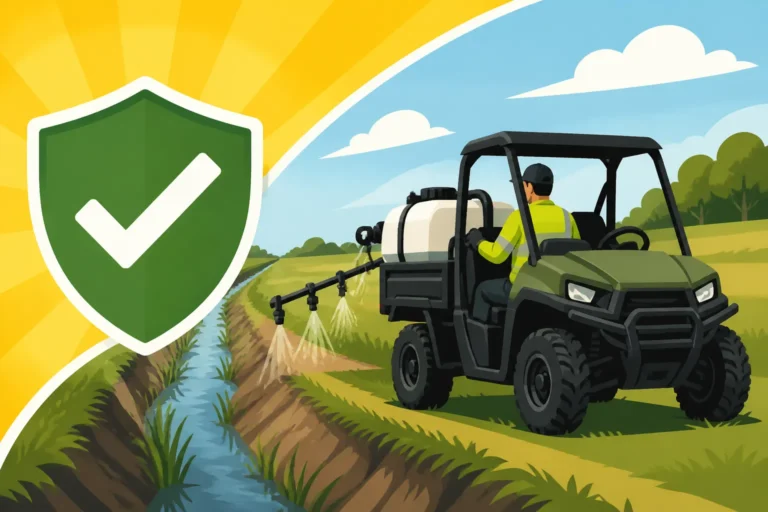
- Spraying Ditches or Noxious Weeds: Many farmers and ranchers use their ATVs or UTVs, often equipped with sprayers, to manage weeds along ditches bordering their property or other areas accessible via public roads. If the purpose is specifically for noxious weed control on or adjacent to agricultural land, the road travel to reach those areas for spraying would be covered. This directly supports the health and productivity of the farm.
- Equipment Maintenance: Driving an ATV or UTV from a field to a shop located just down the road for immediate repair, or vice-versa, would also fit the bill, as it's directly related to keeping agricultural equipment operational.
In all these cases, the key is that the road use is brief, direct, and serves a clear, demonstrable agricultural function. It's not about convenience for personal errands; it's about necessity for farm operations. Many of the heavy-duty components from SuperATV, like their axles, lift kits, or even protective skid plates, are designed to withstand the kind of rigorous use that comes with daily farm work, making them a practical choice for machines used in these legitimate agricultural contexts.
Trips That Don't Qualify as Agricultural
Just as important as knowing what does count is understanding what doesn't. This is where most people get into trouble, assuming that a general "farm vibe" is enough to justify road use. The agricultural exemption is not a loophole for recreational riding or personal convenience.
Here are some common scenarios that would not qualify as legitimate agricultural trips:
- Going to Town for Errands: Driving your UTV into the nearest small town to pick up groceries, mail letters, or visit the hardware store for non-farm-specific items is definitely not an agricultural trip. Even if you're a farmer, this is personal business, and your machine does not gain street-legal status for such purposes. You need to trailer it or use a licensed vehicle.
- Visiting a Neighbor for Non-Farm Business: While you might visit a neighbor who is also a farmer, if the purpose of your trip isn't directly related to shared agricultural work (e.g., borrowing a specific farm tool, discussing a crop share), it won't qualify. A social visit or a trip to borrow a household item is not agricultural.
- Taking Kids for a Ride: Using the county road for a leisurely ride with your children or grandchildren, even if you stay within sight of your property, is recreational. It has no direct connection to active agricultural production and therefore does not fall under the exemption.
- Driving to a Hunting Spot: Unless the hunting is explicitly part of a land management plan for agricultural purposes (e.g., culling deer to protect crops, which typically requires specific permits and is not just general recreational hunting), driving your ATV to a hunting blind, even on your own land accessible via a public road, is generally not considered an agricultural trip. Recreational hunting, while common on farm properties, is distinct from agricultural production.
- Transporting Passengers or Items Not Directly Related to Farm Work: If you're hauling a cooler of drinks for a picnic, a fishing pole, or non-farm guests on the highway, that's not an agricultural purpose. The cargo and the passengers must be directly tied to the farm work being performed.
- General Transportation Around the Farm Property for Non-Work: While it's common to use ATVs and UTVs for quick movement around a large farm, if that movement involves public roads and isn't tied to a specific task like checking crops, fences, or equipment, it can be problematic. The "incidental to" clause means there needs to be an active, ongoing agricultural task the road use supports.
The key takeaway here is that law enforcement officers will be looking for a clear, direct, and necessary link between your road use and an active agricultural operation. If it looks like you're using the road for personal convenience or recreation, you're likely to face a citation.
Essential Requirements and Best Practices for Farm-Related Road Use
Even when your trip genuinely qualifies as "incidental to agricultural purposes," there are still critical requirements and best practices you need to follow to ensure safety and compliance. It's not enough to simply have an agricultural reason; you must also operate your machine responsibly and legally on the public way. Cutting corners here can lead to accidents or fines, regardless of your good intentions.
Driver's License and Operating Requirements
This is a non-negotiable point: even if your ATV or UTV use is solely for legitimate agricultural purposes on a public highway, the operator must possess a valid driver's license. There's no special agricultural exemption that waives the requirement for a licensed driver. This means that if your teenager, for example, is helping out on the farm but doesn't have a valid driver's license, they cannot legally operate the ATV or UTV on a public road, even for a short, farm-related trip. [Do You Need a License for an ATV in Kansas?] goes into more detail about this.
Beyond the license, basic operating requirements still apply. You're expected to drive safely, observe traffic laws (like stop signs and speed limits), and generally operate the machine as you would any other vehicle on a public road, albeit a specialized one. While ATVs and UTVs are not built for highway speeds, maintaining control and being aware of other traffic is paramount. Impaired operation, reckless driving, or any other dangerous behavior will still be subject to standard traffic laws and penalties, agricultural trip or not.
Machine Equipment and Visibility
Visibility and proper equipment are paramount, especially when you're sharing the road with other vehicles that are typically much larger and faster. Your off-road machine needs to be seen and understood by others.
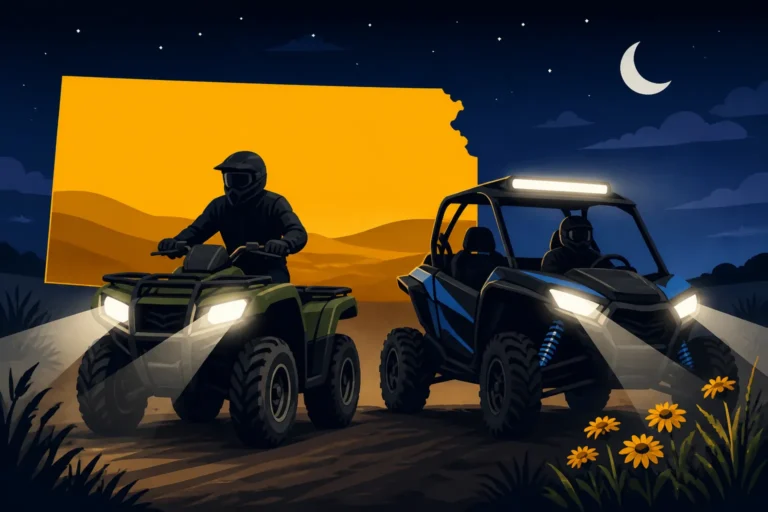
- Lights: If you're operating your ATV or UTV on a public highway between sunset and sunrise, or during times of low visibility, it must be equipped with and use appropriate lighting. This generally means headlights, taillights, and often turn signals. While some agricultural machines might have basic lights, ensuring they meet the standard for road use during these hours is crucial. You might consider adding supplemental LED light bars or auxiliary lighting from a reputable brand like SuperATV to ensure maximum visibility, especially if you're frequently out during dawn or dusk checking fields. For specific requirements, see [Kansas Lighting Rules After Sunset].
- Slow-Moving Vehicle Emblem: For UTVs, especially those that might occasionally fit the description of a Work-Site Utility Vehicle (WSUV), displaying a slow-moving vehicle (SMV) emblem is a smart and often legally required practice when traveling on public roads. This highly visible, orange-red triangle alerts other drivers that your machine is traveling at 25 mph or less, giving them ample time to react. Even if not strictly required for every ATV/UTV under the agricultural exception, it's a best practice for safety, as ATVs and UTVs are inherently slow-moving compared to typical road traffic.
- Tires and General Condition: While not a specific legal requirement for the agricultural exception, ensuring your tires are in good condition and suitable for brief road use (even if primarily off-road focused) is important for safety. Machines with severely worn or specialized paddle tires might raise questions about the suitability of the machine for any road use. Investing in quality, durable tires designed for varied terrain, perhaps from SuperATV, can provide better traction and longevity whether you're in the field or making a quick hop on the highway. Additionally, the machine itself should be in good working order, without obvious defects that would make it unsafe for road travel.
Documenting Your Agricultural Purpose
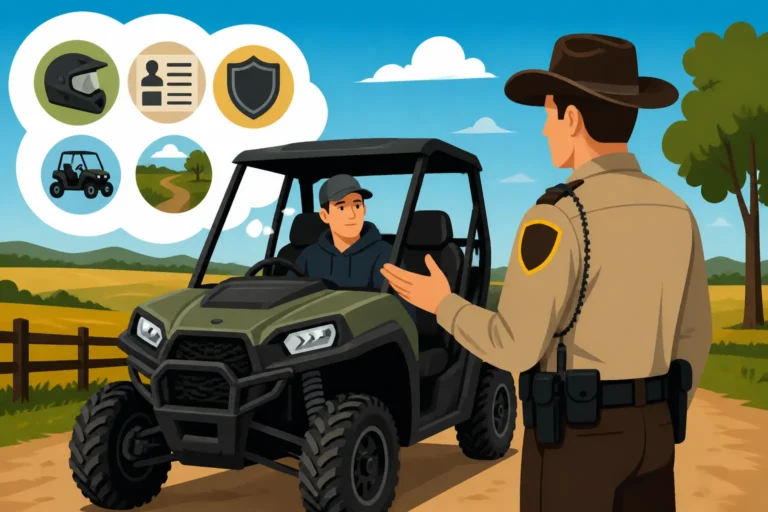
While Kansas law doesn't explicitly require you to carry a specific "agricultural purpose permit" or written justification, having some form of documentation can certainly help if you're stopped by law enforcement. A deputy’s job is to enforce the law, and they might not immediately know your specific farm operations.
Consider these helpful practices:
- Proof of Ownership/Registration: Always carry your nonhighway title or registration document. This proves you are the legal owner of the machine.
- Farm Registration/Business Information: If you operate a registered farm or agricultural business, having some documentation that identifies your operation (e.g., a business card, a farm tax ID, or even a vehicle registration for a farm truck in your name) can lend credibility to your claim of an agricultural trip.
- Be Prepared to Explain: Be ready to calmly and clearly explain why you are on the road and how it directly relates to an active agricultural task. For example, "I'm moving from Field A to Field B to finish planting," or "I'm checking the fence line along this road for cattle." Specificity helps.
- No Loaded Firearms (Unless Permitted): While Kansas has open-carry laws, operating an ATV or UTV with a loaded firearm on a public road, even under the agricultural exception, could lead to additional scrutiny or charges depending on the specific circumstances and local ordinances. Know the laws regarding firearms and vehicles.
Being prepared with clear answers and relevant documentation shows respect for the law and can often lead to a smoother interaction with law enforcement. It allows them to quickly verify that you are operating within the spirit and letter of the agricultural exception.
Distinguishing Agricultural Trips from Other Exceptions and Road Use
The agricultural exemption is just one piece of the puzzle when it comes to off-road vehicles and public roads in Kansas. It's crucial not to confuse it with other types of road access or assume it applies universally. Different machines and different circumstances have entirely separate sets of rules.
Crossing a State Highway vs. Traveling Along It
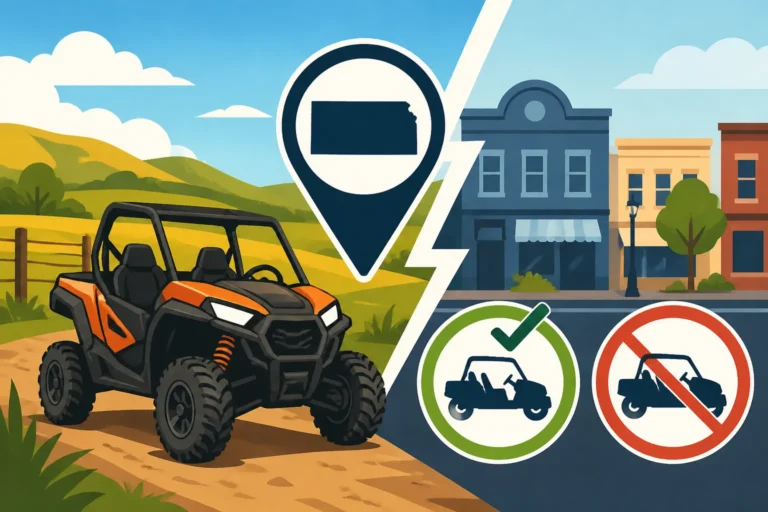
There's a significant difference between crossing a road and traveling along it. Kansas law, under certain conditions, generally allows for the crossing of a state highway (and by extension, other public roads) by an ATV or UTV. This means if your property is bisected by a road, you can often cross directly from one side to the other, provided it's done safely, perpendicularly, and without interfering with traffic. This allowance is typically independent of the agricultural exemption. The primary goal is just to get across, not to travel a distance on the roadway.
However, the agricultural exception specifically allows for traveling along a highway or street for a distance, as long as that travel is incidental to agricultural purposes. This distinction is critical. Just because you can legally cross a highway doesn't mean you can then turn and drive a mile down the road for any reason. The agricultural exemption provides that additional allowance for travel, but only within its specific parameters. Always prioritize safety when crossing; yield to oncoming traffic and make the crossing as quickly and directly as possible. For more information on crossing, refer to [Kansas Rules for Crossing a Highway].
Local Ordinances and City Street Access
Kansas law gives cities the authority to pass ordinances that can allow UTVs (and sometimes ATVs, though less common) on their municipal streets. This is a completely separate mechanism from the state-level agricultural exemption. A city might, for instance, pass an ordinance allowing UTVs on streets with speed limits of 35 mph or less, provided the UTV has specific equipment like turn signals, mirrors, and a city-issued tag. Louisburg, Kansas, is one such city, and you can learn about its rules in posts like [Louisburg's UTV Tag Fees in Kansas].
The key distinction is that an agricultural trip exemption from the state does not automatically grant you access to city streets. If you need to drive your UTV into town for an agricultural purpose (e.g., to pick up a part for a tractor from the local co-op), you generally cannot do so unless the specific city has passed an ordinance allowing UTVs on its streets, and you comply with all local requirements (like obtaining a city tag and insurance). Even then, the "agricultural purpose" might be scrutinized in a city environment versus a rural county road. Always check with individual city halls, because "Kansas Bans ATVs Inside City Limits by Default," and only specific cities choose to opt in by ordinance. You can read more about this in [Kansas Cities That Opt In by Ordinance].
Work-Site Utility Vehicles (WSUVs) and Their Specific Rules
Kansas law also defines a specific category of off-road vehicle called a "Work-Site Utility Vehicle" (WSUV). These are essentially UTVs that meet very particular criteria regarding width, weight, seating, and steering. If a UTV qualifies as a WSUV, it has its own distinct set of rules for road use, which are often more permissive than for standard ATVs or UTVs under the agricultural exemption.
WSUVs are often allowed to operate on public roads with speed limits of 45 mph or less, provided they meet specific equipment requirements (lights, mirrors, etc.) and the operator has a valid driver's license. This is a separate path to limited road legality, entirely distinct from the agricultural exemption for general ATVs and UTVs. A WSUV might be used for agricultural purposes, but its road legality stems from its classification as a WSUV, not solely from the nature of the trip. So, if you have a larger UTV that might fit these criteria, it's worth investigating [Kansas Work-Site Utility Vehicles Explained] and [What Makes a Side-by-Side a Work-Site Utility Vehicle] to understand if your machine could potentially qualify for these broader road privileges. The critical point is not to conflate the WSUV rules with the agricultural exception; they are two different legal avenues.
Here's a quick comparison of various road use scenarios:
| Scenario Type | Description | Applies to ATVs/UTVs? | Key Legal Basis |
|---|---|---|---|
| Agricultural Trip | Travel on public road incidental to farming/ranching operations. | Yes | K.S.A. 8-15,100 exemption |
| Road Crossing | Direct, perpendicular crossing of a public highway. | Yes | K.S.A. 8-15,100 allowance for crossing |
| City Street Use | Travel on city streets within municipal limits. | UTVs (sometimes) | Local city ordinances (must opt-in) |
| WSUV Road Use | Travel on certain public roads by specifically defined Work-Site Utility Vehicles. | WSUVs only | K.S.A. 8-1993 et seq. (WSUV-specific statutes) |
| Recreational Road Use | Riding for leisure or non-work-related travel on any public road. | No | Generally prohibited by K.S.A. 8-15,100 |
Penalties and Risks of Misinterpreting the Exception
Misunderstanding or intentionally misapplying the agricultural exemption can have serious consequences beyond just a warning. Law enforcement takes road safety seriously, and using an off-road vehicle on a public highway without proper authorization can lead to legal troubles, financial burdens, and even personal injury. It's not a matter to be taken lightly.
Potential Fines and Citations
If you are caught operating your ATV or UTV on a public highway in Kansas and your trip doesn't legitimately fall under the agricultural exemption (or another authorized category like a WSUV or city ordinance), you will likely face a citation. These citations can carry fines, which, while varying by jurisdiction, can quickly add up, especially once court costs and administrative fees are factored in. This isn't just a minor slap on the wrist.
Beyond the monetary penalty, repeated offenses or particularly egregious violations could lead to more severe consequences, such as impoundment of your machine. Imagine having your valuable ATV or UTV towed away, adding significant impound and storage fees to your financial woes. Law enforcement officers, particularly county deputies, are generally very familiar with the nuances of ATV and UTV laws in rural areas, and they are not hesitant to enforce them when necessary. For a comprehensive look at the financial consequences, check out [Kansas Penalties for Illegal Road Riding].
Insurance Implications and Liability
Perhaps even more concerning than fines are the potential insurance implications and the significant personal liability you could face in the event of an accident. Most off-road vehicle insurance policies are designed to cover accidents that occur during off-road use. If you are operating your ATV or UTV illegally on a public highway, your insurance provider could deny coverage for any damages or injuries.
Consider this nightmare scenario: you're making what you think is a legitimate agricultural trip on a county road, but a deputy later determines it wasn't. You then get into an accident with a car. Without insurance coverage, you could be personally responsible for:
- The medical bills of anyone injured (including yourself and any passengers).
- The property damage to the other vehicle.
- Your own machine's repair or replacement.
- Legal fees if you're sued.
These costs can quickly escalate into the tens or hundreds of thousands of dollars, potentially bankrupting an individual or family. It's a risk simply not worth taking. Even if [Do You Need ATV Insurance in Kansas?] states that insurance isn't universally required by the state, an illegal road trip could void any policy you do have. Always understand your specific policy's terms regarding road use.
Protecting Your Reputation as a Responsible Rider
Finally, there's the less tangible but equally important aspect of reputation. As an ATV or UTV owner in a rural Kansas community, your actions reflect not just on you but on all riders. When individuals repeatedly disregard the rules, it erodes trust with law enforcement and other community members. This can lead to increased scrutiny, stricter enforcement, and even calls for more restrictive laws against off-road vehicle use.
By understanding and adhering to the agricultural exemption's true intent, you contribute to a positive perception of ATV and UTV owners. You show that you are a responsible land manager, a safe operator, and a law-abiding citizen. This cooperative approach helps ensure that the legitimate uses of these versatile machines, including their vital role in agriculture, continue to be respected and protected in Kansas. Always make informed decisions, prioritize safety, and when in doubt, choose the safest and most legal option – often meaning loading your machine onto a trailer for any non-exempt road travel.
Disclaimer
This article is for general informational purposes only and does not constitute professional advice. Laws, prices and regulations vary by location and change over time. Consult a qualified professional for guidance on your specific situation.