Spark Arrestor Checks Before You Enter a Park
A park’s spark arrestor rule can affect whether your ATV or UTV gets through the gate, but Kansas does not have one check that applies at every riding area. Requirements depend on the site, its current rules and sometimes fire conditions. Here’s how to inspect your exhaust, confirm what a park expects and avoid arriving with a machine that cannot ride.
What a spark arrestor check means at a Kansas park
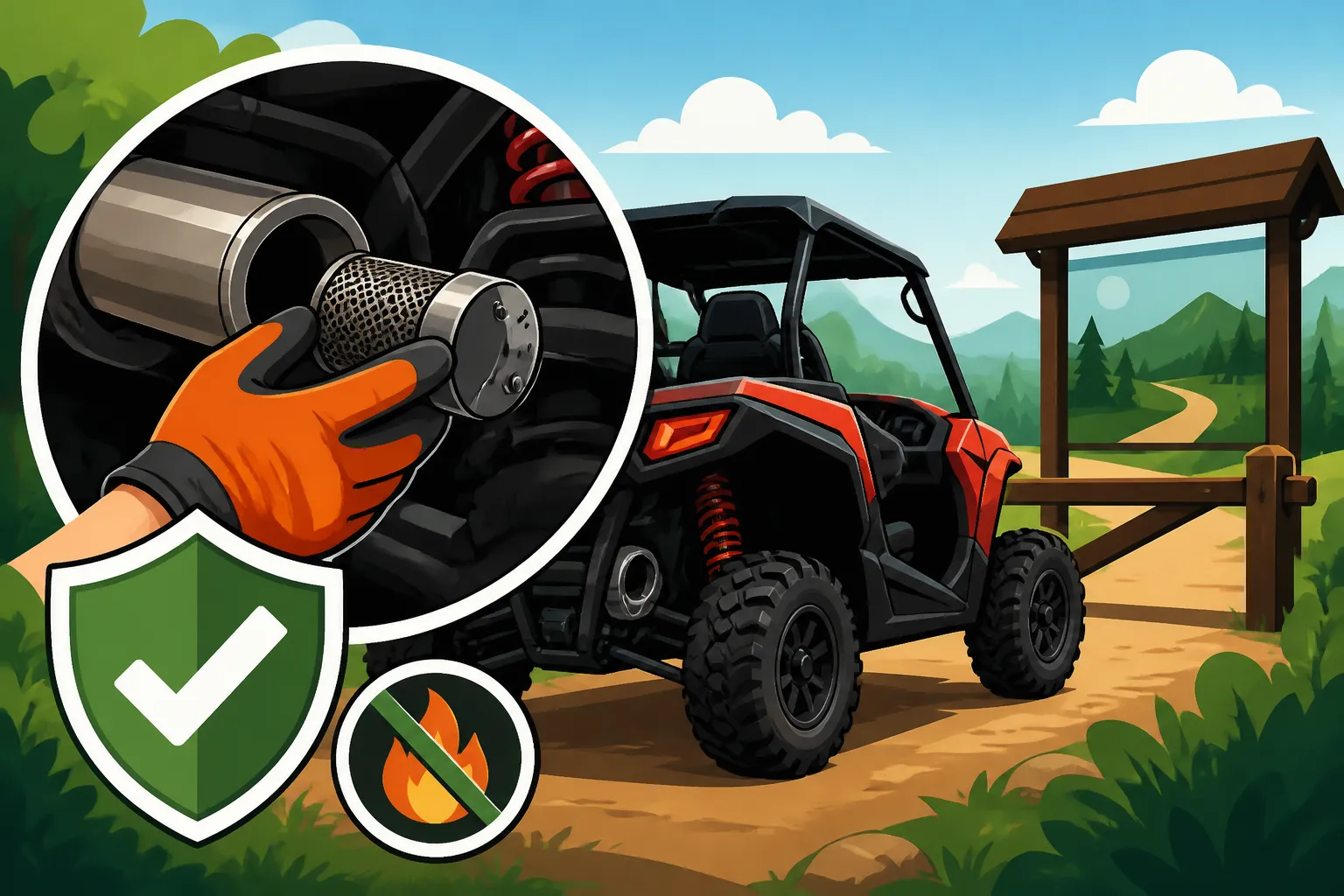
A spark arrestor is a device in or attached to an exhaust system that helps keep hot particles from leaving the exhaust. It is not simply a muffler, and a quiet exhaust is not proof that a machine has a spark arrestor. The parts may be integrated, but you need to verify the equipment rather than guess from its appearance or sound.
Parks may care about spark arrestors because hot exhaust particles can create a fire risk, particularly when vegetation and weather conditions are dry. A site may require an arrestor on certain machines, ask riders to confirm their equipment meets its rules, or impose additional restrictions during elevated fire danger. Whether staff check every machine, spot-check, or rely on riders to comply can vary.
The important distinction is that a park check is not automatically a statewide rule. Do not assume every Kansas riding area uses the same equipment standard, inspection process or consequence for a failed check. For the broader question of whether a particular Kansas park requires one, see Is a Spark Arrester Required at a Kansas Park?. Then contact the riding area directly for its current rule before you leave.
A spark arrestor check may involve one or more of these steps:
- Staff ask whether the machine has an approved or otherwise acceptable spark arrestor.
- A visible marking or product documentation is checked.
- Staff look for an exhaust modification that appears to have removed or altered the device.
- A rider is asked to correct a problem before riding.
- The park applies temporary fire precautions that affect access or permitted activities.
Those examples are possibilities, not a guaranteed checklist for every gate. A park can set its own entry and operating rules, subject to applicable law. Ask what its staff actually need to see rather than arriving with an assumption about what will count.
A permit is a separate issue. A park permit, day pass or private-park admission does not necessarily mean your machine meets equipment rules. Kansas does not issue a general statewide OHV trail permit that automatically clears a machine for every riding site; Kansas Has No State OHV Permit explains that distinction. Check the site’s admission requirements and equipment rules separately.
What counts as proof
The clearest proof is documentation that matches the exhaust or arrestor installed on your machine. Depending on the equipment and the park’s policy, that might be a legible manufacturer marking, an instruction sheet, a part number or information from the manufacturer identifying the component and its intended fitment.
Do not assume that an unfamiliar perforated insert is acceptable just because it sits inside the exhaust. A core, baffle or noise-reduction part may not be a spark arrestor. Likewise, a label on a replacement part is not useful if that part is not actually installed or does not fit the machine’s current exhaust configuration.
If the park specifies a particular standard or certification, ask how staff identify it. The rule may call for a marking or documentation that is not obvious from a quick glance. If it does not specify a standard, ask what evidence it accepts. A clear answer before departure is more useful than debating the part at the gate.
How to inspect your ATV or UTV before leaving
A short pre-trip check can help you catch a missing, damaged or questionable component before you have a trailer loaded and a long drive behind you. Make the inspection with the engine off and cool. Exhaust components can stay hot after a ride, and opening or removing parts while hot can cause burns.
1. Identify the exhaust configuration
Check the owner’s manual and the manufacturer’s parts information for your exact make, model and model year. Determine whether the original exhaust includes a spark arrestor and whether the component is separate or built into the muffler assembly.
This matters because machines can have modified exhausts. An aftermarket muffler, replacement insert or previous owner’s repair may change what is installed. A factory exhaust listed for a model does not prove that the same exhaust remains on the machine today.
If you bought the machine used, look for receipts or records for exhaust work. Ask the previous owner about modifications if the history is unclear. If you cannot identify what is fitted, a dealer or qualified mechanic can help compare the actual parts with the correct parts information.
2. Look for damage or signs of alteration
With the machine cool, inspect the exhaust outlet and the parts you can safely see without dismantling anything. Look for obvious damage, loose fasteners, missing components, heavy corrosion, cracks or evidence that an insert has been removed. A component that is badly damaged or modified may not satisfy a park’s rule even if the machine originally came with the right equipment.
Do not probe the exhaust with a tool or reach inside it. Do not remove a screen or insert to make the inspection easier unless the manufacturer’s instructions specifically call for that service and you know how to reinstall it correctly. When maintenance requires disassembly, follow the manual or have the work done by a qualified service provider.
A quick visual check has limits. Some arrestors are internal, and a rider may not be able to confirm their condition from the outlet. If the part is hidden, use the manual, service records or manufacturer documentation and ask the park what it will accept as proof.
3. Match documentation to the installed part
If you have paperwork, compare the part number or description with the component on the machine. Keep the information accessible on your phone or in a paper folder, especially if the marking is difficult to see once the machine is loaded.
When replacing an exhaust component, check compatibility carefully. A product description should identify the machines it fits and the purpose of the part. If you shop through Amazon or another retailer, confirm the exact model and year fitment with the manufacturer’s information before buying; a listing title or customer review alone does not establish that a part meets a park’s specific requirement.
Keep the receipt and installation information, but do not treat a receipt as proof of compliance by itself. It needs to identify a part that is actually installed and accepted under the park’s rule. If the replacement part has no visible marking, ask the manufacturer or park what supporting documentation will work.
4. Check for maintenance problems
Even a correctly equipped machine can have an exhaust issue that needs attention. Listen for unusual exhaust noise, rattling or a sudden change in sound, and look for visible leaks or loose fittings. These signs do not diagnose a spark arrestor problem on their own, but they are reasons to inspect the system rather than assume it is fine.
Do not ride with a damaged exhaust simply because you plan to pass a check. Exhaust leaks and loose components can create additional safety and mechanical problems. A park may also have separate noise rules, so a spark arrestor and sound compliance are not interchangeable. Check Kansas Sound Limits at a Park if sound requirements are relevant to your destination.
5. Ask the park a specific question
A useful call or message should identify the machine and ask what the staff need to verify. For example:
- Give the park your ATV or UTV make, model and year.
- Explain whether its exhaust is stock or modified.
- Ask whether the park requires a spark arrestor for that machine.
- Ask what marking, documentation or inspection is accepted.
- Ask whether the rule changes during fire restrictions.
- Confirm what happens if staff cannot verify the equipment at check-in.
If the machine has an aftermarket exhaust, describe the exact system or send the park its product information if staff invite you to do so. “It has a screen” or “it is quiet” may not answer the question they need answered.
Write down the answer and the name of the park or office you contacted. Rules can change, and a conversation with one site does not establish what another park requires. If the park posts its current rules online, review those too and check again close to your visit.
Why park rules and permits do not all match
Kansas riding areas are not one uniform system. Some riding opportunities are on private property, where the operator sets entry conditions. Other public properties may limit vehicle use to specific roads or areas and may have their own access requirements. A state or local permit can cover a particular type of use without authorizing riding wherever you choose.
That is why a spark arrestor question belongs in your site-specific planning. A park’s equipment rule may apply even when no state OHV trail permit is needed. Conversely, having an arrestor does not give you permission to ride on land that is closed to machines or outside the designated area.
For private riding locations, read the rules for the exact park rather than relying on a general description of Kansas riding. Kansas Private Park Waivers and Rules covers the broader role of private-park policies, while Kansas Rocks Park Rules for Riders and Kansas Syracuse Dunes Park Rules are useful starting points when either destination is on your schedule. Do not assume that a rule at one private park applies at another.
Public property requires a separate check. Kansas state parks and wildlife areas may have specific restrictions on where machines can go, and an access permit does not turn a closed trail into an open one. Kansas Park Permit vs Trail Permit explains the difference between a permit and permission to ride a trail. If you are visiting a state park, confirm both the allowed routes and any equipment requirements with the park office; Calling a State Park Office Before You Load Up can help you plan that check.
Fire conditions can change what is allowed even after you have confirmed the usual rules. A park may issue temporary restrictions, close an area or limit activities when conditions become hazardous. Check Kansas Fire Restrictions in Dry Months and contact the site for current instructions. A spark arrestor does not override a closure or eliminate the need to follow fire restrictions.
Before loading, confirm four separate things:
| Question | What to confirm |
|---|---|
| Is the riding area open? | Current hours, closures and weather-related restrictions |
| Is my machine allowed? | Vehicle type, size or other site limits |
| Do I need a permit or pass? | What it covers, where it is valid and how to obtain it |
| Does my exhaust meet the rule? | Required equipment, accepted proof and any inspection process |
Keeping these questions separate avoids a common planning mistake: treating a pass or permit as a complete approval of both the machine and the ride. A permit may cover access or use in a particular place; equipment rules and route restrictions still apply.
What to do if your machine does not pass
If staff say the spark arrestor is missing, damaged or unverified, do not remove another component, argue that a quiet exhaust should count, or try to ride around the check. Ask which part of the requirement is not met and whether documentation can resolve the issue. If the problem is an actual equipment defect, the safe choice is to repair it before riding.
The park may allow you to leave and return once the issue is fixed, but do not assume that will be the case. Ask about the site’s procedure before unloading. If the machine cannot ride, arrange to transport it off the property or leave it securely where the operator directs you. Do not test the exhaust or make repairs in a way that creates a fire risk or violates the park’s instructions.
If staff cannot identify an internal part, offer the manufacturer’s documentation or ask whether they can review the part information. Stay factual: explain what is installed and what records you have. If the park still cannot verify compliance, follow its entry decision and resolve the question before a later visit.
For future trips, keep a small set of records with your machine:
- The owner’s manual or a digital copy.
- Exhaust or arrestor part information.
- Receipts and service notes for exhaust work.
- The park’s written rule or confirmation, if available.
- Contact details for the riding area.
That folder is especially useful when machines are shared, modified or maintained by more than one person. It also helps if you ride at several locations with different policies. Recheck the park’s current requirements each time you plan a visit; an old confirmation is not a guarantee that a rule or fire condition has stayed the same.
A few minutes of verification can save a wasted trip and help reduce fire risk. Confirm the equipment on the machine, ask the specific park what it requires, and keep permit, access and equipment questions distinct. If the answer is uncertain, get it resolved before driving to the gate.
Disclaimer
This article is for general informational purposes only and does not constitute professional advice. Laws, prices and regulations vary by location and change over time. Consult a qualified professional for guidance on your specific situation.