The $52.50 Unconventional Vehicle Permit
The $52.50 Unconventional Vehicle Permit can be easy to misunderstand: it is not a statewide trail pass and does not open every Kansas park road to ATVs or UTVs. Its role is narrower. Here’s what the permit may cover, where it does not apply, how reciprocity works, and what to check before you unload your machine.
What the $52.50 permit covers
Kansas’s unconventional vehicle permit is for limited use of eligible machines on certain roads and parking areas at Kansas Department of Wildlife and Parks (KDWP) properties. The key words are certain roads and parking areas: having a permit does not mean you can ride wherever you find a track, trail, shoreline or open patch of ground.
The permit is commonly identified as costing $52.50. Fees and permit conditions can change, so verify the current amount and requirements with the park office before you make a trip. The permit is not a replacement for a machine’s title or proof of ownership, and it does not turn an ATV or UTV into a road-legal vehicle.
Kansas does not issue a general statewide OHV trail permit. The park permit is a separate, property-specific permission with a narrow purpose. If you are trying to find public places to ride trails, don’t assume buying it will solve that problem. Kansas state parks do not offer OHV trails, and the permit does not create trail access where none is provided. Kansas Has No State OHV Permit explains the difference between this park permit and a statewide riding sticker.
| Question | What the permit means |
|---|---|
| Does it cover every Kansas trail? | No. It is not a general trail pass. |
| Does it let you ride anywhere inside a state park? | No. Use is limited to routes and areas where machine operation is allowed. |
| Does it make a machine street legal? | No. Park permission does not authorize ordinary road use. |
| Does an out-of-state sticker automatically replace it? | No. Do not assume another state’s permit is recognized. |
| Does having it guarantee access to a riding area? | No. The property must allow the vehicle and route you intend to use. |
A useful way to think about the permit is as one part of an access check—not as a universal authorization. You still need to know whether your machine fits the property’s rules, whether the particular road or parking area is open to it, and whether any signs or temporary restrictions apply.
The permit also does not override general rules for the property. A road can be closed, access can be restricted, and park staff can direct riders to stay on designated routes. Weather, construction, resource protection or other local conditions may affect access. The safest assumption is that you may use only a route the property clearly allows, not every route you can physically ride.
Where it may let you ride—and where it does not
The permit is associated with travel on eligible department roads and parking areas, not recreational riding across open land. That distinction matters because a road-use permit is easy to mistake for permission to explore.
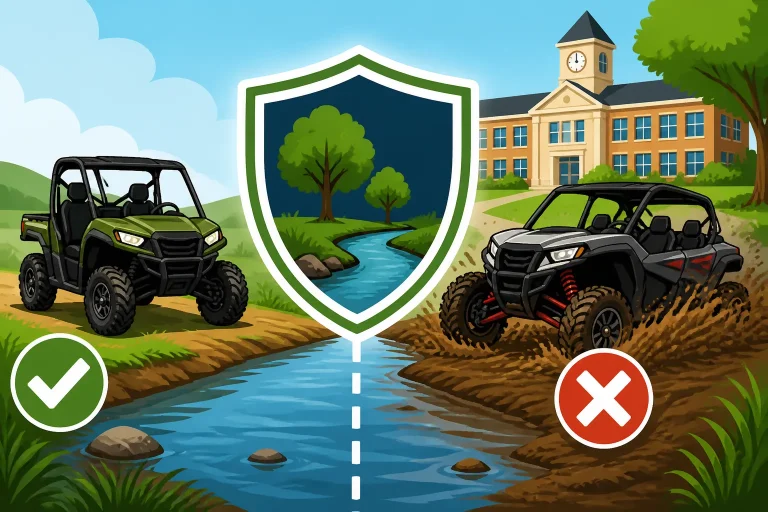
Stay on routes that are open to your type of vehicle. Do not ride onto a trail simply because it appears wide enough, or into a field because there is no fence. A path used by maintenance vehicles is not automatically a public route for ATVs. Likewise, permission to reach a parking area does not necessarily allow riding around the surrounding grounds.
State-park rules can differ from the rules at other public or private riding areas. A site may permit a machine on a specific road while prohibiting it on nearby trails, beaches, grass, or other areas. Posted signs and directions from park staff matter. Where a rule is unclear, ask before riding rather than treating silence as permission. Where a Park Road Permit Actually Lets You Drive and Kansas Department Road Riding Rules offer more detail on the limited scope of road access.
A park permit also does not make a machine legal on public streets outside the property. State, county and city road rules are separate from a park’s access rules. For example, the permit does not cancel restrictions on riding an ATV or UTV on a highway or town street. Kansas Park Permit vs Trail Permit is useful if your main question is whether the permit functions like an OHV trail pass.
Before you rely on the permit, check these points for the particular property:
- Is the property open to the vehicle you have? Rules may distinguish among ATVs, UTVs, golf carts and other machines.
- Which roads or parking areas allow it? Ask for the permitted routes, not just whether “ATVs” are allowed.
- Are any routes closed or restricted? Check signs and ask about temporary conditions.
- Does the machine need anything beyond the park permit? Confirm any ownership, equipment or permit-display requirements.
- Are you planning to ride a trail? Ask directly whether that trail is open to your vehicle; the permit itself does not establish trail access.
If your goal is a dedicated off-road ride, compare the park permit with the rules at the riding area you plan to visit. Kansas has private parks and designated riding locations with their own access requirements. They may require separate admission, waivers, safety equipment or other conditions. A KDWP permit should not be treated as a pass for those places.
Buying the permit and checking reciprocity
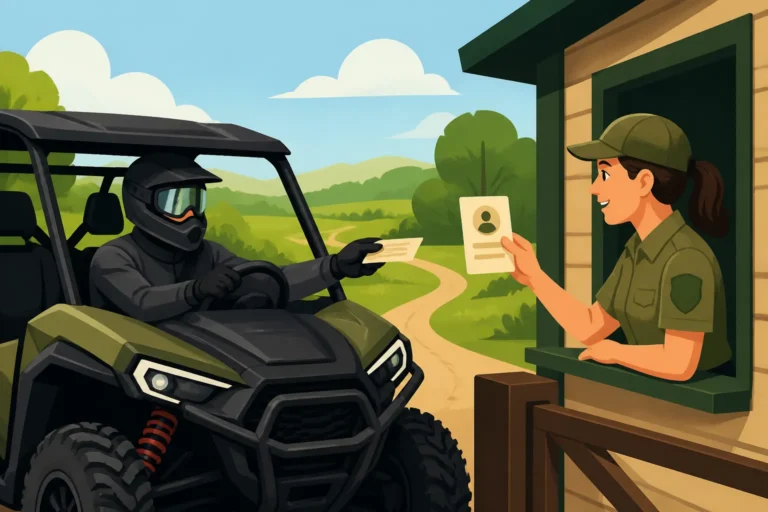
The permit is sold through park offices, rather than as a general trail sticker available for every riding location. Because it is tied to access on department property, contact the park before you load your machine. Confirm that the office can issue the permit you need and ask what information or documents to bring. Buying an Unconventional Vehicle Permit at a Park Office covers the purchase process.
When you call, ask practical questions instead of relying on the permit name alone:
- Is this permit required for my specific machine?
- Is my machine type allowed on this property?
- Which roads and parking areas can I use?
- Is the permit valid for the dates I plan to visit, and when does it expire?
- How must it be displayed or carried?
- What proof of ownership or other paperwork should I bring?
- Are there current closures, restrictions or separate fees?
The listed fee of $52.50 is worth confirming before you go, along with the payment methods accepted at that office. Do not assume a permit bought for one purpose gives you access to a different park or private riding area. Ask whether the permit applies to the location you will use and whether any additional permission is needed.
Does another state’s sticker count?
Do not assume that an out-of-state OHV sticker or registration substitutes for Kansas’s park permit. Kansas’s permit is connected to use of department property under Kansas rules; a credential from another state may serve a different purpose and may not grant the same access. For visitors, the practical move is to contact the Kansas park office and ask what is required for the machine and route. Kansas Honors No Other State Sticker explains why reciprocity should not be presumed.
The reverse is also important: buying a Kansas park permit does not automatically give you permission to ride in another state. Neighboring states and individual properties set their own requirements. If you are crossing a state line, check the destination’s rules rather than relying on the Kansas permit.
A visiting rider should keep the permit’s limits in mind even after buying it. It is not a substitute for a vehicle title, and it does not create a right to operate on public roads. A machine can have proof of ownership and a park permit while still being prohibited from a particular road or trail.
Before you load up
The most reliable way to avoid a wasted trip is to separate three questions: whether your machine is eligible, whether you need the permit, and where you may ride once you have it. A “yes” to one does not answer the other two.
Use this checklist before leaving home:
- Identify the destination. Confirm that it is a KDWP property and not a private park, Corps area or other site with different rules.
- Describe the machine accurately. Give the office the vehicle type and any details it requests; a broad description like “side-by-side” may not settle eligibility.
- Ask about routes. Get clear confirmation that your intended road or parking area is open to that machine.
- Verify the current fee and permit period. The $52.50 amount should be checked with the park office, along with expiration and display rules.
- Check for other requirements. Ask about proof of ownership, equipment, insurance, entrance charges or restrictions that apply at that property.
- Check conditions again before departure. A route that is usually open may be affected by a closure or temporary restriction.
If you are considering a Corps-managed riding area, do not assume the KDWP permit applies there. Some Corps riding areas do not require a state park permit, but the land manager’s rules still control, and access may be limited to designated areas. Why Corps Riding Areas Need No Park Permit discusses that distinction. A permit not being required is not the same as unrestricted riding.
The same caution applies to private parks. Each property can set its own requirements for admission, age limits, helmets, insurance, waivers and vehicle types. Call the park directly and check its current rules. A Kansas park permit does not replace a private park’s admission process.
For a quick planning rule, treat the $52.50 permit as limited permission for specific use on eligible department roads and parking areas—not as a statewide pass. Confirm the details with the park office, follow posted restrictions, and choose a designated riding area if your plan is to ride trails.
Disclaimer
This article is for general informational purposes only and does not constitute professional advice. Laws, prices and regulations vary by location and change over time. Consult a qualified professional for guidance on your specific situation.