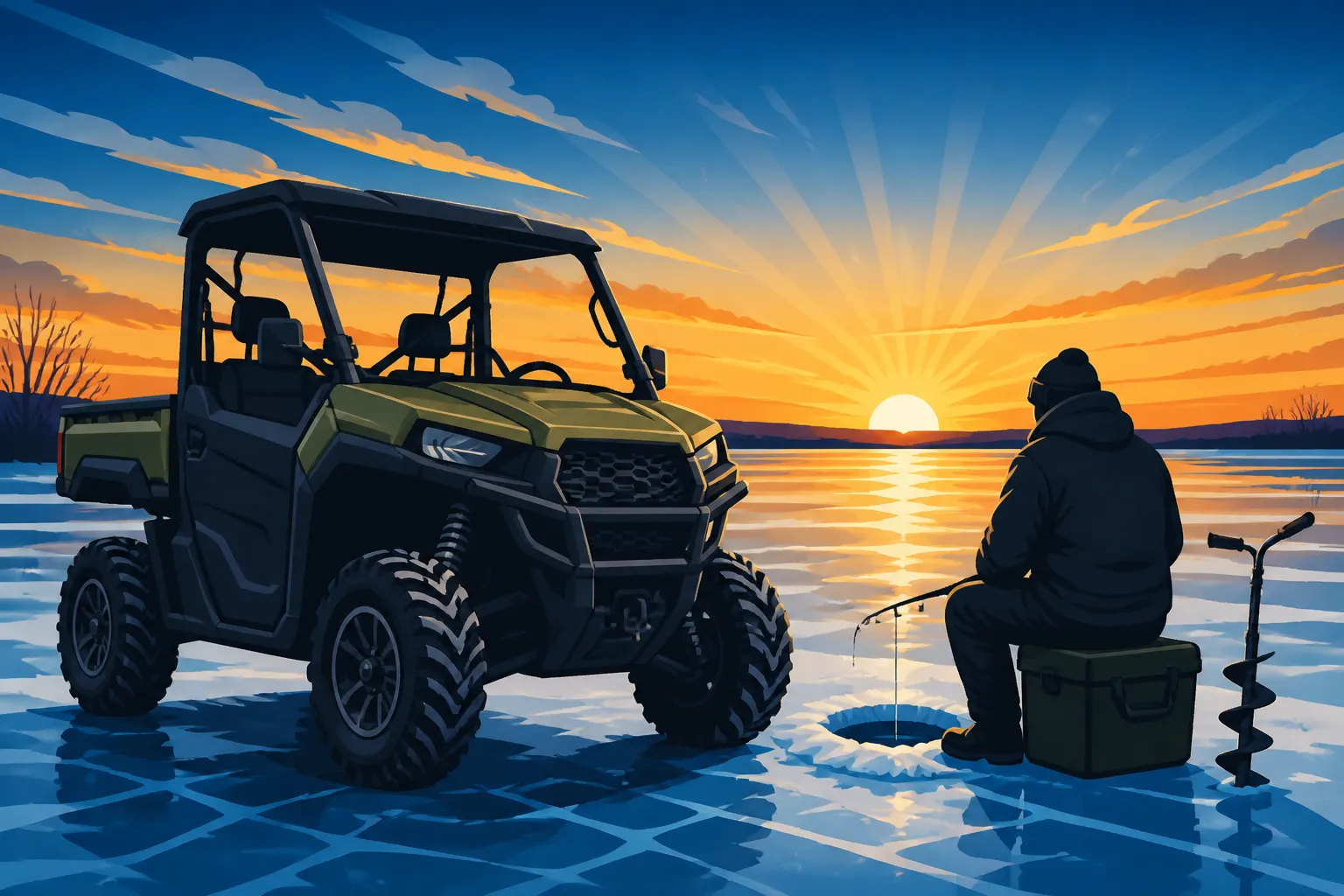
Ice Fishing Access Starts a Half Hour Before Sunrise
Kansas ice-fishing access by ATV or UTV is limited by more than whether a lake is frozen. The access window starts a half hour before sunrise, but that does not mean every shore or frozen waterbody is open to machines. Use an authorized entry point, follow the site’s posted rules, and confirm permit and ice conditions before unloading.
What the half-hour-before-sunrise rule means
The stated start time matters if you plan to ride a machine to an ice-fishing spot. It gives riders an early access window, but it is not permission to drive anywhere on a lake or to use public land as an off-road trail. The location, purpose, route, and posted restrictions still matter.
Think of the rule as one part of a site-specific access plan:
- Purpose: The access is for ice fishing, not recreational riding on frozen water.
- Location: You need to use an entry point designated for machine access.
- Timing: Access begins a half hour before sunrise, subject to any site-specific limits or closures.
- Route: Stay on the approved approach and within the area where machine use is allowed.
- Conditions: The lake must be open and the ice must be safe for your machine and load.
- Other rules: Park restrictions, permit requirements, and temporary closures may still apply.
The time is a starting point, not a guarantee that a gate will be open or that a particular shoreline is accessible. A park can have its own gate schedule, seasonal closure, construction work, or safety restriction. If a posted sign or an employee gives a more specific instruction, follow that instruction rather than relying on a general description of ice-fishing access.
It also helps to separate access from permission to ride. A machine may be permitted on a specific route to reach an ice-fishing area without being allowed on the rest of the property. A frozen lake does not automatically become an open riding area. For broader state-property rules, see Kansas Ice Fishing Vehicle Rules and Kansas Ice Fishing Access Starts a Half Hour Before Sunrise.
Access is different from general trail riding
The difference is practical. If you are taking a quad or side-by-side across an approved route to reach a fishing spot, you are making a trip tied to ice fishing. If you are circling the lake, exploring shorelines, or using the ice for a recreational ride, that may fall outside the permission that allows access.
Do not treat a fishing trip as an excuse to explore closed areas. Keep the machine on the authorized approach, avoid disturbing anglers and wildlife, and return by the same route unless officials indicate otherwise. If the access area is crowded, slow down and give people on foot plenty of room.
A state park permit or other permit should also be understood by what it actually authorizes. A permit connected with park roads is not necessarily a permit to ride trails or cross any frozen water. The general distinction is covered in The Park Permit That Covers Roads, Not Trails. Check with the particular park before assuming that a permit you already have covers the route to your fishing location.
Use only a designated ice entry point
A designated entry point is more than a convenient place to reach the shoreline. It is the approved route for getting a machine onto the ice, and it may be chosen because the approach is manageable, visible, and less likely to conflict with other park use. A nearby boat ramp, gravel pullout, or opening in the shoreline is not automatically an authorized machine entrance.
Before leaving home, find out which access point is open for the kind of machine you plan to bring. Confirm the route from the parking area to the ice, whether a gate or barrier controls access, and whether the entry is usable under current conditions. If directions are unclear, call the managing office instead of improvising at the water’s edge.
The rule is especially important when shoreline conditions change. A ramp may be blocked by snow, ice, standing water, or maintenance equipment. A route that was open during a previous visit may have been closed since. Follow signs at the site and do not drive around a barrier, even if other tracks appear to lead beyond it.
The access principle is explained in Kansas Ice Entry Point Rules and Designated Ramps Are the Only Way Onto the Ice. Those rules point to a simple approach: use the entry the property manager identifies, and do not make a new route because it looks easier.
Check the approach, not just the lake
A frozen surface can appear inviting while the shoreline is still difficult or unsafe to cross. Before unloading, look for the approved approach and any posted warnings. Avoid driving through reeds, over banks, or across areas where the route is not clearly established. Besides risking damage or getting stuck, an improvised route can disturb habitat and put other users in danger.
If the access point is closed, ask whether another designated entrance is open. If none is available, do not treat a different shoreline as a substitute. The fact that a machine can physically reach the water does not make that route legal or safe.
Follow the limits at the site
A site may restrict which machines can enter, where they may park, or how they must approach the ice. It may also close access because of thin ice, changing weather, low water, maintenance, or crowding. Do not assume that a route suitable for a small quad is suitable for a larger side-by-side carrying passengers, fishing equipment, and a shelter.
Keep the machine’s size and load in mind. A heavy UTV with occupants and gear creates a different risk from a single rider on a light ATV. If the access instructions do not clearly cover your vehicle, ask the managing office before heading out.
Plan around the access window and closing time
The access period begins a half hour before sunrise, but the start time is only one part of the schedule. You also need to know when you must leave the ice, when gates close, and whether the park has a separate closing time. Do not assume that the early-access rule means overnight access is allowed or that you may stay on the ice until any hour you choose.
The safest plan is to confirm the complete schedule for the exact location. Ask whether the machine-access window is limited to daylight, whether there is a separate cutoff for vehicles, and how the rule applies if you are already fishing when conditions or posted hours change. The related topic When You Must Be Off the Ice at Night is useful context, but the local instruction at the site controls your trip.
| Before you go | What to confirm |
|---|---|
| Access time | Whether the half-hour-before-sunrise start applies at your chosen location |
| Departure time | When machines must be off the ice and whether gates close earlier |
| Entry route | Which ramp or designated access point is open |
| Vehicle type | Whether your ATV or UTV is allowed on that route |
| Permit | Whether the park or property requires a permit for the approach or vehicle |
| Ice conditions | Whether the property manager has issued a closure or warning |
| Parking | Where to leave the truck and trailer without blocking the access route |
| Weather | Whether wind, snow, or warming temperatures could affect travel or ice safety |
Sunrise and sunset change through the year, so do not rely on a time remembered from a previous outing. Check the current local schedule and leave enough time to get off the ice before the applicable cutoff. If you are unsure whether the time refers to entering the access route or reaching the ice itself, ask the park office to clarify.
A practical arrival plan is to be at the parking area before the access window opens, ready to unload without blocking the ramp. Arriving early does not authorize entering before the permitted time. It simply gives you time to check signs, get equipment ready, and avoid a rushed launch once access begins.
Make a turnaround plan
Decide before setting out what you will do if the designated entrance is closed, the ice looks questionable, or the posted hours differ from what you expected. A good plan is to stay off the ice and choose another legal fishing option, not to search for an unmarked route.
If you are fishing with a group, agree on when everyone will leave and how you will communicate. A slow vehicle, a stuck machine, or a gear problem can make it harder to leave on schedule. Do not wait until the last minute to start packing. Make a conservative turnaround time that leaves room for the unexpected.
Understand permits and property-specific restrictions
A common source of confusion is assuming that one permit covers every kind of machine use. In Kansas, rules can differ between state parks, wildlife areas, Corps property, private riding parks, and other public or private land. A rule that applies at one lake does not automatically apply at another.
For state parks, distinguish a permit for park-road use from permission to ride trails or frozen water. The permit rules do not erase site-specific restrictions. For other property, the permit question may be different, and local management rules still apply. The broad distinction between state-property permits and riding areas is discussed in Kansas Park Permit vs Trail Permit and Why Corps Riding Areas Need No Park Permit.
Before you travel, contact the office that manages the access point and ask a few direct questions:
- Is machine access currently allowed for ice fishing?
- Which entry point should I use?
- Does the half-hour-before-sunrise start apply here, and when must machines leave?
- Is my vehicle type allowed, including a side-by-side if that is what I plan to bring?
- Is a permit required for the route, parking area, or machine?
- Are there temporary closures, ice warnings, or restrictions on passengers?
- Where should I park the truck and trailer?
These questions are more useful than asking only whether “ATVs are allowed.” A staff member may answer yes for one route and no for other parts of the property. Be specific about the lake, access point, vehicle, and purpose of the trip.
Do not confuse permits with access authorization
A permit does not necessarily make a closed route open. It also does not guarantee that ice conditions are safe. Think of permits, access rules, and safety as separate checks. You may need to satisfy all of them, and meeting one requirement does not cancel the others.
If you are visiting from another state, do not assume your home-state registration or sticker substitutes for Kansas or property-specific requirements. The relevant issue may be whether a permit is required at that location and what it covers. For the general visitor question, see Kansas Requires No Sticker of Visitors, but still confirm the rules for the specific property you intend to visit.
When an office cannot confirm access, treat that uncertainty as a reason to pause. Ask for the current rule or choose a different location with clear instructions. A quick call before loading can prevent a wasted drive and an avoidable citation.
Make the trip safer for people, machines, and ice
Legal access does not mean safe ice. The early start can put you on the water before daylight is strong, and conditions can vary across a single lake. Thickness near an entry point does not prove that the route farther out is safe. Springs, moving water, inflows, changing temperatures, snow cover, and pressure cracks can all make ice uneven.
Do not rely on a machine to test ice. A heavier vehicle can break through suddenly, and a successful crossing by another rider is not proof that the same path is safe for you. Check current local guidance, use appropriate personal flotation and ice-rescue equipment, and avoid going out alone. If conditions are uncertain, stay off the ice.
Before departure, prepare for an early, cold trip:
- Check the forecast for temperature changes, wind, precipitation, and visibility.
- Tell someone where you are going and when you expect to return.
- Bring a charged phone, while recognizing that service may be unreliable.
- Carry ice picks or other appropriate self-rescue equipment where they are accessible, not buried under cargo.
- Keep a throw line and warm, dry clothing available.
- Use lights and reflective gear when traveling in low light.
- Secure fishing gear and other loads so they cannot shift during travel.
- Keep passengers within the machine’s designed seating capacity.
- Avoid alcohol or impairing substances while operating a machine.
- Leave extra space around people on foot, shelters, and other vehicles.
For personal safety equipment, buy from a reputable outdoor retailer or a marketplace such as Amazon only after checking that the item is designed for the intended use and fits correctly. A low price or convenient delivery does not make a piece of rescue gear suitable; inspect it before the trip and know how to use it.
Protect the machine and the access route
Cold weather can affect batteries, tires, belts, and starting systems. Check the machine before leaving, especially if it has been stored through winter. Carry basic recovery supplies, but do not attempt a recovery that would put people or additional vehicles on unsafe ice. If a machine becomes stuck or breaks down, prioritize getting people to safety and contact the appropriate property staff or emergency services as needed.
At the access point, avoid spinning tires or digging into the ramp. A damaged approach can make the site harder to use for everyone and may lead to a closure. Keep the entrance clear for other anglers and emergency responders, and do not leave a trailer or vehicle where it blocks a gate.
Respect other users. Ice anglers may be working around shelters, holes, lines, and gear that are difficult to see in low light. Travel slowly, use the established route, and keep distance from fishing setups. Noise and exhaust can also disrupt the experience, so avoid unnecessary idling near people.
A simple pre-trip checklist
A few checks can make the difference between a lawful, manageable trip and an avoidable problem. Complete them before you load the machine, then check the signs again when you arrive.
- Choose the lake and property. Identify who manages it and find the specific access point you plan to use.
- Confirm machine access. Ask whether ATVs or UTVs may use the route for ice fishing at that location.
- Verify the hours. Confirm the half-hour-before-sunrise start, the departure cutoff, and any gate schedule.
- Check permits. Ask whether a permit applies to the machine, road, parking area, or other part of your route.
- Check current conditions. Look for closures, ice warnings, weather changes, and access restrictions.
- Prepare the machine and safety gear. Inspect the vehicle, secure the load, and keep rescue equipment accessible.
- Use only the designated entrance. Do not substitute an unmarked shoreline or bypass a barrier.
- Leave on time. Pack early enough to clear the ice and access route before the required cutoff.
When any answer is unclear, contact the managing office and get a specific answer for your vehicle and location. Rules can differ even between nearby access points, and temporary conditions can change a plan quickly. The most reliable trip is one where the permitted route, timing, and safety conditions are all confirmed before the machine reaches the water.
Frequently Asked Questions
Can I reach the lake before sunrise for ice fishing?
The access window described here starts a half hour before sunrise. Confirm that the rule applies to your chosen property and check for gate hours or other posted limits before entering.
Can I drive onto any frozen lake in Kansas?
No. A frozen surface is not blanket permission for machine use. Use only a location and entry point where access is authorized, and follow signs and closures.
Does a park permit automatically allow me to drive on ice?
Not necessarily. A permit may cover a particular road or use but not every route or frozen-water activity. Ask the managing office what the permit covers at that site.
Is the ice safe because another machine crossed it?
No. Ice conditions can differ across short distances and change with weather and water movement. Do not use another person’s crossing as proof that the ice can support your machine.
Disclaimer
This article is for general informational purposes only and does not constitute professional advice. Laws, prices and regulations vary by location and change over time. Consult a qualified professional for guidance on your specific situation.