Kansas Ice Fishing Access by Machine
Kansas ice fishing access by ATV or UTV depends on the lake, the land manager and the route you take to reach the ice. A machine that can get you across a snowy parking lot is not automatically allowed on a park road or frozen lake. Here’s how to check permits, use designated access points and avoid turning a fishing trip into a rules problem.
Where machine access is allowed
There is no single Kansas-wide rule that gives ATVs and UTVs open access to every frozen lake. The important first step is finding out who manages the place you plan to fish. A state park, a wildlife area and a lake managed by the U.S. Army Corps of Engineers may have different rules, even when they sit beside the same reservoir.
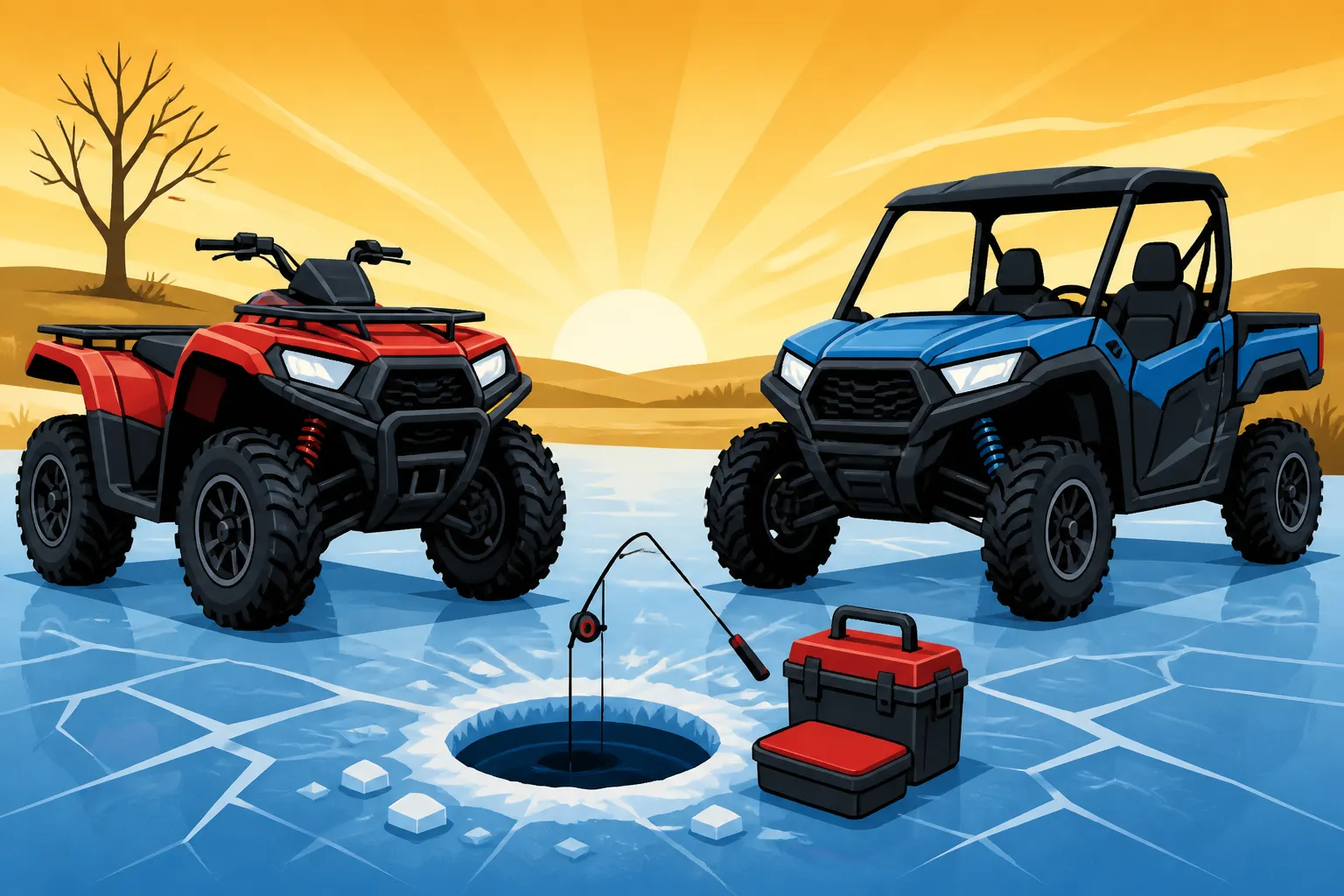
At some Kansas locations, designated ice-fishing access points allow machines onto the ice. That is limited access for reaching fishing areas, not general permission to ride around the lake. Use the approved entry point and follow signs, barriers and instructions from the managing agency. If a ramp or access point is closed, do not treat another shoreline as an acceptable substitute.
The same caution applies to the route you take before reaching the water. A park permit or permission to use a public road does not necessarily let you ride across a field, shoreline, dam, trail or parking area that is closed to machines. Kansas park permits generally address use of certain park roads and parking areas; they are not trail passes and do not create permission to ride wherever you like. For a broader explanation of those limits, see The Park Permit That Covers Roads, Not Trails and Kansas Park Permit vs Trail Permit.
Before you load up, identify:
- The lake and the specific area where you intend to fish
- The land manager for that access point
- Whether machines are allowed on the approach road
- Whether a designated ice-fishing entry is open
- Any posted hours, vehicle restrictions or temporary closures
- Whether a permit applies to your machine or the area
If you cannot confirm that a route is open, call the park or area office that manages it. Ask about the exact access point, not just whether “ATVs are allowed.” That wording can mean different things: access on a park road, use of a parking area, or travel onto the ice.
Ice access is not recreational trail access
A designated ice-fishing entry exists to help anglers reach the water. It should not be read as permission for trail riding, exploring the shoreline, racing, or riding to an unrelated destination. Stay on the route the manager has opened for ice access, and do not ride on land simply because it is frozen, snow-covered or difficult to distinguish from the lake.
Conditions can change quickly. A route that was open on a previous visit may be closed after a thaw, a storm, damage to a ramp or a change in ice conditions. A gate, sign, barricade or staff instruction takes priority over an old map, a social-media post or what another rider remembers.
If you’re considering a different type of public land, check the rules for that site separately. Kansas Wildlife Area Machine Rules and Kansas Fishing Lake Machine Rules cover other access situations, but neither should be treated as a blanket authorization for every lake or every frozen surface.
Permits and out-of-state visitors
Kansas does not offer a general OHV trail permit that grants access to all public riding areas. That does not mean every machine can enter every public property without a permit. A state park may have a permit requirement for an unconventional vehicle using designated park roads or parking areas, while another manager may use a different system. The permit, if one applies, is tied to the location and permitted use.
A permit also does not override a closure or expand the route you are allowed to use. If you need a park permit, confirm what it covers and whether it applies to your vehicle before you head out. Kansas Park Permit for a UTV and Buying an Unconventional Vehicle Permit at a Park Office explain the permit questions to sort out before arriving.
Do not assume that registration or an OHV sticker from another state substitutes for a Kansas park permit. Kansas has no general trail-pass system for visitors to reciprocate with, and permits from another state do not automatically grant riding rights here. At the same time, do not assume that an out-of-state visitor must buy a Kansas sticker for every trip. The answer depends on the property, the route and the vehicle. Confirm the requirements with the site manager; Kansas Requires No Sticker of Visitors explains why “no statewide sticker” is different from “no rules at the lake.”
For a visitor, the simplest checklist is:
- Find the lake’s managing agency and the specific access location.
- Ask whether your machine may use the road or parking area leading to the ice.
- Ask whether the designated ice entry is open to your type of machine.
- Confirm whether that location requires a permit for the route you’ll use.
- Ask about hours, closures and any machine-size or equipment restrictions.
If you are told a permit is required, ask where it can be obtained and what areas it covers. Some permits are sold through the park office rather than through a general online trail-pass system. Do not wait until you are at the water’s edge to discover that the office is closed or that your machine is not covered by the permission you bought.
Hours, entry points and ice conditions
At locations that allow machines for ice fishing, access is generally tied to designated entry points and posted operating hours. For certain Kansas public lands, machine access for ice fishing starts a half hour before sunrise. Hours can vary by site, and a local rule or temporary closure may narrow that window. Check the current instructions for the specific lake rather than applying one location’s schedule everywhere.
Pay attention to both the time you may enter and the time you must leave. A rule that allows entry before sunrise does not necessarily allow a machine to remain on the ice all night. If the site sets an evening cutoff, plan to be back off the ice by then. Ask the office what happens when changing weather or a delayed return makes the posted schedule difficult to meet.
A designated ramp is more than a convenient place to drive down to the water. It is the approved access route. Use only the point that is open for ice-fishing access. Do not drive down an unmarked bank, around a gate or across a frozen inlet to avoid a queue. A shoreline can conceal soft ground, vegetation, rocks, drainage structures or a sudden change in depth.
Before leaving home, check for:
- Current ice-fishing access notices or closures
- Posted hours and any overnight restrictions
- Whether the access route is open to ATVs, UTVs, or both
- Parking and trailer arrangements
- Weather, wind and temperature changes
- Restrictions on passengers or machine dimensions
- Instructions about where machines may travel once on the ice
Do not confuse an open access point with a declaration that the ice is safe. A manager may allow access for a specific purpose while still expecting each angler to judge conditions and take personal responsibility. Ice thickness can vary across one lake, especially near inlets, outlets, pressure cracks, vegetation, moving water and areas affected by wind or changing temperatures. A machine’s weight makes a weak spot much more consequential than it would be for a person walking.
Never use another rider’s tracks as proof that the ice will support your machine. Tracks can lead over a route that has since weakened, and a surface that held one vehicle may not hold a different machine, passengers and fishing gear. If conditions look uncertain, turn back or choose a shore-based plan. The convenience of riding out to a spot is not worth risking a machine, a life or a difficult rescue.
Preparing your machine and fishing trip
An ice-fishing trip by machine needs more planning than a short ride on dry ground. Cold weather reduces battery performance, changes how tires grip and makes a minor breakdown harder to manage. A UTV with a cab may offer more shelter, but it can also be heavier and wider than an ATV. Confirm that the access rules allow your machine before choosing your route.
Bring the documents and practical items you may need:
- Proof of ownership or other documents that identify the machine
- Any permit required for the specific property
- A phone number for the park or area office
- Warm clothing, gloves and eye protection
- A fully charged phone and a backup way to contact someone
- A first-aid kit and basic repair supplies
- Recovery equipment appropriate for your machine and conditions
- A paper map or downloaded map if service may be unreliable
- Ice-safety equipment suited to the conditions and your experience
Keep the machine’s registration, title and any permit documents accessible, but do not rely on paperwork as proof that you may ride on a particular route. Ownership documents can help identify a machine; they do not replace permission from the land manager. If your title or machine class is unclear, Kansas Proof of Ownership on the Trail and Choosing the Right Class on a Form may help you prepare questions before you travel.
A few gear purchases can make a cold trip more manageable, but buy for the route and weather rather than for a generic “ice fishing” checklist. For example, a compact first-aid kit, insulated gloves or a waterproof phone case may be useful additions. Amazon can be a place to compare those basics, but check dimensions, cold-weather suitability and return terms before ordering. A product marketed for winter use is not necessarily designed for machine recovery or emergency ice travel.
Before driving onto the ice, secure rods, augers, shelters, fuel containers and loose tools. Tie down anything that might shift during a sudden stop or slide. Keep visibility in mind: snow, blowing ice and low light can make a machine difficult for other anglers to see. Use lights where appropriate and avoid blocking the designated access route while unloading.
Think through a breakdown before it happens. Tell someone where you are going and when you expect to return. Carry enough warm gear to wait safely if the machine will not start. If a machine becomes stuck or fails on the ice, avoid turning a recovery attempt into a second emergency. Do not put people in danger to save equipment. Follow emergency instructions from the managing agency and contact local responders when the situation calls for help.
For equipment that is easy to overlook, compare items such as a waterproof storage bag, a compact tire repair kit and an emergency blanket. Amazon may help you review several options in one place, but verify that a tool fits your machine and can be used safely in the cold. A small kit you know how to use is more useful than a large assortment left unopened.
Common mistakes and a safer decision process
The most common mistake is treating “public lake” as equivalent to “open to machines.” Public access may mean a boat ramp, fishing access or a parking area, not permission to drive a quad or side-by-side onto the ice. Another is assuming that a state park permit acts like a general riding pass. It does not automatically authorize trails, shorelines or routes that are not designated for machine use.
Other avoidable mistakes include:
- Driving onto the lake from an unofficial shoreline
- Relying on a rule from a different reservoir or park
- Assuming another state’s sticker is valid in Kansas
- Treating a permit as permission to ignore operating hours
- Using old information after a gate or access point has changed
- Riding beyond the ice-fishing access route for recreation
- Assuming that a machine’s size or weight does not matter
- Believing that visible tracks establish safe ice conditions
A sensible decision process is straightforward:
- Name the exact access point. “The lake” is too broad. Identify the ramp, park area or shoreline entrance you intend to use.
- Identify the land manager. Do not rely on a nearby town or a different part of the reservoir to answer for that site.
- Confirm permission for your machine. Ask separately about the approach route, parking area and travel onto the ice.
- Check permits and hours. Find out what is required, where to get it and when you must be off the ice.
- Check conditions again before departure. A previous visit or an old report does not establish that the access point is open today.
- Use only the approved route. Respect signs, barriers and staff directions, even if another route looks easier.
- Turn back if the situation changes. A closure, deteriorating weather or questionable ice is a reason to change plans.
If you need to call an office, ask precise questions: “Is this particular ice-fishing entrance open to an ATV or UTV?” “May the machine travel from the parking area to the ice?” “Are there posted hours or a permit requirement?” “Is there a current closure or size restriction?” These questions are more useful than asking only whether “ATVs are allowed,” because they separate access to the property from permission to use a particular route.
The practical rule is to plan around the site’s posted access, not around what your machine is capable of doing. A narrow ATV and a wide side-by-side may face different restrictions, and a route that works for one may not work for the other. If you are unsure, stay off the ice until the manager confirms the rules and conditions.
Disclaimer
This article is for general informational purposes only and does not constitute professional advice. Laws, prices and regulations vary by location and change over time. Consult a qualified professional for guidance on your specific situation.