Kansas’s $52.50 Unconventional Vehicle Permit
Kansas’s $52.50 unconventional vehicle permit can be confusing because it is not a general ATV trail pass. It is tied to limited use at Kansas state parks, and it does not make an off-road machine street legal or open every park road. Here’s what the permit is for, what it doesn’t cover, and what to check before loading up.
What the unconventional vehicle permit is for
Kansas uses the term “unconventional vehicle” for certain machines that do not fit the ordinary passenger-vehicle category. Depending on the vehicle and where you plan to use it, that may include an ATV, UTV, golf cart, or another off-road machine. The classification matters: Kansas has several distinct off-road vehicle classes, and a machine’s shape, seating, tires, and weight can affect which rules apply. If you are unsure where yours fits, start with Four Off-Road Classes Kansas Law Treats Differently.
The $52.50 figure in the title refers to the Kansas unconventional vehicle permit associated with limited use at state parks. It is not a statewide registration, a road-use plate, or a pass that lets you ride trails across Kansas. The name can make it sound broader than it is, so think of it as a park-specific permission to use a qualifying machine in the places and ways the park rules allow.
This distinction is important because Kansas does not have a general state OHV trail permit system. A permit for park roads does not create access to off-road trails, public hunting land, or private property. Nor does it replace permission from a landowner or the rules of a private riding park. For the separate question of whether a machine needs a statewide registration or tag, see Kansas Has No OHV Registration.
The permit’s purpose is easiest to understand by separating three questions:
- Is the vehicle in a class that can qualify? The vehicle’s design and legal class matter. A machine that looks like a small utility vehicle may not be treated the same as a golf cart or ATV.
- Does the park allow that vehicle in the area you want to use? A permit does not override local signs, closures, or park restrictions.
- Do you have the required permit for that use? Check the park’s current instructions before you arrive, rather than assuming the permit is unnecessary or that buying it grants unrestricted access.
| What you want to do | Does the unconventional vehicle permit automatically allow it? | What to check |
|---|---|---|
| Use a qualifying machine on an allowed state-park road | It may be the relevant permit, subject to park rules | Whether the park allows your vehicle and which roads are open |
| Ride an off-road trail at a state park | No | Whether that trail is open to your vehicle; Kansas state parks are not a general OHV trail network |
| Ride at a private off-road park | No | The private park’s admission, age, equipment, and machine rules |
| Ride on Corps of Engineers land | The state park permit does not automatically apply | The area’s own rules and designated riding areas |
| Drive on a public city street | No | Kansas law and the local city ordinance, if one applies |
| Cross private land or ride on a farm | No | The landowner’s permission and any applicable road-use rules |
If your main goal is trail riding, don’t buy the permit on the assumption that it opens a trail system. Kansas has a small number of designated riding areas, and their access rules are separate. Kansas ATV Trails: Where You Can Actually Ride is a better starting point for planning an off-road trip.
Where the permit does and does not let you ride
The practical scope of the permit is limited. At a state park, the relevant use is generally movement on permitted park roads and related allowed areas, not free riding across fields, shorelines, wooded areas, or closed roads. Park signs and staff instructions matter. If a road is posted closed to your kind of machine, having a permit does not make it open.
A useful rule of thumb is to treat the permit as permission to use a machine only in a place that separately allows it. The permit is not a map of approved routes. It does not tell you which roads are open, whether a particular vehicle is acceptable, or whether a temporary closure is in effect. Those details are specific to the park and can change with maintenance, weather, events, or other operating needs.
Park roads are not trails
A road within a state park may look informal, but that does not make it a trail. Stay on roads and parking areas where the park allows your vehicle, and follow signs indicating restrictions. Do not leave the road to reach a beach, fishing spot, campsite, or scenic area unless the park expressly permits that route.
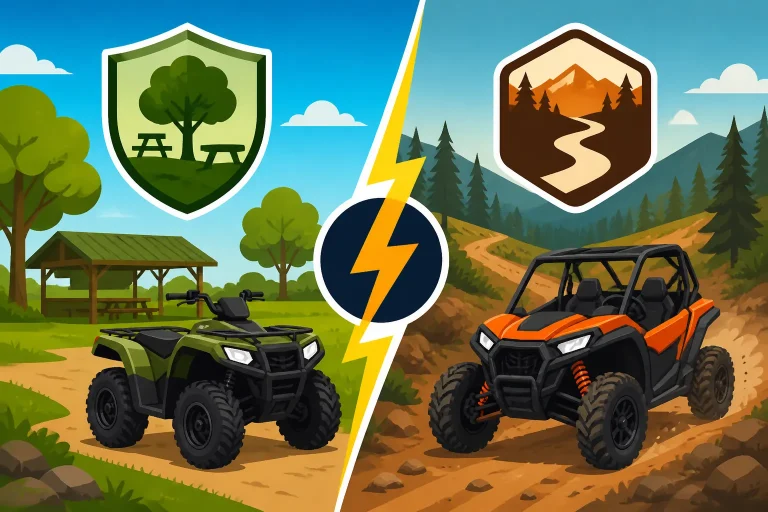
Kansas state parks do not provide a general network of OHV trails for permit holders. The state’s park-road permission and an off-road riding opportunity are two different things. That distinction is the point of The Park Permit That Covers Roads, Not Trails. If you want to spend the day riding technical or recreational trails, check a designated riding area rather than planning around a state-park road permit.
Some parks may have roads that are unsuitable for a particular machine, even if the machine is otherwise eligible. A narrow route, steep grade, loose surface, or traffic pattern can make a road impractical or restricted. Ask the park office about your vehicle and intended route, not just whether “ATVs” or “UTVs” are allowed in general.
State parks are different from other public land
A state park permit does not automatically extend to every nearby public area. Corps of Engineers recreation land, wildlife areas, refuges, and other public properties can have separate rules. Some designated riding areas do not require the state park permit because they are governed by a different agency or have their own access system. For example, Why Corps Riding Areas Need No Park Permit explains why a state park permit and a Corps riding area are not interchangeable.
The same caution applies to state wildlife or hunting land. A hunting license, a park permit, or permission to use a road does not necessarily authorize recreational riding across that property. Check the rules for the specific land unit and stay within areas open to machines. Kansas KDWP Land Rules for Machines can help distinguish permitted road access from general off-road use.
Private parks set their own terms, too. A state permit does not replace a day pass, waiver, required safety equipment, or a private park’s rules about passengers and age. Before hauling a machine to a private facility, contact that park directly.
It does not make the machine street legal
A state park permit is not a city tag and does not make a machine legal on public roads. Road use depends on the vehicle class, the road, and the applicable state and local rules. Some Kansas cities authorize certain types of machines on selected streets under local ordinances, while other places do not. The state park permit does not substitute for that local approval.
If your plan includes driving from a campground to a restaurant or taking a public road between park areas, verify the road rules separately. Start with Kansas UTV Street Legal Rules by City or, for an ATV, Can You Drive an ATV on the Road in Kansas?. Do not assume that a park gate or a permit sticker means the machine can use the public road outside the park.
Buying the permit and confirming the current fee
The permit is sold through state park offices rather than as a general statewide trail pass. That matters if you plan to arrive outside normal office hours or at a location where you expect to ride soon after arrival. Do not assume you can buy it at any store, through an unrelated online marketplace, or from a private riding park. Confirm the current purchase process with the park office before leaving home.
The $52.50 amount is the figure associated with this permit, but permit fees and procedures can change. Confirm the current cost, the accepted payment methods, and any requirements directly with the official park office before budgeting or traveling. For details on where and how the permit is handled, see Why This Permit Is Sold Only at Park Offices and How to Buy a Kansas Park Permit.
When you call, give the staff more detail than simply saying “I have a UTV.” Ask whether the specific vehicle is eligible and whether your planned use is allowed. Helpful information includes:
- The machine’s make and model
- Whether it has handlebars or a steering wheel
- Its seating arrangement and number of passengers
- Its width and unladen weight, if known
- The park you intend to visit
- Whether you plan to use park roads, reach a campsite, or access a particular facility
- The dates and approximate arrival time
These details help avoid a mismatch between the vehicle category and the permit you are asking about. Some vehicles that look similar to a UTV can fall into different legal classes. Why the Manufacturer Decides Your Title Class explains why a machine’s original design can matter, while Choosing the Right Class on a Form is useful when the category is not obvious.
Before paying, ask whether the permit applies to the particular machine or to some other aspect of the trip, and whether there are display or documentation requirements. Do not guess about where a decal or permit document should go. The park can tell you how it wants proof shown or carried.
Also ask whether a separate vehicle entrance permit, camping permit, or other park charge applies to your visit. The unconventional vehicle permit should not be treated as an all-purpose park admission or camping pass. Different charges serve different purposes, and the details can depend on the park and the kind of visit. Kansas Park Entrance Permits and What They Cover offers a useful overview of that distinction.
If you need to show the permit during the trip, keep the paperwork protected from rain, mud, and dust. A simple waterproof document sleeve can help; if you order one through Amazon, check that it is large enough for the permit and any supporting documents. That is a convenience, not a permit requirement, so follow the park’s instructions about the official form of proof.
Visitors from other states and permit reciprocity
Visitors should not assume an out-of-state sticker, registration, or trail pass replaces Kansas’s park permit. Kansas does not generally treat another state’s OHV sticker as a universal pass for Kansas state parks. The key question is not only whether the machine is registered at home, but whether the Kansas destination requires its own permit and allows that vehicle in the intended area.
The safest approach is to treat the park’s local rules as controlling for use inside that park. Call before you travel and explain where the machine is registered, what kind of machine it is, and what you plan to do. If you are coming from a neighboring state, these guides may help with the broader issue of riding in Kansas: Kansas Visitors From Missouri, Kansas Visitors From Nebraska, Kansas Visitors From Oklahoma, and Kansas Visitors From Colorado.
Be especially careful not to confuse reciprocity with road legality. Even if an out-of-state registration is recognized for some purpose, it does not necessarily authorize the machine on Kansas city streets, county roads, or state highways. A park permit does not settle those road-use questions either. Confirm both the destination rules and any public-road rules on your route.
For a visitor whose only plan is to ride at a private park, ask that park whether it requires proof of ownership, insurance, a waiver, or a state permit. Each facility can set its own entry conditions. A state park permit may not be relevant to that visit at all.
If you plan to use multiple kinds of land on the same trip, make a short list of each stop and verify them one by one. A state park, a Corps riding area, private property, and a private off-road park may all have different requirements, even when they are close together. A permit bought for one destination does not carry over automatically to the next.
Before you head to the park
A quick check before loading can prevent the most frustrating outcome: arriving with the right machine but the wrong expectation. Confirm the current fee and purchase location, then ask the park about vehicle eligibility, allowed roads, operating hours, and any local restrictions. If your planned use includes riding trails, verify that the destination actually has trails open to your kind of machine.
Use this checklist:
- Identify your machine accurately. Record its model, seating arrangement, steering type, and other basic details. If you are unsure of its legal class, use How Kansas Law Defines a Nonhighway Vehicle as a starting point.
- Choose the exact destination. “A state park near the lake” is not specific enough. Call the park you will visit.
- Describe your intended route. Ask about the roads or facilities you hope to reach, and whether your machine may use them.
- Confirm the current permit process. Check the current fee, where to buy it, payment options, and what proof you need to carry or display.
- Check operating hours and closures. Park-road access may be limited by operating hours, signs, maintenance, or temporary restrictions. Confirm the park’s current schedule rather than assuming you can ride after dark.
- Separate park use from public-road use. If your route leaves the park, check the road and city rules independently.
- Plan for the correct kind of riding. If you want an off-road trail, find a designated riding area and check that area’s own rules.
A paper map can be useful when cell service is weak or you need to compare the park’s posted roads with your planned route. If you order a map sleeve or a compact field map through Amazon, choose something that can handle rain and can be read without taking your attention away from riding. Keep navigation decisions to stops, not while operating the machine.
Visibility and document protection are separate from the permit, but they can make a park trip smoother. For instance, a durable document pouch bought through Amazon can keep registration or ownership paperwork from getting soaked in a utility compartment. Reflective material or a high-visibility vest ordered through Amazon may also be useful when loading or unloading near other vehicles, though the park’s actual equipment rules still control.
Pack the papers and items that answer likely questions: the permit or proof of purchase, ownership documents if you have them, the park’s contact information, and any relevant equipment required by the destination. Do not treat a phone screenshot, an out-of-state sticker, or a purchase receipt as a substitute for whatever proof the park specifically requests.
If the office is closed when you arrive, do not assume you can use the roads first and sort out the permit later. Contact the park before the trip to ask how after-hours arrivals are handled. Similarly, if weather or a closure changes your route, ask staff whether an alternate road is allowed. A permit gives no special authority to bypass a closure or ignore a posted restriction.
For a broader look at the limits of this permit, Kansas Park Permit vs Trail Permit is helpful. The short version is that the permit is a narrow tool for a particular kind of park use. It is not a statewide trail pass, not a road registration, and not permission to ride anywhere that looks open.
Disclaimer
This article is for general informational purposes only and does not constitute professional advice. Laws, prices and regulations vary by location and change over time. Consult a qualified professional for guidance on your specific situation.