Kansas Visitors From Nebraska
A Nebraska registration sticker or permit does not automatically authorize every kind of riding in Kansas. The useful distinction is that Kansas has no statewide OHV trail sticker for visitors to buy, while individual parks, landowners and local road rules can still set limits. Here’s how to check what applies before you cross the border with an ATV or UTV.
What Nebraska visitors need to know about Kansas permits
Kansas does not require an out-of-state rider to buy a general statewide OHV sticker to ride. It also does not have a statewide trail-pass system that accepts Nebraska’s permit in its place. In practical terms, there is no Kansas trail sticker for your Nebraska sticker to substitute for. See Kansas Has No State OHV Permit, Kansas Requires No Sticker of Visitors and Kansas Honors No Other State Sticker.
That does not mean you can ride anywhere without a permit. The place you plan to ride matters more than your state of residence. A Kansas state park, Corps recreation area, private riding park or privately owned field may each have different access rules. A required park permit or private-park pass is specific to that location; it is not a statewide sticker.
| Where you plan to ride | What to check before unloading |
|---|---|
| Kansas state park | Whether a current unconventional-vehicle permit applies to using park roads, and where machines may travel |
| Corps riding area | Whether the specific area is open to your machine and what local rules apply |
| Private off-road park | Admission, waiver, machine and passenger rules, hours, and any required equipment |
| Private land | The owner’s permission and any conditions they set |
| Public road or street | Whether that road is open to your machine under state and local rules |
A permit for one place does not grant access to another. A state park permit, for example, is not a pass for private trails. A private park’s day pass does not make a machine legal on a city street. The same principle applies to paperwork from Nebraska: it may help establish ownership or compliance with Nebraska rules, but it does not replace Kansas location-specific requirements.
Kansas’s state-park unconventional-vehicle permit is also easy to misunderstand. It is associated with operating an unconventional vehicle in the relevant park setting, not with a network of state OHV trails. Kansas does not run a statewide system of public OHV trails, and a park-road permit should not be treated as trail access. Check Kansas Unconventional Vehicle Park Permits and The Park Permit That Covers Roads, Not Trails before planning a ride at a state park. Ask the park office whether the permit applies to your machine and planned route, and confirm where riding is allowed.
If you are visiting a Corps recreation area, do not assume the state park permit applies. Areas such as Tuttle Creek and other Corps-managed locations have their own access arrangements. Start with Kansas Corps of Engineers Riding Areas, then confirm the status and rules for the specific area before towing there.
Private parks are a separate category again. They set their own entry procedures and may require a waiver, a pass, or compliance with park-specific rules on helmets, passengers, age, noise and equipment. Check Kansas Private Off-Road Parks and contact the park directly if a detail could affect your trip.
Match your paperwork to the place you are riding
Before leaving Nebraska, make a short plan for each riding day. Identify the exact destination, find out who manages it, and ask what is required for your machine. “We’re riding in Kansas” is not enough information to determine whether a permit or pass is needed.
A practical check looks like this:
- Name the riding area. Get the park or property name, not just the nearest town or lake.
- Identify the manager. It may be a state park, Corps recreation area, private operator, city or landowner.
- Ask about access for your machine. Describe whether you are bringing an ATV, side-by-side, dirt bike or another vehicle. Rules can differ by machine type.
- Confirm the permit or pass. Ask whether it is required, where it can be obtained, and whether it covers your intended use.
- Check route limits. Ask where you may ride, where you may park or unload, and whether trails or roads are open.
- Bring ownership documents. Keep paperwork that helps identify the machine and show your connection to it.
- Recheck close to departure. Closures, operating hours and park procedures can change.
Ownership paperwork is worth carrying even when Kansas does not require a statewide riding sticker. A Nebraska title, registration document or bill of sale may help answer questions about who owns the machine, especially if its identity or ownership is unclear. It is not a permit to ride on a closed trail or another person’s land. For more on documents, see Kansas Proof of Ownership on the Trail and Kansas Rules for an Out-of-State Machine.
Make sure the vehicle identification number is readable and matches your papers. If the machine was recently purchased, keep the bill of sale and any title or manufacturer paperwork together. If you are carrying a photocopy or digital copy, consider keeping the originals safely secured as well, particularly when the paperwork is difficult to replace.
Do not assume a Nebraska registration decal is required in Kansas just because it is displayed on the machine. Nor should you assume that displaying it gives you extra Kansas access. Kansas’s lack of a statewide OHV permit means there is no Kansas trail sticker requirement for a visitor, but each riding area can still require its own pass or proof of permission.
Where Nebraska riders can ride and what to verify
Kansas riding options are spread across different kinds of land, so destination research is essential. Public recreation areas, private parks and private land are not interchangeable. Some locations may be intended for off-road use; others may permit only limited vehicle access on designated roads or parking areas.
At a state park, ask whether the unconventional-vehicle permit is needed for your planned use and whether the park allows your type of machine on the route you intend to take. Do not interpret permission to use a park road as permission to ride cross-country or on a hiking trail. Rules may restrict machines to designated roads and parking areas, and posted signs or staff instructions can limit access further.
At a Corps area, check the exact riding location rather than relying on a general statement that the lake or recreation area is open. Some areas may have designated riding spaces while other land nearby does not allow off-road vehicle use. Confirm where to unload, which vehicles are allowed, and whether hours or seasonal restrictions apply. Kansas Trail Conditions Before You Tow can help you build a final check into your travel plan.
At a private park, read the operator’s rules before paying or signing a waiver. Confirm that your machine fits the park’s size or equipment limits, whether passengers are allowed, and whether children need to meet an age or supervision requirement. Check whether the pass is for the rider, the vehicle, or both. A park can also close a route or restrict riding conditions even when you have already made the trip.
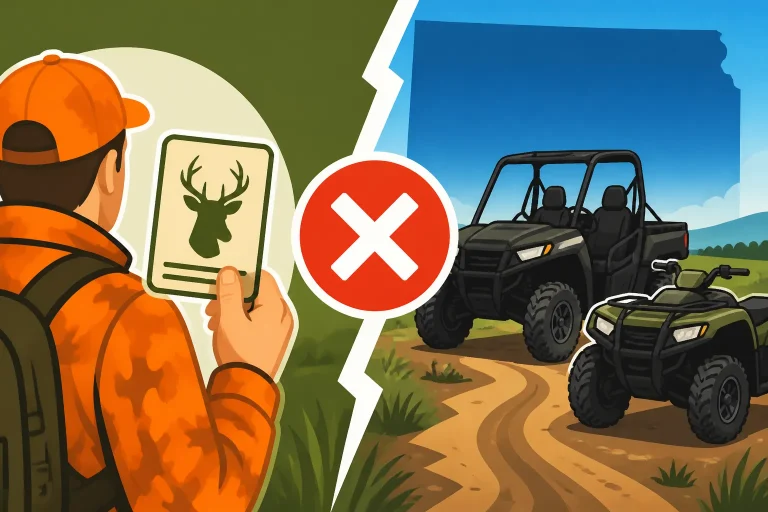
Private farmland and hunting property require a different approach: get permission from the person who controls the land. Do not infer permission from an open gate, an existing track, or the fact that a field borders a public road. Ask about boundaries, livestock, gates, noise and where the machine may be driven. Permission to cross one parcel does not establish permission to ride another.
Road use is its own question. A title, registration, insurance policy or park pass does not by itself make an ATV or UTV street legal. Kansas road rules can depend on the machine’s classification, the type of road and whether a local ordinance allows use. A city’s rules may differ from those of a nearby rural area. If you are planning to ride beyond a trailhead or private property, read Kansas UTV Street Legal Rules by City and Can You Drive an ATV on the Road in Kansas? before setting out.
A common planning mistake is to treat the trip as one continuous ride from a campsite, cabin or parking area to a trail. The connecting road may not be open to your machine, even if the destination itself allows off-road riding. Load the ATV or UTV for any connection that is not clearly authorized, and ask the property manager about access between the place you are staying and the riding area.
A simple pre-trip checklist for Nebraska visitors
Use this checklist when you are organizing a Kansas ride:
- Confirm the destination and land manager. Do not rely only on a map pin or a general area name.
- Ask whether a permit applies. Kansas has no statewide OHV sticker, but a particular park or riding facility may require its own permit or pass.
- Check where the permit allows you to go. Park-road access is not the same as trail access.
- Verify machine eligibility. Ask about width, vehicle type, passengers and any equipment rules.
- Review current hours and closures. A place that normally allows riding may have a temporary closure or seasonal limit.
- Carry useful ownership documents. Keep the machine’s identifying information and available title, registration or purchase papers together.
- Get permission for private land. Secure clear permission before riding, and follow any conditions set by the landowner.
- Keep road use separate from trail use. Check local ordinances and applicable state rules before riding on streets or roads.
- Save the manager’s contact details. If you arrive and a gate is closed or signs conflict with your plan, contact the responsible office rather than guessing.
For a visitor from Nebraska, the simplest answer is: you generally do not need to purchase a Kansas statewide OHV trail sticker, because Kansas does not have one. But that answer is only about a statewide sticker. It does not settle whether a particular park requires a permit, whether a private operator charges for entry, whether a landowner has granted access, or whether a road is open to your vehicle.
Treat the riding destination as the source of its own access rules. Verify those rules before loading the trailer, carry paperwork that can help identify your machine, and do not use a Nebraska sticker or a Kansas park pass as a substitute for permission to ride somewhere else.
Disclaimer
This article is for general informational purposes only and does not constitute professional advice. Laws, prices and regulations vary by location and change over time. Consult a qualified professional for guidance on your specific situation.