Kansas Sunset to Sunrise Lighting Rules
It's happened to all of us who love to ride out here in the Sunflower State: you're having a fantastic day out on the trails or tending to chores on the back forty, and suddenly, the sun starts to dip below the horizon. That golden hour turns into dusk, and before you know it, it's pitch black. Then the panic sets in: Can I even be out here right now? Do I have the right lights? Am I going to get a ticket just for trying to get back to the barn? Navigating Kansas law around riding your ATV or UTV after sunset can feel like trying to find your way through a corn maze in the dark. This guide is here to shine a light on the specific lighting requirements and legalities for operating your machine in Kansas from sunset to sunrise, helping you understand when and how you can legally ride after dark without running afoul of the law.
The General Ban on Road Use After Dark
Kansas law, for the most part, takes a pretty firm stance when it comes to operating off-road machines on public roads, especially after dark. The default position is that ATVs and UTVs are not street legal, and that blanket ban becomes even more rigid when visibility is low. It’s not just about what lights you have; it’s about the underlying legal framework that classifies these machines as non-highway vehicles in the first place.
Why Kansas Law Restricts Night Riding
The primary reason for the strict restrictions on night riding on public roads boils down to safety, plain and simple. ATVs and most UTVs, by their very design, aren't built to share the road with cars and trucks, particularly when it's dark. They often lack the comprehensive lighting, turn signals, mirrors, and other safety features required of on-road vehicles. Imagine a sedan driver coming around a blind curve on a rural Kansas highway after dark, only to encounter a small, dimly lit ATV. The risk of a serious accident skyrockets.
Kansas statutes, like those found in [Kansas ATV Road Rules Under 8-15,100], are designed to prevent these kinds of dangerous situations. They acknowledge that while these machines are incredibly useful and fun for their intended purposes, those purposes generally don't include navigating busy public thoroughfares, especially not when the sun goes down. The law wants to minimize the chance of a collision where a rider, or anyone else on the road, could be seriously injured. The default position is protection, and that means keeping ATVs off the asphalt when it's dark.
The Importance of Visibility
Visibility isn't just a suggestion when you're operating any vehicle; it's a fundamental safety requirement. For ATVs and UTVs, which are generally smaller and less conspicuous than passenger vehicles, visibility becomes even more critical after dark. A small ATV with inadequate lighting can easily blend into the shadows on a dark county road, making it virtually invisible to oncoming traffic or vehicles approaching from behind.
This isn't just about seeing where you're going; it's about being seen. Other drivers need to clearly understand that you're there, what direction you're traveling, and what your intentions are. Poor visibility can lead to misjudgments, last-minute swerving, or worse. Even if you're riding cautiously, an unseen machine is a recipe for disaster. This is why, even in the limited scenarios where night riding on public roads is permitted, Kansas law is very specific about the type and quality of lighting required. It's all about ensuring that your machine stands out, rather than disappearing, into the night.
When Night Riding IS Allowed: Specific Exceptions and Local Ordinances
While the general rule is to keep your off-road machine off public roads after dark, Kansas law does provide some crucial exceptions. These exceptions are typically tied to specific uses or local governmental decisions, reflecting the practical needs of residents, particularly in rural areas.
Agricultural and Work-Related Exemptions
One of the most significant carve-outs in Kansas law is for agricultural purposes. Farmers and those engaged in legitimate agricultural work often need to move their ATVs and UTVs between fields, across property, or to access equipment, sometimes long after the sun has set. Kansas recognizes this necessity. For instance, if you're using your machine for tasks directly related to farming, ranching, or other agricultural operations, you may be permitted to operate on public roads, including after sunset.
This isn't a free pass for joyriding, though. The machine must be used for a legitimate purpose, such as checking cattle, hauling feed, or accessing leased hunting ground as part of a ranching operation. The law makes allowances for [Kansas Agricultural Trips on a 65 mph Road], even if that road is a state highway, provided certain conditions are met and you stay as near to the right as practicable. While the statute doesn't explicitly state "lights on" for every agricultural use after dark, common sense and the spirit of the law dictate that if you are on a public road, even for agriculture, you need to be highly visible. Think of it as a safety blanket over the legal allowance – the allowance is there, but you must still operate safely and predictably, which includes adequate lighting.
City-Specific Ordinances for UTVs
Here's where things can get a bit more localized and, frankly, confusing. While the state of Kansas generally prohibits ATVs and most UTVs on public roads, it gives cities and counties the power to create their own ordinances to allow certain types of UTVs on their local streets. These are the [Kansas Cities That Authorize ATV Street Use], and they often come with very specific rules, including strict lighting requirements for night operation.
If your city, like Louisburg or Scott City, has an ordinance that permits UTVs on certain streets, that ordinance will almost certainly include detailed provisions for lighting when riding after dark. These typically mimic those of other motor vehicles, requiring proper headlights, taillights, brake lights, and sometimes even turn signals. For instance, Louisburg's ordinance, like many others, specifies that UTVs must have all the standard equipment, which of course includes a robust lighting system for sunset to sunrise operation. It's absolutely critical to check with your specific city hall or municipal clerk's office for their local rules, as they can vary wildly from one town to the next. What's legal in Andover might not be in De Soto, and what works during the day definitely won't work after dark without the right lights.
Crossing a State Highway
Sometimes, even if you’re riding legally on private land or a county road that permits your machine, you might need to briefly cross a state highway to get to another piece of property or a different section of trail. Kansas law permits [Crossing a State Highway in Kansas], but this permission still carries the implied responsibility of safety, especially when it's dark.
While the act of crossing is generally allowed, you're expected to do so safely and quickly, yielding to all traffic. If you're attempting this maneuver after sunset, you absolutely must ensure your machine has sufficient lighting to be seen by highway traffic. This means at least headlights and taillights that are clearly visible from a distance. A quick crossing doesn't exempt you from being visible; it only heightens the need for it, as you're interacting with faster-moving vehicles for a brief but critical period. Don't assume a quick dash across the pavement means you can skip the lighting; that's a dangerous gamble to take.
Lighting Requirements for Legal Night Operation
When the sun dips below the horizon, simply having some light isn't enough; you need the right kind of light, in the right places, and with the right intensity. Kansas law, especially in cases where UTVs are permitted on city streets or agricultural use requires road travel, generally aligns its lighting expectations with those of motorcycles, requiring specific functionality to ensure safety and visibility.
Headlights
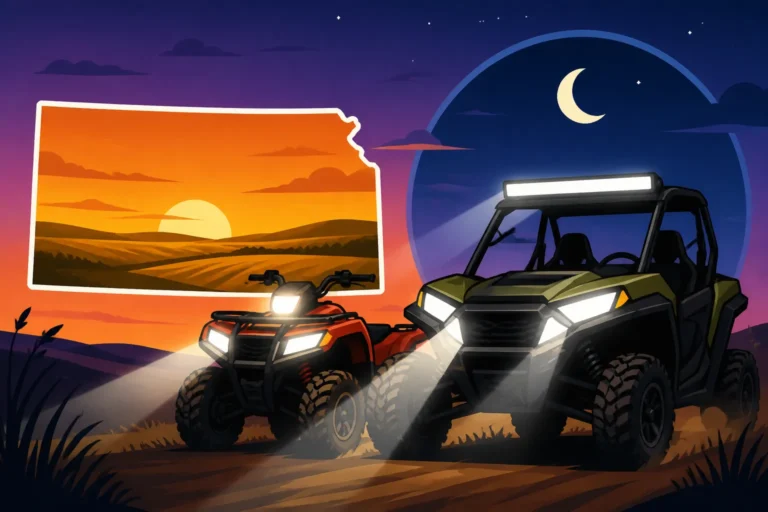
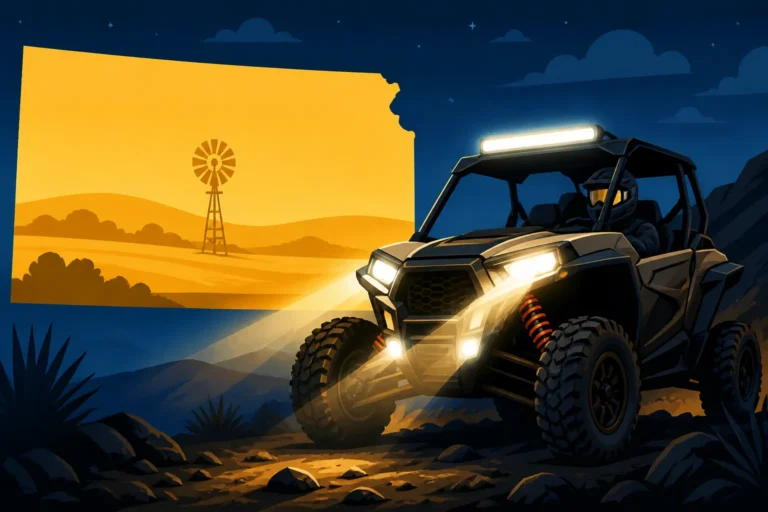
For any legal operation of an ATV or UTV on a public road after sunset, headlights are non-negotiable. Typically, Kansas law for vehicles that operate at night (and this would extend to UTVs under city ordinance or agricultural use) requires at least one, but usually two, working headlights. These headlights must be capable of illuminating the road ahead for a specified distance – often 500 feet for high beams and 200 feet for low beams, similar to [Kansas Motorcycle Lighting Standards].
The lights need to be white or amber in color, mounted at a certain height from the ground, and in good working order. They shouldn't be flickering, dim, or obscured. If you're investing in aftermarket lighting, make sure it meets these legal specifications for brightness and beam pattern. Modern LED light bars can offer incredible illumination, but ensure they are aimed properly and not blinding oncoming traffic. Many riders find that a good set of auxiliary lights from a company like SuperATV can significantly enhance their visibility and illuminate the path ahead, making night riding safer and more enjoyable, provided they are legal for road use in specific circumstances.
Taillights and Brake Lights
Just as important as seeing where you're going is being seen from behind. This is where taillights and brake lights come into play. Kansas law requires at least one red taillight that is visible from a specified distance (often 500 feet) to the rear. This taillight must be illuminated whenever your headlights are on, ensuring constant rear visibility after dark.
Equally critical are brake lights. When you apply the brakes, a red light (or lights) at the rear of your machine must illuminate, signaling to anyone behind you that you are slowing down or stopping. This is a fundamental safety feature that prevents rear-end collisions. For UTVs operating under city ordinances, these requirements are usually very explicit and mandatory. Even for agricultural use, having fully functional taillights and brake lights is a matter of common sense and prudent operation when on public roads after dark. Always check that these are clean, unbroken, and shining brightly before you venture out.
Reflectors and Other Visibility Aids
While not always explicitly defined as "lighting" in the same way as headlights and taillights, reflectors play a crucial role in passive visibility, especially if your primary lights fail or if you're parked. Kansas law often requires red reflectors on the rear of vehicles, and sometimes amber reflectors on the sides, to make them visible when illuminated by another vehicle's headlights.
Beyond the minimum legal requirements, smart riders will always go the extra mile for visibility, especially for [Lights Your Quad Needs to Ride After Sunset]. This includes adding reflective tape to the sides of their machines, wearing high-visibility clothing (bright colors, reflective vests), and even considering auxiliary lighting like amber side marker lights or lighted whips if riding in a group or in open areas like sand dunes. Products from companies like SuperATV offer a wide range of accessory lighting that, while not always required for road use, can significantly increase your presence and safety after dark on a trail or private land. The more visible you are, the safer everyone is.
Turn Signals and Horns
For most ATVs, and even many UTVs, turn signals and horns are not standard factory equipment. However, when a UTV is legally permitted to operate on city streets under a local ordinance, these items often become mandatory requirements. Many city ordinances that "opt-in" for UTVs will specify that the machine must be equipped with turn signals (front and rear, amber or red), a horn audible from a certain distance, and sometimes even side mirrors.
The logic here is that if a UTV is going to share the road with cars, it needs to communicate its intentions and warn other drivers just like a car would. Without turn signals, indicating a turn becomes ambiguous and dangerous. A horn is essential for warning pedestrians or other vehicles of your presence. If you live in a city that allows UTVs on streets after dark, you'll almost certainly need to equip your machine with these additional safety features. This is another area where aftermarket kits, often designed for street-legal conversions, can be incredibly useful.
Special Cases: Golf Carts and Work-Site Utility Vehicles (WSUVs)
Kansas law distinguishes between different types of unconventional vehicles, and these distinctions carry specific implications for lighting requirements, especially after dark. Golf carts and Work-Site Utility Vehicles (WSUVs) have their own sets of rules that are important to understand.
Golf Cart Lighting Rules
Golf carts are in a category all their own, and their permissible road use is almost entirely dictated by local city ordinances. If a city allows [Kansas Golf Cart Road Rules], those rules will include specific lighting requirements for operation between sunset and sunrise. These often include:
- Headlights: At least one, but usually two, white headlights visible from a certain distance.
- Taillights: At least one, but usually two, red taillights visible from a specified distance.
- Brake Lights: Red brake lights that illuminate when the brakes are applied.
- Turn Signals: Often required for street-legal operation, especially after dark.
- Reflectors: Red reflectors on the rear, and sometimes amber on the sides.
- Slow-Moving Vehicle Emblem: A fluorescent orange-red triangle emblem on the rear is frequently required for golf carts operating on public roads, regardless of the time of day, but becomes even more critical after dark to warn faster traffic.
Many golf carts, as they come from the factory, lack these comprehensive lighting systems. If you plan to use your golf cart on city streets after dark, you will almost certainly need to invest in a street-legal conversion kit to add the necessary lights, horn, and reflectors. Don't assume your casual evening cruise will be exempt; deputies often patrol for just these kinds of infractions.
WSUV Lighting for Road Use
Work-Site Utility Vehicles (WSUVs) are a unique class in Kansas, defined by specific width, weight, and seating requirements, among others. These machines are explicitly designed for work and are often used on job sites, farms, or industrial complexes. While their primary use isn't on public roads, Kansas law does allow for limited road use for specific purposes. When a WSUV is legally operating on a public road, especially after dark, it must meet certain visibility standards.
The specific lighting requirements for [Kansas Work-Site Utility Vehicle Road Rules] can be less explicitly detailed than for city-permitted UTVs, as their road use is usually very limited in scope and duration. However, the general principles of safe operation always apply. This means that if you are driving a WSUV on a public road between sunset and sunrise, you will need:
- Headlights: Functioning white or amber headlights to illuminate the path and make you visible from the front.
- Taillights: Functioning red taillights to make you visible from the rear.
- Brake Lights: Functioning red brake lights to signal slowing or stopping.
- Reflectors: Appropriate reflectors, particularly on the rear, to enhance passive visibility.
- Slow-Moving Vehicle Emblem: Depending on the speed rating and intended use, a slow-moving vehicle emblem might also be required or highly recommended to alert other drivers to your slower pace.
It's always best to err on the side of caution and ensure your WSUV is as visible as possible if you intend to operate it on public roads after dark. Equipping it with robust lighting, even if it exceeds the minimum, is a wise safety investment.
Consequences of Non-Compliance and Staying Safe
Ignorance of the law is rarely an excuse, especially when it comes to vehicle operation and safety. Riding your ATV or UTV on Kansas public roads after dark without proper lighting can lead to more than just a stern talking-to; it can result in significant legal and financial repercussions, not to mention putting yourself and others at serious risk.
Penalties for Riding Without Proper Lights
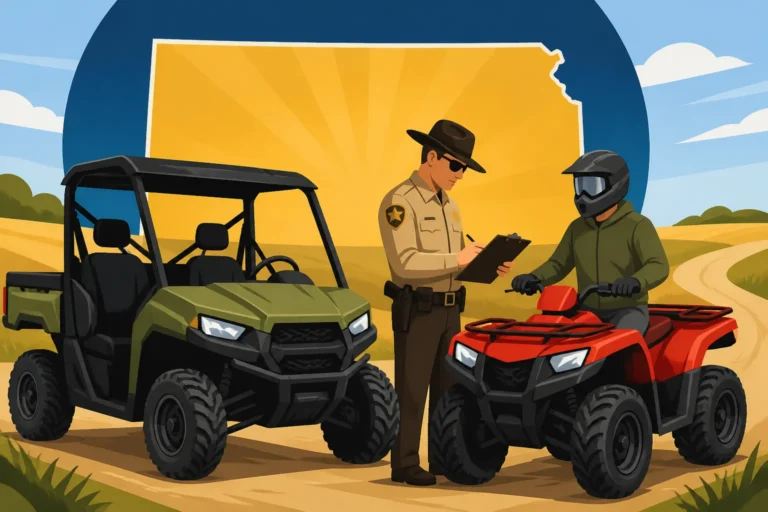
If a county sheriff or city police officer stops you for operating your ATV or UTV after sunset without the required lighting, you could be facing a citation. The specific penalties can vary, but generally, you're looking at fines and court costs. For example, a ticket for an equipment violation, which insufficient lighting falls under, can add up quickly. These fines can be compounded if you're also riding in an area where your machine isn't permitted to be on the road at all, or if you don't have a valid driver's license. [Kansas Penalties for Illegal Road Riding] can be substantial, and those costs are often just the beginning.
In some cases, especially if an officer deems your operation unsafe or you're a repeat offender, your machine could even be impounded. Imagine having your UTV towed away, then having to pay impound fees on top of the fines and court costs. It's a frustrating and expensive lesson to learn. Furthermore, if you're involved in an accident while riding illegally after dark, your liability can increase significantly, and your insurance company might even deny a claim if you were operating outside the legal parameters. What a County Sheriff Can Ask a Rider to Show on a traffic stop can absolutely include checking for functioning lights when it's dark.
Essential Safety Practices for Night Riding
Even when you have all the legally required lights, night riding inherently carries more risks than daytime riding. Low light reduces depth perception, hides obstacles, and makes it harder to judge distances. Therefore, a smart rider always goes beyond the letter of the law to adopt best safety practices.
Here are a few tips to keep yourself and others safe when operating your machine between sunset and sunrise:
- Slow Down: Your reaction time is reduced at night. Drive slower than you would during the day, giving yourself more time to see and react to hazards, whether they're potholes, wildlife, or other vehicles.
- Wear Reflective Gear: Even with bright lights on your machine, a reflective vest or helmet can make you much more visible to other drivers, particularly if their headlights hit you directly.
- Clean Your Lights: Dust, mud, and bug splatters can significantly reduce the effectiveness of your lights. Before any night ride, give all your lenses a good wipe down.
- Maintain Your Machine: Regularly check your wiring, bulbs, and battery. A dead battery or a loose connection can leave you stranded in the dark, which is a dangerous situation.
- Avoid Unknown Terrain: Stick to familiar trails or roads at night. It's much easier to get disoriented or encounter unexpected obstacles in the dark on unfamiliar ground.
- Use Auxiliary Lighting Wisely: While not always legal on public roads, high-quality aftermarket LED light bars or spot lights from a brand like SuperATV can be a huge asset for illuminating private trails or work areas. Just be mindful of local regulations and other drivers if you’re momentarily on a road. Turn them off or dim them when around others to avoid blinding them.
- Ride with a Buddy: There's safety in numbers. If something goes wrong, having another person with you can be a lifesaver.
- Inform Someone of Your Route: Let someone know where you're going and when you expect to return. This is a good practice for any ride, but especially for night excursions.
By combining legal compliance with these common-sense safety measures, you can dramatically reduce the risks associated with riding your ATV or UTV after dark in Kansas, ensuring you get home safely after a productive or enjoyable evening.
Disclaimer
This article is for general informational purposes only and does not constitute professional advice. Laws, prices and regulations vary by location and change over time. Consult a qualified professional for guidance on your specific situation.