Kansas Rules for a Ten-Year-Old Rider
A ten-year-old may be able to ride an ATV in Kansas, but age alone does not settle what is allowed. The answer depends on where the child rides, the machine, and the rules of the property or park. This guide explains the practical distinctions, including road limits, helmets, passengers, and ways to reduce risk.
What Kansas rules mean for a ten-year-old
Kansas does not have a general minimum age that automatically bars a ten-year-old from riding an ATV off-road. That does not mean every child can ride every machine anywhere. The machine’s design, the riding location, property rules, and the child’s ability to control it all matter.
For ordinary off-road riding, a child does not need a driver’s license just because they are operating an ATV on private land. Kansas also does not require a state safety course as a general condition of off-road riding. Those points are not permission to ride on public roads, and they do not override a landowner’s or riding park’s rules. See Kansas ATV Age Requirements and Kansas Safety Course Options for related details.
Start by identifying the type of machine. A small youth quad, a full-size ATV, and a side-by-side are not interchangeable just because they are all used off-road. Controls, weight, speed, passenger capacity, and visibility can be very different. A ten-year-old who can manage one youth ATV may not be able to brake, steer, or recover a heavier machine.
| Where the child rides | What to check first | Practical rule of thumb |
|---|---|---|
| Private land | Owner permission, terrain, machine fit, supervision | Ride only with permission and away from public traffic |
| Private riding park | Minimum age, machine limits, helmet and passenger rules | Check the park’s current rules before unloading |
| Public park or wildlife land | Permit conditions, designated roads, posted restrictions | A permit does not automatically open trails to ATV riding |
| Public road | Road restrictions, local ordinance, driver requirements | Do not assume a ten-year-old may ride on a road or street |
A separate article explains Kansas Rules for a Teen Rider, while Kansas Rules for a Child Passenger covers a child riding as a passenger rather than operating the machine.
Where a ten-year-old can ride
Private property
Private land is often the simplest setting for a child’s first rides, but the child still needs permission from the property owner. A family member’s land is not automatically an open riding area if the property is leased, shared, or subject to restrictions. Posted signs and direct instructions matter. For more on access, see Kansas Rules for Riding Farm Ground.
Keep the riding area away from roads, public rights-of-way, livestock, water hazards, and machinery in use. A farm track may look quiet, but it can connect to a public road, cross a work area, or be used by trucks. Set clear boundaries before the child starts, and explain where riding is not allowed.
Private riding parks
A private park may set a minimum age for operating particular machines, require helmets, restrict passengers, or require an adult to stay nearby. These are park rules, not a statewide age threshold, and they can differ between properties. Check directly with the park before making the trip. The park’s rules may apply even if the child is riding with a parent. See [Kansas Private Park Minimum Ages] and Kansas Private Park Helmet Rules.
Also check whether the park allows the specific machine. Some areas restrict vehicle width or limit which types of machines can use a trail. A ten-year-old’s youth quad may be allowed where a wider side-by-side is not, or the reverse may apply under a park’s own policy. Do not rely on a trail description from an old post or an assumption based on the machine’s size.
Public land and roads
Kansas does not offer a general state trail pass that makes public land open for ATV trail riding. Rules depend on the land manager and the specific area. Where an unconventional vehicle permit applies, it may allow use of designated park roads rather than unrestricted trail riding. Check the site’s current rules and signs before riding. Kansas Park Permit vs Trail Permit explains why those permissions are not the same thing.
Public roads are a different matter from private trails. Kansas generally restricts ATV use on public highways, with limited exceptions. A ten-year-old should not be treated as eligible to ride on a road just because a nearby city or county allows some off-road machines in certain circumstances. The rules can depend on the machine, road, local ordinance, and required operator qualifications. See Kansas Rules for Riding a City Street and Kansas Rules for Crossing a Highway before planning any road use.
A child who is too young to meet an applicable driver requirement cannot rely on a parent following behind as a substitute. Keep the ride off public roads unless the exact situation is clearly allowed under current law and local rules.
Choosing a machine and setting safety rules
A legal ride can still be a poor match for the rider. Choose the machine by the child’s size, coordination, strength, and demonstrated ability—not just the child’s age or the label on the seat. The child needs to reach and operate the controls comfortably, steer without straining, brake effectively, and get on and off without help that would be needed in an emergency.
Follow the manufacturer’s instructions for the intended rider and machine. Do not increase speed or move a child onto a larger machine just because they have completed a few easy rides. A larger ATV can be difficult to stop or turn, and a machine that feels manageable on flat ground may become hard to control on a slope, in mud, or around ruts.
A practical readiness check includes whether the child can:
- Explain the throttle, brakes, and shutoff control.
- Start, stop, and turn at low speed under supervision.
- Keep both hands on the controls and both feet in the intended positions.
- Stop when told, without continuing toward a hazard.
- Identify the riding boundary and return to the adult if unsure.
If any of those tasks are unreliable, delay the ride or choose a more appropriate machine and simpler terrain. A safety course can still be useful even when it is not a statewide requirement. Kansas Online Safety Courses offers a place to start.
Helmets and protective gear
Kansas’s motorcycle helmet rules do not automatically make every ATV rider subject to the same helmet requirement. Still, a properly fitted helmet is an important safety measure for a ten-year-old. A private park may also require one, so check the park’s policy. See Does Kansas Have an ATV Helmet Law at All? for the legal distinction.
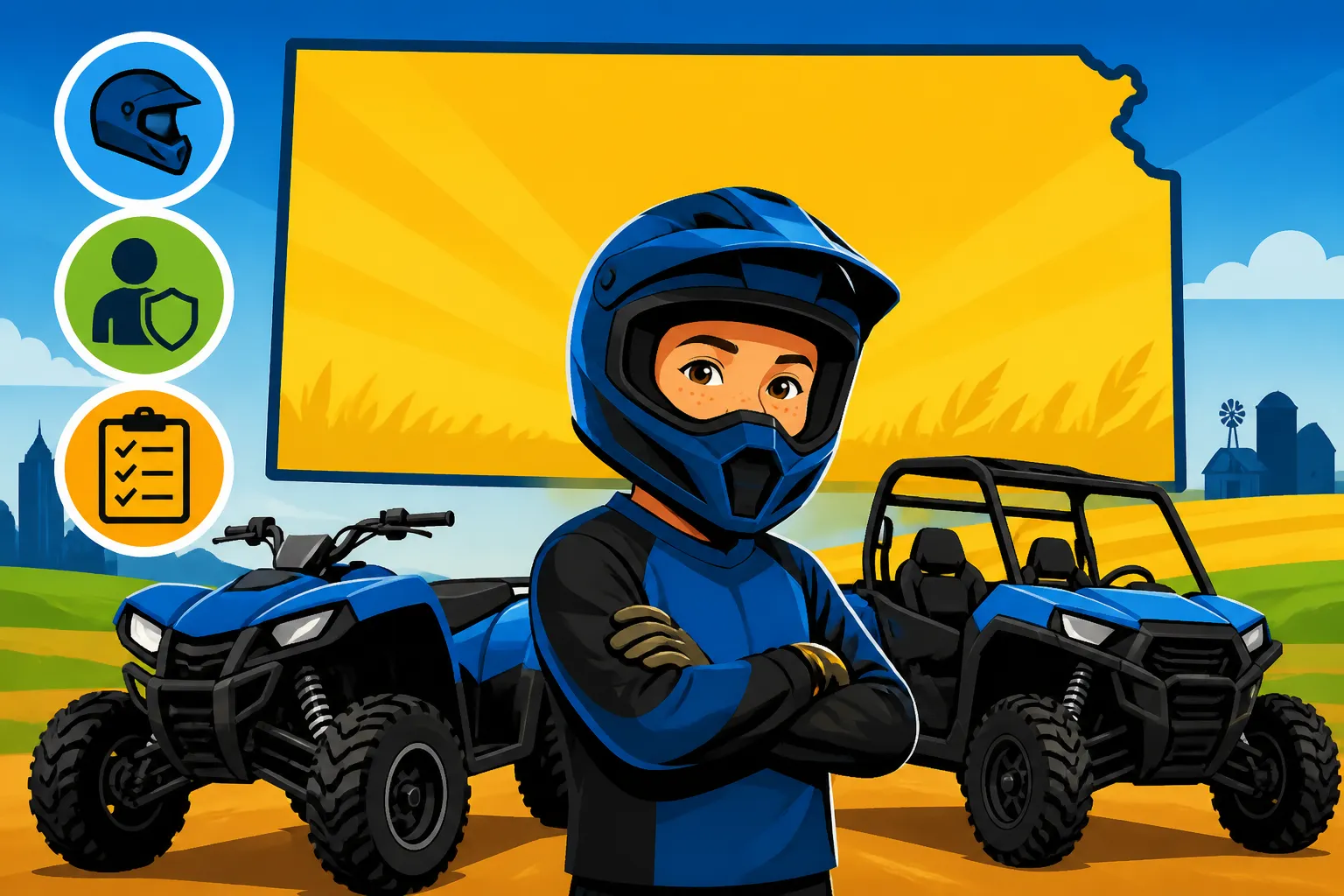
Choose a helmet intended for off-road riding, make sure it fits securely, and replace it after a significant impact or when the manufacturer’s guidance says it should be replaced. Eye protection helps keep dust and debris out. Long sleeves, long pants, gloves, and sturdy over-the-ankle footwear can help protect against scrapes, hot parts, and flying material.
When shopping on Amazon or elsewhere, check the product’s certification information and sizing guidance rather than relying only on a listing title or appearance. A helmet that slides, lifts, or pinches is not a good fit. Make sure the child can fasten the strap and that an adult checks it before each ride.
Supervision and riding conditions
Keep a responsible adult close enough to see and respond. Supervision is not simply being somewhere on the property; the adult should be able to intervene quickly and should not be distracted by another task. For a beginner, use a predictable, open area and short sessions. Avoid riding near other vehicles, steep slopes, loose gravel, deep water, and areas where a small rider may be hard to see.
Set a few rules before the engine starts:
- Ride only in the agreed area and at a controlled speed.
- Stop if the adult signals, if the machine behaves unusually, or if the child feels unsure.
- Do not ride near another machine unless the adult has planned the route and spacing.
- Do not carry a passenger unless the machine is designed and equipped for one and the park or property rules allow it.
- Do not ride when tired, upset, or unable to focus.
A single-seat ATV is for one rider. Carrying a second child on it changes how the machine handles and can put both riders at risk. A side-by-side has different passenger considerations, but its seat belts, seating positions, and manufacturer limits still need to be followed. A child’s ability to sit in a seat does not by itself make the machine suitable for them to operate.
A simple pre-ride check for parents
Before each outing, confirm the permission and conditions that apply that day. A private property may have new work underway, a park may change access rules, and weather can make a familiar route unsafe. Take a moment to check the machine as well as the riding area.
Use this checklist:
- Permission: The owner or park allows this child and this machine to ride.
- Location: The route stays off public roads unless the exact road use is permitted.
- Machine fit: The child can reach and operate the controls, and the machine is suitable for the rider.
- Condition: Tires, brakes, throttle, steering, and shutoff work as intended.
- Protection: Helmet and other protective gear fit and are in good condition.
- Passengers: The machine is designed for the number of riders, and passenger rules are met.
- Supervision: An adult can see the child and respond immediately.
- Boundaries: The child knows where to ride, where not to go, and how to stop.
If the child is riding at a public facility, confirm whether the site requires proof of ownership, a permit, or other documents. Kansas Proof of Ownership on the Trail explains one document question that can come up. Do not assume that a title or permit grants permission to ride anywhere; it proves or authorizes only what its rules cover.
Keep the first ride short and slow. Ask the child to demonstrate stopping and turning before going farther, and stop if control or attention slips. If a machine feels too large, the terrain is more demanding than expected, or the child cannot follow instructions consistently, choose another day or a better-matched setup. The most useful rule is simple: permission, machine fit, and close supervision all need to be in place before the child rides.
Disclaimer
This article is for general informational purposes only and does not constitute professional advice. Laws, prices and regulations vary by location and change over time. Consult a qualified professional for guidance on your specific situation.