Kansas Has No OHV Registration
The world of off-road vehicles can feel like a tangled mess of rules, and for folks in Kansas, the biggest head-scratcher often revolves around whether your ATV or UTV needs to be registered. You hear about other states requiring annual stickers, plates, and all sorts of hoops to jump through, and it's easy to assume Kansas is the same. But here's the plain truth: if you're riding an ATV or a standard UTV in Kansas, you won't find yourself dealing with an annual registration like you would for a car or even a motorcycle. This guide is here to untangle that confusion, explaining why Kansas operates differently and what paperwork you do need to handle for your machine.
Understanding Kansas's Unique Approach to Off-Highway Vehicles
When you first dive into the world of ATVs and UTVs in Kansas, the absence of an "OHV registration" can be downright baffling. Many new riders, or even seasoned ones moving in from other states, expect to get a license plate or an annual sticker for their quad or side-by-side. It’s a common assumption because so many other vehicles on the road – and even off-road machines in neighboring states – require some form of registration. But Kansas has carved out its own path, creating a system that prioritizes proof of ownership over annual road-use registration for most off-highway vehicles. This distinct approach often leaves owners scratching their heads, wondering if they're missing something crucial. The key is to understand that while registration might be absent, a vital piece of paperwork is absolutely mandatory: the title.
The Core Distinction: No Registration, But Titling is Key
Let's cut right to it: Kansas doesn't require annual registration for your ATV, dirt bike, or most UTVs. That means you won't be heading to the county treasurer's office every year to renew a tag, pay a yearly fee, and slap a sticker on your machine. This is a huge relief for many owners who just want to ride on private land or designated off-road parks without the bureaucracy of yearly renewals. However, this lack of registration does not mean your machine is exempt from all paperwork. Far from it, in fact.
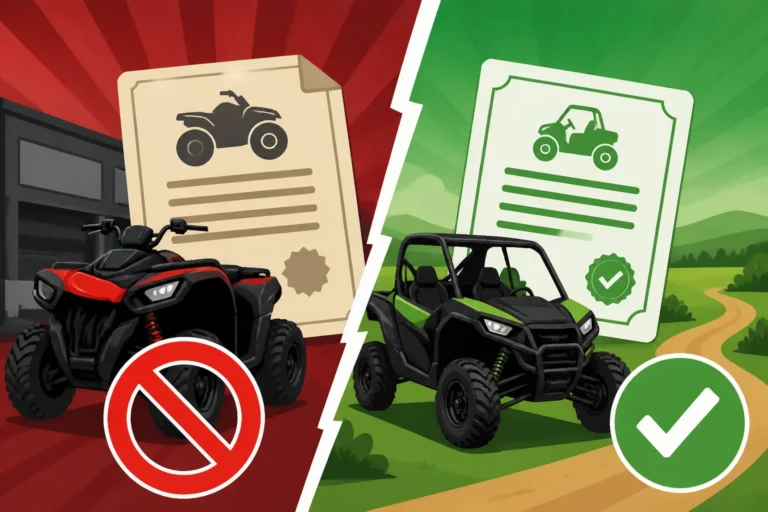
The state focuses intently on proper ownership documentation. Instead of registration, Kansas mandates that nearly every off-highway vehicle be issued a "nonhighway title." Think of this as the birth certificate and ownership deed for your machine. It's proof that you legally own it, much like a car title proves ownership of your family sedan. This title is a one-time process when you first acquire the machine (or when you bring it into the state), and it’s critical for establishing a clear chain of ownership, deterring theft, and facilitating future sales. Many people incorrectly assume that because there's no registration, there's no paperwork at all, leading to confusion when they try to sell a machine or have it inspected. Understanding this fundamental difference between "registration" (an annual road-use permit) and "titling" (proof of ownership) is the first step to being a compliant off-road enthusiast in Kansas. For a deeper dive into what this means, you can look at [Kansas Titles ATVs as Nonhighway Vehicles] and learn more about Kansas Has No OHV Registration.
Why Kansas Skips Annual Tags for Off-Road Machines
So, why the departure from the norm? Why does Kansas say no to annual tags for ATVs and UTVs? The primary reason lies in how the state categorizes these machines. For the most part, Kansas law views ATVs and UTVs as machines designed and intended for off-highway use. Unlike passenger cars or trucks, they are generally not meant for routine travel on public roads and highways. Annual registration and tags are typically tied to road-legal status and often fund state road maintenance and other vehicle-related services. Since most off-road machines don't contribute to the wear and tear on public roads in the same way, the state has opted for a different system.
The state essentially provides a blanket exemption from traditional registration for off-highway vehicles. This saves owners the hassle and expense of yearly renewals for machines that might only see limited use or never leave private property. It's a pragmatic approach that recognizes the specific utility of these vehicles. This isn't to say there are no fees or costs involved; you'll still pay a one-time titling fee and sales tax when you purchase your machine. But the continuous, recurring cost and administrative burden of an annual tag are simply not part of the Kansas off-road experience. This distinction is crucial for understanding why your quad might not have a license plate like your car, and it's a detail often overlooked by those unfamiliar with Kansas law. To understand more about these specific cost exemptions, consider reading [Kansas Has No Annual Tag Fee] and [Why an ATV Is Exempt From Registration Entirely].
What a Kansas Nonhighway Title Actually Means
Understanding the concept of a nonhighway title is paramount for any ATV or UTV owner in Kansas. It's not just a piece of paper; it's the legal backbone of your machine's existence within the state's framework. Without it, buying, selling, or even proving ownership in case of theft becomes incredibly difficult, if not impossible. Many people see "nonhighway" and immediately think it means "unimportant" or "optional," but that couldn't be further from the truth. This title serves a critical function, distinguishing itself from a traditional vehicle title while still maintaining its legal weight.
The Purpose of a Nonhighway Title in Kansas
At its core, a Kansas nonhighway title serves as indisputable proof of ownership. It officially records who the legal owner of the ATV, dirt bike, or UTV is. Imagine buying a brand-new quad, spending a significant amount of money, and then having no official document to prove it's yours. That's the scenario you'd face without a nonhighway title. This document is crucial for establishing a clear chain of custody from the manufacturer to the first owner, and then through any subsequent private sales. It's what the authorities will look for if your machine is ever stolen, helping to track it and prove it belongs to you.
Furthermore, the title prevents fraud and ensures transparency in transactions. When you buy a machine from a private seller, you'll need them to sign over the existing title to you. This process, overseen by the county treasurer's office, ensures that the seller truly owns the machine and that you are legally becoming the new owner. It’s a robust system designed to protect both buyers and sellers in the off-road vehicle market. The "nonhighway" aspect simply indicates that the vehicle is not designated for regular road use, distinguishing it from a car or truck title that implies street legality and requires annual registration. For more information on this vital document, be sure to check out [Kansas's Nonhighway Title Explained] and understand [Why a Kansas Nonhighway Title Never Comes With a Tag].
Machines That Fall Under the Nonhighway Title Rules
The nonhighway title designation in Kansas covers a broad range of off-road machines, but it's important to know exactly what fits into this category. Generally speaking, it includes all-terrain vehicles (ATVs), dirt bikes, and many types of utility terrain vehicles (UTVs), often called side-by-sides, that are primarily designed for off-road recreation or work on private land. These are the machines you'd typically take to a riding park, use on your farm, or explore trails with, and they don't have the specific characteristics that would place them into other unique Kansas vehicle classifications.
However, Kansas also has more specialized categories that, while still not requiring annual registration, do have their own distinct titling and potential road-use rules. These include Work-Site Utility Vehicles (WSUVs) and Micro Utility Trucks (MUTs). For instance, a UTV might be titled as a WSUV if it meets specific width, weight, and seating requirements and is primarily used for work. While these also receive a title from the county treasurer, their classification can sometimes allow for limited road use under specific conditions or local ordinances. The key takeaway for all these categories is the mandatory titling; the "nonhighway" umbrella broadly covers most recreational off-road machines, ensuring proof of ownership even if they never see a paved road. It's crucial to correctly identify your machine's type when you title it, as this can affect potential use. For further clarification on how the state defines these, consider reading [How Kansas Law Defines a Nonhighway Vehicle] and [Titling a Side-by-Side in Kansas].
The Titling Process: Your Mandatory Paperwork Journey
Even without annual registration, the titling process for your ATV or UTV in Kansas is a critical administrative step that cannot be skipped. It's your official welcome into the world of legal off-road vehicle ownership in the Sunflower State. Navigating this journey can feel a bit daunting, especially if you're new to the process or dealing with a unique situation like a private sale or a machine without clear prior documentation. However, understanding the requirements and the steps involved can make it a smooth and straightforward experience. Getting this right from the start avoids headaches down the road.
Essential Documents for Titling Your Machine
When you head to your local county treasurer's office to title your ATV or UTV, you'll need to arrive prepared with a specific set of documents. Think of it like gathering all the ingredients for a recipe – miss one, and the whole thing falls apart. The most fundamental document for a new machine is the Manufacturer's Certificate of Origin (MCO) or Manufacturer's Statement of Origin (MSO). This is essentially the birth certificate for your vehicle, issued by the factory, and it proves that the machine is brand new and hasn't been titled before.
If you're buying a used machine, whether from a dealer or a private seller, you'll need the previously issued Kansas title, properly assigned (signed over) to you by the previous owner. Alongside this, a detailed bill of sale is crucial. This document should clearly state the buyer's and seller's names and addresses, the date of sale, the purchase price, and the vehicle identification number (VIN) of the machine. Services like LawDepot can be invaluable here, providing templates for legally sound bills of sale or affidavits, ensuring all necessary details are captured accurately. You’ll also need a valid form of identification (like a driver's license) and proof of your Kansas residency. Having all these in order before you go will save you a trip and ensure a smooth transaction. You can find more details on this by checking [Kansas Title Paperwork Explained] and [Taking an MCO to the County Treasurer's Window].
Where and When to Get Your Title Done
Unlike some state-level processes, titling your ATV or UTV in Kansas is handled at the county level. This means you'll need to visit your local county treasurer's office, typically the one in the county where you reside or where the machine will be primarily kept. It’s important to remember that this isn't a state Department of Motor Vehicles office; it's a specific county function, so don't be surprised if the process feels a bit more local and personalized. The staff there are usually well-versed in these nonhighway titles and can guide you through any questions.
Perhaps the most critical piece of advice regarding the "when" is to act promptly. Kansas law gives you a strict 60-day deadline from the date of purchase (or the assignment date on the MCO/title) to apply for your new title. Missing this deadline can result in late filing penalties, which can add unnecessary costs to your purchase. Life happens, and those 60 days can fly by, especially after the excitement of a new machine. So, mark your calendar, gather your documents, and make an appointment or plan your visit to the county treasurer's office as soon as possible. Being proactive ensures you stay compliant and avoid extra fees. Further guidance can be found in [Kansas Gives You 60 Days to Apply] and [Title an ATV at the County Treasurer, Not the State].
Overcoming Common Titling Hurdles
Even with the best intentions, the titling process can hit snags. One of the most common issues arises when you've purchased a used machine in a private sale and the previous owner has lost the MCO or original title. This can feel like a dead end, but thankfully, Kansas has provisions for such situations. You might need to utilize a [Kansas Nonhighway Affidavits], which is a sworn statement affirming ownership and detailing how the machine was acquired. This helps establish a new chain of ownership when the original documents are missing.
Another challenge can come from buying a machine that has been handed down through generations or purchased long ago without proper documentation, meaning there's simply [Kansas Title Without a Bill of Sale]. In these cases, the affidavit route often becomes essential. LawDepot, for example, offers templates for various affidavits that can be customized to fit your specific situation, helping you create a legally compliant document. It's always best to try and get as much information and documentation from the seller as possible, but if key papers are missing, consulting with your county treasurer's office about acceptable alternative proofs of ownership, like serial number inspections or specific affidavits, is crucial. For information on replacing a lost title, you can refer to [Replacing a Lost Kansas Nonhighway Title].
Costs Associated with Kansas OHV Ownership (Beyond Registration)
While Kansas proudly boasts no annual registration fees for off-highway vehicles, it would be unrealistic to assume that owning an ATV or UTV in the state is entirely devoid of costs. There are still mandatory fees and taxes that every owner will encounter, primarily centered around the initial titling process. Beyond these upfront expenses, responsible ownership also involves budgeting for ongoing costs like insurance, potential access permits for riding areas, and general maintenance. Understanding these financial realities is key to a hassle-free ownership experience and prevents any unwelcome surprises.
The Titling Fee and Sales Tax
When you take your paperwork to the county treasurer's office, two primary costs will come into play: the titling fee and sales tax. The titling fee itself is a relatively small, one-time charge for processing your nonhighway title. While I can't give you a specific current number, it's designed to cover the administrative cost of issuing the title, and you'll find it's a nominal amount compared to the overall purchase price of your machine. It's a standard fee that applies to all off-highway vehicles that need a title.
Far more significant in terms of cost will be the sales tax. In Kansas, sales tax on ATVs and UTVs is collected at the county treasurer's office when you apply for your title, not necessarily at the point of sale, especially if it's a private transaction. The sales tax calculation includes the statewide rate plus any applicable local (county and city) sales taxes, which can vary significantly depending on where you reside. If you're trading in an old machine towards a new one, Kansas offers a trade-in credit, meaning you'll only pay sales tax on the difference between the new machine's price and your trade-in allowance. This can lead to substantial savings. Always ensure you have a clear bill of sale or dealer invoice showing the purchase price and any trade-in value so the tax can be calculated correctly. To understand more about this, check out [Kansas Charges $10 for a Title] and [Kansas Sales Tax Collected at Titling].
Other Potential Expenses for Riders
Beyond the initial titling fee and sales tax, several other expenses contribute to the overall cost of owning an ATV or UTV in Kansas. While not mandated by the state for all off-highway vehicles, insurance is a critical consideration for responsible ownership. Although Kansas doesn't universally require insurance for ATVs or UTVs, individual cities that allow road use for UTVs (under local ordinances) almost certainly will. Even if not required, comprehensive insurance can protect your investment against theft, damage, or liability if you're involved in an accident. The cost of insurance can vary widely based on your machine, coverage limits, and driving history.
If you plan to ride on state-managed lands, such as certain state parks or wildlife areas, you might need to purchase a specific permit, such as an "Unconventional Vehicle Permit." These are annual permits that grant access to designated park roads and areas, but they are not trail passes. Similarly, if you frequent private off-road parks like Kansas Rocks Recreation Park or Syracuse Sand Dunes Park, you'll pay day-use fees or annual passes to access their trails and facilities. And, of course, don't forget the ongoing operational costs: fuel, routine maintenance (oil changes, tire wear, belt replacements), and protective gear. While the lack of registration saves you one annual expense, budgeting for these other necessary costs ensures you can enjoy your machine safely and without financial strain. For more insight into these costs, refer to [Kansas ATV Insurance Costs] and [Kansas Park Permits in Your Budget].
Road Use Implications Without Registration
The absence of a registration requirement for ATVs and UTVs in Kansas often leads to a common misunderstanding: that these machines are therefore free to roam public roads. This is a critical misconception that can lead to fines, citations, and even serious accidents. The state's stance on registration (or lack thereof) is largely tied to the intended use of these vehicles, which is overwhelmingly off-road. Therefore, while you won't get a "street legal" registration for your quad, that doesn't grant you carte blanche on Kansas's highways and byways.
The Default Ban on Public Roads
Let's be absolutely clear: in Kansas, the default rule is that ATVs and most UTVs are not permitted on public roads. This includes state highways, county roads, and city streets. The nonhighway title you receive explicitly reinforces this; it's a title of ownership, not a permit for public road travel. The very definition of these machines in Kansas law categorizes them as off-highway vehicles, designed for terrain beyond paved surfaces. Attempting to drive your unregistered, non-street-legal ATV on a public road, even a quiet gravel county road, is a violation of state law.
This default ban is in place for several reasons, primarily safety. Off-road vehicles lack many of the safety features required for street-legal vehicles, such as turn signals, proper mirrors, and robust lighting systems designed for high-speed traffic. They also handle very differently on paved surfaces compared to dirt or gravel, increasing the risk of rollovers or loss of control. It's a common frustration for riders who live just off a county road and want to ride a short distance to a neighbor's property or a nearby field. However, the law is designed to protect both the ATV rider and other motorists. Always assume your machine is not street legal unless you have explicit, written authorization to the contrary. For more on this, consult [Having a Title Does Not Make an ATV Street Legal] and [Kansas Bans ATVs on Interstates].
Exceptions to the Road Ban: Farm Use and Local Ordinances
While the default is a ban, Kansas law does provide specific, limited exceptions for off-highway vehicle use on public roads. The most significant exception applies to machines used for bona fide agricultural purposes. If you're operating your ATV or UTV for farm-related tasks – such as moving between fields, checking livestock, or hauling equipment on a rural road adjacent to your property – you may be exempt from the general road ban. However, this exception is typically for direct farm operations and doesn't extend to recreational riding on public roads, even in rural areas. Riders utilizing this exception should still exercise extreme caution, use appropriate lighting (especially during low-light conditions), and adhere to traffic laws.
Another important exception comes from local control. While the state imposes the general ban, Kansas law allows individual cities and counties to pass their own ordinances that permit UTVs (and sometimes ATVs) on their streets. This is not automatic, though; it requires a specific, active decision by local government. If a city passes such an ordinance, they will usually establish specific rules, such as speed limits, required safety equipment (like turn signals, mirrors, or seatbelts), and often an annual city-issued permit or tag. If you live in or plan to ride in a specific municipality, it is absolutely essential to check their local ordinances before assuming you can ride on city streets. What's allowed in one town might be strictly forbidden in another, even a short drive away. For examples of how cities handle this, you can check [Kansas Agricultural Trips on a 65 mph Road] and [Kansas Cities That Authorize ATV Street Use].
Key Differences for Work-Site Utility Vehicles (WSUVs) and Micro Utility Trucks (MUTs)
Kansas's classification system for off-highway vehicles goes beyond the simple "ATV" and "UTV" labels, introducing specific categories like Work-Site Utility Vehicles (WSUVs) and Micro Utility Trucks (MUTs). While these machines also avoid the standard annual registration, their unique characteristics and intended uses mean they operate under a slightly different set of rules, especially concerning their titling process and their very limited road use privileges. Understanding these nuances is crucial, as misclassifying your machine can lead to legal issues.
How WSUVs and MUTs Differ in Titling (Still No Registration)
Just like their ATV and standard UTV counterparts, Work-Site Utility Vehicles (WSUVs) and Micro Utility Trucks (MUTs) are not subject to annual state registration in Kansas. You won't be getting a yearly license plate for them. However, where they diverge significantly is in their specific titling requirements and the detailed definitions that qualify them for these unique classifications. A WSUV, for example, is specifically defined by statute based on factors such as its unladen weight (typically over 800 pounds), width (often 48 inches or more), seating arrangement (side-by-side bench or bucket seats), and its intended use primarily for work on construction sites, farms, or other large properties. Similarly, MUTs have their own specific set of characteristics, usually resembling small, compact trucks with a cargo bed.
The key here is that if your UTV meets the statutory definition of a WSUV or MUT, it will be titled as such, rather than as a general "nonhighway vehicle." This distinct titling process ensures that the state recognizes its specific design and purpose. While the process of obtaining the title from the county treasurer's office is similar, the documentation might need to specifically confirm that the machine meets the WSUV or MUT criteria. This distinction is vital because these classifications can unlock certain, albeit limited, road-use privileges that a standard nonhighway ATV or UTV would not have. To understand these definitions better, you can explore [Kansas Work-Site Utility Vehicles Explained] and [What Counts as a Micro Utility Truck].
Road Use Privileges for WSUVs and MUTs (Under Specific Conditions)
The main reason why the WSUV and MUT classifications are so important stems from the subtly different road use privileges they may afford, especially when compared to a standard ATV. While still not fully "street legal" like a car, WSUVs, when properly titled and equipped, can often be operated on public roads for specific purposes, usually tied to their work-site function. This might include traveling short distances between sections of a large farm, moving from one construction zone to another, or accessing utility lines. The exact parameters for this limited road use are defined by state statute and can sometimes be further refined or restricted by local ordinances. They typically must adhere to speed limits, have appropriate lighting, and sometimes display a slow-moving vehicle emblem.
Micro Utility Trucks also have specific, restricted road use privileges, often designed to facilitate their use in campus settings, industrial parks, or within specific municipal boundaries where ordinances permit. Again, these are not permissions for general recreational road cruising but are instead highly conditional allowances for specific types of work or travel. It’s crucial for owners of WSUVs and MUTs to be intimately familiar with the exact statutory requirements and any local ordinances that apply to their particular machine and intended route. Misunderstanding these nuances can easily lead to a citation. Just because a machine has a WSUV title does not mean it can automatically be driven anywhere a regular car can. For specific rules, refer to [Kansas Work-Site Utility Vehicle Road Rules] and [Kansas Micro Utility Truck Road Rules].
Navigating Buying and Selling Off-Road Machines in Kansas
Whether you're looking to bring a new ATV or UTV home, or it's time to part ways with your current machine, understanding the transaction process in Kansas is essential. The absence of an annual registration scheme doesn't mean a free-for-all; in fact, it places even more emphasis on proper titling and documentation. Navigating a purchase or sale successfully depends on clear communication, complete paperwork, and adherence to state and county procedures. Getting it right ensures a smooth transfer of ownership and avoids potential legal headaches down the line for both parties.
Buying from a Kansas Dealer
When you purchase a new or used ATV or UTV from a licensed dealer in Kansas, the process is generally more streamlined, as the dealer handles much of the initial paperwork on your behalf. They are responsible for providing you with the Manufacturer's Certificate of Origin (MCO) for new machines, or the properly assigned Kansas title for used ones. The dealer will also collect the state and local sales tax at the point of sale, which they then remit to the state. This means you won't have to worry about paying sales tax again when you go to the county treasurer's office for titling; you'll simply present your dealer invoice as proof of payment.
Kansas dealers also have specific responsibilities regarding their inventory. For instance, since 2025, new rules have been in place concerning how dealers title used ATVs and UTVs sitting on their lots, aiming for greater transparency and easier transfer to new owners. While the dealer streamlines things, it's still your responsibility to take the provided paperwork (MCO or assigned title, and dealer invoice) to your county treasurer's office within the 60-day window to apply for your new title. Always ensure the VIN on the paperwork matches the VIN on the machine before driving it off the lot, and don't hesitate to ask the dealer any questions about the titling process. You can learn more about specific dealer rules by reading [Kansas Dealer Inventory Titles Since 2025].
Private Sales: Buyer and Seller Responsibilities
Private sales in Kansas for ATVs and UTVs require more direct involvement from both the buyer and the seller, as there's no dealer intermediary to handle the paperwork. For the seller, the most crucial responsibility is to provide a clean, properly assigned Kansas nonhighway title to the buyer. This means the seller needs to sign and date the "assignment of title" section on the back of the physical title document, listing the buyer's name and the sale price. If the seller has lost the title, they must obtain a replacement title before they can legally sell the machine. Without a properly assigned title, the buyer will face significant hurdles trying to title the machine in their name.
For the buyer, a complete and detailed bill of sale is paramount, even if the seller is providing an assigned title. This document, which can be easily drafted using resources like LawDepot, should include the full names and addresses of both parties, the date of sale, the agreed-upon purchase price, and the vehicle identification number (VIN). It serves as your proof of purchase, especially for sales tax calculation. The buyer is then responsible for taking the assigned title and bill of sale to their county treasurer's office within 60 days of the sale to apply for their new title and pay the applicable sales tax. Never buy an off-road machine in Kansas without a title or a clear path to getting one, as you could find yourself with a machine you can't legally prove ownership of. To understand the specifics of this, look into [Kansas Titles After a Private Sale] and [Buying From a Private Seller in Kansas].
| Aspect | Standard Road Vehicle (Car/Truck) | ATV/UTV (Nonhighway Vehicle) | Work-Site Utility Vehicle (WSUV)/Micro Utility Truck (MUT) |
|---|---|---|---|
| Registration | Mandatory annual registration with tags/plates | No annual state registration | No annual state registration |
| Titling | Mandatory one-time titling (road vehicle title) | Mandatory one-time titling (nonhighway title) | Mandatory one-time titling (specific WSUV/MUT title) |
| Sales Tax | Collected at point of sale (dealer) or titling (private sale) | Collected at county treasurer during titling | Collected at county treasurer during titling |
| Titling Fee | Applies to all titled vehicles | Applies to nonhighway titles | Applies to WSUV/MUT titles |
| Road Legality | Generally road legal with proper registration and equipment | Generally NOT road legal (default ban on public roads) | Limited road legality under specific conditions/ordinances |
| Farm Use | May be exempt from certain rules for agricultural operations | Limited road use for bona fide agricultural purposes allowed | Limited road use for bona fide agricultural purposes and work-site use allowed |
| City Ordinances | Standard road rules apply | Some cities may allow UTVs on streets with local permit/rules | More likely to have city ordinances allowing limited street use |
| Purpose | General transportation | Off-road recreation, utility, farm work | Specific work-site functions, utility, light hauling |
Disclaimer
This article is for general informational purposes only and does not constitute professional advice. Laws, prices and regulations vary by location and change over time. Consult a qualified professional for guidance on your specific situation.