Why a Dealer Inventory Title Is Not Road Legal
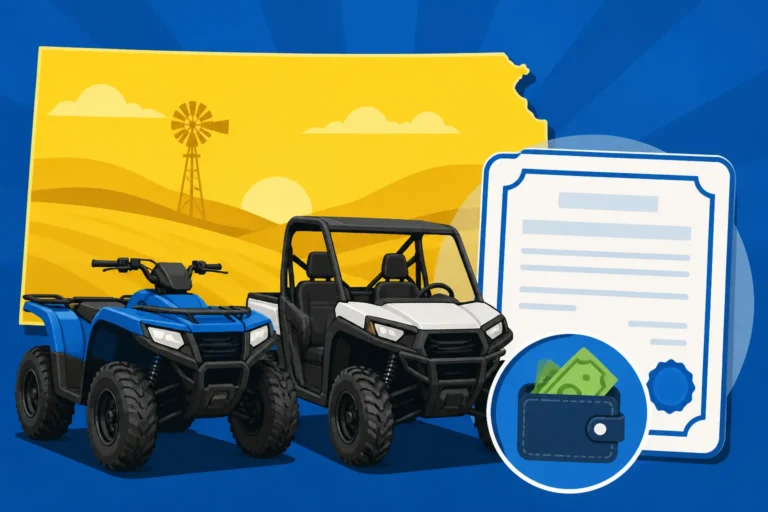
Many folks in Kansas get confused when they buy a shiny new ATV or UTV from a dealership. They might receive a "dealer inventory title" and mistakenly believe it means their machine is ready for the open road. This guide will clear up that common misunderstanding, explaining exactly why a dealer inventory title doesn't make your off-road machine street legal in Kansas and what steps you really need to take to get your vehicle properly titled for its intended use.
What Exactly is a Kansas Dealer Inventory Title?
When you walk onto a dealership lot and see rows of gleaming ATVs and UTVs, they aren't all fully titled in the traditional sense. Instead, they are typically held under a specific type of documentation designed for commercial purposes. Understanding this status is crucial to avoid any legal missteps after your purchase.
Understanding the Purpose: Stocking and Sales
When a Kansas dealership gets a shipment of new ATVs, UTVs, or other off-road vehicles from the manufacturer, they don't immediately title each one in their name as if they were going to drive it home. Instead, these machines are held under what the state refers to as a "dealer inventory title." Think of it as a placeholder – a way for the state to acknowledge that the dealership possesses these machines for the sole purpose of selling them to consumers, without requiring the dealer to pay full titling fees or taxes on every single unit sitting on their lot. It's an administrative convenience, not an ownership document for operational use. It simply verifies that the machine is part of the dealer's sellable stock.
This system is designed to streamline the business operations for dealers, preventing them from having to continuously transfer titles for every new machine that comes in and out of their inventory. Imagine the mountain of paperwork and fees if every single ATV on a large dealer lot had to go through the full titling process before it even reached a customer! The dealer inventory title, therefore, is crucial for dealers to efficiently manage their stock and prepare for eventual retail sales. It's a temporary status that anticipates the machine's true journey into a customer's hands.
How Dealers Acquire and Hold Them
When a new ATV or UTV arrives at a Kansas dealership, it comes with a Manufacturer's Certificate of Origin (MCO). This MCO is the very first document of ownership for a brand-new vehicle. Instead of immediately converting that MCO into a standard nonhighway title for themselves, which would be unnecessary given their intent to sell, dealers effectively hold the MCO (or a state-issued equivalent for inventory purposes) as part of their inventory. The state's system, particularly after legislative updates like [Kansas SB 97 and Dealer Inventory Titles] (which was a big deal for dealers in 2025!), allows for this distinction. The dealer is listed as the legal owner for inventory purposes, but this doesn't confer the same rights as a typical consumer nonhighway title. They're basically saying, "We have this machine, and we're going to sell it."
For used machines, the process is a bit different but still inventory-focused. When a dealer takes a used ATV or UTV as a trade-in, or purchases it outright, they are required to obtain a nonhighway title in their dealership's name. This is crucial for establishing a clear chain of ownership before reselling the machine. However, even with this title in their name, it still functions as an inventory title while it sits on their lot. It signifies that the machine is part of their business assets for sale, not a vehicle they intend to operate on public lands or roads themselves. This title will then be assigned to you, the buyer, once the sale is complete, triggering your own titling obligations.
The Temporary Nature of These Titles
The most important thing to grasp about a dealer inventory title is its inherently temporary nature. It's a status, not a permanent form of registration for an individual owner. Once you, the customer, purchase an ATV or UTV from a Kansas dealer, that dealer inventory status immediately ceases for that specific machine. The dealer assigns the manufacturer's certificate of origin (for new machines) or the existing nonhighway title (for used machines) over to you. This assignment marks the beginning of your responsibility to secure a proper [Kansas Nonhighway Title Explained] in your own name.
This transition from a dealer inventory title to your personal nonhighway title is a critical step that many new owners overlook or misunderstand. The dealer's possession of the inventory title is merely a bridge between the manufacturer or previous owner and you. It is never intended to be the final document that allows you to operate the machine. It sets the stage for your own titling process, ensuring that the state has a clear record of ownership transfer and that you, as the new owner, can then fulfill all legal requirements for your machine's use.
The Legal Divide: Why "Inventory" Doesn't Mean "Road Legal" in Kansas
Let's delve into the legal definitions and distinctions between a dealer's inventory status and a vehicle being deemed road legal in Kansas. There's a significant difference that can lead to headaches if misunderstood.
Defining "Road Legal" for Off-Road Vehicles in Kansas
In Kansas, the term "road legal" for an off-road vehicle like an ATV or UTV is a tricky one, and it's far less common than many people assume. By default, most ATVs and UTVs are explicitly not considered road legal. The state's statutes, particularly under [Kansas ATV Road Rules Under 8-15,100], generally prohibit their operation on public roads and highways. There are very specific, limited exceptions, such as for agricultural purposes or in certain cities that have passed local ordinances allowing UTVs on their streets. Even in these special cases, being "road legal" requires more than just a title; it demands specific equipment, insurance, and often a city-issued permit or tag.
For the vast majority of Kansas riders, their ATV or UTV is classified as a "nonhighway vehicle." This classification inherently means it's built and intended for off-road use only – think trails, fields, private land, and designated riding areas like Tuttle Creek. A dealer inventory title doesn't change this fundamental classification. It doesn't magically equip your machine with turn signals, brake lights, mirrors, or the other accouterments required for safe and legal road operation. The legal definition of "road legal" is stringent and applies to very few off-road machines without significant modification and specific local authorization.
Kansas's Classification of ATVs and UTVs
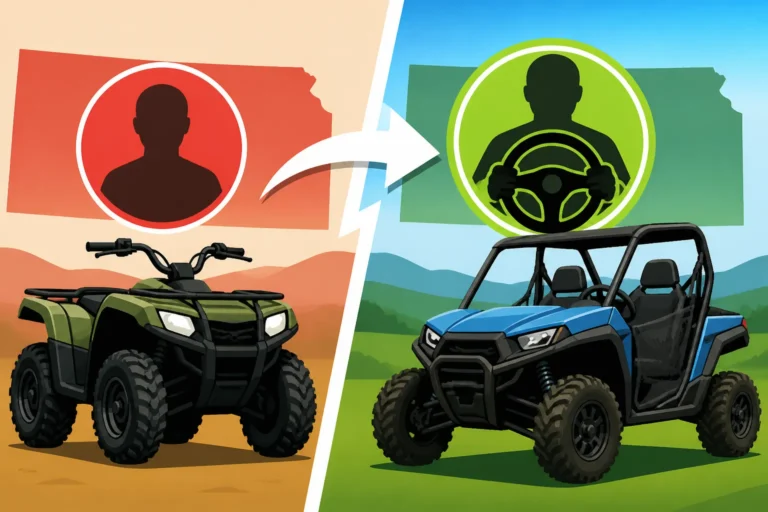
Kansas law is quite specific when it comes to classifying off-road vehicles, and it's important to understand these distinctions. ATVs are generally defined as vehicles designed for off-road use, usually with handlebars and a straddle seat, and are explicitly titled as "nonhighway vehicles." Side-by-sides, or UTVs, can fall into a few categories: sometimes also as nonhighway vehicles, or, if they meet certain criteria (like width, weight, and seating), they might be classified as Work-Site Utility Vehicles (WSUVs). WSUVs have a slightly different set of rules regarding limited road use, but they are still far from "road legal" in the traditional sense. [What Makes a Side-by-Side a Work-Site Utility Vehicle] explains these nuances in detail.
Regardless of whether your machine is an ATV, a standard UTV, or a WSUV, a dealer inventory title simply identifies it as a piece of merchandise. It doesn't grant it a special status that overrides these fundamental classifications. The classifications themselves dictate what the machine can and cannot do, legally speaking, on various types of terrain, especially public roads. A dealer inventory title doesn't come with any waivers or exemptions from these classification-based restrictions. It's merely a way for the state to track the machine's existence within the commercial pipeline before it reaches its ultimate owner.
The Role of a Nonhighway Title for Owners
Once you purchase an ATV or UTV in Kansas, your primary goal (after the excitement of ownership, of course!) is to obtain a nonhighway title. This is the proper ownership document for almost all off-road vehicles in the state. This title confirms that you are the legal owner, and it's a crucial document for proving ownership if your machine is ever stolen, needs to be insured, or if you decide to sell it down the line. It's the equivalent of a car title, but for vehicles that aren't meant for highways. Without it, you could face difficulties in establishing your ownership rights.
However, and this is a key point of confusion, merely having a nonhighway title in your name still does not automatically make your ATV or UTV road legal. It simply legitimizes your ownership for off-road purposes. To reiterate: [Having a Title Does Not Make an ATV Street Legal]. The nonhighway title is about ownership and identification, not about granting permission to operate on public roads. That permission comes from specific statutes, exceptions, or local ordinances, which also often require additional equipment and sometimes a separate city tag and insurance. So, while you absolutely need your nonhighway title, don't confuse it with a golden ticket to the pavement.
Why a Dealer Inventory Title Prevents Road Access
Let's get down to the brass tacks of why this specific type of title keeps your machine off the public thoroughfares. It boils down to a few critical missing components and a fundamental difference in purpose.
Lack of Registration and Plate Requirements
One of the most fundamental reasons a dealer inventory title prevents road access is the absence of registration and vehicle plate requirements. For a vehicle to be road legal in Kansas (if an exception applies), it must be properly registered with the state, and it must display a valid license plate or, in some city ordinance cases, a specific city-issued tag. Dealer inventory titles, by their very nature, do not come with any form of registration or a license plate. They exist purely as an internal tracking mechanism for commercial entities.
Consider a car on a dealership lot. It might have a dealer plate for test drives, but that's a temporary measure tied to the dealership, not the individual car's registration for a specific owner. Similarly, an ATV or UTV under a dealer inventory title is not individually registered for public road use. [Kansas Has No OHV Registration] in the traditional sense for ATVs, which adds another layer of misunderstanding for some. While there's no state OHV registration, the requirement for a valid tag or plate for road use is distinct and simply isn't met by a dealer inventory title. Without that official stamp of approval and visible identification, your machine is not permitted on public roads.
Missing Safety and Equipment Certifications
Public roads come with a host of safety regulations designed to protect all users. Vehicles on these roads must meet specific equipment standards: proper headlights, taillights, brake lights, turn signals, mirrors, horn, and sometimes even windshields. Most ATVs and UTVs, as they roll off the factory floor, are not equipped with all these items, precisely because they are designed for off-road use. A dealer inventory title doesn't magically bestow these certifications or equipment upon the machine. It doesn't mean the state has inspected it for roadworthiness.
The focus of a dealer inventory title is on commercial transaction, not compliance with public safety standards for highway travel. If you were to attempt to drive a machine with only a dealer inventory title on a public road, you would not only be operating an unregistered (for road use) vehicle, but you would also likely be in violation of numerous equipment laws. Law enforcement officers, when they pull you over, aren't going to care about the nuances of dealer paperwork; they're going to see a vehicle that isn't equipped or authorized for the road, leading to citations.
The Core Purpose: Inventory Management, Not Operation
Ultimately, the most straightforward reason is that a dealer inventory title's core purpose is administrative: to allow dealerships to efficiently manage their stock of vehicles for sale. It's a tool for commerce and taxation, enabling the state to track sales and collect sales tax when a machine is finally sold to a consumer. It is absolutely not designed, intended, or legally recognized as a document that permits the operation of the vehicle by an individual owner on public roads or even certain public lands.
Once the machine is sold, its status changes from "dealer inventory" to a consumer-owned vehicle. At that point, the responsibility shifts entirely to the buyer to obtain a [Kansas Nonhighway Title Requirements] and adhere to all other local and state regulations for its intended use, whether that's strictly off-road, or in those rare instances where limited road use is allowed. Trying to operate an ATV or UTV with just the dealer's paperwork on a road is a shortcut that simply won't work and will lead to legal trouble. It's a clear cut distinction based on the very intent of the document itself.
Navigating the Process: Titling Your Machine After Purchase
So, you've bought your machine. Now what? This section outlines the essential steps to get your ATV or UTV properly titled in Kansas, ensuring you have legitimate proof of ownership.
The Initial Paperwork You Receive
When you purchase a new ATV or UTV from a Kansas dealer, you'll receive several important documents. For a brand-new machine, the most crucial will be the Manufacturer's Certificate of Origin (MCO), which essentially serves as its birth certificate. For a used machine, the dealer will provide you with the properly assigned nonhighway title they held in their inventory. Along with these, you'll get a bill of sale detailing the purchase price, any trade-in allowances, and the sales tax collected (or due). It's vital to keep all these documents organized, as they are your keys to legal ownership. You might find a template for a bill of sale on sites like LawDepot if you ever deal with a private sale later, but the dealer will provide their own official documents.
The dealer should also provide you with temporary tags or a temporary permit to move the machine, but these are generally for transport to your home or storage, not for recreational riding on public roads. It's crucial to understand the limitations of these temporary documents. They give you a window to get your proper title, but they don't grant you carte blanche for road use. Always clarify with your dealer what these temporary papers allow you to do and, more importantly, what they don't.
Taking Your Documents to the County Treasurer
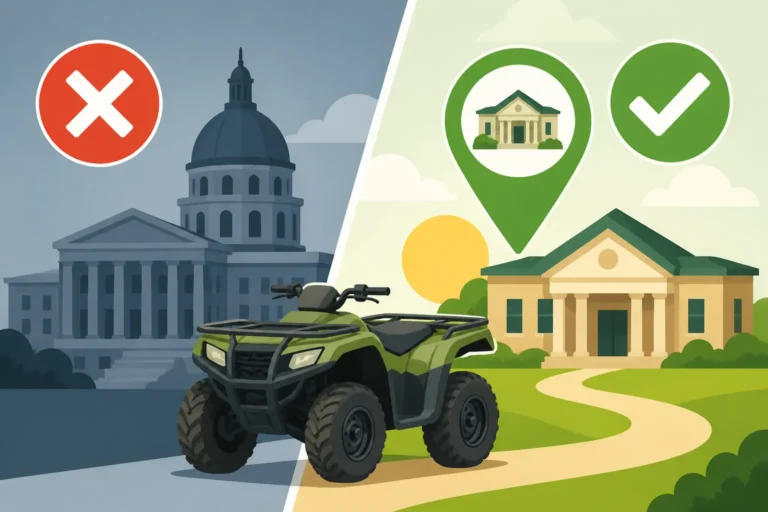
Your next critical step is to take all your paperwork to your local [Kansas County Treasurer Offices] within a specified timeframe. In Kansas, you have [Kansas Gives You 60 Days to Apply] from the date of purchase (or the assignment date on the MCO/title) to apply for your nonhighway title. This is where you'll officially transfer ownership into your name. You'll need the MCO or assigned title, the bill of sale, and proof of identification. The county treasurer's office is the specific government entity authorized to handle these transactions, not the Kansas Department of Revenue directly for nonhighway vehicles.
At the treasurer's office, they will review your documents, collect the [Kansas Sales Tax Collected at Titling] (if not already collected by the dealer, or for private sales), and charge the [Kansas Charges $10 for a Title] fee for your nonhighway title. Make sure all your information is accurate and legible on the forms. Don't hesitate to ask the clerks any questions you have; they deal with [Kansas Title Questions Treasurers Hear] every day and can often clarify confusing points. Being prepared with all your documents and understanding the process will make your visit much smoother.
Understanding the 60-Day Deadline
The [Sixty Days From the Assignment Date] is not just a suggestion; it's a legal requirement. Kansas law dictates that new owners must apply for their nonhighway title within 60 days of the vehicle's purchase date or the date the title/MCO was assigned to them. Missing this deadline can lead to penalties. While the exact penalty might vary, it's typically an additional fee that gets added to your titling costs. It's an unnecessary expense that's easily avoided by being proactive.
Beyond the financial penalty, failing to title your machine within 60 days can complicate things if you need to prove ownership for insurance purposes or if you decide to sell the machine soon after purchase. Having a current, accurate title in your name is foundational to legal ownership and hassle-free enjoyment of your off-road machine. Mark the date on your calendar as soon as you buy your ATV or UTV, and make that trip to the county treasurer's office a priority. You want to make sure your investment is properly documented from the get-go.
Common Misconceptions and the Real-World Consequences
Let's debunk some common myths and look at what happens if you misunderstand the rules. Navigating off-road vehicle laws can be confusing, but clarity can save you a lot of trouble.
Thinking a Title Equals Road Legality
This is perhaps the biggest misconception out there: many new ATV and UTV owners in Kansas mistakenly believe that simply having a title (whether it's the dealer's inventory title or their own nonhighway title) automatically grants them permission to ride on public roads. We've touched on this, but it bears repeating with emphasis: a title is a document of ownership, not a permit for operation on public roads. The state issues a title to prove you own the machine, not to certify it for highway use.
This belief can lead to serious legal issues. In Kansas, generally, [Kansas Bans ATVs on Interstates], [Kansas Bans ATVs on Federal Highways], and by default, [Kansas Bans ATVs Inside City Limits by Default]. There are exceptions, as mentioned, for agricultural use or in cities that have specifically opted in via ordinance (like Louisburg or Scott City), but these are exceptions, not the rule. Relying solely on a title for road use is a misunderstanding of state law that can put you at odds with law enforcement and endanger yourself and others. Always separate the concept of "ownership" from "road legality."
Penalties for Illegal Road Use
The consequences of operating an ATV or UTV on public roads in Kansas without proper authorization can range from inconvenient to severe. If a law enforcement officer pulls you over, you could face fines for operating an illegal vehicle on the roadway. This could include citations for operating an unregistered vehicle (for road purposes), lacking proper safety equipment, or simply driving a prohibited vehicle type on that particular road. These fines can quickly add up, turning an enjoyable ride into a costly headache.
Beyond financial penalties, repeated offenses or serious incidents could lead to your machine being impounded. Imagine the hassle and expense of trying to retrieve your ATV from an impound lot, especially if it involves proving proper ownership after a titling mix-up. Furthermore, if you're involved in an accident while operating illegally on a public road, your insurance might not cover damages, leaving you personally liable for repairs, medical bills, or property damage to others. The risks far outweigh any perceived convenience of using a public road illegally. [Kansas Penalties for Illegal Road Riding] are designed to deter unsafe and unauthorized use, so it's wise to understand and avoid them.
Ensuring You're Properly Documented for Peace of Mind
To truly enjoy your ATV or UTV in Kansas, having peace of mind about its legality is paramount. This means making sure you have the correct nonhighway title in your name, promptly obtained from the county treasurer's office. It also means understanding where you can and cannot legally ride. If you operate your machine on private land, ensure you have permission from the landowner (a simple permission form, perhaps found on LawDepot, can be useful). If you venture to designated riding areas like [Tuttle Creek ORV Area in Kansas] or [Syracuse Sand Dunes Park in Kansas], familiarize yourself with their specific rules.
For those few situations where limited road use might be permitted (e.g., specific agricultural trips or within certain city limits with a permit), ensure you have all the required equipment, insurance, and local tags. Consulting your local county treasurer's office or city clerk's office can provide clarity on specific local ordinances. A well-informed owner is a responsible owner, and taking the time to understand Kansas ATV and UTV laws will protect your investment and allow you to fully enjoy the thrill of off-road riding without legal worries. Having a clear, current title is the first step towards that peace of mind.
Here's a comparison table to summarize the key differences:
| Feature | Dealer Inventory Title | Nonhighway Title (Consumer) | Road Legal Status (for ATVs/UTVs) |
|---|---|---|---|
| Purpose | Temporary ownership for dealer stock/resale | Proof of individual ownership for off-road vehicle | Authorization for specific public road operation |
| Issued To | Dealership | Individual owner | Applies to the vehicle and operator based on specific rules |
| Road Operation | No, strictly for inventory/transport only | No, does not grant road access by itself | Yes, but only under specific, limited exceptions and requirements |
| Registration/Plates | None (for consumer operation) | None (Kansas has no state ATV registration) | Required (city tag/plate) if specific road use is allowed |
| Safety Equipment | Standard factory off-road equipment | Standard factory off-road equipment | Requires specific road-legal equipment (lights, mirrors, etc.) |
| Sales Tax | Collected at time of consumer purchase | Collected at titling (if not by dealer) | May require additional fees/permits (e.g., city tag fee) |
| Validity | Temporary, until sold to consumer | Permanent, until vehicle is sold or destroyed | Varies based on ordinance, permit expiration |
| Example Scenario | ATV sitting on a dealership showroom floor | Your ATV in your garage, ready for the trails | A UTV with a city tag driving on a specific street in Louisburg |
Disclaimer
This article is for general informational purposes only and does not constitute professional advice. Laws, prices and regulations vary by location and change over time. Consult a qualified professional for guidance on your specific situation.