Kansas’s Nonhighway Title Explained
It’s a scenario far too common in Kansas: you’ve just brought home a shiny new ATV or a rugged side-by-side, eager to hit the trails or tackle some ranch work. You’ve got the keys, maybe even a new helmet, and then someone mentions "the title." Suddenly, a wave of confusion hits. Is it like a car title? Do you need a special tag? What's a "nonhighway title" anyway? This guide is here to clear up all that head-scratching, explaining exactly what a Kansas nonhighway title is, why it's essential, and how you can navigate the process without getting lost in bureaucratic mud.
Understanding the Kansas Nonhighway Title: What Exactly Is It?
Bringing home an ATV or UTV in Kansas is an exciting time, whether it's for tearing up the dunes at Syracuse Sand Dunes Park, working cattle out in western Kansas, or simply enjoying some recreation on your own property. But unlike your truck or SUV, these machines fall under a different set of rules when it comes to ownership documentation. This is where the Kansas nonhighway title comes in, a document that's absolutely vital but often misunderstood by new and even experienced owners. It’s not just a piece of paper; it’s your legal proof of ownership in the Sunflower State.
Defining a Nonhighway Vehicle in Kansas
Let's start with the basics. In Kansas, an "all-terrain vehicle" (ATV) or "utility vehicle" (UTV), along with dirt bikes and other similar machines primarily designed for off-road use, are officially classified as "nonhighway vehicles." This classification is crucial because it immediately sets them apart from your standard cars, trucks, or motorcycles that are intended for public road use. These machines are engineered for rugged terrain, not asphalt highways, and the state's titling system reflects that fundamental difference. They typically feature knobby tires, high ground clearance, and an absence of typical road-legal equipment like turn signals or a speedometer in many cases. Understanding this definition is the first step in grasping the purpose of their unique title. [How Kansas Law Defines a Nonhighway Vehicle] dives deeper into the specific legal language, but for practical purposes, if it’s built for the dirt, rocks, or fields, it’s likely a nonhighway vehicle.
The distinction between a nonhighway vehicle and a road-legal vehicle isn't just a technicality; it impacts everything from how you prove ownership to where you can legally operate your machine. For instance, a vehicle like a golf cart, while often used off-road, might have different classification rules if it's equipped to meet certain city ordinances for limited street use. However, for most ATVs and UTVs, the core identity is "nonhighway." This means the state recognizes it as a legitimate vehicle, but one whose primary domain is off the beaten path.
The Purpose and Function of the Nonhighway Title
So, if your ATV isn't going to be cruising down I-70, why does it need a title at all? Simply put, a Kansas nonhighway title serves as indisputable proof of ownership. It’s your official declaration that this particular machine, identified by its unique Vehicle Identification Number (VIN), belongs to you. Think of it like a birth certificate for your ATV or UTV; it records its existence and who is legally responsible for it. Without this title, proving that you legitimately own your machine becomes incredibly difficult, opening the door to potential legal headaches and making transactions a nightmare.
This title is absolutely essential for several key reasons. First, when you buy a new ATV or UTV from a dealer, or a used one from a private seller, the title transfer process is what legally moves ownership from one party to another. It ensures a clear chain of custody, protecting both the buyer and the seller. Second, if your machine is ever stolen – a devastating experience for any owner – the nonhighway title is what law enforcement will use to verify your ownership and help track down and recover your property. Imagine trying to explain to the police that your machine was stolen without a formal document to back up your claim; it would be a losing battle. This document provides that critical legal grounding. [Kansas Titles ATVs as Nonhighway Vehicles] clarifies that this titling requirement is standard across the board for these types of machines, underscoring its importance.
Key Information Found on Your Kansas Nonhighway Title
When you finally get your Kansas nonhighway title in hand, you'll notice it contains specific information designed to identify your machine and you as its rightful owner. It might look a little different from a standard car title, but the core function is the same. The title will clearly list your name and address as the owner, and if there are multiple owners, both names will typically appear. It will also specify crucial details about your machine itself: the make, model, year, and most importantly, the Vehicle Identification Number (VIN). The VIN is like your machine's fingerprint – a unique sequence of characters that identifies that specific ATV or UTV. Always double-check this number against your machine's actual VIN to ensure everything matches perfectly.
Beyond owner and vehicle details, the title will also indicate any lienholders if you financed your purchase. This means if you took out a loan to buy your ATV, the bank or credit union will be listed on the title as having a financial interest in the machine until the loan is paid in full. Once you satisfy the loan, the lienholder will release their claim, and you can get a clear title. Unlike car titles, you generally won't see an odometer reading on a nonhighway title, as mileage isn't typically tracked for off-road vehicles in the same way it is for road-legal ones. The focus is purely on establishing legal ownership, not road history.
Why Kansas Titles Off-Road Machines Differently
Kansas has a unique approach to how it handles off-road vehicles. While many states require some form of registration, often involving an annual sticker or plate, Kansas opts for a streamlined system centered around the nonhighway title. This difference can often be a source of confusion for folks moving to Kansas from other states, or for new owners who assume ATVs and UTVs are treated just like cars. Understanding the rationale behind this distinct system helps demystify the process and reinforces the importance of the nonhighway title.
The Absence of Traditional Road Registration
One of the most significant aspects of Kansas's system is the complete absence of traditional road registration for ATVs and UTVs. This means you will not be issued a license plate or an annual registration sticker by the state specifically for your off-road machine. When you get your nonhighway title, it's just that – a title. There's no separate annual fee to renew or a tag to display, which is a major departure from how most vehicles are handled. For many, this comes as a pleasant surprise, as it reduces recurring costs and paperwork. However, it’s a detail that often trips up new owners, leading them to believe that if there's no "tag," there's no need for any paperwork at all, which is simply not true.
This lack of registration simplifies things for owners who use their machines exclusively on private land or in designated off-road parks. You won't have to worry about renewal dates or annual fees with the state. [Kansas Has No OHV Registration] clarifies this point directly, affirming that this is a key characteristic of owning an off-road machine in the state. However, it's crucial not to mistake this absence of registration for a complete lack of rules or the ability to ride wherever you please. While the state doesn't require registration, local cities and counties might have their own specific ordinances for limited road use, and those often do involve local permits or fees, but these are distinct from a statewide registration.
Differentiating Between Titling and Registering
It's absolutely essential to understand the difference between titling and registering your off-road machine in Kansas. Titling, as we've discussed, is the act of establishing legal ownership of your ATV or UTV. It's a one-time process (unless the title is lost or transferred) that creates a permanent record of who owns the vehicle. Registration, on the other hand, is generally associated with permission to operate a vehicle on public roads and is often an annual or biennial process involving fees and the issuance of license plates or stickers.
For most ATVs and UTVs in Kansas, there is no state-level registration requirement because these machines are, by default, not street legal. Therefore, while you absolutely need a nonhighway title, you do not "register" your ATV in the way you would your car. This distinction is vital for understanding why you get one document but not the other. The title proves it's yours, but it does not grant you the right to drive it on public roads. [Why an ATV Is Exempt From Registration Entirely] provides more context on this exemption. The intention behind this system is to acknowledge these machines as valuable property while recognizing their specialized, off-road purpose.
Historical Context and Legislative Intent
The current system for titling nonhighway vehicles in Kansas isn't an accident; it's the result of specific legislative decisions and a recognition of how these machines are primarily used within the state. Kansas, with its vast agricultural lands, numerous ranches, and popular off-road areas, has a strong culture of ATV and UTV use for both work and recreation. The lawmakers understood that imposing standard road-vehicle registration requirements on machines that rarely, if ever, touch public highways would be an unnecessary burden on owners.
The focus shifted to establishing clear ownership rather than regulating road use, which is typically handled by local ordinances for very specific, limited scenarios. This approach acknowledges the economic importance of these machines to the agricultural sector, where they are indispensable tools for managing land and livestock, and also respects their recreational value on private property and dedicated off-road parks. By simplifying the statewide requirements to just a nonhighway title, Kansas aimed to make ownership straightforward while still providing the legal framework necessary for property rights and preventing theft. This system balances the needs of owners with the state's regulatory responsibilities.
The Process of Obtaining a Kansas Nonhighway Title
Now that we understand what a Kansas nonhighway title is and why it's structured the way it is, let's get down to the practical steps of actually getting one. This is where many people feel overwhelmed, but with the right information, the process is quite manageable. The key is to gather all your documents, know where to go, and understand the deadlines and fees involved. Missing a step can lead to delays or penalties, so paying close attention here can save you a lot of hassle.
Required Documents for Titling Your Machine
Getting your nonhighway title starts with having the correct paperwork. The specific documents you'll need can vary slightly depending on whether your machine is brand new, used from a dealer, or purchased from a private seller.
- For a New Machine: You’ll primarily need the Manufacturer’s Certificate of Origin (MCO). This is the official document from the factory that proves the machine's initial ownership and specifications. The dealer typically provides this to you.
- For a Used Machine from a Dealer: The dealer should provide you with the properly assigned previous title. If they have a "dealer inventory title," they'll transfer that. You'll also need a bill of sale or purchase agreement from the dealer. [Kansas Dealer Paperwork at Delivery] outlines what to expect from a dealership.
- For a Used Machine from a Private Seller: This is where it can get a bit trickier. You'll need the properly assigned title from the previous owner. They will sign it over to you. Additionally, a bill of sale is absolutely critical. Even a handwritten bill of sale, if it contains the necessary information like the buyer's and seller's names, addresses, purchase price, date, and VIN, can suffice. Using a template from a service like LawDepot can ensure you have all the necessary legal clauses covered, protecting both parties. [Using a Handwritten Bill of Sale to Title a Quad] is a helpful resource here. If the previous owner never titled the machine, or the title is lost, you might need a nonhighway affidavit (TR-13), which the county treasurer's office can provide.
- All Purchases: Regardless of how you acquired your machine, you'll need to demonstrate proof of sales tax payment, or be prepared for the sales tax to be collected at the county treasurer's office. You'll also need a valid photo ID and proof of your Kansas address. [Kansas Title Paperwork Explained] goes into further detail about all these requirements.
Failing to have these documents in order is the most common reason for delays. Before you even head to the county office, lay everything out and double-check it against this list. It's always better to over-prepare than to be sent home because you're missing a signature or a piece of paper.
Where and When to Apply for Your Title
Once you’ve gathered all your documents, your next step is to head to your local Kansas County Treasurer's office. This is the only place where you can process your nonhighway title application. The Kansas Department of Revenue handles motor vehicle registrations and driver’s licenses, but all vehicle titles, including nonhighway ones, are processed at the county level. So, don’t make a trip to Topeka; your local county office is where you need to be. You should apply for the title in the county where you reside or where the machine is primarily kept. [Kansas County Treasurers Handle Titles] confirms this local process.
There's a critical deadline to keep in mind: you have 60 days from the date of purchase or assignment of the title to apply for your new title. This 60-day window starts ticking the moment the previous owner signs over the title or the dealer delivers the MCO. Don't procrastinate! There are penalties for filing late, which can add unexpected costs to your purchase. Life gets busy, but marking this deadline on your calendar immediately after buying your machine is a smart move. [Kansas Gives You 60 Days to Apply] and [Sixty Days From the Assignment Date] emphasize the importance of this timeframe. If you miss it, you'll face late filing penalties, which can be a real pain and drain your wallet unnecessarily.
Understanding Fees and Sales Tax
Beyond the initial purchase price of your ATV or UTV, there are a few mandatory costs associated with getting your Kansas nonhighway title. The good news is that for the title itself, the fee is generally quite modest. The state of Kansas charges a flat fee for the nonhighway title. [Kansas Charges $10 for a Title] confirms this is typically a minimal cost, making the titling process accessible. This fee is a one-time charge for issuing the title document itself.
However, the more substantial cost you need to budget for is Kansas sales tax. In Kansas, sales tax is collected at the time of titling, not necessarily at the point of sale, especially if you bought from a private party or an out-of-state dealer who didn't collect it. This means when you go to the County Treasurer's office, you'll be paying the state sales tax (6.5%) plus any applicable local sales tax for your specific county and city. These combined rates can vary quite a bit across the state, often averaging around 8.5% or more. [Kansas Sales Tax Collected at Titling] is an important reminder of this. If you bought from a Kansas dealer, they should have already collected the sales tax, and you'll present proof of that payment to the treasurer. For a private sale, however, be prepared to pay the full sales tax at the window. This is a common surprise for buyers who don't anticipate this additional cost on top of the purchase price.
Life with a Kansas Nonhighway Title: What It Means for You
Having a Kansas nonhighway title in hand is more than just a bureaucratic checkbox; it significantly impacts how you own, manage, and eventually, how you might sell your ATV or UTV. It’s the foundational document that secures your investment and provides peace of mind. Understanding its implications helps you navigate various situations that might arise during your ownership journey.
Proving Ownership and Preventing Theft
The most fundamental benefit of your Kansas nonhighway title is its role as definitive proof of ownership. In the eyes of the law, that title, with your name printed on it and the VIN matching your machine, is the strongest evidence that you are the legal owner. This is critically important for protecting your investment. If, for instance, you ever need to make an insurance claim for damage or theft, your insurance company will almost certainly require a copy of the title to verify your legal interest in the machine. Without it, you could face significant hurdles in getting your claim processed.
Beyond insurance, the title is your primary defense against theft. Unfortunately, ATVs and UTVs are attractive targets for thieves due to their value and portability. If your machine is stolen, the first thing law enforcement will ask for is the VIN, which is prominently listed on your title. Having that title readily available allows them to enter your machine's details into national databases, greatly increasing the chances of recovery. Imagine trying to explain to the police that your quad was stolen, but you have no official document linking you to it. It would be a frustrating and likely fruitless endeavor. Keeping your title in a safe, secure place – not on your machine – is paramount.
Selling or Transferring Your Titled Machine
When the time comes to sell your ATV or UTV, your Kansas nonhighway title becomes the centerpiece of the transaction. A clear, properly assigned title is what makes a sale legal and smooth for both you and the buyer. To sell your machine, you, as the current owner, will sign and date the "assignment" section on the back of the title, transferring ownership to the new buyer. You'll typically need to fill in the buyer's name and address, the sale date, and the purchase price.
It's crucial to complete this section accurately and legibly. Any errors or omissions can cause issues for the buyer when they go to title the machine in their name. Along with the assigned title, it's highly recommended to provide the buyer with a detailed bill of sale. A document drafted using a reliable template, like those available from LawDepot, can spell out the terms of the sale, state the machine's condition, and protect you from future disputes. This is especially important for private sales, where there isn't a dealer to facilitate the paperwork. [Kansas Title Transfer After a Sale] provides further guidance on this important step, ensuring you protect yourself and the buyer during the transaction. Always make a copy of the signed title and bill of sale for your records before handing them over.
Financing and Lien Information on Your Title
If you financed the purchase of your ATV or UTV through a bank, credit union, or dealership, that financial institution will have a legal interest in your machine until the loan is fully repaid. This interest is formally recorded on your Kansas nonhighway title as a "lien." When you receive your title, it will clearly list the lender as the lienholder. This means that while you possess and use the machine, the lender holds the primary legal claim to it until your debt is satisfied.
This lien prevents you from selling the machine or transferring the title without the lender's consent. Once you’ve made your final payment and the loan is paid off, the lienholder will typically send you a lien release document. You'll then need to take this document to your County Treasurer's office to have the lien formally removed from your title, allowing you to receive a "clear" title with no outstanding financial claims against it. This is a critical step to ensure you have full, unencumbered ownership of your machine. [How a Lien Appears on a Nonhighway Title] explains the process and appearance of a lien on your Kansas title.
Common Misconceptions About Kansas Nonhighway Titles
The unique nature of Kansas's nonhighway titling system, coupled with variations in rules from other states, often leads to misunderstandings. These misconceptions can lead to trouble, from illegal road riding to unexpected penalties. Clearing up these common myths is crucial for any ATV or UTV owner in the Sunflower State to operate responsibly and within the bounds of the law.
The "Title Equals Street Legal" Myth
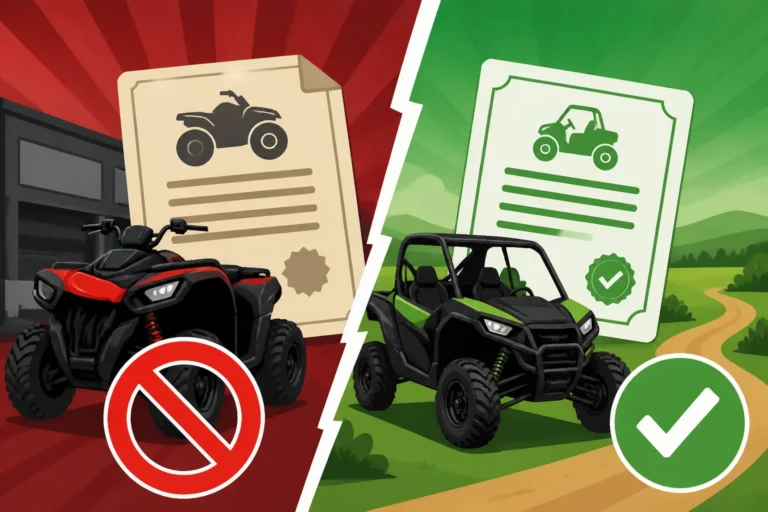
Perhaps the most dangerous and persistent misconception is the belief that simply having a Kansas nonhighway title makes your ATV or UTV street legal. This is unequivocally false. A nonhighway title, by its very definition, applies to vehicles not intended for public road use. The title is proof of ownership, not a license to drive on highways or city streets. In fact, most Kansas roads, particularly state and federal highways, are off-limits to ATVs and UTVs, regardless of whether you have a title or not. The title itself will often state something to the effect of "NOT FOR HIGHWAY USE" or "NONHIGHWAY VEHICLE."
Many owners from other states are accustomed to systems where a title or registration implies some level of road legality. Kansas is different. While some cities and counties in Kansas have passed specific ordinances allowing some UTVs (often under strict conditions and requiring local permits and insurance), this is a localized exception, not a statewide rule, and it rarely applies to standard ATVs. Relying on your nonhighway title as permission to drive on public roads will likely result in a citation from law enforcement. [Having a Title Does Not Make an ATV Street Legal] is an important piece of advice that cannot be stressed enough. Always check local ordinances and never assume your titled off-road machine is welcome on a paved road without explicit authorization.
Confusion with Other State's Registration Systems
Kansas's approach to off-road vehicle documentation is not universal, which often causes confusion, especially for new residents or those comparing notes with friends in neighboring states. Many states, such as Missouri or Colorado, require ATVs and UTVs to be registered annually, often issuing a small sticker or tag that must be displayed on the machine. This registration often comes with an annual fee and is sometimes linked to a state trail system or safety program.
Because Kansas has no such statewide registration requirement for ATVs and UTVs, visitors from these states or new Kansas residents might feel like they're missing a step, or worse, mistakenly believe Kansas has no rules at all. They might look for an "OHV sticker" that simply doesn't exist here. This difference in systems can lead to misunderstandings about what is, or isn't, required. While you might encounter a similar machine in Oklahoma with a registration decal, in Kansas, that's simply not the case for most off-road vehicles. Remember, [Kansas Has No OHV Registration] means the state has opted for a titling-only approach to ownership, simplifying the state-level administrative burden for owners.
The Difference Between a Nonhighway Title and a WSUV Title
Another significant point of confusion arises when comparing a standard nonhighway title for an ATV or UTV with a Work-Site Utility Vehicle (WSUV) title. Kansas law has a specific classification for WSUVs, which are essentially certain types of UTVs that meet stringent criteria (such as width limits, weight requirements, and seating configuration) that allow them to be registered for limited road use, primarily in specified work zones or by specific city ordinances.
A WSUV can be issued a different type of title and, more importantly, can be registered for a special WSUV tag for specific on-road privileges. This is distinct from the general nonhighway title, which offers no such road-use permission. Many UTV owners mistakenly believe their standard UTV automatically qualifies for WSUV status or that their nonhighway title somehow grants them similar privileges. It does not. The WSUV classification is very specific and applies to a smaller subset of utility vehicles that meet particular design specifications. [Kansas Work-Site Utility Vehicles Explained] breaks down these critical differences, highlighting that while both are "utility vehicles," their legal classifications and road-use capabilities are worlds apart. If your UTV doesn't meet the precise definition of a WSUV, it remains a nonhighway vehicle, strictly for off-road use, regardless of its powerful engine or comfortable seating.
Specific Scenarios for Titling Your Off-Road Machine in Kansas
While the basic process of titling an ATV or UTV is straightforward, real-world situations aren't always so simple. You might buy from a private seller who's lost the title, bring a machine from another state, or face missing paperwork. Each of these scenarios requires a slightly different approach, but rest assured, Kansas has provisions for them. Knowing how to handle these specific situations can save you a lot of grief and ensure you eventually get that all-important nonhighway title in your name.
Titling a Machine from a Private Sale
Buying an ATV or UTV from a private seller can often be a great way to find a good deal, but it also carries unique paperwork challenges, especially compared to buying from a dealer. The biggest hurdle often arises if the seller has lost their original title, or worse, if they never titled the machine in their name to begin with. In Kansas, it’s illegal to sell a machine without a title if it’s required to have one, but it still happens.
If the seller has a properly assigned title, great! Make sure they sign it over to you correctly and that all the information is accurate. But what if the title is lost or missing? In this situation, you will need to apply for a duplicate title if the seller was the titled owner. If the machine was simply never titled, or the seller has lost the original title and can’t obtain a duplicate, you might need to utilize a Kansas Nonhighway Affidavit (Form TR-13). This affidavit allows you to attest to the ownership history and circumstances. It often requires supporting documentation, like a detailed bill of sale and possibly a VIN inspection. A comprehensive bill of sale, perhaps generated through a service like LawDepot, is absolutely vital here to document the transaction and protect yourself. [Kansas Titles After a Private Sale] delves into these complexities, emphasizing the need for meticulous record-keeping and due diligence when buying used. Always be wary of a seller who has no title and seems unwilling to help you get the necessary paperwork in order.
Titling an Out-of-State Machine
Moving to Kansas with your existing ATV or UTV, or buying one from a seller across state lines, introduces another layer of complexity. Each state has its own rules for off-road vehicles, and what was perfectly legal and customary in your previous state might not align with Kansas requirements. For instance, if your machine was registered with an annual tag in Missouri, that registration doesn't transfer or apply in Kansas because, as established, Kansas doesn't have a statewide registration system for these machines.
When you bring an out-of-state machine to Kansas, your primary goal is to obtain a Kansas nonhighway title. You'll generally need the original title from the previous state, properly assigned to you. If that state used a registration-only system without a formal title (which is rare for these types of machines but can happen), you might need to present your registration documents and a bill of sale, along with a VIN inspection. The county treasurer will evaluate the provided documents from the other state to determine the appropriate course of action. It's always a good idea to call your local Kansas County Treasurer's office beforehand and explain your specific situation to ensure you bring all the necessary documents. [Titling an ATV in Kansas From Out of State] offers specific guidance for this common scenario.
Dealing with Lost Titles or Missing Paperwork
Losing your Kansas nonhighway title can feel like a disaster, but thankfully, it’s a problem with a clear solution. If your title is lost, stolen, or damaged beyond recognition, you can apply for a duplicate title at your County Treasurer's office. You'll typically need to fill out an application for a duplicate title, provide proof of identification, and pay a small fee. Once processed, a new title document will be mailed to you. It's a straightforward process, but it does take time, so don't wait until you need to sell the machine to discover your title is missing. [Replacing a Lost Kansas Nonhighway Title] walks you through the steps.
What if you've purchased a machine that, for whatever reason, has never been properly titled in Kansas, and the previous owner has no paperwork? This is where the Kansas Nonhighway Affidavit (Form TR-13) becomes your best friend. This affidavit is designed for situations where a title is unavailable, allowing you to establish ownership through other means. You'll need to fill it out thoroughly, providing as much detail as possible about how and when you acquired the machine. You'll also need a bill of sale – again, a robust template from LawDepot can be invaluable here – and possibly a VIN verification from law enforcement. The County Treasurer's office will review your affidavit and supporting documents to determine if they can issue you a new title. This process can be more involved, so patience and thoroughness are key. [Kansas Nonhighway Affidavits] provides critical information on this specific form.
Troubleshooting and Special Considerations for Your Kansas Title
Even with the best preparation, questions and unique situations can arise when dealing with your Kansas nonhighway title. From minor errors on the document to understanding the nuances of liens, knowing how to troubleshoot these issues can save you time and prevent future headaches. This section addresses some of the more specific considerations that owners might face.
Correcting Errors on Your Title
Mistakes happen, and sometimes they end up on your official title document. Whether it's a misspelled name, an incorrect VIN (a very serious error!), or a wrong address, discovering an error on your Kansas nonhighway title can be frustrating. The good news is that these errors can typically be corrected, but it's crucial to address them as soon as you notice them. The longer you wait, the more complicated it can become, especially if you later try to sell the machine.
To correct an error, you'll need to visit your local County Treasurer's office. Bring your current title, proof of identification, and any documentation that supports the correction you're requesting (e.g., your driver's license for a name correction, or the MCO for a VIN error). The clerk will guide you through the process, which usually involves completing a form and potentially reissuing a corrected title. Accuracy is absolutely critical for your VIN; if the VIN on your title doesn't match the VIN stamped on your machine, it can lead to serious legal problems, including difficulties proving ownership and potential issues if the machine is ever stolen. Always double-check all information on your title the moment you receive it.
Understanding Liens and Releases
As mentioned earlier, if you financed your ATV or UTV, your lender will be listed as a lienholder on your nonhighway title. This lien signifies their legal interest in your machine until the loan is paid in full. It’s a standard practice in vehicle financing. When you complete your loan payments, your financial institution is legally obligated to release that lien. They will typically send you a physical document, often called a "Lien Release" or "Satisfied Lien" form, which states that your loan has been paid and their claim on your machine is extinguished.
Once you receive this lien release, it's vital to take it to your County Treasurer's office promptly. They will process the release, remove the lienholder's name from your records, and usually issue you a new, "clear" title that no longer shows any encumbrances. While you might hold onto the old title with the lien recorded, having a clear title without any outstanding liens is essential for demonstrating full ownership and will be required if you plan to sell or transfer the machine in the future. Don't simply tuck away the lien release; ensure the title itself reflects your full, unencumbered ownership. [Kansas Title and Lien Records] provides more background on how these records are maintained.
When a Nonhighway Title Isn't Required (Exemptions)
While the vast majority of ATVs, UTVs, and dirt bikes in Kansas require a nonhighway title, there are a few very specific and limited circumstances where a machine might be exempt. These exemptions are rare for typical recreational or utility ATVs and UTVs and often pertain to specialized equipment or very old machines that predate titling requirements. For instance, some very specific types of farm equipment that are clearly not designed for transport and are exclusively used on private agricultural land might fall under an exemption, but this is usually for things like tractors or specialized implements, not standard ATVs or UTVs.
It’s generally safest to assume that if you own an ATV or UTV, it needs a nonhighway title. Trying to leverage a perceived exemption can lead to complications, especially if you ever need to sell the machine or if its ownership comes into question. If you genuinely believe your machine might be exempt, the best course of action is to contact your local Kansas County Treasurer's office and inquire directly, providing them with all the details about your specific machine. They can give you definitive guidance. However, for most owners of modern off-road machines, the requirement for a Kansas's Nonhighway Title Explained is a standard and necessary part of ownership in the Sunflower State. Always err on the side of getting the title to protect your investment and comply with state law.
| Feature | Kansas Nonhighway Title | Kansas WSUV Title (Specific UTVs) | Standard Car/Truck Title |
|---|---|---|---|
| Purpose | Proof of ownership | Proof of ownership, limited road use | Proof of ownership, general road use |
| Road Legality | No (by default) | Yes (limited, by ordinance) | Yes (general) |
| Annual Registration | No | Yes (city-level tag/permit) | Yes (state-level tag/plate) |
| Primary Use | Off-road, private land | Work sites, specific city roads | Public highways, streets |
| Common Machines | ATVs, most UTVs, dirt bikes | Specific UTVs meeting size/weight/seating criteria | Cars, trucks, motorcycles |
| Issuing Authority | County Treasurer | County Treasurer (title), City Hall (tag) | County Treasurer (title), Dept. of Revenue (registration) |
| Title Fee | $10 (approx.) | $10 (approx.) | Varies (approx. $10) |
Disclaimer
This article is for general informational purposes only and does not constitute professional advice. Laws, prices and regulations vary by location and change over time. Consult a qualified professional for guidance on your specific situation.