Why a Kansas Nonhighway Title Never Comes With a Tag
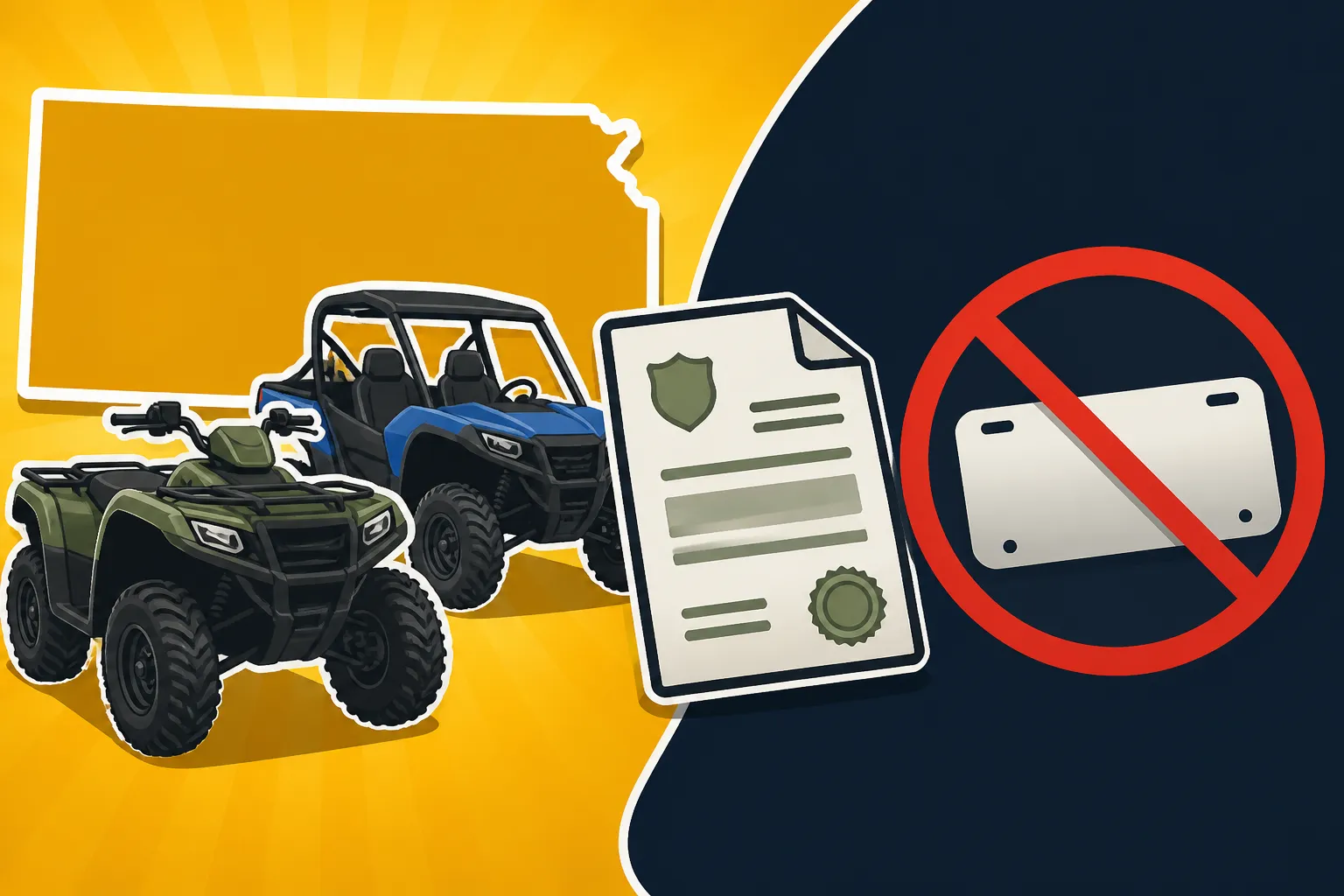
You just picked up a fantastic ATV or UTV in Kansas, or maybe you're considering a purchase, and you're hearing whispers about "nonhighway titles." It's exciting to get your new machine, but then you encounter the paperwork, and a common question pops up: "Where's my license plate? Why isn't there a tag for this thing?" This isn't just a minor detail; it's a fundamental difference in how Kansas law categorizes and treats off-road vehicles compared to standard cars or trucks. This guide is here to clear up that confusion, explaining precisely why your Kansas nonhighway title comes without a tag and what that distinction truly means for your riding adventures.
The Fundamental Difference: Highway vs. Nonhighway Vehicles
The core of this "no tag" mystery lies in how the state of Kansas legally defines and categorizes different types of vehicles. When you title a car, truck, or motorcycle, you're titling a machine designed and intended for use on public roads and highways. This primary purpose dictates a whole host of requirements, including registration, annual tags, and stringent safety standards. Your ATV or UTV, on the other hand, falls into a completely different classification.
Vehicles Designed for Public Road Use
Think about your daily driver. It has headlights, taillights, turn signals, mirrors, a horn, and often many other features mandated by federal and state highway safety regulations. These features aren't optional; they're integral to operating safely in traffic, alongside other vehicles, and interacting with road signs and signals. When you go to the county treasurer's office to title and register such a vehicle, you'll receive a physical license plate and a registration decal (tag) to affix to it. This tag serves as proof that the vehicle is currently registered, has paid its annual fees, and is legally permitted to operate on public roads. It's a clear visual signal to law enforcement and other drivers that your vehicle meets the basic legal requirements for highway travel.
Vehicles Designed Exclusively for Off-Road Use
Now, consider your ATV or UTV. While modern machines have certainly become more sophisticated with powerful engines and comfortable seating, their fundamental design philosophy is different. They're built for dirt, mud, rocks, and rough terrain, not asphalt highways. Kansas law recognizes this distinction very clearly. These machines are explicitly defined as "nonhighway vehicles," meaning they are not manufactured primarily for use on public streets, roads, or highways. Because their intended use is off-road, the state does not require them to meet the same safety standards as highway vehicles, nor does it issue annual registration tags for them. This is a crucial point that often catches new owners off guard, leading to the question of why their brand-new machine comes with a title but no immediate way to slap a license plate on it. The absence of a tag isn't an oversight; it's a direct consequence of its legal classification.
Deciphering the Kansas Nonhighway Vehicle Definition
Kansas law is quite specific about what constitutes a nonhighway vehicle, and understanding these definitions is key to grasping why your ATV or UTV receives a particular type of title – one that never includes a traditional license plate or annual registration tag. It's not arbitrary; it's rooted in the state's attempt to regulate these machines based on their design and typical usage.
What Qualifies as a Nonhighway Vehicle
The core definition hinges on the vehicle's primary design intent. Generally, a nonhighway vehicle is described as any motorized vehicle that is not manufactured for operation on a public highway. This immediately distinguishes your ATV or UTV from passenger cars, trucks, or even motorcycles. Instead, these machines are built for performance and durability in off-pavement environments, whether that's tearing up a sand dune, traversing a muddy field, or cruising a gravel trail. [How Kansas Law Defines a Nonhighway Vehicle] goes into this in more detail, but the key takeaway is that their very nature exempts them from the road-legal requirements that necessitate a tag. This is why you'll get a title, but you won't get that familiar license plate.
The law also typically categorizes ATVs and UTVs based on their width, weight, and steering mechanisms. For instance, an ATV is generally defined as a motorized vehicle designed for off-highway use, having a seat or seats designed to be straddled by the operator and any passenger, and handlebars for steering. A side-by-side (often classified as a UTV or work-site utility vehicle depending on its specifics) will typically have a steering wheel and side-by-side seating, resembling a miniature car. Despite these differences, if they are not primarily manufactured for highway use, they fall under the nonhighway umbrella. This broad classification means that while you still need to prove ownership through a title, the state sees no reason to issue a road-use tag for a machine it doesn't expect to see on state highways.
The Exemption from State Registration and Tags
Because ATVs and UTVs are classified as nonhighway vehicles, they are explicitly exempt from the annual state registration process that applies to road-legal vehicles. This is a crucial piece of information for any owner. [Kansas Has No OHV Registration] clarifies that you won't be paying yearly fees to the state to renew a tag or sticker for your off-road machine. This exemption means no annual fees, no trips to the county treasurer's office for a new sticker, and no physical license plate to mount on your quad or side-by-side. The title itself serves as the primary official document for the machine, establishing legal ownership.
This exemption is often a source of both relief and confusion. Relief because it means fewer annual costs and bureaucratic steps compared to a car. Confusion because many new owners, accustomed to the system for their automobiles, naturally expect a tag to accompany any titled vehicle. It's important to remember that this exemption applies to state registration. While state law doesn't require a tag, some local jurisdictions – certain cities, for instance – do have their own unique ordinances for UTVs that permit limited street use and might require a local city-issued permit or tag. However, these local tags are entirely separate from, and do not override, the state's nonhighway classification or its exemption from state registration. They are city-specific permits, not state highway tags.
What a Kansas Nonhighway Title Actually Accomplishes
So, if your nonhighway title doesn't come with a shiny new license plate, what's the point of getting one? It's a fair question, and the answer is surprisingly robust. While it might not signify road legality, a Kansas nonhighway title is an incredibly important document that serves several vital purposes for your off-road machine and your ownership experience. Don't let the lack of a tag diminish its significance; this piece of paper is your proof of ownership, a safeguard, and a necessity for many transactions.
Establishing Legal Ownership
The most fundamental purpose of your Kansas nonhighway title is to establish and prove legal ownership of your ATV or UTV. Just like the title for your car, this document ties you directly to the machine as its rightful owner. This is absolutely critical for a multitude of reasons, both practical and legal. Without a title in your name, you don't have indisputable proof that the machine belongs to you. This can become a huge problem if you ever need to sell the machine, transfer it to a family member, or even if it's stolen. [Kansas's Nonhighway Title Explained] provides a deep dive into what this document signifies.
When you purchase a new ATV or UTV from a dealer, they will typically handle much of the initial paperwork to get the title processed in your name. If you're buying from a private seller, you'll need to ensure you receive a properly assigned title from them, along with a bill of sale. For private sales, a robust bill of sale is your best friend. Resources like LawDepot can provide templates that ensure all necessary information is captured, protecting both buyer and seller. Taking the time to properly title your machine after purchase means you have a legally recognized record of ownership, which protects your investment and simplifies future transactions.
Deterring Theft and Aiding Recovery
While a title won't physically prevent your ATV or UTV from being stolen, it plays a critical role in deterring theft and, more importantly, in its recovery if it does go missing. A titled machine is part of a recorded system; its Vehicle Identification Number (VIN) is linked to your name in state records. If an untagged ATV or UTV is stolen and then recovered by law enforcement, a title makes it far easier to identify the rightful owner and return the machine. Without a title, proving that a recovered machine belongs to you can become an incredibly complicated and frustrating process, often involving affidavits and other hoops to jump through.
Moreover, the act of titling a machine can sometimes deter thieves. When a stolen machine is sold without a title, it's often a red flag to potential buyers, making it harder for thieves to unload their illicit gains. For machines purchased out-of-state, particularly if they come from a state that doesn't require titling for off-road vehicles, going through the Kansas titling process after moving to the Sunflower State is a wise protective measure. The cost of a Kansas nonhighway title is typically a nominal fee, making it a very affordable form of insurance against the headaches of proving ownership. [Kansas Charges $10 for a Title] is a helpful read that explains the fee and its purpose.
Necessary for Future Sales and Transfers
Let's be realistic: at some point, you might decide to upgrade your machine, sell it, or pass it down to a family member. Your nonhighway title is absolutely essential for these transactions. Without a clear, properly assigned title, selling your ATV or UTV can be incredibly difficult, if not impossible, to do legally. Buyers are, and should be, wary of purchasing a machine without a title, as it opens them up to potential legal issues, like buying a stolen vehicle or a machine with an undisclosed lien.
When you sell your machine, you'll endorse the title over to the new owner, much like you would with a car title. This formal transfer of ownership protects both you and the buyer. It ensures that your liability ends with the sale and that the new owner has the legal documentation needed to prove their ownership. Similarly, if you plan to gift your machine or transfer it due to inheritance, the title is the key document to facilitate this process smoothly. Using a comprehensive bill of sale, which you can often find templates for on sites like LawDepot, alongside the title, creates a complete record for both parties. Always make sure to complete the transfer promptly; [Kansas Gives You 60 Days to Apply] for a title after purchase, which applies to private sales as well.
When and Where a Tag Might Apply to Your Machine
While we've firmly established that a state issued tag doesn't come with your Kansas nonhighway title, it's not quite the end of the story for all off-road machines. There are specific circumstances and types of vehicles where a form of "tag" or permit might be required, but it's crucial to understand these are distinct from the state's primary titling process for ATVs and UTVs. These are generally local initiatives or specific vehicle classifications.
City Ordinances for UTV Street Use
This is where the waters can get a little murky for some owners. While Kansas state law explicitly classifies ATVs and UTVs as nonhighway vehicles and thus exempts them from state registration and tags, it also grants local municipalities the authority to create their own ordinances regarding the limited operation of certain machines on city streets. This primarily applies to UTVs, and sometimes golf carts, but almost never ATVs. If your city has passed such an ordinance, it means they've opted to allow UTVs on specific streets, under specific conditions. [Kansas Cities That Authorize ATV Street Use] provides more context.
In these cities, to operate your UTV on public streets, you will typically need to obtain a special city-issued permit or tag. This isn't a state license plate; it's a local decal or plate that signals compliance with that particular city's rules. These local tags usually come with their own set of requirements, which can include proof of insurance, a valid driver's license, specific safety equipment (like turn signals, mirrors, or windshields), and an annual fee. For example, cities like Louisburg have detailed ordinances laying out these requirements, and they issue their own unique identification for compliant UTVs, which can involve a registration fee. [Louisburg's UTV Tag Fees in Kansas] highlights how these local fees work. It’s imperative to check with your specific city hall before assuming any street legality, as rules vary wildly from one town to the next, and many cities still ban UTVs from streets altogether.
Work-Site Utility Vehicles (WSUVs)
Kansas law also has a unique classification for "Work-Site Utility Vehicles" (WSUVs). These are generally UTVs that meet very specific criteria regarding width (usually 48 inches or less), weight (over 800 pounds unladen), and design (bench or bucket seating, steering wheel). While WSUVs are also classified as nonhighway vehicles, their definition allows for limited road use under specific conditions, often related to agriculture or construction, or within the confines of a specific work site. [What Makes a Side-by-Side a Work-Site Utility Vehicle] explains these criteria.
Similar to city ordinances, if a WSUV is used on a public road within the parameters of the law, it might need to display specific markings, such as a slow-moving vehicle emblem. However, even with these provisions for limited road use, a WSUV still receives a nonhighway title from the state, and it does not come with a standard state-issued license plate or annual registration tag. The limited road use is typically tied to agricultural purposes or crossing highways, not general street cruising. The title remains the same, proving ownership, but without a state-level registration tag.
Navigating Off-Road Riding Without a State Tag
The lack of a state-issued tag for your ATV or UTV in Kansas might feel unusual if you're new to the off-road world, but it simply emphasizes that these machines are primarily intended for private land and designated off-road areas. Understanding this distinction is crucial for enjoying your machine legally and responsibly. It means focusing on where you can ride and what documentation you should always carry.
Permitted Riding Areas
Since your nonhighway titled machine doesn't have a state tag for road use, its natural habitat is off the pavement. The good news is Kansas offers various options for off-road enthusiasts:
- Private Land: This is by far the most common place to ride ATVs and UTVs in Kansas. If you own the land, you're free to ride on it. If you plan to ride on someone else's private property, you must obtain explicit permission from the landowner. Trespassing is a serious offense, and simply seeing open fields doesn't mean you can ride there. Always ask first, and ideally, get that permission in writing, or at least a text message you can show if a deputy asks.
- Designated ORV Parks and Areas: Kansas has a few fantastic dedicated off-road parks where you can legally ride your ATV or UTV. Places like Tuttle Creek ORV Area, School Creek ORV Area, Kansas Rocks Recreation Park, and Syracuse Sand Dunes Park offer a variety of terrain and experiences. [Kansas ATV Trails: Where You Can Actually Ride] is an excellent resource for exploring these options. These parks often have their own rules, fees, and sometimes require specific permits (e.g., a park entry fee, not a state registration tag) or safety equipment, but they are entirely legal places to ride your untagged machine.
- Limited Road Use (Farm & Ranch): Kansas law does provide for limited road use of ATVs and UTVs for agricultural purposes. This typically means crossing a highway or riding on certain county roads for a short distance to access another part of your farm or ranch. These exceptions are specific and generally require the machine to be used for bona fide agricultural tasks, and not for recreational joyrides on public roads. You still need a valid driver's license to operate the machine on any public roadway, even under these exceptions. [Kansas Rules for Riding a County Road] dives into the nuances of these limited allowances.
Carrying Proof of Ownership
Even though your ATV or UTV doesn't have a tag, you absolutely need to carry proof of ownership with you when you ride, especially if you're off your own property. This usually means keeping a copy of your nonhighway title or a bill of sale accessible. In a scenario where law enforcement stops you, particularly if you're riding on public land or a designated ORV area, they may ask for proof that the machine belongs to you. Presenting a copy of your title immediately clarifies your legal right to possess and operate the machine, saving you potential headaches.
It's a good practice to keep the original title in a safe place at home, like a fireproof safe, and carry a laminated photocopy or a digital image on your phone. This way, if anything happens to the copy you're carrying, your original is secure. While you won't have a tag to show, having documentation that proves ownership, along with any necessary park permits or written landowner permission, is your best defense against questions about the legality of your ride.
Common Misconceptions and What to Do Next
The world of off-road vehicle titling and regulation can be a bit of a labyrinth, especially when coming from a background of traditional highway vehicles. It's easy to fall prey to common misconceptions, but understanding the reality is crucial for compliance and enjoyable riding. Let's tackle some of the biggest misunderstandings and outline your next steps.
"A Title Makes My ATV/UTV Street Legal"
This is perhaps the most persistent and dangerous misconception out there. Many new owners, upon receiving their Kansas nonhighway title, mistakenly believe that simply having a title implies their ATV or UTV is now street legal, or at least capable of becoming so with a few modifications. This is fundamentally untrue. [Having a Title Does Not Make an ATV Street Legal] is a direct and important clarification. As we've discussed, the nonhighway title proves ownership, but it does not grant permission for general use on public roads.
The state of Kansas categorizes ATVs and UTVs as nonhighway vehicles precisely because they are not designed or intended for road use. They lack many of the safety features required for highway operation, and their performance characteristics are ill-suited for interacting with traffic. Attempting to operate a non-city-permitted ATV or UTV on public roads, state highways, or interstates (which are strictly forbidden) can lead to significant fines, legal penalties, and even impoundment of your machine. It's essential to separate the concept of "ownership documentation" (the title) from "operating permission" (which comes from specific local ordinances or narrow state law exceptions for farm use, not the state title).
"I Need an Annual Sticker or Tag From the State"
Another common misunderstanding is the expectation of an annual registration sticker or metal tag from the state, similar to what you get for your car or truck. As this entire guide emphasizes, Kansas does not require annual state registration or issue tags for ATVs and UTVs because they are nonhighway vehicles. [Kansas Has No OHV Registration] is definitive on this point. You will title your machine once, proving ownership, and that's it from a state registration standpoint.
The absence of an annual tag means you won't receive renewal notices from the state, and you won't have to budget for recurring state registration fees. This is a benefit, reducing the ongoing cost of ownership. However, it doesn't mean no fees or permits whatsoever. As mentioned, local city ordinances for UTV street use or entry fees for private off-road parks are separate and distinct. Don't confuse these with a state-mandated annual registration for your nonhighway vehicle. Your $10 title fee is a one-time charge, not an annual one. [What the $10 Nonhighway Title Fee Covers] details what this initial fee is for.
Your Next Steps: Ride Responsibly and Know Your Local Rules
Now that you understand why your Kansas nonhighway title doesn't come with a tag, your next steps should focus on responsible riding and being fully informed:
- Keep Your Title Safe: Store your original nonhighway title in a secure location. Carry a copy or digital image when you ride.
- Know Where You Can Ride: Stick to private property with permission, or designated off-road parks and trails. Thoroughly research any public lands or corps areas you plan to visit, as rules can vary.
- Check Local Ordinances: If you own a UTV and envision any limited street use, contact your local city hall to inquire about any specific ordinances they may have. Do not assume street legality.
- Consider Insurance: While Kansas doesn't mandate state registration for ATVs/UTVs, it's wise to consider insurance. Liability coverage can protect you in case of an accident on private land or in a park, and comprehensive coverage can protect your investment against theft or damage.
- Stay Informed: Laws and regulations can sometimes change, though the core nonhighway vehicle definition has been quite stable. Stay connected with local off-road groups or check official Kansas Department of Revenue resources periodically for any updates that might affect your riding.
By understanding the specific legal classification of your ATV or UTV in Kansas, you can avoid common pitfalls and ensure that your off-road adventures are both thrilling and compliant with the law. Happy trails!
| Feature | Kansas Highway Vehicle (Car, Truck, Motorcycle) | Kansas Nonhighway Vehicle (ATV, UTV) |
|---|---|---|
| Primary Design Intent | For use on public streets, roads, and highways | For off-road use, not primarily for public highways |
| State Title Issued | Yes (Proof of ownership) | Yes (Proof of ownership) |
| State Registration | Required annually | Not required |
| State License Plate | Issued annually with registration | Not issued |
| Annual State Tag/Decal | Yes, renewed annually | No |
| Road Legal by Default | Yes, with valid registration and license | No, generally prohibited on public roads |
| Limited Road Use Exceptions | Standard highway rules | Very specific, e.g., agricultural, WSUV criteria, city ordinance |
| Proof of Ownership on Machine | Vehicle registration, driver's license | Title copy/digital, landowner permission, park permits |
| Typical Cost for State Tag | Varies by vehicle type, weight, and county, annual | N/A (No state tag issued) |
| Common Misconception | If it has a title, it can drive anywhere | If it has a title, it's street legal |
Disclaimer
This article is for general informational purposes only and does not constitute professional advice. Laws, prices and regulations vary by location and change over time. Consult a qualified professional for guidance on your specific situation.