When a Park Can Send You Home Without a Refund
A riding day can end early if a park decides a rider has broken a rule, created a safety risk or ignored staff instructions. Whether admission is refunded usually depends on the park’s posted terms and the reason for removal. Check the rules before you unload, especially if you are visiting from out of state or planning around weather.
Why a Kansas riding park may ask you to leave
Private riding areas set conditions for entry and continued use. Those conditions may cover helmets, passengers, speed, alcohol, machine sound, trail access, pets, camping and staff directions. Paying admission does not necessarily give a rider permission to ignore those rules for the rest of the day.
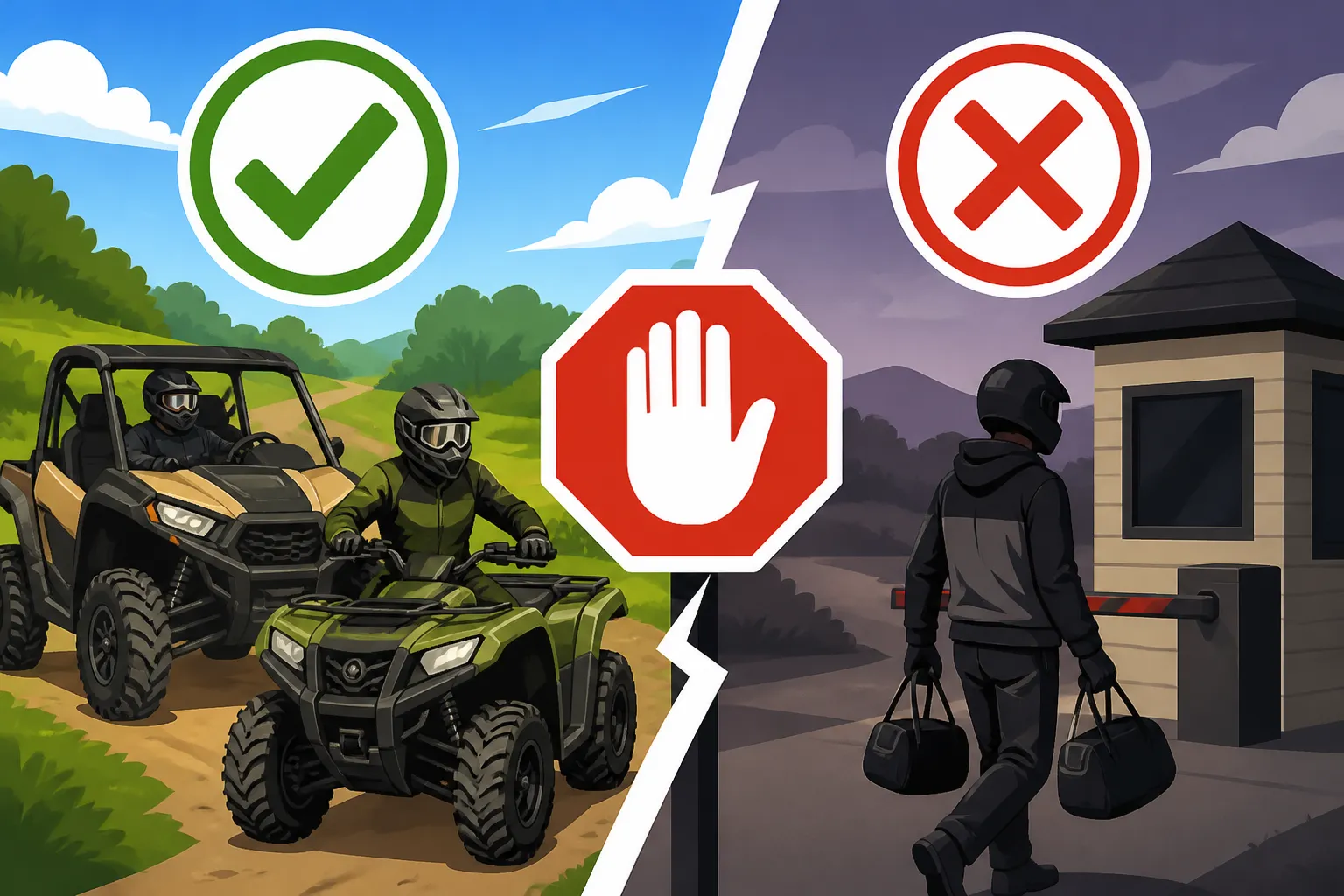
A park may stop a ride or remove someone when conduct puts people, machines or property at risk. Examples can include riding recklessly, leaving marked areas, operating while impaired, carrying an unauthorized passenger, or continuing after staff have given a warning. A machine that appears unsafe, or a rider who refuses an inspection required by the park, can also become an access issue. The exact grounds and consequences vary by property.
The important distinction is between a park rule and a statewide riding rule. Kansas does not operate a general OHV trail-pass system for private parks. A private property owner can set its own admission requirements and operating rules, while public-land access may be subject to different restrictions. Kansas Has No State OHV Permit explains why a state permit is not a substitute for a private park’s permission.
Before a visit, read the specific park’s current rules rather than relying on what was allowed at another facility. For example, the rules at Kansas Rocks Park Rules for Riders may not be the same as those at Kansas Syracuse Dunes Park Rules. Helmet requirements, passenger limits, age restrictions and alcohol policies can differ. A rule that seems minor at one location may be a condition of entry at another.
Removal does not always mean the park owes a refund. Admission may be treated as payment for access subject to the posted conditions, not as a promise that every rider can stay for the full day regardless of conduct. Still, do not assume that every park has the same no-refund policy. The terms may distinguish between a rider removed for violating rules and a closure caused by the operator, an emergency or unsafe conditions.
What the refund policy may cover
A refund decision often depends on why access ended, when it ended and what the operator promised at the time of purchase. The receipt, admission page, waiver, sign at the entrance or booking terms may describe whether admission is refundable, transferable or valid for another date. Save those terms and your proof of purchase.
| Situation | What may happen | What to check |
|---|---|---|
| Rider breaks a posted rule | The rider may be removed, and admission may not be refunded | Removal and refund terms, including whether warnings are required |
| Park closes or restricts riding for safety | The park may offer a credit, rescheduling option or refund, depending on its policy | Closure, weather and cancellation terms |
| One rider in a group is removed | The decision may apply only to that person, or the park may address the whole group | Group-admission and passenger rules |
| Rider leaves voluntarily | Admission may remain nonrefundable | Whether the park allows re-entry or date changes |
| Machine or equipment fails | The park may still treat admission as used | Mechanical-failure and re-entry terms |
| Admission was bought online or through another seller | Different cancellation terms may apply | The seller’s terms as well as the park’s rules |
This table describes possibilities, not a guarantee of how a particular operator will decide. A posted policy may use different wording, and special event admission can have separate conditions. If the terms are unclear, ask before paying: “If staff close a trail or send a rider home, what happens to the admission?” A direct answer is more useful than trying to resolve the issue after a disagreement at the gate.
Rain deserves separate attention. A park may stay open during light rain but close trails after heavy precipitation, or it may allow riding while warning that conditions are difficult. A wet trail can become unsafe or suffer damage, and management may restrict access to protect riders and the property. Before towing a machine a long distance, look for the park’s current operating notice and ask how it handles a closure after admission has been purchased. Refunds When Rain Shuts a Riding Park covers the questions to ask about weather-related cancellations.
A closure is not the same as removal for a rule violation. If the operator ends riding for everyone, ask whether the policy offers a rain check, a new date or another remedy. If only one rider is removed, ask which specific rule was violated and where that rule was posted. Staying calm and asking for the written terms usually gives you a clearer path than arguing at the gate.
Reduce the chance of being removed
A few checks before arrival can prevent the most common misunderstandings. Park rules are property-specific, and an out-of-state sticker or permit does not automatically replace local admission or safety requirements. Kansas Requires No Sticker of Visitors addresses state reciprocity, but private operators can still require their own passes, waivers, equipment or proof of compliance.
- Read the rules for the exact location. Check the park’s current page or call if important details are missing. Confirm allowed machine types, trail limits, passenger rules, age requirements and riding hours. A rule at one Kansas park should not be assumed to apply at another.
- Confirm requirements for each rider. Ask whether helmets, eye protection, insurance or signed waivers are required. Rules may differ for children, passengers and adults. The park’s waiver and admission terms are covered in Kansas Private Park Waivers and Rules.
- Ask about your machine. Verify that your ATV or UTV is allowed on the trails you plan to use. A width restriction, sound limit or other equipment requirement can affect entry. Do not assume that a machine’s Kansas title class determines which trails a private park permits it to use.
- Be candid about passengers and riders’ ages. If a machine has one seat, do not add a passenger unless the park and manufacturer allow it. Check age and supervision requirements before bringing a young rider. Park-specific policies may be stricter than what you have encountered elsewhere.
- Ask about weather and closures before you leave. Check trail conditions on the day of the visit and learn what happens if the park closes after you arrive. If you need to reserve a campsite or pay for an event separately, ask whether those charges follow a different cancellation policy.
- Keep a copy of the terms. Save the admission confirmation, waiver, posted rules and any message from staff about closures or refunds. If there is a disagreement, accurate records make it easier to discuss what was promised.
If you plan to use public land instead of a private riding park, do not assume the same access system applies. A Kansas park permit can cover particular roads or areas without granting access to private trails; see Kansas Park Permit vs Trail Permit. For a public-area trip, check the managing agency’s rules and the boundaries of permitted travel. For a private facility, the property’s own rules control access.
What to do if staff tell you to leave
First, stop riding and follow immediate safety instructions. Do not continue onto a trail, drive around a barrier or attempt to re-enter without permission. A dispute over admission is not worth turning into a safety incident or a trespass problem.
Ask politely for the reason for removal and the rule involved. If staff say a particular requirement was violated, ask where it appears in the posted rules or waiver. If a warning was given, note when and what was said. You can ask whether the decision applies to one rider or the entire group, and whether any unused admission can be transferred or credited. Do not assume the answer will be yes, but it is reasonable to ask.
If you believe the park has misunderstood what happened, explain briefly and stick to the facts. Avoid threats, insults or filming staff in a way that escalates the situation. If the conversation is not productive, leave as directed and follow up later through the park’s published contact channel. Include the date, receipt, relevant rule and a concise account of the exchange. A clear written request is more likely to receive a useful response than an argument at the entrance.
When the issue is a general closure, ask for the operator’s written refund or rescheduling policy and whether it applies to your admission type. When the issue is alleged misconduct, ask which term governs the decision and whether the park offers a review process. Keep expectations grounded: a request for an explanation is not the same as an automatic right to a refund.
A park can often set and enforce reasonable conditions for using its property, but the details depend on its published terms and the circumstances. The best way to protect your trip is to verify the rules before paying, follow staff instructions, and clarify refund terms before you unload. That matters even more when a long drive, group reservation or overnight stay makes a last-minute change expensive.
Disclaimer
This article is for general informational purposes only and does not constitute professional advice. Laws, prices and regulations vary by location and change over time. Consult a qualified professional for guidance on your specific situation.