Speed Limits Posted at a Kansas Riding Park
A speed sign at a Kansas riding park can mean something different from the state’s general speed rule. The key is knowing whether you’re on state-managed land, at a private park, or on a public road. Here’s how to read the posted limit, what to confirm before riding, and why a park permit doesn’t make every road or trail open to ATVs and UTVs.
What a posted speed limit means in Kansas
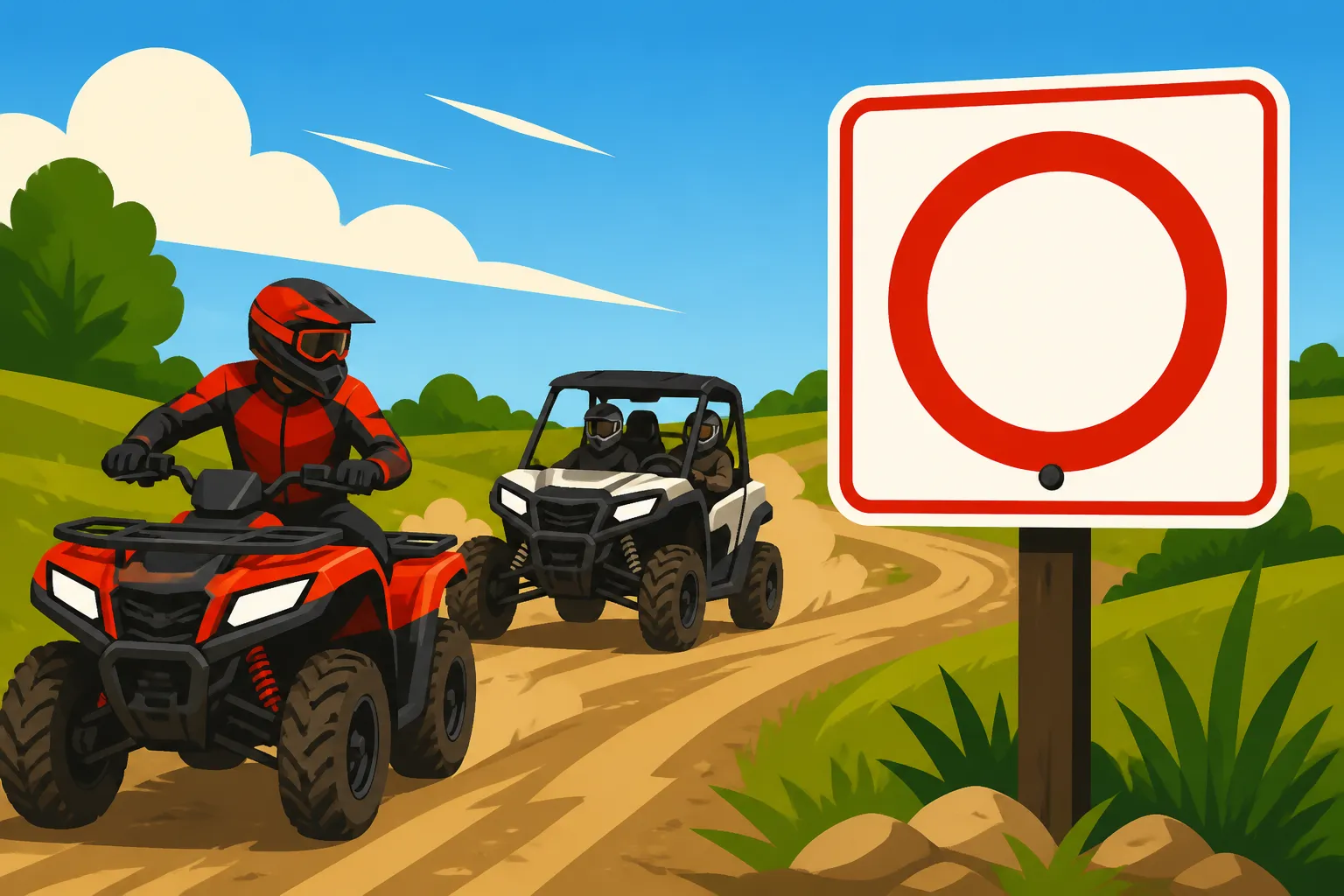
According to the Kansas Department of Wildlife and Parks, motorized vehicles on department lands and waters, including state parks, are limited to 25 miles per hour unless otherwise posted. In practical terms, look for signs that set a different speed for a particular road or area, and follow that posted limit rather than assuming the general limit applies everywhere.
That rule is specific to department lands and waters. It does not establish a single speed limit for every Kansas riding park, especially private off-road parks. A private park may post its own limits for roads, parking areas, staging areas, or riding zones. Follow the park’s signs and rules, and ask staff if a sign is missing, unclear, or seems to conflict with instructions you received.
A posted limit is a maximum, not a target. Reduce speed when visibility is limited, the surface is loose or uneven, riders are nearby, or you can’t stop safely within the distance you can see. Dust, rocks, mud, and narrow turns can all make a speed that seems manageable on an open stretch unsafe in another part of the park.
It also helps to separate the speed limit from the question of where you may ride. A speed sign does not authorize access to a closed route, private property, or a trail that does not allow your machine. Before traveling, check Kansas Trail Conditions Before You Tow and Kansas Trail Etiquette Locals Expect, then confirm that the riding area permits your type of vehicle.
State parks are different from private riding parks
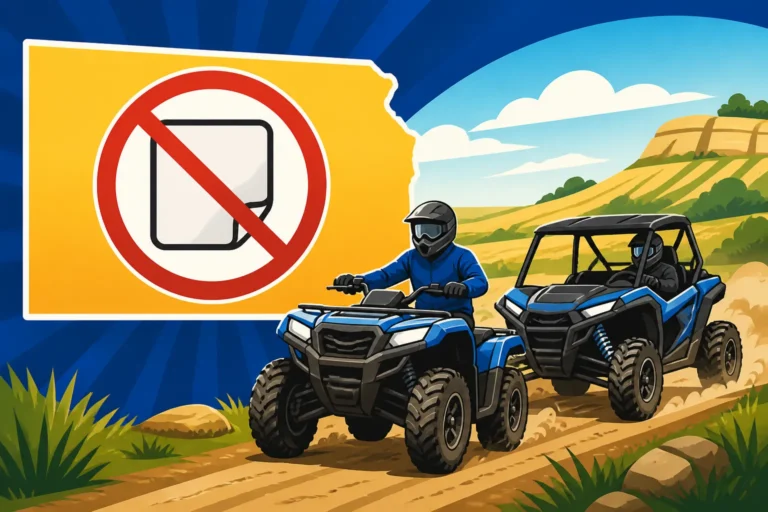
Kansas state parks are not a network of ATV and UTV trail systems. According to the Kansas Department of Wildlife and Parks, no Kansas state parks feature ATV or UTV trails, and off-road vehicle use is also prohibited on state wildlife areas. This makes it important not to mistake a state park road or parking area for an off-road trail.
There is a limited state-park road-use situation for qualifying vehicles. According to the Kansas Department of Wildlife and Parks, UTVs operating on allowed improved roads and parking areas within state parks need a specialized unconventional vehicle permit. The department also says non-residents using qualifying unconventional vehicles in those areas must purchase a state park vehicle permit and an unconventional vehicle permit. These permits do not turn closed areas into riding routes.
The 25 mph limit applies to motorized vehicles on department lands and waters unless otherwise posted, according to the Kansas Department of Wildlife and Parks. A sign may set a lower or different limit for a specific place. Check for signs when entering the park and again when moving between roads, parking areas, and other marked zones.
That state rule should not be carried over automatically to a private riding park. Private facilities may have their own posted limits and operating rules. If you’re visiting one, review the park’s requirements before unloading and follow staff directions while riding. Kansas Private Park Waivers and Rules and Kansas Rocks Park Rules for Riders can help you think through the kinds of facility rules to check.
| Where you are riding | What to do about speed | What to confirm |
|---|---|---|
| State park or other department land | Follow the posted sign; the general limit is 25 mph unless otherwise posted, according to the Kansas Department of Wildlife and Parks | Whether your route is an allowed road or parking area, and whether your vehicle needs a permit |
| Private riding park | Follow the facility’s posted limits and operating rules | Whether the park allows your ATV or UTV in that area and whether staff have additional instructions |
| Public street or road | Follow the rules that apply to that road and to your vehicle | Whether local rules permit your machine to operate there; a park sign does not authorize public-road use |
If you’re unsure whether a facility is state-managed or private, find out before treating its posted speed as a statewide rule. The distinction matters for access, permits, and which rules apply. Kansas State Parks Have No OHV Trails explains the state-park distinction, while Kansas Private Park Insurance Rules covers another set of requirements that may be determined by a private facility.
Check the route, vehicle, and permit before riding
A speed limit only answers how fast you may travel in a particular place. It does not establish that your machine is allowed there. Before leaving the staging area, confirm that the route is open to your vehicle type and that any required permit is in place.
Kansas’s classifications can help explain why two machines may not face the same access requirements. Under Kansas law, an ATV is a motorized nonhighway vehicle, excluding electric-assisted bicycles, that is no wider than 55 inches, has a dry weight of 1,500 pounds or less, and travels on three or more nonhighway tires, according to the Kansas Office of Revisor of Statutes. The state defines a work-site utility vehicle using different measurements and equipment requirements; the definition includes a steering wheel, four or more nonhighway tires, and side-by-side seating for at least two people, and excludes micro utility trucks.
Those definitions are not a substitute for checking the park’s own access rules. A vehicle that qualifies as a UTV under one classification may still be restricted from a specific trail or area. For example, Kansas Trails That Allow Side-by-Sides is useful when comparing trail access, and Kansas Trail Difficulty Ratings can help you assess whether a route suits the machine and riders in your group.
Kansas does not have a statewide OHV trail permit system or general public-land trail pass, according to the Kansas Department of Wildlife and Parks. That does not mean no permit is ever required. The department requires a specialized unconventional vehicle permit for UTVs on allowed improved roads and parking areas in state parks, and non-residents using qualifying vehicles in those areas also need the state park vehicle permit.
A park permit and a speed limit address different things. The permit may be required to use an allowed area; the posted sign controls speed within that area. Neither gives permission to ride on a closed trail, a state wildlife area where off-road use is prohibited, or a public road where your machine is not authorized. For more on the distinction, see Kansas Unconventional Vehicle Permit and Kansas Park Permit vs Trail Permit.
Before riding, use a simple check:
- Identify whether the land is state-managed or private.
- Confirm that your machine is allowed on the exact route or area.
- Check whether a park or vehicle permit is required.
- Read the posted speed signs at the entrance and along the route.
- Ask park staff about unclear signs, closures, or local operating instructions.
If the park’s rules and a sign appear to disagree, don’t guess. Slow down or stop in a safe place and ask staff for clarification. That is safer than treating a sign as optional or assuming a general speed rule overrides a local restriction.
Speed on a public road is a separate question
A riding park’s speed signs apply to the places they govern. They do not make an ATV or UTV street-legal, and they do not replace public-road rules. Kansas treats standard ATVs and work-site utility vehicles as nonhighway vehicles; their status and limited exceptions for road use are separate from a riding park’s operating rules.
According to the Kansas Highway Patrol, vehicles originally made for off-road or nonhighway use cannot be made fully street-legal and registered for general operation on public roadways. Limited exceptions may allow operation on certain roads, such as for agricultural purposes under specific conditions or where local ordinances permit it. A park’s sign does not create one of those exceptions.
Where Kansas law allows an ATV on a public highway, street, or road between sunset and sunrise, it must have lights required by law for motorcycles, according to the Kansas State Legislature. That requirement applies to the public-road situation described by the law; it does not mean headlights must be illuminated at all times in a riding park.
Public-road access also has boundaries that do not depend on a park’s posted speed. Kansas law prohibits ATVs and work-site utility vehicles from operating on interstate highways, including the Kansas Turnpike, according to the Kansas Legislature. A route that leads toward a public road is not permission to continue onto a prohibited road.
If you plan to travel between a park and nearby roads, check the applicable local rules before the ride. A local ordinance may authorize limited operation in a particular place, but a general road-use assumption can lead to an unsafe or unlawful trip. For related questions, see Kansas Rules for Riding a County Road, Kansas UTV Street Legal Rules by City, and Having a Title Does Not Make an ATV Street Legal.
If an incident or disagreement about a rule occurs on state-managed public land, the Kansas Department of Wildlife and Parks’ Law Enforcement Division is responsible for enforcing public-lands regulations and off-road vehicle rules there. That does not make a speed sign a substitute for careful riding: keep within the posted limit, leave room to stop, and yield to other users.
Sources
- Kansas Office of Revisor of Statutes — 8-1402a. "All-terrain vehicle" defined (checked November 2, 2026)
- Kansas Department of Wildlife and Parks — Kansas State Park Entrance and Camping Fees (checked November 2, 2026)
- Kansas Department of Wildlife and Parks — State Park Regulations (checked November 2, 2026)
Disclaimer
This article is for general informational purposes only and does not constitute professional advice. Laws, prices and regulations vary by location and change over time. Consult a qualified professional for guidance on your specific situation.