Kansas Trail Etiquette Locals Expect
Kansas riders know the frustration: you’ve hauled a quad or side-by-side to a riding area, only to find a closed trail, a crowded staging spot, or someone kicking up dust right behind you. Good trail etiquette helps everyone ride safely and keeps access open. This guide covers the habits that matter on Kansas trails, from loading up to leaving the last parking area.
Start with the riding area’s rules
Confirm access before you load
Kansas riding opportunities include public recreation areas and private parks, and their rules are not interchangeable. A route that is open to one kind of machine may exclude another, while a park may set its own rules for helmets, passengers, sound, speed, or alcohol. Check the specific area’s current rules before setting out, and follow posted signs once you arrive. A trail name on a map is not, by itself, permission to ride it.
This matters especially when you are planning around places such as Tuttle Creek ORV Area, School Creek ORV Area, Kansas Rocks Recreation Park, or Syracuse Sand Dunes. Each location has its own access details and riding conditions. If you are choosing a route for a group, first confirm that the area allows every machine in the group. [Kansas Trails That Allow Side-by-Sides] can help you think through that fit before you make the drive.
Do not assume an open gate means every trail is open. A gate may provide access to a parking area, while signs farther in mark a closure or a route restriction. If you are uncertain whether a road or trail is intended for riding, stop and check with the property manager or the posted information rather than treating uncertainty as an invitation.
Match your machine and riding style to the route
A narrow, rocky route can be a poor choice for a wide UTV, a novice rider, or a group that includes children. Before leaving the staging area, compare your machine’s width and capabilities with the route’s restrictions and difficulty. Trail ratings are useful, but they do not replace a realistic assessment of ground clearance, tires, experience, and weather. [Kansas Trail Difficulty Ratings] offers a useful starting point for thinking about those differences.
Plan for the least experienced rider in the group, not only the person who knows the area best. A route that feels straightforward to a regular rider may become stressful when someone is unfamiliar with loose rock, ruts, sand, or steep turns. If the group is split on what to ride, pick the easier option or agree on a clear meeting point before anyone takes a different route.
Maps and navigation tools can help you understand where you are, but they do not override signs, closures, or landowner directions. Some riders use onX Offroad to prepare a route and identify nearby roads or riding areas before leaving home. Treat any digital map as a planning aid: confirm access at the site, keep an eye out for physical markers, and do not follow a line that appears to cross closed or private land.
Share the trail with patience and care
Give other riders room
A trail is a shared space, not a place to prove who can go fastest. Keep a speed that leaves enough room to react to a sudden stop, a blind corner, a child on a small machine, or a rider who is negotiating an obstacle. Slow down when approaching other people, especially near trail junctions, staging areas, and narrow sections where there is little room to pass.
When you catch up to another rider, give them time and space to notice you. Avoid riding close behind, revving repeatedly, or pressuring them to move faster. Wait for a safe, visible place to pass and make your intentions clear. If you are the slower rider, use a suitable pull-off when it is safe, but do not pull into soft ground, vegetation, or an unsafe slope just to let someone through.
The same courtesy applies when you meet riders traveling the other direction. Slow down, make room where possible, and take turns negotiating a tight section rather than forcing a squeeze. In a UTV, remember that the machine may occupy much of the usable trail; do not assume a quad or dirt bike can simply disappear into the edge.
Control dust, noise, and group spacing
Dust can make a ride miserable and hazardous, especially on dry Kansas trails where visibility may drop quickly. When following another machine, leave a generous gap and reduce speed rather than riding through a thick cloud. If you are leading, avoid accelerating hard past people or campsites when a gentler pace will do. Dust settles slowly, so a brief pause may be kinder than continuing to trail a rider who can barely see.
Noise travels farther than many riders expect. Be considerate near homes, campsites, parking areas, and other visitors. Avoid unnecessary engine revving, especially early or late in the day, and use only routes and areas where your machine is permitted. A loud machine can turn an otherwise pleasant day into a complaint that affects the whole riding community.
Groups should ride in a way that does not block the trail. Keep enough distance to see and react, but stay close enough that the group remains organized at turns and intersections. If several machines need to stop, move as far off the riding line as the site safely allows. Avoid spreading across the trail or leaving a machine parked where oncoming riders cannot see it.
For group outings, agree on a leader, a sweep rider, and regrouping points before starting. [Kansas Group Ride Planning] can help you prepare those basics. A route-planning tool such as onX Offroad may be useful for sharing a planned route with the group, but make sure everyone understands where to stop and what to do if the group gets separated.
| Situation | Considerate response | What to avoid |
|---|---|---|
| You catch up to a slower rider | Keep distance and pass only where it is safe | Tailgating, honking, or forcing a pass |
| Dust reduces visibility | Slow down and allow the cloud to clear | Staying close and riding blind |
| A group needs to stop | Move machines clear of the riding line where possible | Blocking a junction or narrow trail |
| You reach a blind corner | Slow down and stay alert for oncoming riders | Cutting the corner or accelerating through |
| You find a closed route | Turn around and use an open route | Going around a barrier or sign |
Protect the trail and the land around it
Stay on designated routes and respect closures
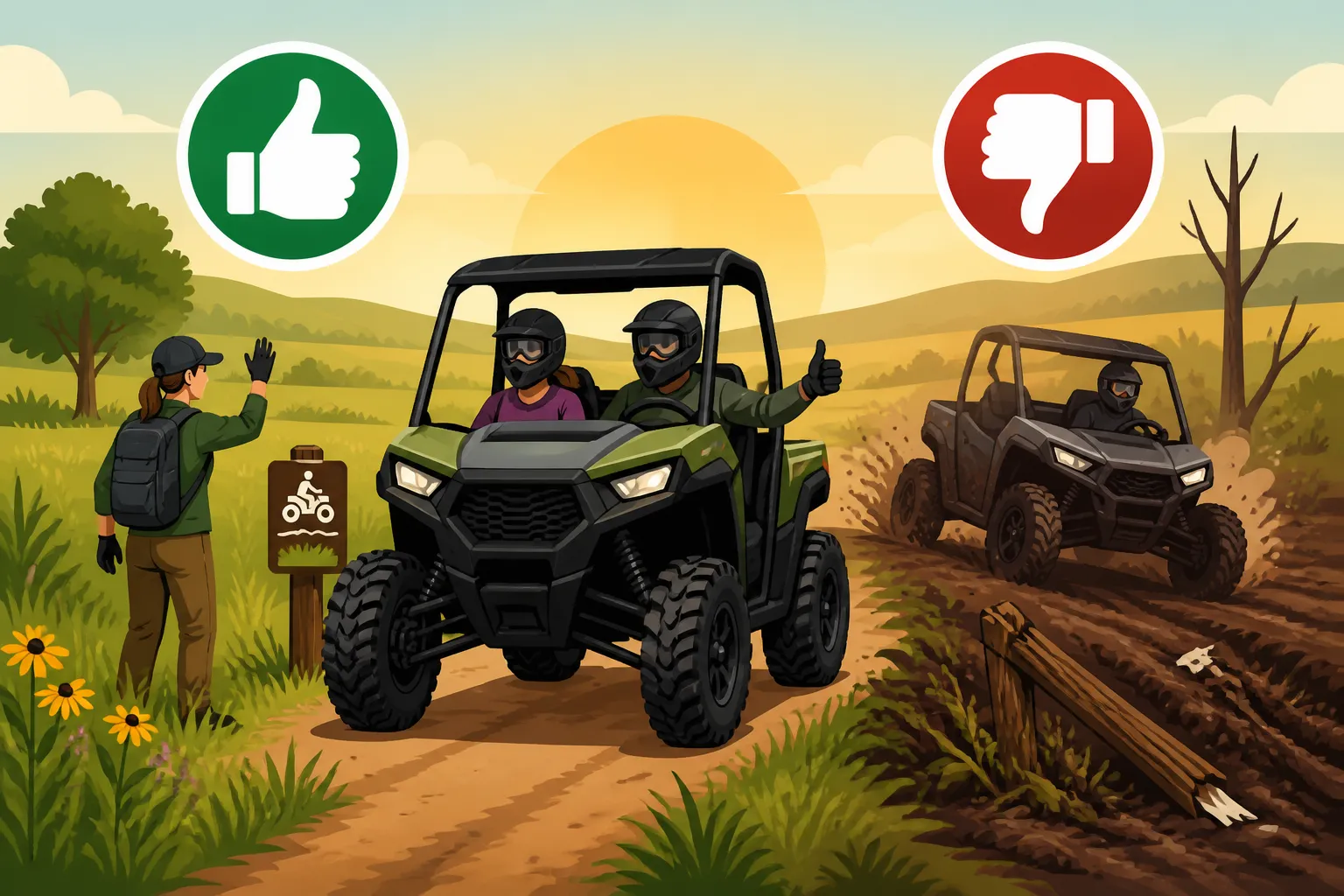
Riding off the marked route can damage vegetation, cause erosion, disturb wildlife, and create tracks that property managers may later need to close. Keep your machine on routes designated for riding, even if a shortcut looks dry or harmless. Do not widen a trail to get around a puddle, rut, or obstacle. A bypass can become a lasting scar and encourage other riders to do the same.
Closures deserve particular attention after rain. Wet ground can rut deeply under tires, and repeated traffic may damage a trail long after the surface begins to look dry. Check conditions before you tow and again at the entrance. [Kansas Trail Closures After Rain] is a useful reminder that a planned ride may need to change when weather affects access.
A sign or barrier is not a challenge to get around. Do not move barricades, ride around a closed gate, or assume a route is open because you see fresh tire tracks. If you come across a closure that is not clear, stop and ask the park operator or land manager. Choosing a different route is less frustrating than risking damage, a citation, or a closure that affects other riders.
Leave campsites, parking areas, and natural features in good shape
Pack out everything you bring in, including food wrappers, broken straps, empty bottles, and small pieces of packaging that can blow away. Do not leave trash in a fire ring or tuck it beside a tree, even if the site looks remote. If you see litter and can safely pick it up, doing so is a simple way to show respect for the people who maintain the area.
Use established parking and staging spaces, and avoid driving over grass or vegetation to make room for another trailer. At a crowded trailhead, take the time to park thoughtfully so other vehicles can unload and leave. [Kansas Trailheads With Trailer Parking] can help with planning, but arrive ready to adapt if the designated area is full. Do not block access roads, gates, or emergency routes.
Treat wildlife, livestock, fences, and water features with care. Keep your distance from animals and do not chase them for a photo or a better view. Never cut a fence or open a gate and leave it open. If a gate is meant to be closed behind you, close it; if instructions are unclear, pause and seek guidance. These small actions matter on working land and in places where a riding area shares space with other uses.
Prepare thoughtfully and handle problems calmly
Arrive ready to ride and navigate
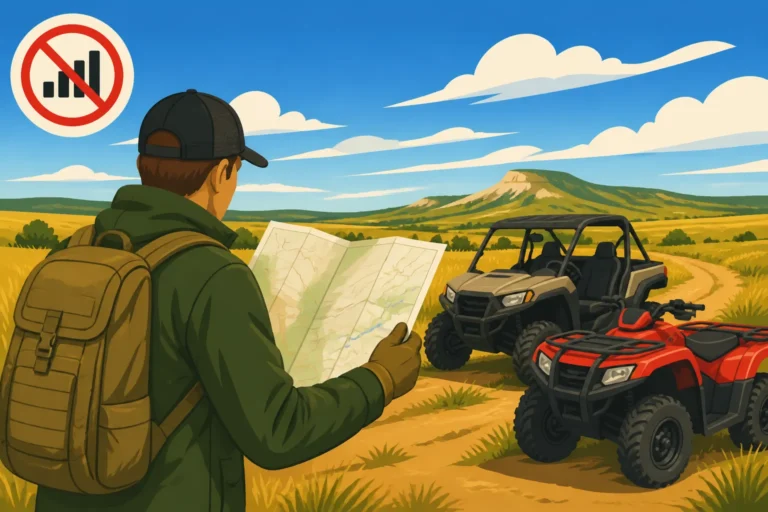
A considerate ride starts before you reach the trailhead. Check the weather, access information, and machine restrictions; make sure your group knows where it is going; and bring what you need to handle a delay without relying on other riders. A phone may lose service in rural areas, so save route information for offline use and consider carrying a paper map. [Carrying a Paper Map Where Cell Service Drops] covers why a backup can be valuable when a screen stops helping.
Tell someone where you plan to ride and when you expect to return. Carry basic repair and first-aid supplies appropriate for your machine and group, and make sure riders know how to stop or signal if a problem comes up. Good preparation reduces the chance that another group has to abandon its ride to help with a preventable issue.
onX Offroad can be one way to review a route before leaving, but do not depend on a phone alone. Keep a charged device protected from dust and weather, and have a fallback plan if it fails. Before the ride begins, identify the entrance, likely turnarounds, and any planned regrouping points. Clear plans are particularly helpful when several machines travel together or riders have different experience levels.
Respond well when something goes wrong
If a rider breaks down, gets hurt, or becomes separated, stop somewhere safe and keep the trail as clear as possible. Avoid gathering every machine around a disabled vehicle if the route is narrow. One or two people can help while the rest of the group waits at a safe regrouping point. If the situation involves an injury or immediate danger, use the appropriate emergency response rather than trying to handle it alone.
When a disagreement arises, keep your voice calm and focus on what happened and what needs to happen next. A heated argument at a trailhead rarely improves anyone’s day. If someone is riding recklessly or ignoring a closure, do not put yourself at risk by confronting them on a narrow trail. Follow the riding area’s reporting process or contact the responsible staff.
Finally, thank the people who maintain the area and follow any instructions they give. Private parks may have waivers and site-specific rules, while public riding areas can have different access conditions. [Kansas Private Park Waivers and Rules] is a helpful reminder to read the details before unloading. When riders show patience, respect closures, control dust, and leave the area clean, they help make a good day on the trail more likely for everyone.
Disclaimer
This article is for general informational purposes only and does not constitute professional advice. Laws, prices and regulations vary by location and change over time. Consult a qualified professional for guidance on your specific situation.