Running a Generator at a Riding Park Campsite
A generator can keep a riding-park campsite comfortable and make it easier to charge equipment, but it can also disturb nearby campers or create a serious safety hazard. At Kansas riding parks, operating rules are set by the individual park, not by one statewide campsite rule. Check with the park before you load up, then plan where the generator will run, when it will be shut off, and how you’ll use it safely.
Check the park’s rules before bringing a generator
There is no single generator policy for every Kansas riding park. A private campground may allow generators with limits, restrict them to certain hours or areas, or prohibit them altogether. Rules can also differ between primitive sites, sites with electrical hookups, and busy event weekends.
Start with the park’s current rules, then call if the wording is unclear. Ask whether generators are allowed at your specific site, whether there are operating-hour restrictions, and whether the park sets requirements for noise, placement, fuel storage, or extension cords. Confirm any rules that matter to your plan rather than assuming that a generator used at another campground will be acceptable here.
The park’s policy may be part of its general Kansas Private Park Camping Rules or its wider Kansas Private Park Waivers and Rules. A waiver is not a substitute for operating instructions, so ask specifically about generator use. If you are heading to Syracuse Sand Dunes, check Kansas Syracuse Dunes Park Rules and ask whether its current campsite rules address generators. For any campground, written rules can help you plan, but a quick call is useful when a detail is missing.
| Question to ask | Why it matters |
|---|---|
| Are generators allowed at my site? | Some locations or site types may have different restrictions. |
| What are the permitted operating hours? | You may need to schedule charging or other high-demand use. |
| Are there noise limits or quiet hours? | A generator that is technically allowed can still violate a quiet-hours rule. |
| Where may the generator be placed? | The park may require separation from tents, neighboring sites, or walkways. |
| Are there fuel-storage or fire restrictions? | Dry conditions, event rules, or local policies can affect what you may bring. |
| Are electrical hookups available? | A powered site may remove the need to run your own generator. |
Check again shortly before departure if your plans depend on the generator. Rules can change, and temporary restrictions may apply during crowded weekends, fire-danger periods, or special events. If the park says generators are not allowed, do not assume that a smaller or quieter model will be an exception. Ask whether another option is permitted, such as using a hookup or charging a battery before the trip.
If you are still choosing a campground, compare more than riding access. Look at the site type, available amenities, and whether power is offered. The list of Kansas Riding Areas With RV Hookups may help narrow down options, but verify the details directly with the park before relying on a hookup.
Choose a safe location and power setup
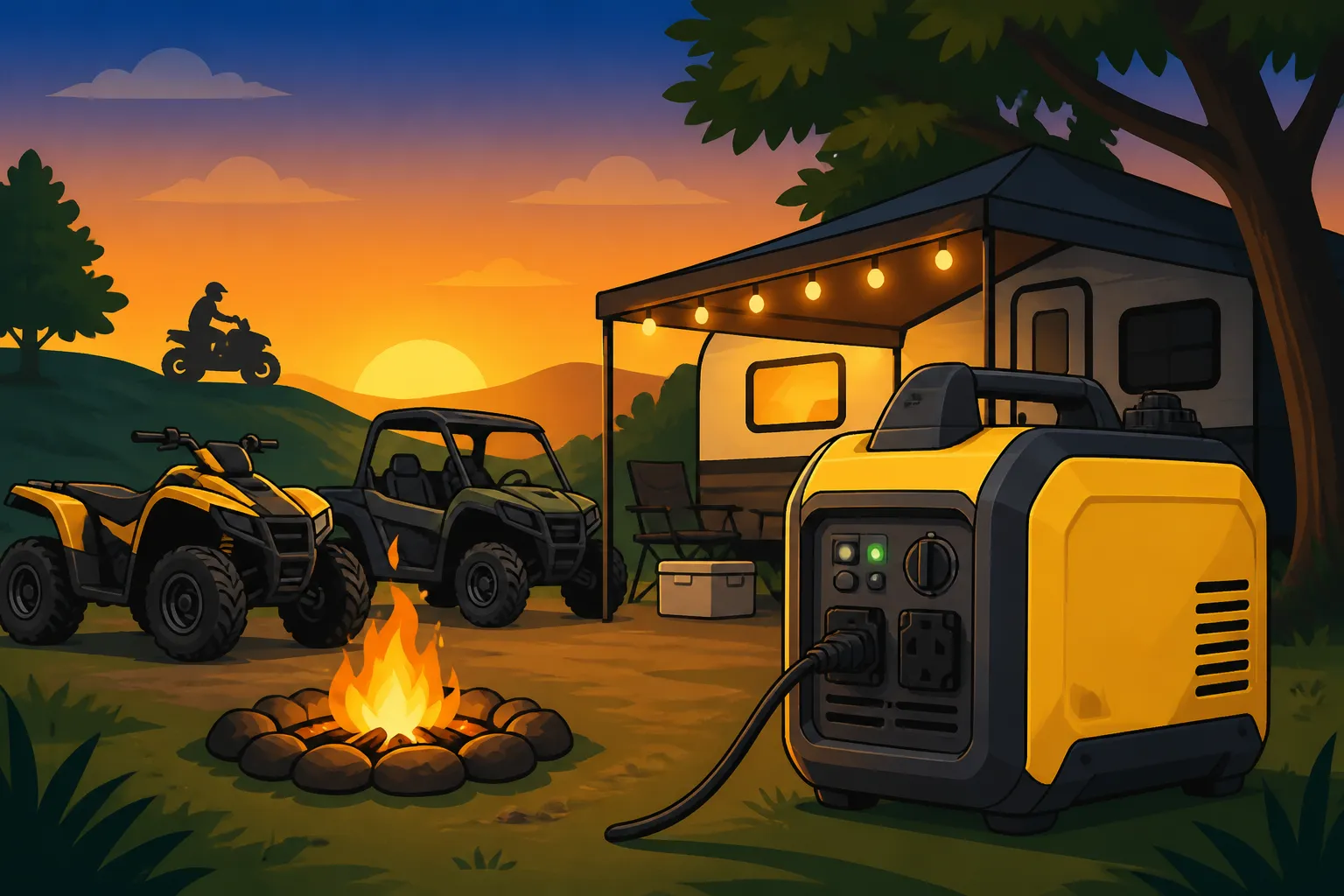
A generator belongs outdoors in open air. Never run one inside a tent, vehicle, trailer, camper, shed, or other enclosed or partly enclosed space. Carbon monoxide is an odorless, poisonous gas that can build up quickly and cause serious injury or death. Opening a door, window, or tent flap does not make indoor operation safe.
Set the generator outdoors, away from doors, windows, vents, and occupied sleeping areas. Keep it away from neighboring campsites too. Direct exhaust away from people and structures, and consider how the wind might shift. A spot that seems safe at setup can become a problem if the exhaust starts drifting toward a tent or camper.
Follow the separation distances and placement instructions in the generator’s manual. Do not guess based on how loud it sounds or how far away the next campsite appears. Choose a stable, level location where the generator cannot be knocked over, flooded by runoff, or reached by children. Keep it clear of footpaths, parked vehicles, dry vegetation, and anything else that could catch fire or block airflow.
A carbon monoxide alarm inside a camper or RV is a valuable backup, not permission to run the generator close to it. It does not replace outdoor placement, safe separation, or the manufacturer’s instructions. If an alarm sounds or anyone develops symptoms such as headache, dizziness, nausea, weakness, or confusion, move everyone to fresh air and seek emergency help.
Match the generator to the job
Work out what you actually need to power before packing. A phone, light, and small battery charger require less power than several appliances running at once. Check the rated running and starting requirements of each device, then make sure the generator can handle the combined load. Starting a motor or compressor can require more power than keeping it running.
If the generator is mainly for charging batteries, running it for a planned period may be less disruptive than leaving it on all day. A portable power station or charged batteries may cover small needs without continuous engine noise. Those options still need to be used and charged according to their instructions, but they can reduce the number of hours a generator runs.
Use only outdoor-rated extension cords that are in good condition and suitable for the load. Keep connections dry, route cords where people will not trip over them, and avoid pinching them under tires or equipment. Do not overload a cord, connect cords in a way the manufacturer warns against, or improvise a connection to a building or campground electrical system. If you are unsure whether a cord or appliance is compatible, check the equipment instructions before using it.
Protect the generator from weather and traffic
Outdoor operation does not mean leaving a generator exposed to every hazard. Follow the manufacturer’s directions for rain, moisture, and ventilation. Do not cover a running generator in a way that traps heat or blocks exhaust, and do not place it under an enclosed shelter. If the weather makes safe operation impossible, shut it down and wait for conditions to improve.
Keep the generator and cords out of the way of vehicles, trailers, and people walking to the facilities. Riding parks can be busy, especially when campers are unloading or returning from the trails. A generator set on a campsite edge may look convenient but can create a trip hazard or put it too close to another site. If the designated location does not seem safe, ask park staff before moving it.
Keep noise, fumes, and fire risk under control
A generator can be permitted and still be a poor fit for a crowded campsite if it runs loudly or for long stretches. A low-noise or inverter model may be more comfortable for neighbors, but it does not guarantee that the park will allow it or that it will meet a local rule. The park’s requirements come first.
Use the generator only when you need it. Plan charging and appliance use so you can switch it off during quiet periods and overnight. If a park has posted quiet hours, follow them even if the generator seems quiet from inside your own camper. The people nearby may be sleeping in tents with little sound insulation. Check Quiet Hours When You Camp at the Dunes if that location is part of your trip, and confirm the current schedule with the park.
Positioning the generator farther away can reduce disturbance, but do not move it so far that you lose safe exhaust clearance or create a long, poorly routed cord. Avoid pointing exhaust toward another campsite, a trail, a road, or a shared area. If a neighbor tells you that fumes or noise are reaching their site, take the concern seriously. Shut it down while you reassess the location or ask staff for help.
Fuel needs careful handling. Follow the generator manual and the campground’s fuel-storage rules. Keep fuel in an appropriate container, away from heat, flames, and places where it could be tipped over. Do not refuel a hot or running generator. Shut it down and let it cool as directed before refueling, and clean up any spills before restarting. Do not smoke or use an open flame near fuel.
Keep the generator away from campfires, cooking flames, and dry grass. During dry conditions, a park may impose additional fire restrictions; check Campfire Bans During a Kansas Dry Spell for related planning and confirm any current restrictions with the park. A generator exhaust system can become hot, so do not place it near tent fabric, leaves, bedding, or other combustible materials.
Make a simple campsite plan before you leave
A little planning can prevent a campsite disagreement or a last-minute scramble for power. Decide what the generator needs to run, when you will run it, and who in your group is responsible for shutting it down. If you will be away riding, do not leave the generator running unattended unless the manufacturer and park rules clearly allow that practice. In any case, do not leave it operating where a child or another camper could approach it.
Before departure, check these points:
- Confirm that the park allows generators at your site and ask about operating hours.
- Read the generator manual for placement, ventilation, weather, load, and refueling instructions.
- Identify a level outdoor location away from people, structures, vehicles, vegetation, and walkways.
- Check the power needs of your appliances and bring suitable, undamaged outdoor-rated cords.
- Pack fuel only as allowed by the generator instructions and campground policy.
- Plan to shut the generator off during quiet hours and whenever it is not needed.
- Keep the park’s contact information available in case staff need to clarify a rule.
If you arrive and cannot find a safe placement, do not force the setup. Ask staff to help identify an acceptable spot or leave the generator off. The same goes for unexpected weather, a fuel spill, a damaged cord, or an alarm. A night without generator power is inconvenient; an unsafe setup can put your group and other campers at risk.
For a group trip, make the plan clear to everyone who might operate the equipment. One person may know the controls while another assumes the generator can run unattended. Agree on the shutdown routine, where fuel is kept, and what to do if the generator moves, tips, or starts producing unusual noise or fumes. Keep the manual accessible rather than relying on memory.
If you still need camping details for a particular location, use the park’s current rules and staff guidance rather than assuming that one Kansas riding area operates like another. The park decides what it permits at its sites, while the generator manufacturer’s instructions govern safe operation. Following both makes it more likely that you can power what you need without creating a problem for your campsite or your neighbors.
Disclaimer
This article is for general informational purposes only and does not constitute professional advice. Laws, prices and regulations vary by location and change over time. Consult a qualified professional for guidance on your specific situation.