Kansas Visitors From Colorado
Colorado riders planning a Kansas trip often assume their home-state registration or permit will carry over. Kansas generally does not require visiting riders to buy a state OHV sticker, but that does not mean every public area, private park, or road is open to riding. The key is matching your machine and plans to the rules of each place you visit.
What Colorado Visitors Need for Kansas Riding
Kansas does not have a statewide OHV trail permit or sticker requirement for visiting riders. In practical terms, you generally do not need to buy a Kansas state decal just because you brought an ATV or UTV across the border. Kansas also does not treat a Colorado permit as a substitute for local access permission: each riding area can set its own entry rules.
| Where you plan to ride | What to check before unloading |
|---|---|
| A Kansas state park | Whether the area allows your machine and whether a park-road permit applies |
| A Corps of Engineers riding area | The specific area’s open routes, access conditions, and any posted restrictions |
| A private off-road park | Current admission, vehicle, safety, and waiver rules |
| A city street or county road | Whether that road is open to your type of machine and whether local requirements apply |
| Private property | Permission from the landowner and any conditions they set |
This distinction matters because “no state sticker” does not mean “unrestricted riding.” Kansas has no statewide trail pass to buy, but access is still controlled by land managers, park operators, municipalities, and private landowners. For the broader permit picture, see Kansas Has No State OHV Permit and Kansas Requires No Sticker of Visitors.
A Colorado registration, permit, or other document may be useful for proving information about your machine, but it does not automatically authorize riding in Kansas. Nor does a Kansas title or any other ownership document grant permission to use a trail, road, or property. Keep your ownership paperwork available, and confirm access rules with the place you intend to ride.
The machine’s type can matter as much as the rider’s home state. Kansas distinguishes among several kinds of off-road and utility vehicles, and road rules are not identical for every class. If you plan to use public roads, do not assume a Colorado classification or equipment setup makes the machine legal on a Kansas road. The state’s off-road categories are summarized in Four Off-Road Classes Kansas Law Treats Differently, and visiting-rider road questions are covered in Kansas Rules for a Visiting Colorado Rider.
State Parks, Corps Areas, and Private Riding Parks
Kansas does not operate a statewide network of OHV trails through its state parks. A state park may have roads or parking areas with rules for unconventional vehicles, but that is different from opening the park’s trails to general ATV or UTV riding. Check the specific park before making a trip, especially if your plan depends on riding directly from a campsite or using a road to reach a launch or trailhead.
Some Kansas state park road use may require an unconventional vehicle permit. This is not a general trail pass, and it does not grant access to routes that are closed to machines. The permit’s scope and availability should be confirmed with the park office; it may be limited to designated park roads and parking areas. The distinction is explained in Kansas Park Permit vs Trail Permit and Where a Park Road Permit Actually Lets You Drive.
Do not buy a permit on the assumption that it makes every state park suitable for an ATV outing. Before you travel, ask the park whether your machine may use the particular road or area you have in mind, whether a permit is needed, and whether any exceptions apply. If the trip is mainly about trail riding, look for an area that clearly allows motorized off-road use rather than treating a park-road permit as trail access.
Corps of Engineers areas can be a different option, but access is still location-specific. Some Kansas Corps areas have designated riding areas, and those areas may not require a state park permit. That does not mean you can ride anywhere on Corps property. Stay within the designated riding area, follow posted signs, and check for closures or operating conditions before towing out. See Kansas Corps Riding Areas for the distinction between an authorized riding area and other Corps land.
Private parks are often the most straightforward choice for trail riding because they are set up for off-road use. Their rules are not uniform, though. A park may set requirements for helmets, passengers, age, noise, machine condition, waivers, camping, or hours. Admission charges and other costs can change, so check directly with the operator for current details. Review Kansas Private Park Waivers and Rules before you arrive, and ask whether the park accepts your machine’s size and type.
For any destination, verify these details before departure:
- Machine eligibility: Ask whether ATVs, UTVs, dirt bikes, or your specific vehicle type are allowed.
- Where riding is allowed: Confirm whether the area has trails, designated roads, or only parking and access roads.
- Permit or admission requirements: Ask which permits apply to that site and whether they are available at the entrance or must be arranged elsewhere.
- Current closures: Weather, maintenance, fire danger, or local conditions can affect access.
- Safety and equipment rules: Confirm helmet, passenger, sound, lighting, and other requirements.
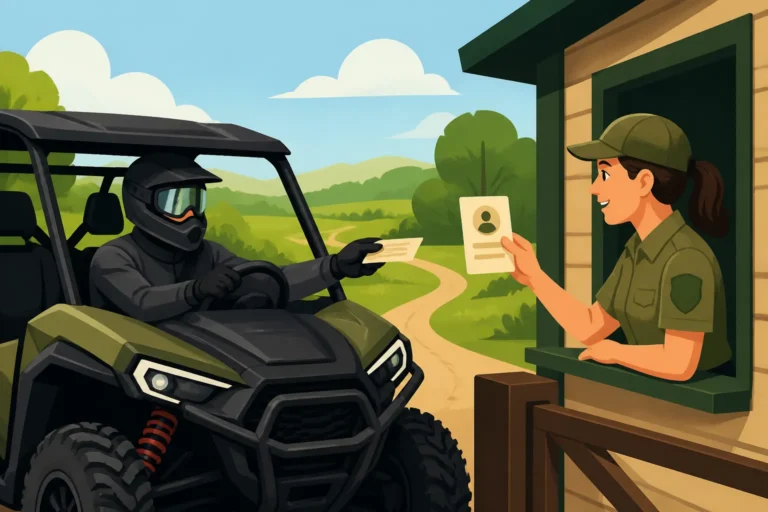
- Proof to bring: Ask what the gate staff or land manager expects you to show, such as proof of ownership or a waiver.
A phone call or a check of the operator’s current information can prevent a long drive to a place that does not permit your kind of riding.
Roads Are a Separate Question From Trail Permits
A state OHV sticker is not the same thing as permission to ride a road. Even if Kansas does not require visiting riders to purchase a state OHV decal, road use remains subject to separate state and local rules. A permit for a park road, where required, also does not make a machine street legal or open ordinary roads to off-road use.
Kansas road rules can depend on the vehicle class, the type of road, and the city or county involved. Some cities may authorize certain vehicles on specified streets, while other places do not. A city tag or local approval, when available, applies under that local government’s rules; it is not a statewide road permit. Before riding through a town or connecting two riding areas by road, confirm the route with the relevant local authority. Kansas UTV Street Legal Rules by City explains why permission can change from one municipality to another.
Do not treat a county road as an extension of a trail. Check whether that road is open to your machine and whether local rules require a tag, insurance, lighting, or other conditions. Road rules can also differ for an ATV, a side-by-side, a golf cart, and a micro utility truck. The broader overview in Why Road Rules Change With the Machine You Ride can help you identify which questions apply.
A visiting rider should also avoid assuming that an off-highway permit from Colorado resolves Kansas road requirements. Home-state paperwork may show that a machine is registered or permitted at home, but it does not override the rules of the Kansas road or city where you ride. If your plans include any road travel, get a clear answer about the exact vehicle and route before setting out.
For a trip that stays inside a riding park or designated off-road area, road legality may be less central, but it still matters when accessing the site. A legal trailer route and a legal riding route are different things: hauling the machine to an entrance does not mean it can be driven on nearby roads.
A Practical Checklist Before Crossing the Border
Use this short checklist to separate the state sticker question from the access and road questions:
- Confirm the destination first. Identify the exact park, riding area, or property. “Riding in Kansas” is too broad to establish where a machine may go.
- Ask whether a Kansas state sticker is required. For visiting OHV riders, Kansas generally does not require a state OHV sticker. A particular park or private operator may still have its own permit or admission process.
- Ask what the permit actually covers. A park-road permit is not a trail pass, and neither one grants access to closed or private land.
- Check local road rules separately. If the route includes public streets or roads, confirm that the machine can use them and whether local requirements apply.
- Bring ownership information. Carry a bill of sale, title, registration, or other documents you have for the machine. These can help establish ownership, but they are not substitutes for riding permission.
- Review the riding area’s rules for every rider. Passenger limits, helmet rules, age policies, waivers, and equipment standards may differ among destinations.
- Recheck conditions shortly before departure. A site can change its hours, close a route, or restrict access because of weather or maintenance.
If you are unsure whether a document from Colorado is relevant, ask the Kansas destination or local authority what it expects from a visitor. For proof-of-ownership questions, see Kansas Proof of Ownership on the Trail. For broader questions about using a machine from another state, Kansas Rules for a Visiting Colorado Rider is a useful starting point.
The simplest way to plan is to treat three issues separately: whether Kansas requires a statewide OHV sticker, whether the destination permits your machine, and whether any road on your route is legally open to it. The first answer is generally no for visiting riders; the other two depend on the location and vehicle. Checking those details in advance is more useful than relying on a Colorado permit or assuming that “no Kansas sticker” means unrestricted access.
Disclaimer
This article is for general informational purposes only and does not constitute professional advice. Laws, prices and regulations vary by location and change over time. Consult a qualified professional for guidance on your specific situation.