Kansas Rocks Park Rules for Riders
Kansas Rocks Park rules matter before you unload: a private riding park can set conditions that differ from Kansas road laws or another park’s policies. Check the current requirements for admission, machines, riders, and safety equipment before you travel. This overview explains what to verify and how to avoid arriving with a machine or group that cannot ride.
Start With the Park’s Current Rules
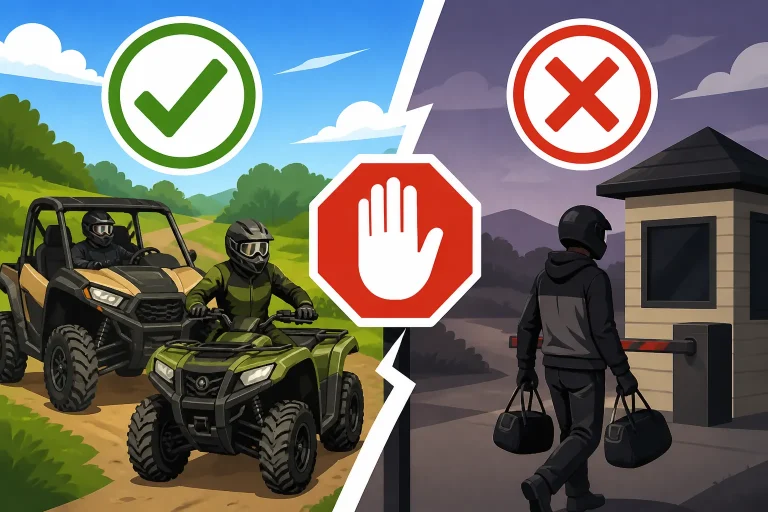
Kansas Rocks Recreation Park is a private riding area, so the park’s own rules govern access and riding on its property. Those rules are separate from Kansas laws about riding on public roads, and they may differ from the rules at another private park. A state permit, city tag, or permission to ride elsewhere does not automatically give you access to Kansas Rocks.
Check the park directly before loading your machine. Ask for the current rules, and confirm whether they change for events, weather, maintenance, or a particular riding area. A past visit, an old social media post, or another rider’s recollection may not reflect the conditions for your trip.
As you plan, separate the requirements into three categories:
- Park access: admission, check-in, waivers, operating hours, and any restrictions on arrival.
- Riding conditions: which machines and riders are allowed, where you can ride, and what conduct is prohibited.
- Kansas law: rules that apply on public roads or other places outside the park.
A park pass is not the same as a state-issued trail permit. Kansas does not have a general state OHV trail pass that substitutes for a private park’s entry requirements. And a permit or sticker from another state does not by itself establish permission to ride at Kansas Rocks. For the distinction between state-managed access and private riding areas, see Kansas Has No State OHV Permit and Kansas Private Park Waivers and Rules.
| What to check | Why it matters | What to confirm with the park |
|---|---|---|
| Admission and check-in | Access may depend on the park’s schedule and current procedures | Whether you can ride that day, where to check in, and what payment or paperwork is accepted |
| Machine eligibility | Width, type, condition, or equipment may affect access | Whether your ATV, UTV, dirt bike, or other machine is allowed |
| Rider eligibility | Age, supervision, and passenger policies can differ | Minimum ages, adult supervision, and rules for passengers |
| Safety requirements | The park may set its own equipment conditions | Helmet, eye protection, sound, or spark-arrestor requirements |
| Land and trail conditions | Weather or maintenance can affect access | Closures, restricted areas, and current trail conditions |
| Camping and group plans | Overnight or event access may have separate conditions | Whether camping, pets, large groups, or organized rides are permitted |
If the park’s current instructions are more specific than this overview, follow the park’s instructions. When something is unclear, get an answer before traveling rather than relying on a guess at the gate.
Confirm Access, Check-In, and Paperwork
Before setting out, make sure the park is open to riders on the day you plan to arrive. Opening schedules and access arrangements can vary, and a private park may close part or all of its property for conditions or events. Do not assume that a listed season means the gates are open every day within that season. Check the current schedule and ask whether you need to reserve, register, or arrive within a particular window.
Ask what check-in involves. Private parks may have an admission process, rules acknowledgment, waiver, or other paperwork. Confirm who needs to complete the paperwork: the machine owner, each rider, a parent or guardian for a minor, or everyone in the group. If a rider is under the age of majority, do not assume a parent’s signature can be handled after arrival. Check how the park wants that paperwork completed.
It can also help to ask what the park considers proof of ownership or authorization. A title or bill of sale is useful for documenting a machine, but it is not a substitute for the park’s entry process. If a machine is borrowed, rented, or owned by someone who is not attending, ask whether the rider should bring written permission or other documentation. For ownership documents and riding-area expectations, see Kansas Proof of Ownership on the Trail.
Before you leave, keep important information together and easy to access:
- The park’s current admission and check-in details
- Each rider’s completed paperwork, if the park requests it
- A parent or guardian’s contact information for younger riders
- Machine ownership or permission documents, if relevant
- Directions and a backup plan if a gate or access point is closed
- A way to contact the park if your arrival is delayed
Do not interpret a general Kansas permit as permission to use a private facility. State-managed park roads, public land, private trails, and a private off-road park are different settings with different access rules. If you are comparing them, Kansas Park Permit vs Trail Permit explains why a permit’s coverage matters. For Kansas Rocks, the practical answer is to ask the park what it requires and follow its current instructions.
If the park gives you a rule verbally, repeat it back to confirm you understood it. For instance, clarify whether the rule applies to every rider or only to the person checking in, and whether a condition applies to all machines or only certain types. Keep any written confirmation with your trip details.
Check Rules for Machines, Riders, and Passengers
A machine that is legal to own or title in Kansas is not automatically eligible for every private riding area. Parks can apply their own limits based on machine type, size, equipment, or the terrain they manage. Before hauling an ATV or UTV, give the park an accurate description of it and ask whether it can ride.
Useful details to provide include the machine’s general type, width, seating capacity, and any major modifications. Do not assume that a machine fits because a similar model was admitted on a previous visit. Different trims, accessories, tires, or added equipment can affect dimensions or the park’s assessment. If your machine is close to a stated limit, ask how the park measures it and whether attachments count.
The machine’s Kansas title classification is a separate question from park admission. A title does not make an ATV or UTV street legal, and it does not guarantee access to a private riding area. Learn about Kansas classifications in Four Off-Road Classes Kansas Law Treats Differently and Kansas Title for a Side-by-Side. If the park gives a machine-specific restriction, follow that restriction even if the machine is titled and insured.
Rider age rules also need a direct check. A parent may need to supervise a child, complete paperwork, or ensure that the child rides an appropriate machine. The exact requirements can depend on the park and the activity. Do not assume a child may ride simply because the child has ridden at home, at a different park, or on private land. For a broader look at how private parks handle age policies, see Kansas Private Park Age Minimums.
Passenger rules are machine-specific. A quad designed for one rider should not be treated as a two-person machine because a passenger can physically sit on it. A UTV with multiple seats may still have park-specific passenger conditions, and the manufacturer’s seating design matters. Confirm whether children may ride as passengers and whether the park applies additional limits. Passenger Rules at Kansas Rocks Recreation Park is useful when you are planning a ride with someone who will not operate a machine.
Safety equipment is another point to verify rather than infer. Ask whether the park requires helmets, eye protection, or other gear, and whether requirements differ by age or machine type. Even when an item is not required by a particular rule, it can still be a sensible choice for the terrain and riding conditions. Dust, rocks, changing weather, and other machines are practical reasons to prepare carefully.
Check the park’s policies on conduct as well. Ask whether it has rules about alcohol, speed, noise, riding out of bounds, passing, or stopping on trails. These are not details to work out once the group is already riding. Everyone should know the boundaries before the first lap, especially if riders have different levels of experience.
If your group includes riders with different machines, share the relevant rules with everyone in advance. A single check-in does not mean every rider has the same eligibility or equipment requirements. The group should agree on where to meet, how to handle a breakdown, and what to do if someone wants to stop riding.
Prepare the Machine and Respect Park Boundaries
A pre-trip inspection helps you catch problems before they become a trail-side repair. Check tires, brakes, steering, throttle return, lights if relevant to the park’s rules, and any loose or damaged parts. Carry basic tools and the supplies suited to your machine, but do not assume the park will provide repairs or recovery. Ask whether there are areas where a machine must remain on a trailer or whether any equipment is restricted.
Ask specifically about sound and spark arrestors if your machine has an exhaust modification or you are uncertain about its setup. A machine that has been changed for performance may raise questions about noise or equipment compliance. Do not rely on a statement such as “it has always been fine elsewhere.” Requirements can vary by property, and the park decides what it will admit.
When you arrive, follow the marked route and stay within areas open to riding. Private property can include closed trails, work areas, sensitive ground, and access roads that are not riding routes. A visible track is not proof that an area is open. If signage is unclear, stop and ask park staff rather than crossing a boundary to investigate.
Trail conditions can change after rain, maintenance, or heavy use. Check for closures and avoid riding around a barrier or through a posted restriction. Going around a closure can damage the property and create safety risks for riders and staff. Before you travel, Kansas Trail Conditions Before You Tow can help you think through what to confirm about access and conditions.
Ride within your ability and the machine’s limits. Rocky terrain can make speed, line choice, ground clearance, and tire condition important. Leave room between machines, make your presence clear before passing, and avoid stopping where approaching riders may not see you. If you are riding with someone new to the area, select routes and pace that suit that person rather than letting the group’s fastest rider set the plan.
Respect other park users. Follow posted instructions, yield where required, and avoid crowding a rider who is working through an obstacle. Keep pets, spectators, and vehicles in permitted areas, and do not let a support vehicle block a route. Ask staff where to park trailers and where non-riders may safely wait.
If the park has a sound limit, spark-arrestor check, or other equipment inspection, cooperate with the process. Do not try to bypass a check or modify the machine at the entrance in a way that compromises safety. If your machine does not meet a requirement, the best option is to resolve it before the trip or arrange another place to ride.
A good rule for uncertain situations is to stop first, then ask. That applies to a trail that appears closed, an unfamiliar route, a damaged obstacle, or a machine issue that makes continued riding unsafe. Staff can tell you whether an alternate route is open and what to do next.
Plan for Groups, Camping, and Changing Conditions
Group rides need more coordination than a solo visit. Confirm that every rider’s machine is allowed, and make sure the group agrees on the check-in process, safety rules, and meeting points. Decide in advance how you will handle a separated rider, a mechanical problem, or a change in weather. A simple plan can prevent one person from continuing while another rider is missing or unable to keep up.
If the group includes children or first-time riders, set expectations before arrival. Explain that park boundaries and staff directions apply to everyone, and that no one should ride beyond their ability just to keep up. Keep supervision clear: identify the adult responsible for each child and make sure that adult knows the park’s age and passenger rules.
Do not assume camping is included with riding access. Overnight stays, campsite reservations, fires, generators, pets, quiet hours, and vehicle parking may be governed by separate rules—or may not be available for the date you are visiting. Ask the park directly what facilities are open and what arrangements need to be made. If camping nearby is part of the plan, confirm that the campground is separate from the riding area and check its requirements as well.
Weather deserves a fresh check, especially if rain or changing ground conditions could affect access. A route that was manageable in dry conditions may be difficult or unsafe after a storm. Ask whether the park has closed trails or changed riding access. Do not assume that a scheduled visit guarantees every trail will be open.
Pack for the conditions, but keep your equipment manageable. Useful items often include water, weather-appropriate clothing, eye protection, a basic first-aid kit, and a charged phone or another communication option. Cell reception can vary, so agree on a meeting place and a check-in plan rather than depending entirely on messages.
A few questions are worth asking before you hitch up:
- Is the park open to riders on the day we plan to arrive?
- Does our machine type and configuration meet the park’s requirements?
- What check-in, admission, waiver, or reservation steps apply?
- What age, supervision, passenger, and safety-equipment rules should our group follow?
- Are any trails or facilities closed, and what are the current riding conditions?
- Are camping, pets, events, or overnight parking allowed for our plans?
- What should we do if a machine breaks down or a rider needs assistance?
Write down the answers or save the park’s current instructions. This is particularly helpful when several people are traveling separately or a different person is handling check-in. It also gives the group a reliable reference instead of a chain of secondhand messages.
If any answer remains unclear, delay the trip until you can confirm it. A short call or message is easier than discovering at the gate that a machine, rider, or camping plan does not meet the park’s conditions. For related planning questions, Kansas Private Park Helmet Rules and Kansas Private Park Alcohol Rules can help you identify policies to confirm directly.
Frequently Asked Questions
Does a Kansas permit or another state’s sticker let me ride at Kansas Rocks?
No. A state permit or out-of-state sticker is not a substitute for permission to ride on private property. Check Kansas Rocks’ current entry requirements directly.
Does having a Kansas title mean my ATV or UTV is allowed in the park?
No. A title documents the machine and its ownership or status; it does not guarantee that a private park will admit it. Ask the park about your machine’s type, size, and equipment.
Can I bring a child or passenger?
Possibly, but do not assume the rules. Confirm age, supervision, and passenger requirements with the park, and make sure the machine is designed to carry the number of people riding.
Are the park’s rules the same as Kansas road rules?
No. Park rules apply on the private property, while Kansas road laws apply in their own settings. A machine’s eligibility for the park does not establish that it may be driven on public roads.
Disclaimer
This article is for general informational purposes only and does not constitute professional advice. Laws, prices and regulations vary by location and change over time. Consult a qualified professional for guidance on your specific situation.