What to Show at a Kansas State Park Gate
If you’re towing an ATV or UTV to a Kansas state park, the gate question can be confusing: a state park entrance permit, an unconventional vehicle permit, and a trail pass are not the same thing. This guide explains what to have ready, what each permit covers, what out-of-state riders should know, and what to do if a machine or permit is questioned.
Start With the Right Permit
A state park entrance permit covers park access, not every kind of riding
A Kansas state park entrance permit is about entering the park with a vehicle. It does not, by itself, authorize an ATV or UTV to travel wherever the rider would like once inside. The important distinction is between entering park property and operating an off-road machine on a particular route.
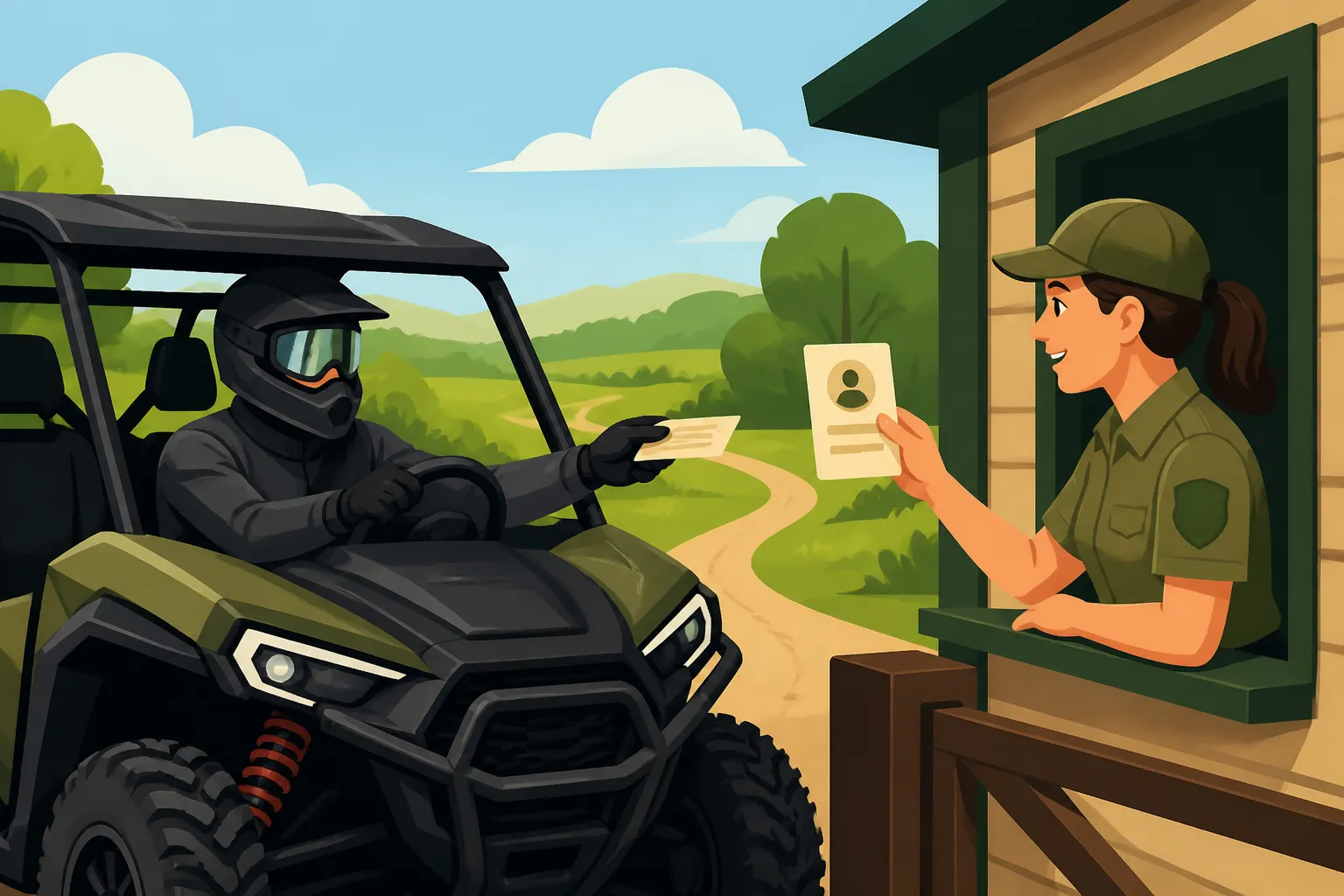
At the gate, be ready to show proof that you have paid for or otherwise meet the park’s entrance requirements. Depending on how you arrive and how the park is operating, that could mean presenting a permit, a confirmation, or another form of proof accepted by park staff. If you are not sure what applies to your visit, contact the park before loading the machine. A gate attendant may not be able to resolve every question while a line of vehicles waits behind you.
If you are taking a pickup and trailer into the park, think about the pickup first. The truck is the vehicle entering the park and may be subject to the applicable entrance requirements. Your ATV or UTV is a separate question: even if the truck is admitted, the machine still has to meet the rules for its use and route. An entrance permit is not a blanket approval for riding.
An unconventional vehicle permit is a separate item
Kansas has a permit for unconventional vehicle use at state parks. It is distinct from a standard state park entrance permit and from the title for the machine. If you plan to take an ATV, UTV, or another qualifying machine onto park roads where that use is allowed, check whether you need this permit and how to obtain it before you arrive.
The state park unconventional vehicle permit is associated with travel on permitted park roads and parking areas. It does not create access to trails, open fields, shorelines, or other areas where machines are not allowed. It is also not a general Kansas off-highway vehicle registration sticker. Kansas does not have a statewide OHV trail-pass system that gives riders permission to use any public riding area. For a fuller explanation, see Kansas Unconventional Vehicle Park Permits and Kansas Has No State OHV Permit.
A permit for a state park does not replace other requirements that may apply to the vehicle or the trip. For example, the machine may need a valid title, and a local ordinance may impose requirements when riding on city streets outside the park. Keep those separate in your mind: the title establishes ownership, while a park permit addresses a limited form of park use.
A title, registration, and trail pass do not mean the same thing
Kansas ATV and UTV owners often hear the word “paperwork” used as if it were one thing. It is not. A title is evidence of ownership. A state park entrance permit relates to entering the park. An unconventional vehicle permit relates to limited machine use in the park. A registration sticker or trail pass, where a different jurisdiction has one, is another category altogether.
Kansas titles many off-road machines as nonhighway vehicles, but having a title does not make an ATV or UTV street legal or give it permission to ride on park trails. Likewise, a machine that has a title from another state does not automatically qualify for every kind of Kansas park access. If you want to understand the ownership document itself, read Kansas Proof of Ownership on the Trail and Kansas Park Permit vs Trail Permit.
The easiest way to avoid a frustrating gate conversation is to treat the documents as separate items. Bring the proof that applies to your park entry, have the required park-use permit if you plan to ride a qualifying machine on permitted routes, and carry ownership paperwork as a backup. Do not assume that one sticker, card, or receipt answers every question.
What to Have Ready at the Gate
A practical document checklist
There is no single universal packet that every Kansas state park gate requires from every visitor. The details can depend on the park, the activity, the vehicle, and whether you are entering for the day or staying overnight. Still, a simple checklist makes it easier to arrive prepared rather than rummaging through a glove box while the gate attendant waits.
| Item to have available | What it helps establish | Important limitation |
|---|---|---|
| State park entrance permit or accepted proof of payment | That the vehicle has met the park’s entrance requirement | It does not authorize ATV or UTV travel on restricted routes |
| Unconventional vehicle permit, when required for the planned machine use | That you have the permit associated with permitted park-road use | It is not permission to ride on trails or closed areas |
| Camping reservation or camping permit, if staying overnight | Your campsite or overnight arrangement | It does not replace vehicle or machine-use requirements |
| Machine title or other proof of ownership | Who owns the ATV or UTV | Ownership does not establish permission to ride in a particular place |
| Driver’s license or identification, if requested or relevant | Identity and, where applicable, driving eligibility | It does not replace a required permit |
| Phone or printed copy of confirmations | A backup if a screen, account, or signal is unavailable | A confirmation only helps if it corresponds to the correct visit and permit |
Before leaving home, check that the permit or confirmation matches the vehicle, visit, and intended use. A receipt from a previous trip may not apply to a new visit. If you have more than one machine on the trailer, do not assume that a document associated with one machine covers the others. Ask the park office how its permit applies to your situation.
It can be useful to keep documents together in a waterproof folder or a secure document pouch. Some riders use a small pouch for paper copies and store a digital backup on a phone. If you shop for a pouch or other travel organizer through Amazon, check that it can be secured and kept dry; the point is simply to keep paperwork accessible, not to rely on any particular product.
Make the permit easy to show
A gate visit goes more smoothly when you can reach the relevant proof without unloading gear or digging beneath tools. Put the park entrance permit or receipt somewhere easy to access in the tow vehicle. Keep the unconventional vehicle permit and the ATV or UTV’s ownership papers together but separate from items you may need to hand over for the truck.
For a digital confirmation, save it before you reach the park. Rural approaches can have weak or unreliable cell coverage, and a message that will not load at the gate is not much help. A screenshot or saved file can serve as a practical backup, but follow any park instructions about the form of proof it accepts. If the permit must be displayed in a particular way, make sure you know that before setting off.
If you are traveling with a group, designate one person to handle the documents. This sounds minor, but it prevents the familiar scene of one person searching a phone, another checking the trailer, and a third asking whether the permit is still in the kitchen. A quick document check at home is much easier than sorting things out in a crowded entrance lane.
Be ready to explain what you plan to do
A gate attendant may need to know whether you are camping, fishing, boating, or transporting an ATV or UTV. A clear answer helps staff direct you to the right information. For example: “We have a campsite reservation, and we want to know whether this side-by-side may travel on the road to our campsite” is more useful than “We have a permit, so where can we ride?”
Describe the machine accurately. A small quad, a side-by-side, a golf cart, and a micro utility truck may fall under different definitions and rules. If you are unsure how the machine is classified, bring its title or manufacturer information and ask the park office before the trip. Do not rely only on its appearance or on what a seller called it.
Most importantly, ask about the route, not just the vehicle. A machine might be permitted on one signed park road and prohibited on a nearby trail or access road. If a staff member gives you directions, follow the posted signs as well. A verbal answer at the entrance does not override a closure, a road restriction, or a sign farther inside the park.
What the Permit Allows and What It Does Not
Park roads and parking areas are not the same as trails
The central rule to remember is that a Kansas state park unconventional vehicle permit is limited in scope. It is associated with designated park roads and parking areas where machine use is allowed. It is not a trail pass. It does not grant riders the freedom to leave the road and explore the surrounding landscape.
That difference matters because a park road may lead to a campground, parking lot, boat access, or another permitted destination, while a trail may be closed to motorized vehicles. A rider who sees a visible track in the grass or a route other visitors have used should not assume that it is an approved route. Use posted roads and follow signs indicating closures or restrictions. For more on the road-only limitation, see Kansas Machines on Department Roads Only.
The same principle applies even when the ground looks open and inviting. Kansas lakes, shorelines, wildlife areas, and park landscapes can have sensitive areas, erosion concerns, or designated uses that are not obvious from the driver’s seat. A permit is not a substitute for checking the map and signs. If a route is not clearly authorized, stop and ask before using it.
A state park permit is not a general trail pass
Riders sometimes expect to buy one sticker that unlocks every public riding area in a state. Kansas does not operate a universal state OHV trail-pass system that works that way. A permit connected with a state park does not automatically authorize riding at a private off-road park, on Corps property, on a wildlife area road, or on land managed by another agency.
This is why it is worth being precise when you ask about a permit. “Do I need a permit?” can mean several things: a permit to enter the park, a permit to operate a machine on certain park roads, a camping permit, or a permit for a different property. Ask which permit applies to your exact destination and planned route. The distinctions are explained further in Kansas Park Entrance Permits and What They Cover.
A rider arriving with a pass from another state should not assume Kansas honors it. Out-of-state stickers may relate to that state’s registration or trail-access program, but they do not replace Kansas park requirements. If you are visiting from Missouri, Nebraska, Oklahoma, Colorado, or elsewhere, check Kansas requirements separately. See Kansas Honors No Other State Sticker for the reciprocity issue.
A permit does not erase posted restrictions
Even with the right permit, you must follow closures, signs, and park rules. A road may be temporarily closed because of construction, weather, maintenance, an event, or other conditions. A route that was open during a previous visit may not be open on the day you arrive. Pay attention to signs at the entrance and at intersections, and do not treat a permit as permission to ignore them.
This is especially important after heavy rain. Gravel and unpaved routes can become slick or vulnerable to rutting, while low areas can hold water longer than expected. If a route is closed, do not go around a barrier or use the shoulder to get past it. Ask park staff whether there is an approved alternative, or change your plan.
If you need to reach a campground or access point and the direct route is closed to your machine, do not improvise a route across grass or along the shoreline. Contact the park office for guidance before moving the machine. An inconvenient detour is better than a citation, damage to the property, or a difficult conversation about riding where you were not authorized.
Visiting From Outside Kansas
A home-state sticker is not a Kansas park permit
Visitors frequently arrive with paperwork that is valid at home and assume it covers their trip in Kansas. That assumption can cause trouble because a sticker from another state may show that a machine is registered or permitted there, but it does not necessarily satisfy Kansas park rules.
Think of reciprocity as a question to ask, not a safe assumption. Check whether Kansas recognizes the specific document for the specific activity you plan to do. Even when an out-of-state title is accepted as proof of ownership, it does not automatically replace a Kansas park-use permit or an entrance permit. These are separate questions.
Before you tow from across the state line, make a short call to the park office. Identify the state where the machine is titled, the type of machine, the park you plan to visit, and whether you intend to ride it on park roads. The office can tell you what to bring and whether there are local restrictions that affect your plan. For the broader visiting-rider issue, see Kansas Rules for Out-of-State Machine and Calling a State Park Office Before You Load Up.
Bring ownership paperwork as backup
Kansas does not treat a state park gate as a place where every rider must present a title before entering. Still, carrying proof of ownership can be useful if a machine’s identity or status is questioned, especially if you are traveling with an older ATV, a recently purchased UTV, or a machine titled in another state.
Keep a copy or the relevant ownership document secured with your travel papers. Do not leave the original in an exposed trailer box or a spot where it could be lost during unloading. If the machine is borrowed, leased, or owned by someone else in your group, carry a clear explanation of who owns it and who is transporting it. A simple written note from the owner may help clarify the situation, though it does not replace a formal permit when one is required.
For machines with unusual paperwork, resolve the question before your trip. A missing title, a mismatched serial number, or an incomplete sale document can create complications that are hard to fix at a park gate. The park office can explain its entry and riding rules, but it is not a substitute for the county treasurer when the issue is title or ownership. If you are preparing a purchase or transfer, see Kansas Title Paperwork Explained.
Do not confuse state park access with road legality
A Kansas title for a nonhighway vehicle does not make an ATV or UTV legal for unrestricted street use. Likewise, a state park permit does not authorize riding on public roads outside the park. If your route to the park crosses a town or county road, verify the rules for that jurisdiction rather than assuming the park permit follows you beyond the entrance.
That distinction can be easy to miss when a park road connects to a nearby public road or campground entrance. A machine may be allowed on a particular park road but prohibited on the adjacent city street. The reverse can also happen: a local ordinance may permit a tagged UTV on certain streets, while the park’s rules limit where it can travel within the park. For city and street-use questions, review Kansas UTV Street Legal Rules by City.
Plan the entire trip, including the last mile to the entrance. If the machine is being hauled on a trailer, it may be simplest to keep it on the trailer until you are inside the park and have confirmed the permitted route. Do not ride along a public road simply because it appears to be the shortest way from the highway to the park gate.
Camping, Fishing, and Other Activities
A campsite reservation is not a riding permit
If you are staying overnight, have your reservation or camping permit available in addition to the documents associated with park entry and machine use. A campsite reservation tells staff where you are staying; it does not automatically authorize an ATV or UTV to travel on every road or trail leading there.
Check how the park expects you to reach your campsite. Some visitors tow machines to the campsite and unload there; others may want to ride a machine between a campground and a permitted destination. Those are different arrangements. Ask whether your machine may use the specific connecting road and whether any time, route, or equipment restrictions apply.
Do not assume that a campground road is open to every type of vehicle just because passenger cars use it. Follow posted signs and staff instructions, and keep speed low around campsites, pedestrians, children, and wildlife. If the road is not clearly marked for your machine, ask before riding it.
Fishing access does not create permission to ride anywhere
A fishing license, boat access, or ice-fishing plan is separate from the permits related to entering a state park or operating an unconventional vehicle. A fishing license does not grant ATV or UTV trail access. A park permit does not replace fishing credentials. Each document serves a different purpose.
If you plan to use a machine to reach a fishing spot, confirm the permitted route and destination in advance. Do not assume you can ride along a shoreline, across a boat launch, or over a frozen surface merely because other visitors have done so. Ice access can have its own designated entry points and safety rules. A machine may be allowed on a specified route but prohibited from entering the water or crossing an unapproved area.
For winter visits, make the call before you tow. Conditions around Milford Lake, Tuttle Creek, Perry Lake, and other Kansas waters can differ, and access rules may depend on the particular location. Check [Kansas Ice Fishing Machine Rules] and ask the park office which roads and entry points are currently designated for your plan.
Keep permits and activity documents organized separately
A family trip can involve several documents: a park entrance permit, a campsite reservation, an unconventional vehicle permit, fishing licenses, and proof of ownership. Keep them in a way that makes it clear what each one covers. A small folder with separate sections can be more helpful than a pile of receipts and cards in the center console.
A phone can hold digital copies, but it should not be your only plan. Save confirmations for offline access, keep the device charged, and consider a paper copy for the reservation or permit details. If you use a document wallet or phone organizer purchased through Amazon, choose something that will not interfere with safe driving or leave important papers exposed to rain and dust. Make sure the actual required permit is handled in the manner the park directs.
At the gate, show only what is relevant and answer questions plainly. If the attendant asks whether you are camping, explain where you are booked. If the question is about the ATV, say what kind of machine it is and where you intend to ride. Clear, accurate answers are more useful than presenting a stack of documents without explaining the plan.
Common Gate Problems and How to Avoid Them
Arriving without the right permit
The most avoidable problem is arriving with a standard entrance permit but no unconventional vehicle permit for the planned use. The truck may be allowed into the park, yet the rider may still be unable to take the machine onto the road they had in mind. Another common mistake is assuming that an out-of-state sticker counts as the Kansas permit.
Make a short pre-trip list: identify the park, confirm the entrance requirement, ask whether your ATV or UTV needs a park permit, and check whether the route you want to use is open to that machine. If you are camping, add the reservation details. If another person purchased the permit, make sure you can access the confirmation or understand what proof the park expects.
Do this before the trailer is hitched. A quick call or review of the park’s official instructions can prevent wasted fuel, a delayed arrival, or a disappointed family that has spent the drive imagining a ride the park does not allow.
Assuming the gate attendant can approve an exception
A gate attendant can provide useful directions and explain routine requirements, but do not assume that the person at the entrance can authorize use of a closed road or create an exception to a park rule. If your situation is unusual, contact the park office or manager in advance and ask for a clear answer.
Examples include a modified machine, a disability-related access request, a route to a particular campsite, a vehicle that does not fit neatly into familiar categories, or a machine with paperwork from another jurisdiction. Explain the details rather than asking a broad yes-or-no question. The more specific you are, the more useful the response is likely to be.
If you receive permission for an exception, ask how it will be documented and which route it covers. Do not extend a limited approval to other areas or assume it applies to a different day. If you cannot confirm an exception, follow the posted rule and avoid riding the machine into the uncertain area.
Relying on memory, old signs, or another rider’s advice
Rules can vary by park, and access arrangements can change. A friend’s experience from a previous summer is helpful background, not proof that a route is open today. The same goes for a photograph of an old sign or a social media post that does not identify when it was taken.
Use the park’s current information and contact the office if anything is unclear. Confirm the machine type, planned date, and intended road or destination. Ask whether there are temporary closures or special event restrictions. Keep the answer with your trip notes so the driver and other riders have the same understanding.
Riders sometimes carry a paper map as a backup in case cell service drops. That can be sensible for navigation, but a map does not establish that a route is open to motorized use. You can find paper map holders and related travel accessories through retailers such as Amazon, but rely on the park’s current signs and instructions for access decisions.
A Simple Pre-Trip Routine
Check the park and the route
Start with the exact state park you plan to visit. Confirm its entrance requirements and ask whether your ATV or UTV may be used there. Then narrow the question to the road or destination: Is the machine permitted on that route? Is the route open during your visit? Are there restrictions on the machine’s class, size, or use?
If your plan includes a campground, boat ramp, fishing access, or ice entry point, mention that. “Can I ride in the park?” is too broad to get a useful answer. A better question is, “Can this type of side-by-side travel on the signed park road between the entrance and our campground, and do I need a separate unconventional vehicle permit?”
Record the answer and the office contact details. If you arrive to find different signs, a closure, or a changed route, follow the signs and ask staff. The pre-trip answer helps you plan; it does not override conditions on the ground.
Check the machine and the paperwork
Before departure, confirm the machine is the one described in the permit or question you discussed with the park. If you are bringing several machines, ask whether the requirements apply separately to each one. Check that the title or ownership document corresponds to the machine’s identifying information, especially if it is used, recently purchased, or borrowed.
Make sure the tow vehicle has the documents for entrance and any reservation. Keep machine-use paperwork accessible, and save digital confirmations offline. If you are carrying paper copies, protect them from rain, mud, and the loose items that tend to collect in a truck cab after a day of riding.
If the machine’s title class is unclear, do not wait until the gate to sort it out. Manufacturer specifications and title records may help explain what the vehicle is. Kansas class definitions can affect how an off-road machine is treated, so see Four Off-Road Classes Kansas Law Treats Differently when you need to understand the broader classification issue.
Ask the gate the right follow-up questions
Once you arrive, show the relevant permit or proof of payment and explain your plan. If staff confirms that your machine may use a road, ask which road, where it leads, and whether any restrictions apply. If the answer is no, ask whether there is an approved alternative or whether the machine must remain on the trailer.
If the attendant is unsure, ask where to get a definitive answer rather than pushing for an informal guess. You can call the park office or follow the instructions staff provides. Stay courteous, especially when the entrance is busy. A calm, direct question usually gets a clearer response than arguing from what another park allowed.
Before you leave the entrance area, make sure the driver and every rider understand the same plan. Agree on where the machine will be unloaded, which route it may use, and where it must stay parked. That small conversation helps prevent one person from interpreting a limited permit as permission to explore the whole park.
Disclaimer
This article is for general informational purposes only and does not constitute professional advice. Laws, prices and regulations vary by location and change over time. Consult a qualified professional for guidance on your specific situation.