Sharing a Gravel Road With Loaded Grain Trucks
Many of us love the freedom of cruising Kansas's vast network of gravel roads on our ATVs and UTVs, whether we're heading to a hunting spot, working the back forty, or just enjoying a scenic ride. But let's be honest: that idyllic picture can turn pretty intense when you suddenly find yourself sharing that narrow, dusty path with a fully loaded, fast-moving grain truck. The sheer size and speed difference can be incredibly intimidating, and it often leaves riders wondering exactly how to navigate these encounters safely and legally. This guide is here to walk you through the realities, the rules, and the crucial safety measures you need to take to share those vital rural arteries with the titans of the harvest season.
The Unique Challenges of Kansas Gravel Roads and Heavy Traffic
Riding your ATV or UTV on a rural Kansas gravel road offers an unparalleled sense of freedom and access, whether you're tending to livestock, scouting new hunting ground, or simply enjoying the vast open spaces of the Sunflower State. However, these aren't always serene, empty paths. Especially during planting and harvest seasons, these roads become major arteries for agricultural traffic. Suddenly, your quiet ride can be interrupted by the roar of a massive grain truck, turning your leisurely cruise into a high-stakes dance. It's not just about the rules; it's about understanding the physics and the environment you're operating in.
The Sheer Size and Speed of Grain Trucks
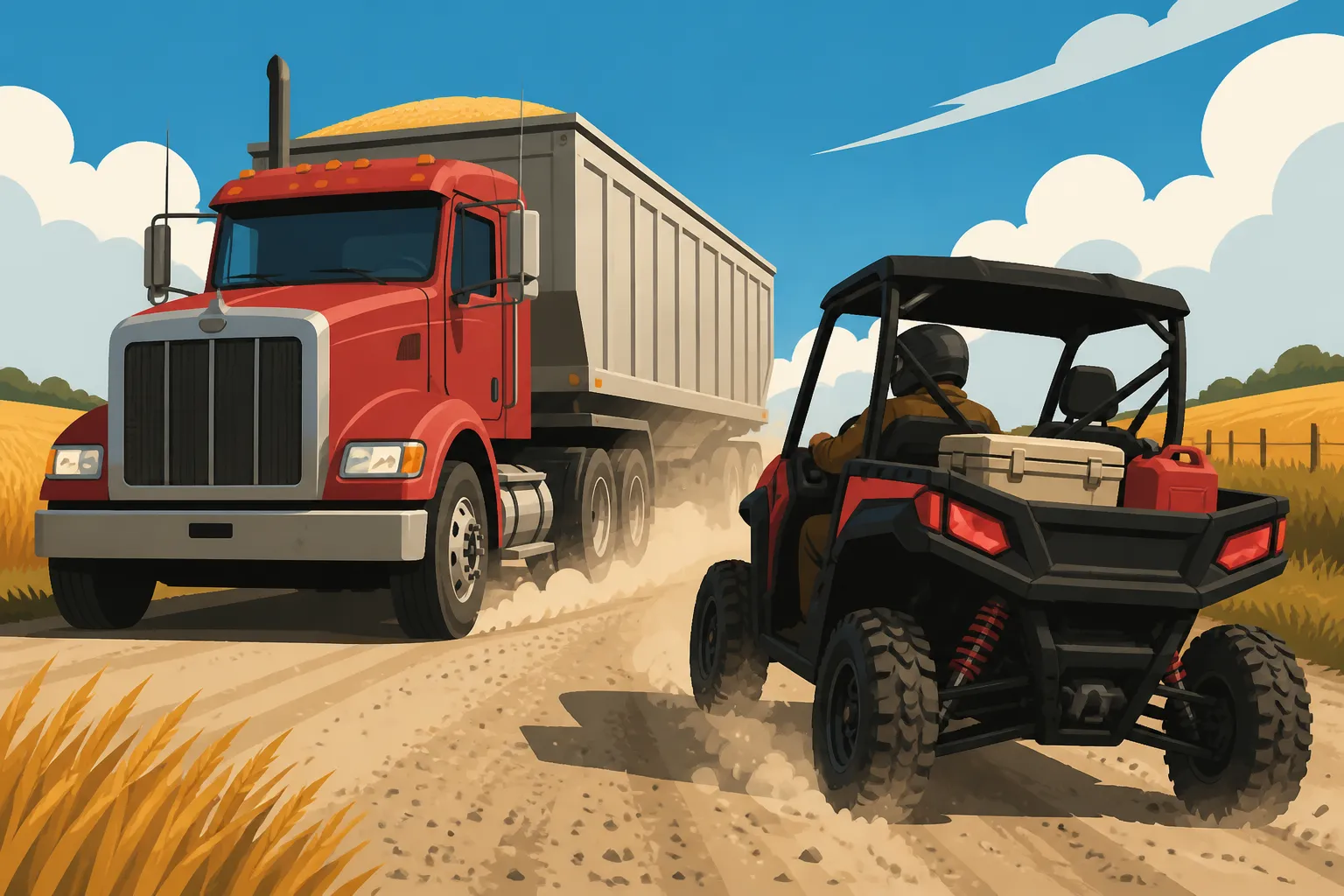
The most immediate and often startling challenge is the sheer physical presence of a loaded grain truck. These vehicles are enormous, easily weighing tens of thousands of pounds when full, compared to your ATV or UTV, which might weigh less than a thousand. This immense difference in mass means a truck cannot stop or maneuver nearly as quickly as your off-road machine. They also tend to travel at significant speeds on gravel roads, often close to or at the posted limit, because farmers are working on tight schedules, especially during harvest.
Picture this: you're cresting a small rise, enjoying the view, and suddenly there's a grain truck barreling towards you, taking up nearly the entire width of the road. Your heart might jump into your throat. It's a common, hair-raising scenario. Truck drivers are often dealing with their own challenges—heavy loads shifting, limited visibility directly in front or behind them, and the constant vibration of the road. They might not see you as quickly as you see them, especially if you blend into the rural landscape. This disparity in size and speed necessitates a proactive, defensive riding strategy on your part.
Dust, Visibility, and Obstacles
Kansas gravel roads are notorious for dust, particularly in dry conditions. When a grain truck passes, it kicks up a veritable cloud that can obscure vision for hundreds of yards. If you're following a truck, or if one passes you from the opposite direction, you can instantly lose all visibility, which is terrifying when you're on a smaller machine. This dust isn't just an annoyance; it's a significant safety hazard, making it impossible to see oncoming traffic, sharp turns, or unexpected obstacles like potholes, washouts, or wildlife.
Beyond dust, gravel roads present other inherent challenges. The surface itself can be loose, uneven, and unpredictable, especially on corners or after heavy rain. There can be deep ruts, sharp rocks, and soft shoulders that can cause a smaller vehicle to lose traction or even tip. Then there's the ever-present threat of wildlife – deer, pheasants, and even stray cattle can dart into the road without warning. These factors, combined with the presence of heavy machinery, demand constant vigilance and a heightened awareness of your surroundings.
The Unexpected on Rural Roads
Rural roads, unlike highways, often have unexpected elements. There might be unmarked driveways, hidden entrances to fields, or farmers pulling out with tractors and implements. Kids might be playing nearby, or a rancher could be moving livestock. These aren't pristine, well-marked thoroughfares; they are working landscapes. For ATV and UTV riders, this means you can't assume anything. You need to be prepared for sudden stops, evasive maneuvers, and the need to yield to farm equipment that may be slow-moving or extra wide.
Consider a situation where you're riding around a blind curve, and a slow-moving combine, nearly twice the width of the road, is suddenly there. Or a herd of cows being moved down the road. These scenarios require not just quick reflexes but also an understanding that these roads serve a primary agricultural purpose. Your recreational or utility ride needs to adapt to the rhythm and demands of the working rural community.
Legal Responsibilities and Road Etiquette for ATV and UTV Riders
Navigating Kansas's gravel roads on an ATV or UTV isn't just about common sense; it also involves understanding the specific laws that govern these machines. It's easy to assume that because it's a gravel road, the rules are looser, but that's a dangerous misconception. Ignorance of the law won't protect you from a citation or, worse, an accident. Being prepared means knowing your rights and responsibilities. [What a County Sheriff Can Ask a Rider to Show] is a good resource to review before you head out.
Understanding Kansas's Road Use Laws for Off-Road Vehicles
Kansas law, specifically [Kansas ATV Road Rules Under 8-15,100], is quite clear: generally, ATVs and UTVs are not street legal on public roads. However, there are crucial exceptions, especially for agricultural purposes, that often apply to those gravel roads. For instance, you might be allowed to operate your machine on public roads if you are crossing a highway or driving on a county road for agricultural purposes. This "agricultural exception" is critical for many rural Kansans who use their machines as tools.
It's important to remember that these exceptions come with stipulations. You often need to have certain equipment, like proper lighting, especially if you're out after sunset. [Kansas Lighting Rules After Sunset] are a must-know. Moreover, while you might not need an annual registration tag for an ATV itself, you absolutely need a valid driver's license to operate any vehicle on a public road, even if it's just a gravel county road. Never assume that because your ATV isn't "registered" like a car, you don't need a license. It's essential to understand these nuances to avoid legal trouble and ensure you're riding responsibly.
Your Duty to Share the Road Safely
Even when legally operating your ATV or UTV on a Kansas gravel road, you have a fundamental duty to operate it safely and in a manner that doesn't endanger others. This means adhering to speed limits, even if they feel slow on your machine. It means being predictable in your movements and signaling your intentions when possible. When you encounter a larger vehicle, especially a grain truck, your priority should be to make yourself visible and yield the right-of-way.
Imagine you're on a narrow, one-lane gravel road with thick grass on both sides, making the shoulders soft and difficult to use. A grain truck is approaching. [Riding as Near the Right as Practicable] means moving as far to the right as safely possible, even if it means slowing down considerably or temporarily pulling onto a safer, firmer section of the shoulder or into a field entrance if available. The truck cannot easily deviate from its path due to its size and momentum. Your smaller machine has the flexibility to move, and it's your responsibility to do so to ensure a safe pass for both parties. This isn't just courtesy; it's a critical safety measure.
What a County Sheriff Can Ask a Rider to Show
If you're stopped by a county sheriff or other law enforcement on a Kansas gravel road while riding your ATV or UTV, they will have specific expectations. First and foremost, they'll want to see your driver's license. As mentioned, operating any vehicle on a public road requires one. Next, they might ask about the purpose of your trip – confirming if it falls under an allowed exception, such as agricultural use. This is where [Kansas Agricultural Trips on a 65 mph Road] comes into play. If your machine is a side-by-side that qualifies as a Work-Site Utility Vehicle, different rules might apply, but generally, ATVs are under stricter road restrictions.
You should also be prepared to provide proof of ownership for your machine, which often means having your title information accessible, even if you just have [Kansas Title Before Your First Ride] stored digitally on your phone. While insurance isn't universally mandated for ATVs in Kansas, some cities that allow UTVs on their streets require it. If you're using your machine for agricultural purposes, it might be covered under a farm liability policy, but it's crucial to confirm this with your insurance provider. [Carrying Papers on a Ranch Road] is just good practice, whether it's legal documents or your hunting license. Being polite, cooperative, and having your documentation in order can make a roadside stop much smoother.
Essential Safety Strategies and Gear for Sharing the Road
Riding on gravel roads, particularly during busy farming seasons, demands a proactive approach to safety. It's not enough to simply follow the rules; you need to anticipate potential hazards and equip yourself and your machine to mitigate risks. Every decision you make, from the gear you wear to the accessories you add to your machine, contributes to your overall safety when sharing the road with loaded grain trucks.
Maximizing Your Visibility to Truck Drivers
When you're riding an ATV or UTV, you are inherently less visible than a full-size truck or car. This problem is compounded on dusty, uneven gravel roads. Therefore, your primary goal must be to maximize your visibility to other drivers, especially those in large agricultural vehicles. Brightly colored clothing, like neon green or orange, is not just for hunting season; it's a year-round safety measure. A high-visibility vest, even over your regular riding gear, can make a significant difference.
Beyond clothing, think about your machine. Adding reflective tape to your ATV or UTV, especially on the front, rear, and sides, can catch a truck's headlights, particularly around dawn or dusk. Consider installing additional lighting. While your stock headlights might be adequate for off-road trails, a pair of aftermarket LED lights, like those from SuperATV, can significantly increase your forward projection and make your machine more noticeable to oncoming traffic. These aren't just for seeing; they're for being seen. A bright, flashing amber light on a tall flag or pole mounted to your machine, particularly on a side-by-side, can be a lifesaver, cutting through dust clouds and appearing above tall crops or roadside brush. [Kansas Slow-Moving Emblem Rules] also apply to some farm equipment, and adding one to your UTV, even if not strictly required, is a smart move for safety.
Riding Techniques for Dusty and Uneven Surfaces
Riding on gravel roads requires specific techniques to maintain control and reduce risk. When you see a dust cloud ahead, or hear the rumble of an approaching truck, slow down immediately. Reduce your speed well before the dust engulfs you. This gives you more time to react to unexpected obstacles or a sudden loss of visibility. If you're following a truck that's kicking up a lot of dust, increase your following distance significantly – much more than you would in a car on pavement. Wait for the dust to settle before proceeding, or find a safe spot to pull over and let the cloud dissipate.
On uneven surfaces, maintain a firm grip on the handlebars and keep your weight balanced over the machine. Be prepared for the machine to slide a bit on loose gravel, especially in turns or under braking. Use smooth, controlled inputs rather than sudden steering or braking. If you encounter deep ruts or washouts, approach them slowly and at an angle that allows both wheels to cross safely, rather than dropping one wheel directly into a hole. Always scout ahead, looking for the smoothest, most predictable path. Remember, on [Kansas Rules for Riding a County Road], you are sharing the right-of-way, and anticipating issues is key.
Equipping Your Machine for Road Safety
Equipping your ATV or UTV properly goes beyond just visibility. First, ensure your tires are in good condition and properly inflated. Damaged or underinflated tires can lead to blowouts or loss of control on gravel. Many riders, myself included, opt for more aggressive all-terrain tires that provide better grip on loose surfaces than stock tires might. These can be crucial for maintaining traction and control when braking or maneuvering on dusty, gravel-strewn roads.
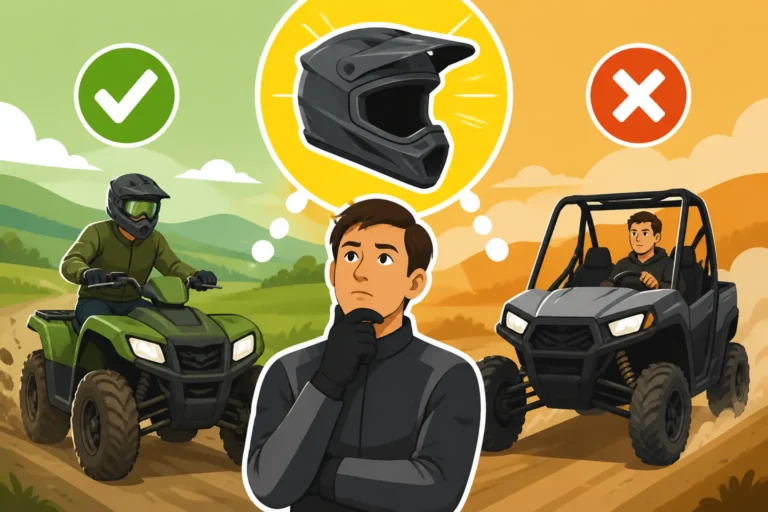
Consider a windshield for your UTV. While not always necessary off-road, a good windshield from a company like SuperATV can protect you from dust, gravel flung by passing vehicles, and insects, improving your comfort and ability to see clearly. Eye protection, whether goggles or safety glasses, is non-negotiable for ATV riders. [Choosing a Helmet When No Law Requires One] is still a smart safety decision, even if not legally mandated for adults on ATVs in Kansas. The right helmet not only protects your head but can also integrate with eye protection to keep dust and debris out. For UTVs, ensure all occupants are wearing seatbelts and that the machine is equipped with a functioning roll-over protection structure (ROPS).
Here's a quick comparison of essential visibility aids:
| Visibility Aid | Benefit | Cost Range (Typical) | When to Use |
|---|---|---|---|
| High-Visibility Vest | Instant increase in rider visibility | Low | Always, especially on roads |
| Reflective Tape | Catches headlights, effective in low light | Very Low | Always, on front, rear, and sides of machine |
| LED Auxiliary Lights | Increased forward light, makes machine more visible | Medium | Low light, dust, bad weather |
| Tall Whip Flag (Orange) | Visible above crops, dust, or hills | Medium | Open fields, dunes, dusty roads |
| Amber Flashing Light | Draws attention, especially effective at dusk/dawn | Medium | Dusk, dawn, dust, slow-moving status |
| Slow-Moving Vehicle Emblem | Universally recognized signal for slow speed | Low | When operating under 25 mph on roads |
What to Do in Specific Road Encounter Scenarios
Even with the best preparation, encountering a loaded grain truck on a narrow Kansas gravel road can be unnerving. Knowing how to react in specific situations can be the difference between a near-miss and a collision. It's about being ready to react defensively and respectfully.
Approaching and Being Approached by a Grain Truck
When you see a grain truck approaching from the opposite direction, or catch its dust cloud in the distance, your immediate action should be to slow down. Reduce your speed gradually and move as far to the right side of the road as is safely possible. If the shoulder is wide and firm enough, and there are no ditches or obstructions, consider pulling over completely, especially if the road is very narrow. A UTV with a wide stance, perhaps equipped with SuperATV offset A-arms for stability, will still need clear space to pass.
If pulling over isn't an option, or if the shoulder is unsafe, simply hugging the right edge of the travel lane and reducing your speed significantly is the best course. Make eye contact with the truck driver if possible – a quick nod or wave can confirm they see you. Hold your line, don't swerve unpredictably, and allow the truck to pass. The key here is not to challenge the truck for space; yield it graciously. Their momentum and braking distance are vastly different from yours.
Dealing with Limited Visibility and Blind Spots
Dust clouds are a common problem. If you find yourself in a thick dust cloud created by a passing or approaching truck, your visibility can drop to zero in an instant. The safest action is to slow to a crawl, or even stop if necessary and safe to do so, and turn on all your lights (headlights, taillights, and any auxiliary lights). Do not attempt to drive through a dense dust cloud at speed. You could hit a pothole, veer into a ditch, or collide with another vehicle or obstacle you can't see.
Trucks also have significant blind spots, especially on their right side and directly behind them. If you are ever in a position where you are traveling alongside a grain truck, try to avoid lingering in their blind spots. Either pass quickly and safely where legal, or drop back to a distance where you can see their mirrors and they can clearly see your machine. Never assume a truck driver sees you, especially when turning or backing up near a field entrance. Always give them plenty of space.
What to Do in Case of an Incident or Near Miss
Even with all precautions, near misses can happen. The rush of wind, the gravel hitting your machine, the sheer noise – it can be startling. After such an event, take a moment to pull over safely and compose yourself. Check your machine for any damage and ensure you are okay. It’s a good opportunity to evaluate what happened and what you can do differently next time.
In the unfortunate event of an actual incident or collision, even a minor one, prioritize safety. First, ensure everyone involved is uninjured and move machines out of the flow of traffic if possible and safe. Exchange information with the other driver. If there are injuries or significant damage, or if you are unsure of the situation, call local law enforcement immediately. [Kansas Accident Reporting for an ATV Crash] rules apply just as they would for any vehicle on a public road. Document everything with photos and notes, including road conditions, time of day, and any other relevant details. It's always better to over-report than to regret not doing so later.
Disclaimer
This article is for general informational purposes only and does not constitute professional advice. Laws, prices and regulations vary by location and change over time. Consult a qualified professional for guidance on your specific situation.