65 mph as the Ceiling
Many Kansas ATV and UTV owners dream of taking their machines beyond the fields and trails, perhaps for a quick run to the local store or to connect two pieces of property. However, the open road in Kansas often comes with a heap of confusion, especially when you hear whispers about a "65 mph ceiling" for off-road vehicles. It’s easy to misunderstand what this means, leading to frustration and potential legal trouble. This guide is here to untangle the complexities of Kansas road laws, specifically addressing when and if your off-road machine can ever touch that 65 mph limit, and what other crucial rules you need to know to stay safe and legal.
The Baseline: Why Most ATVs and UTVs Are Generally Banned from Kansas Roads
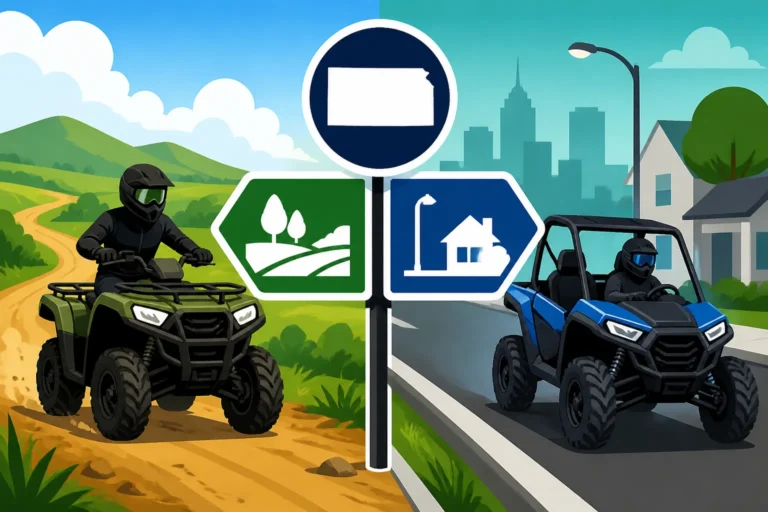
It’s a tough pill to swallow for many, but the default position in Kansas law is that ATVs and UTVs are not street legal. Chapter 8 of Kansas statutes, particularly sections like [Kansas ATV Road Rules Under 8-15,100], lays out the framework. These machines are primarily designed and intended for off-road use, and that distinction is paramount in the eyes of the law. This isn't just about speed; it's about vehicle classification, safety features, and the very intent of the machine's design.
Understanding the Legal Definitions of Off-Road Vehicles
Kansas law is very particular about how it defines different types of machines, and these definitions directly impact where you can ride them. An All-Terrain Vehicle (ATV) is typically defined as a motorized off-highway vehicle designed to travel on four or more low-pressure tires, with a seat designed to be straddled by the operator, and handlebars for steering. [An ATV Defined in Chapter 8] goes into specific detail. Utility Terrain Vehicles (UTVs), while similar in spirit, often feature side-by-side seating, a steering wheel, and sometimes a bed for cargo. These distinctions aren't just technicalities; they are the foundation upon which all road use regulations are built. If your machine doesn't meet the specific criteria for an exception, it stays off the pavement.
The Dangers of Unregistered and Uninsured Road Use
Riding your ATV or UTV on a public road when it's not legally permitted isn't just a minor infraction; it carries significant risks. For starters, you could face hefty fines, and your machine could even be impounded. But beyond the legal repercussions, there are severe safety concerns. ATVs and UTVs lack many safety features common in road-legal vehicles, such as turn signals, proper brake lights, robust headlights, and often the crash protection required for higher-speed impacts. Furthermore, if you're involved in an accident while riding illegally, your insurance company might deny coverage, leaving you personally responsible for damages and medical bills. It's a risk simply not worth taking. Even if you modify your machine with aftermarket parts from companies like SuperATV, those additions alone do not inherently make it street legal without the proper legal classification or local authorization.
The Work-Site Utility Vehicle (WSUV) Exception and Its Speed Parameters
Now, let's talk about where that 65 mph ceiling occasionally pops up. This isn't a free pass for every UTV out there; it specifically refers to a unique class of vehicle in Kansas law: the Work-Site Utility Vehicle, or WSUV. Kansas has a distinct classification for these machines, and it's unlike many of its neighboring states. [Kansas Work-Site Utility Vehicles Explained] really breaks down what sets these apart.
What Qualifies as a Kansas Work-Site Utility Vehicle
To be classified as a WSUV in Kansas, a machine must meet several specific criteria. It needs to be:
- At least 48 inches wide ([Kansas WSUV Width of 48 Inches])
- Weigh more than 800 pounds unladen ([Kansas WSUV Weight Over 800 Pounds])
- Designed by the manufacturer to carry its operator and any passengers side-by-side (hence "side-by-side" seating rather than straddling)
- Equipped with a steering wheel
- Intended for use off-highway
If your UTV fits these detailed descriptions, it might qualify for WSUV status, which then opens a very specific, limited door to road use. It's crucial to understand [What Makes a Side-by-Side a Work-Site Utility Vehicle] because this classification is the linchpin for road-legal use at higher speeds in Kansas.
The 65 mph Ceiling: Where and When It Applies
So, where does the 65 mph come in? Kansas law allows WSUVs, if properly titled, to be operated on public roads with a speed limit of 65 mph or less. This is a critical nuance: it doesn't mean a WSUV can go 65 mph, or should go 65 mph. It means the road it's allowed on can have a posted speed limit of up to 65 mph. The WSUV itself must still be operated at a safe and reasonable speed for its design and the conditions. This permission is primarily for county and township roads, and in areas where local ordinances specifically permit it. It's not for interstates or federal highways, which are generally off-limits for all off-road machines, even WSUVs. The 65 mph is the ceiling for the posted road speed, not necessarily the operational speed of your WSUV. You need to respect the actual posted speed limit of the road you are on.
Equipment Requirements for WSUV Road Use
Even if your machine qualifies as a WSUV and you're on a permitted road, you're not done yet. To legally operate a WSUV on Kansas roads where permitted, it must be equipped with specific safety features. These typically include:
- Headlights
- Taillights
- Brake lights
- Turn signals
- Reflectors
- A rearview mirror
- A parking brake
- A horn
- Seatbelts for all occupants
- A windshield
Many of these items, like enhanced lighting and mirrors, can be added with aftermarket kits. Companies like SuperATV offer a range of accessories that can help equip a WSUV to meet these requirements, but remember, installing these parts alone does not grant WSUV status or road legality; the vehicle itself must first meet the underlying classification, and you must adhere to all local and state laws. Always consult the specific statute or local ordinance to ensure your WSUV is fully compliant before hitting the road.
Agricultural Exemptions and Farm-Related Road Use
Kansas is an agricultural state, and its laws reflect this with specific exemptions for machines used in farming operations. This is a separate category from WSUVs and city ordinances, and it comes with its own set of rules regarding road access and speed.
Defining "Agricultural Purposes" on Kansas Roads
The agricultural exemption allows ATVs and UTVs (even those not classified as WSUVs) to be operated on public roads for specific farm-related activities. This isn't a blanket permission to joyride; it's strictly for [Kansas Agricultural Trips on a 65 mph Road] or other farm-related travel. Examples include moving between fields, transporting equipment for planting or harvesting, checking irrigation pivots, or traveling to service farm infrastructure. The key here is the purpose of the trip. If you're hauling a sprayer to a new field or driving to a feedlot, you might be covered. If you're heading to the gas station for snacks, probably not. [Kansas Machines Used Only on a Farm] clarifies these uses.
Speed and Right-of-Way for Agricultural Use
When an ATV or UTV is being used for legitimate agricultural purposes on a public road, it is generally allowed on roads with a posted speed limit of 65 mph or less. Similar to WSUVs, this is the maximum road speed allowed, not the speed at which your farm machine should be operated. These machines often operate at much slower speeds, and drivers are typically required to operate as far to the right as practicable, ensuring the flow of traffic is not unduly impeded. [Kansas Rules for Riding a County Road] and [Kansas Agricultural Trips on a 65 mph Road] further explain the expectation for riders to keep to the right. While these machines can cross state highways, they cannot travel on them for extended distances. Remember, safety always comes first, and these machines are not designed for high-speed road travel.
Licensing, Lighting, and Other Considerations
Even with an agricultural exemption, common sense and safety rules still apply. The operator must generally hold a valid driver's license. Furthermore, if you're operating the machine between sunset and sunrise, it must be equipped with proper lighting, similar to motorcycle lighting standards, to ensure visibility to other motorists. This means headlights and taillights that meet specific brightness and visibility standards. While you might not be going 65 mph, you absolutely need to be seen, especially on dusty county roads where visibility can be compromised. Always carry proof that you are legitimately engaged in an agricultural purpose, as a deputy might stop you to verify your reason for road use.
Local Ordinances: When Cities Open Their Streets to UTVs
Beyond state-level WSUV classifications and agricultural exemptions, there's another crucial layer of legislation: local city and county ordinances. Kansas gives cities the power to allow UTVs on their streets, and this is where you'll find significant variation in rules, speed limits, and even fees. [Kansas Cities That Authorize ATV Street Use] is an excellent resource for understanding this patchwork of local laws.
How Cities Create UTV-Friendly Zones
Many smaller towns and even some larger communities in Kansas have recognized the utility and popularity of UTVs for local transportation, particularly for older residents or those with short commutes. To permit UTV use, a city council must pass a specific ordinance. This ordinance will outline exactly which streets are open, the hours of operation, required equipment, and often specific speed limits that might be much lower than 65 mph. For instance, some cities might restrict UTVs to roads with a posted speed limit of 35 mph or less, or even 25 mph. [How a City Council Opens Its Streets to UTVs] explains this process.
Common Requirements and Local Speed Restrictions
When a city opens its streets to UTVs, they typically impose strict equipment requirements that often mirror or even exceed those for WSUVs. You'll likely need:
- Headlights
- Taillights
- Brake lights
- Turn signals
- A rearview mirror (or often, side mirrors)
- A horn
- A slow-moving vehicle emblem (especially if top speed is low)
- Seatbelts
Some cities also require specific insurance coverage, an annual city permit or tag, and a valid driver's license. [Kansas City Insurance Requirements] and [Kansas City Tag Fees for a UTV] are common considerations. The speed limit within these city-approved zones is paramount. While the state statute for WSUVs might mention 65 mph road ceilings, individual city ordinances often set much lower operational speed limits for UTVs on their streets, frequently in the 25-35 mph range, consistent with neighborhood traffic. For example, [Louisburg's 45 mph Street Limit in Kansas] is an exception to the lower limit, indicating the variation. It's critical to check the specific ordinance for your city.
Researching Your Local Ordinance Before You Ride
The biggest mistake you can make is assuming that because one town allows UTVs, all towns do, or that the rules are universal. They are not. If you plan to ride your UTV on city streets, you must research the specific ordinance for that municipality. This usually involves checking the city's official website, contacting the city clerk's office, or speaking with local law enforcement. For instance, if you're riding in Scott City or De Soto, you'd need to look up [Scott City's Ordinance in Kansas] or [De Soto's Ordinance in Kansas]. Penalties for riding illegally can range from tickets and fines to impoundment. Don't risk it. Always know the rules before you unload your machine.
Table: Kansas Off-Road Vehicle Road Use Summary (General Guidelines)
| Vehicle Type | Primary Intended Use | General Road Legality (State Law) | Max Road Speed Limit (State) | Common Equipment Requirements for Road Use | Specific Exceptions |
|---|---|---|---|---|---|
| ATV | Off-Road | Generally Banned | N/A | N/A | Agricultural use (specific purposes only); Local ordinances may allow some limited use. |
| Standard UTV | Off-Road | Generally Banned | N/A | N/A | Agricultural use (specific purposes only); Local ordinances often permit with specific rules. |
| Work-Site Utility Vehicle (WSUV) | Work/Off-Road | Permitted on roads <= 65 mph (if titled) | 65 mph (road limit) | Head/Tail/Brake Lights, Turn Signals, Horn, Mirror, Seatbelts, Windshield | Must meet specific width (>48"), weight (>800 lbs), steering, and seating criteria; Cannot use interstates/federal highways. |
| Golf Cart | Low-Speed/Golf | Generally Banned | N/A | Head/Tail/Brake Lights, Reflectors, Mirror, Slow-Moving Vehicle Emblem | Allowed on roads <= 25 mph by city ordinance; Some state law for crossing roads up to 30 mph. |
| Micro Utility Truck (MUT) | Low-Speed/Utility | Permitted on roads <= 45 mph | 45 mph (vehicle limit) | Head/Tail/Brake Lights, Turn Signals, Horn, Mirror, Seatbelts, Windshield, VIN | Must be manufactured and certified by the manufacturer as an MUT; Cannot use interstates/federal highways or roads over 45 mph. |
Note: This table provides general guidelines. Always consult specific Kansas statutes and local city/county ordinances for definitive rules and requirements for your machine and intended riding location. The 65 mph mentioned for WSUVs and agricultural use refers to the maximum posted speed limit of the road, not necessarily the operational speed of the machine itself.
Disclaimer
This article is for general informational purposes only and does not constitute professional advice. Laws, prices and regulations vary by location and change over time. Consult a qualified professional for guidance on your specific situation.