Choosing a Helmet When No Law Requires One
It's a common scenario here in Kansas: you've got your ATV or UTV ready for an adventure, maybe heading out to the fields, a local trail, or just around your property, and you start wondering about helmets. There's no statewide law demanding you strap one on for every ride, and that can lead to some confusion – and sometimes, a false sense of security. This guide is all about cutting through that confusion, helping you understand why choosing the right helmet is a personal safety choice, and what to look for even when the law isn't making the decision for you.
The Kansas Helmet Law Landscape for ATVs and UTVs
When you first start looking into the rules for riding off-road machines in the Sunflower State, you might be surprised to learn that state law is pretty hands-off when it comes to helmets for ATVs and UTVs. This can feel liberating, but it also places a lot of responsibility squarely on your shoulders.
Understanding the Absence of a Universal Mandate
Many riders ask, [Does Kansas Have an ATV Helmet Law at All?] And the answer, generally speaking, is no, not for most off-road riding. The statutes that deal with helmets are primarily written with motorcycles in mind, not the four-wheeled (or more) machines we love to ride through pastures, over creeks, or on our hunting land. This means that if you're out on private property, traversing open fields, or even on designated off-road trails, you won't typically find a state trooper citing you for not wearing a helmet.
This absence of a universal mandate often gives riders a sense of freedom. "If the law doesn't require it, why should I bother?" is a thought many of us have had. However, this isn't an invitation to disregard safety. Instead, it's a call for personal accountability. The state trusts you to make informed decisions about your own well-being, knowing that the inherent risks of off-road riding don't disappear just because a law isn't on the books. It's crucial to distinguish between what's legally required and what's genuinely smart for your safety and the safety of your loved ones. The terrain here can be deceptive, and even a familiar path can throw an unexpected curveball.
When Local Ordinances or Private Parks Step In
While the state of Kansas might not have a blanket helmet law for ATVs and UTVs, it's a different story when you start looking at specific locations or riding areas. Think of it like a patchwork quilt of regulations, where different areas have stitched on their own rules.
Some cities, for instance, have taken it upon themselves to create ordinances that regulate the use of UTVs on public streets. If you're riding a UTV in one of the [Kansas Cities That Authorize ATV Street Use], you might very well find that a helmet is required, especially for younger riders or if the UTV is licensed for limited street use. These city ordinances often come with specific equipment requirements, and a helmet can be part of that package to ensure rider safety on shared roadways. Always check with the local city hall or police department before you plan to ride your UTV within city limits, as the rules can vary wildly from one town to the next. What's perfectly fine in Andover might be a ticketable offense in Louisburg.
Beyond city streets, private off-road parks are another common place where you'll encounter mandatory helmet rules. Places like [Kansas Rocks Recreation Park] near Mapleton or [Syracuse Sand Dunes Park in Kansas] in Hamilton County set their own comprehensive rules to ensure the safety of all patrons. These parks know the risks involved in their specific riding environments—whether it's navigating challenging rock crawling trails or tackling towering sand dunes—and helmets are almost always a non-negotiable requirement. They might also have age restrictions, requiring anyone under 18 (or even older, depending on the park) to wear a helmet at all times while riding. Before you load up your machine and head to a private park, always visit their website or call ahead to familiarize yourself with their specific safety regulations, including helmet mandates. It saves you the headache of being turned away at the gate, and more importantly, it ensures you're prepared for a safe day of riding.
Why You Should Always Wear a Helmet (Even Without a Law)
Let's be real for a moment. Nobody wants to have an accident. We all picture perfect rides, sunny skies, and smooth trails. But the truth is, off-road riding, by its very nature, carries risks. And when it comes to protecting yourself, relying solely on the absence of a law is like relying on luck.
The Unpredictable Nature of Off-Road Riding
One of the greatest appeals of ATV and UTV riding is the freedom to explore diverse and often challenging terrain. But that same challenge is what makes it inherently unpredictable. You could be riding a familiar path on your farm, a trail at Tuttle Creek, or navigating through dense timber, and something unexpected can happen in a flash.
Imagine this: you're cruising along a well-worn path, maybe a little too comfortable, and suddenly your front tire drops into a hidden rut that wasn't there last week after a heavy rain. The machine lurches, you lose balance, and before you know it, you're off the seat. Or perhaps you're on a spirited ride with friends, take a turn a little too wide, and clip a tree branch you didn't see. Even a simple rollover on a gentle slope can turn serious very quickly. These aren't just hypothetical nightmares; they are real-world scenarios that riders face every day. The speeds, the uneven ground, the possibility of encountering other riders, wildlife, or even loose livestock – all contribute to an environment where a moment's distraction or a split-second miscalculation can lead to a significant impact. We often think of major crashes, but even a low-speed tip-over can result in a serious head injury if your head hits a rock, a tree stump, or the hard ground. Your head is not designed to withstand these types of forces, and the consequences can be life-altering.
Protecting Your Most Valuable Asset
Your brain is the command center of your body, responsible for everything from breathing to remembering your favorite trails. When you're riding, it's exposed to potential impacts from all directions. This is where a helmet steps in as your brain's best friend.
A properly fitted, certified helmet is engineered to absorb and distribute the forces of an impact, preventing them from directly reaching your skull and brain. It has multiple layers designed to work together: a rigid outer shell to spread the impact over a larger area, an energy-absorbing foam liner to cushion the blow, and soft padding for comfort and fit. Without this protection, even a seemingly minor bump to the head can result in a concussion, which is a traumatic brain injury. More severe impacts can lead to skull fractures, contusions, or even devastating internal bleeding. We're talking about injuries that can affect your memory, speech, coordination, and overall quality of life for years, if not permanently. While you might be focusing on the fun of the ride, a helmet ensures that your brain, and therefore your ability to enjoy future rides, remains intact. It's a small investment with an immeasurable return – peace of mind and, most importantly, critical protection for your most vital organ. Many riders invest thousands in their machines, upgrading parts from brands like SuperATV, but forget that their own safety is the most important upgrade of all.
What to Look For When Choosing Your Helmet
So, you're convinced that wearing a helmet is a smart move, even without a law. Great! Now comes the fun (and sometimes overwhelming) part: choosing one. With so many options out there, it can feel like trying to find a needle in a haystack. But focusing on a few key areas will help you narrow down the best choice for you.
Safety Certifications: Your Non-Negotiable Standard
This is the absolute first thing you should look for, no exceptions. A helmet is only as good as the protection it offers, and that protection is verified by specific safety certifications. Never, ever buy a helmet that doesn't carry at least one of these.
- DOT (Department of Transportation): This is the minimum safety standard for helmets sold in the U.S. for on-road use. A DOT-certified helmet means it has met certain impact attenuation, penetration resistance, and retention system effectiveness tests. If a helmet is DOT-certified, it will have a DOT sticker on the back.
- Snell (Snell Memorial Foundation): Snell is an independent, non-profit organization that sets even more rigorous testing standards than DOT. Snell certifications (like Snell M2020, for example) are often sought after by serious riders because they involve multiple impact points, higher impact energy, and more comprehensive penetration tests. A Snell-certified helmet offers an extremely high level of protection.
- ECE (Economic Commission for Europe): This is the European standard and is widely recognized globally for its robust testing protocols. ECE 22.05 or ECE 22.06 (the newer standard) certified helmets are known for being very safe and are often lighter than Snell-certified helmets.
When you're shopping, always check for these labels. Don't fall for marketing hype that boasts "maximum protection" without the backing of a reputable certification. An uncertified helmet might look cool, but it offers little more than psychological comfort and will do very little to protect your head in a real-world impact. Even if you're just puttering around the farm, a certified helmet is the only real choice. Reputable brands, like those that offer heavy-duty accessories such as SuperATV parts, will always ensure their helmets are properly certified.
Types of Helmets for Off-Road Riding
The world of helmets isn't one-size-fits-all. Different riding styles and environments call for different designs. Knowing the main types will help you pick one that suits your Kansas riding adventures.
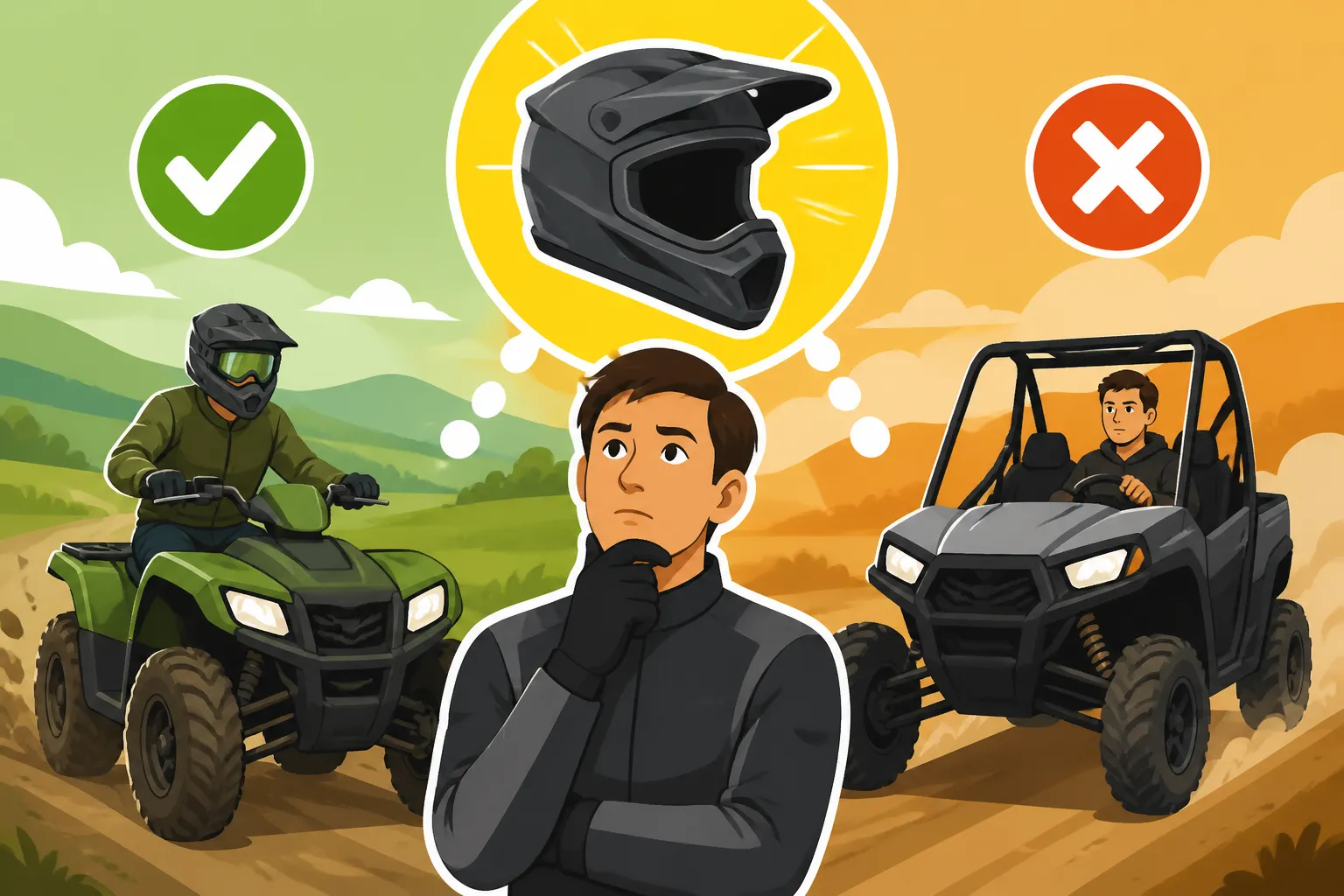
- Full-Face Off-Road Helmets (Motocross/MX Helmets): These are the workhorses of the off-road world. They feature a distinct peak (or visor) that helps shield your eyes from sun glare, roost from other riders, and low-hanging branches. They have an elongated chin bar for maximum face protection and excellent ventilation, which is crucial for strenuous riding and hot Kansas summers. These helmets are typically designed to be worn with separate goggles, offering superior [Eye Protection on a Dusty Section Road]. They provide the best overall protection for aggressive trail riding, racing, or any scenario where impacts are a higher risk.
- Modular Helmets (Flip-Up Helmets): While more common for street riding, some riders opt for modular helmets due to their versatility. The chin bar and visor can flip up, allowing you to talk, drink, or get some air without removing the entire helmet. However, they are generally heavier than dedicated off-road helmets, and their modular design can sometimes compromise the integrity of the chin bar in a severe off-road impact compared to a fixed full-face. They might be a decent choice for slower-paced utility work or light trail riding, but less ideal for dusty, intense off-road environments where maximum protection and ventilation are key.
- Open-Face Helmets (3/4 Helmets): These helmets cover the top, back, and sides of your head, but leave your face exposed. They offer excellent airflow, making them comfortable in very hot weather or for low-speed activities like casual farm chores. However, the lack of chin bar and face shield protection means they are a much riskier choice for recreational ATV/UTV riding, especially at higher speeds or on challenging terrain. A simple forward fall can result in severe facial injuries. For any serious riding, the trade-off in protection usually isn't worth the extra airflow.
Here’s a quick summary to help you visualize:
| Helmet Type | Protection Level | Best For | Pros | Cons |
|---|---|---|---|---|
| Full-Face Off-Road (MX) | Highest | Aggressive trail, racing, challenging terrain | Maximum impact protection, excellent ventilation, good roost shield | Requires separate goggles, can feel bulky |
| Modular (Flip-Up) | Moderate to High | Light trail, utility, general cruising | Versatile, convenient for quick stops/communication | Heavier, less robust chin bar than MX, less ventilation for intense riding |
| Open-Face (3/4) | Minimal Head (No Face) | Very slow utility, casual farm work | Excellent airflow, lightweight | Absolutely no facial protection, higher risk of injury |
Fit, Comfort, and Features
Once you've zeroed in on certified helmets of the right type, it's time to focus on the details that make a helmet truly effective and enjoyable to wear. A helmet won't protect you if it doesn't fit correctly or if it's so uncomfortable that you don't want to wear it.
- Proper Fit: This is paramount. A helmet should fit snugly all around your head, with no pressure points. It shouldn't rock side-to-side or front-to-back when you shake your head. The cheek pads should make firm contact with your cheeks, almost squishing them slightly. If it's too loose, it can shift during an impact, compromising its protective ability. If it's too tight, it will be uncomfortable and distracting. Helmet sizing varies between manufacturers, so don't just go by a letter size; always consult the brand's sizing chart and, if possible, try it on.
- Ventilation: Riding in Kansas can mean blistering heat and humidity in the summer, and crisp, cold air in the winter. Good ventilation is key to comfort and preventing your goggles or visor from fogging up. Look for helmets with multiple intake and exhaust vents to promote airflow.
- Weight: A lighter helmet will reduce neck fatigue on long rides. Modern materials like carbon fiber or advanced composites contribute to lighter, yet still incredibly strong, helmets.
- Goggles/Visor Compatibility: For off-road helmets, you'll almost always need separate goggles. Ensure the eyeport of the helmet is large enough to accommodate your preferred goggles and that the strap sits securely around the back of the helmet. For modular or street-style helmets, check the quality and anti-fog properties of the integrated visor.
- Removable Lining: Being able to remove and wash the helmet's interior padding is a huge plus, especially after a sweaty, dusty ride. It helps maintain hygiene and prevents odors.
- Material: Helmet shells are typically made from polycarbonate, fiberglass composite, or carbon fiber. Polycarbonate is generally the most affordable, offering good protection. Fiberglass composite offers a better strength-to-weight ratio, while carbon fiber is often the lightest and strongest, but also the most expensive. Each has its merits, but remember, the certification is more important than the material itself.
Budgeting for Brain Protection
Let's address the elephant in the room: cost. Helmets can range from under $100 to well over $500, and it's easy to get sticker shock. However, this is one area where you absolutely should not skimp. Think of it this way: what's the cost of a severe brain injury? Compared to that, even the most expensive helmet is an incredible bargain.
While you don't need to break the bank for a top-of-the-line racing helmet, investing in a mid-range, certified helmet from a reputable brand is a wise decision. These often offer an excellent balance of safety, comfort, and features without being overly extravagant. Look for sales at your local powersports dealer or online. Sometimes, last year's model can be a fantastic deal, offering the same safety certifications at a reduced price. Remember, the goal isn't just any helmet; it's a good, safe helmet. As you consider your [Kansas Cost of Ownership Year One], factor in a quality helmet alongside other essential gear.
Maintaining Your Helmet for Long-Term Safety
Buying a great helmet is only half the battle. To ensure it continues to offer maximum protection, you need to treat it right. Proper care and knowing when to replace it are crucial steps that many riders overlook.
Cleaning and Storage Tips
After a dusty day of riding on Kansas trails or working out in the fields, your helmet will undoubtedly need some attention. Neglecting its care can lead to accelerated wear, unpleasant odors, and even compromised safety.
For the exterior shell, a gentle cleaning is usually all that's needed. Use a soft cloth, warm water, and a mild soap (like baby shampoo or dish soap) to wipe away dirt, dust, and bug splatters. Avoid harsh chemicals, abrasive cleaners, or petroleum-based solvents, as these can degrade the helmet's materials, especially its polycarbonate or plastic components, potentially weakening the shell or damaging the clear coat. For stubborn grime, let a damp cloth sit on the area for a few minutes to soften it before wiping.
The interior pads, especially if they are removable, should be washed periodically. Most removable linings are machine washable on a delicate cycle with mild detergent, but always check the manufacturer's instructions first. If they're not removable, you can spot clean them with a damp cloth and mild soap, then allow them to air dry completely. Never put a helmet liner in a dryer, as it can shrink or damage the materials. Good ventilation is crucial to air out the interior after every ride, preventing moisture buildup and mold.
When it comes to storage, treat your helmet with respect. Never just toss it on the ground or hang it by the chin strap. Store it in a cool, dry place away from direct sunlight and extreme temperatures, which can degrade the helmet's materials over time. A helmet bag (often included with purchase) is excellent for protecting it from dust and minor bumps. Keep it off concrete floors if possible, as small, unnoticed impacts can weaken the shell. Store it where it won't fall or be knocked over, ensuring it's ready for your next adventure. Taking good care of your helmet means it will take good care of you for longer.
When to Replace Your Helmet
This is a critical point that many riders struggle with, especially when their helmet still "looks fine." Helmets are designed for a single major impact. Even if there's no visible damage after a crash, the internal foam liner might have compressed or cracked, rendering it useless for future impacts.
- After Any Significant Impact: This is the golden rule. If your helmet takes a serious hit – whether it's a crash, a fall onto a hard surface, or a heavy object dropping on it – it needs to be replaced immediately. The energy-absorbing foam inside works by crushing to dissipate impact forces. Once it's crushed, it can't do its job again. Even a seemingly minor impact that leaves no visible marks can be enough to compromise its integrity. It's like a car airbag: once deployed, it needs replacing. Your helmet is no different.
- General Lifespan: Even without an impact, helmets don't last forever. The materials degrade over time due to exposure to UV light, sweat, oils from your skin, and general wear and tear. Most manufacturers and safety organizations recommend replacing a helmet every 3 to 5 years from the date of manufacture (often stamped inside the helmet or on a sticker). The straps can fray, the foam can lose its resilience, and the adhesive holding parts together can weaken. Beyond this timeframe, a helmet simply can't guarantee the same level of protection it did when new.
- Visible Wear and Tear: If you notice any cracks in the shell, fraying straps, missing rivets, or exposed foam, it's time for a new helmet. Any sign of degradation means the helmet's structural integrity is compromised.
It's a tough pill to swallow, especially if your helmet cost a good chunk of change. But remember, a compromised helmet offers compromised protection. Your brain isn't worth gambling on. Investing in a new helmet when necessary is investing in your continued ability to enjoy all the riding adventures Kansas has to offer.
Disclaimer
This article is for general informational purposes only and does not constitute professional advice. Laws, prices and regulations vary by location and change over time. Consult a qualified professional for guidance on your specific situation.