Golf Carts and UTVs Follow Different Kansas Rules
It's incredibly frustrating when you want to take your off-road machine from the trail to the town, only to find a tangle of rules that seem to change depending on whether you're riding a golf cart, an ATV, or a UTV, and then change again based on the specific city you're in. This guide is here to untangle the confusion, helping you understand the distinct Kansas laws for golf carts and UTVs, why they're treated differently, and what it truly takes to legally ride them on public roads.
Understanding the Legal Distinctions Between Golf Carts and UTVs in Kansas
One of the biggest sources of confusion for off-road enthusiasts in Kansas is understanding how the law distinguishes between various types of "nonhighway" vehicles. It might seem like a golf cart and a side-by-side UTV are functionally similar – both are often used for light transport off paved roads – but Kansas law sees them through entirely different lenses. This distinction is absolutely critical because it dictates where and how you can legally operate them, especially when it comes to venturing onto any sort of public roadway. Trying to apply golf cart rules to a UTV, or vice-versa, is a surefire way to run into trouble.
What Kansas Law Defines as a Golf Cart
When we talk about a "golf cart" in Kansas, the state has a very specific definition in mind, and it's much narrower than what many people might casually think of. Essentially, a golf cart is a small, electric-powered vehicle, often with a top speed designed primarily for use on a golf course. The law specifies that it must have at least three wheels and be designed for carrying golfers and their equipment. The key here is the design intent and speed capability. Most golf carts are not built for sustained road travel at higher speeds, nor are they typically equipped with the full suite of safety features you'd expect on a traditional motor vehicle.
This specific definition means that if your machine starts looking less like something you'd see on the green and more like a miniature pickup truck or a rugged off-road buggy, even if it's electric, it's probably not going to be classified as a golf cart. This can be a rude awakening for someone who bought an electric utility vehicle thinking it fell under the more lenient golf cart rules. The state's intent is to regulate these slow-moving, course-focused vehicles differently than the more powerful machines. [What the Law Counts as a Golf Cart] delves deeper into these specific parameters.
How Kansas Law Classifies Utility Terrain Vehicles UTVs
Unlike golf carts, UTVs (Utility Terrain Vehicles), also commonly called side-by-sides, are generally categorized under the broader umbrella of "nonhighway vehicles" in Kansas. These are machines explicitly designed for off-road use, often equipped with powerful gasoline engines, robust suspension, and seating for two or more passengers side-by-side. The law doesn't define UTVs as precisely as it does golf carts; instead, it tends to group them with ATVs and other vehicles not primarily designed for highway travel. The critical distinction here is their construction and intended use – they are built tough for challenging terrain, hauling, and recreational off-roading, not for cruising down Main Street.
Because of their off-road design, UTVs are subject to a different set of regulations when it comes to road use. The state legislature views them as powerful machines that, without proper local oversight and equipment, could pose a safety risk on public roads. This means that while a city might be able to create an ordinance allowing a UTV on its streets, it's doing so with a clear understanding that it's permitting a vehicle fundamentally designed for a different environment. This fundamental difference in classification is why you'll find completely separate discussions and regulations regarding [Kansas Micro Utility Truck Road Rules] compared to a standard UTV, even though they might look somewhat similar.
The Nonhighway Vehicle Umbrella for Off-Road Machines
The term "nonhighway vehicle" is the overarching category under which both UTVs and ATVs fall in Kansas. This is a crucial concept to grasp because it sets the baseline for all road-use discussions. Essentially, if a vehicle is defined as a nonhighway vehicle, the default assumption under state law is that it is not legal for operation on public roads. This covers a wide range of machines, from dirt bikes to four-wheelers, and of course, your side-by-side UTV. The state legislature has, in [An ATV Defined in Chapter 8], clearly outlined what constitutes these types of vehicles, and that definition is the starting point for all subsequent regulations.
This default ban is incredibly important because it places the burden of proof on local municipalities to opt-in and specifically allow these vehicles on their roads. It's not a case of state law being silent; it's a case of state law explicitly stating these machines don't belong on public roads unless a local authority intervenes. This framework aims to ensure that communities can assess their own safety concerns, road infrastructure, and local needs before permitting off-road vehicles to share the asphalt with cars and trucks. Understanding [Why the Definitions Matter for Roads] is key to navigating these complex rules without getting a ticket.
General Kansas Road Rules: The Default Ban and Agricultural Exceptions
It’s often a bitter pill for off-road enthusiasts to swallow, but the baseline truth in Kansas is that most ATVs and UTVs are simply not allowed on public roads. This isn't just a suggestion; it's a foundational legal principle baked into the state's motor vehicle statutes. However, like many laws, there are specific, narrow exceptions carved out, particularly for agricultural purposes, that can provide a limited avenue for road use. Grasping this default ban and its specific exemptions is the first step to staying out of trouble when you’re considering taking your machine anywhere near a paved surface.
The Statewide Default: Why Most Off-Roaders Are Banned
Kansas law, specifically K.S.A. 8-15,100, establishes a clear general prohibition: nonhighway vehicles, which include most UTVs and ATVs, are not permitted on any public street, road, or highway. This is the starting point for all discussions about street legality in the Sunflower State. The rationale behind this blanket ban is rooted in safety and the inherent design of these vehicles. Off-road machines typically lack many of the safety features standard on street-legal vehicles, such as turn signals, full windshields, crumple zones, and specific lighting configurations suitable for higher speeds and traffic. They are designed for fields, trails, and rough terrain, not for coexisting with cars, trucks, and motorcycles on public thoroughfares.
This default ban means that simply owning a UTV or ATV, even if it has a title, does not grant you permission to drive it on most roads. The title merely establishes ownership and classification as a nonhighway vehicle; it does not confer street-legal status. Many owners mistakenly believe that because they have a title, their machine is somehow exempt, but this is a dangerous misconception. This is why [Having a Title Does Not Make an ATV Street Legal] is such an important concept to understand. Without a specific exemption or a valid city ordinance, riding your UTV on a county road could quickly lead to a citation.
Agricultural and Work Exceptions: Navigating Farm Roads and Fields
While the general ban is strict, Kansas law does provide specific, limited exceptions for agricultural and work-related uses. These exceptions are critical for farmers, ranchers, and those whose livelihoods depend on using their UTVs and ATVs for work. For instance, a person engaged in an agricultural pursuit may operate an off-road machine on a public highway for distances of up to five miles when transporting agricultural products, livestock, or equipment. This often comes into play when moving from one field to another, or from a field to a barn, even if it requires a short stint on a county road. However, these exceptions are not a carte blanche for recreational riding on rural roads.
It’s crucial to understand that these agricultural exceptions are narrowly defined. They are tied to the purpose of the trip – specifically, agricultural or work-related tasks – and not just the location. You can’t simply claim you’re "going to check on the cows" if you’re actually headed to a friend’s house two towns over for a joyride. The vehicle must be used for bona fide farm or ranch purposes, and the operator must still possess a valid driver’s license. This means that while [Kansas Rules for Riding a County Road] might offer some leeway for agricultural uses, recreational use almost always remains prohibited without a specific local ordinance.
Crossing State and Federal Highways: A Limited Privilege
Even with the general prohibition and specific agricultural exceptions, there's another nuanced rule that many riders overlook: the ability to cross state and federal highways. Kansas law generally permits the crossing of a divided or undivided highway at approximately a 90-degree angle, provided the crossing is made safely and without interfering with other traffic. This is a very specific, brief maneuver, and it is not a license to ride down the highway, even for a short distance. It's meant for situations where a farmer might need to get from one section of their land to another, or a landowner needs to access property on the other side of a major road.
This limited crossing privilege requires extreme caution. You must yield to all traffic, and the intent is to minimize the time your nonhighway vehicle spends on the busy roadway. You cannot ride along the shoulder, or use the crossing as an excuse to travel parallel to the highway for any distance. It’s a point-to-point crossing only, designed to facilitate property access, not travel. For more details on the restrictions and responsibilities when navigating these crossings, you can refer to [Kansas Rules for Crossing a Highway], which outlines the specific conditions under which this is permissible.
The Power of Local Ordinances: How Cities Open Their Streets
While state law sets a restrictive default for UTVs and golf carts on public roads, it also provides a critical loophole: the ability for local municipalities to create their own ordinances. This means that even though Kansas generally bans these vehicles from roads, individual cities and counties have the power to "opt-in" and allow them, albeit under specific conditions. This local control is why you can travel from one town to the next and find wildly different rules for your off-road machine, making local research absolutely essential for any rider.
The Opt-In System: When a City Council Allows UTVs
Kansas operates on an "opt-in" system when it comes to allowing nonhighway vehicles like UTVs and golf carts on city streets. This means that no city can simply assume these vehicles are allowed; instead, the city council or governing body must actively pass an ordinance to permit their use. This legislative process allows each community to assess its unique circumstances, including traffic density, road infrastructure, population size, and resident preferences, before making a decision. When an ordinance is passed, it will typically outline specific streets where UTVs are permitted (often excluding state highways or major arterial roads), hours of operation, and required safety equipment.
The process of a city opting in often involves public hearings and community input, reflecting the varied opinions on sharing roads with off-road machines. Some communities embrace the idea, seeing it as a way to enhance recreation or offer convenient local transportation, particularly in smaller towns. Others may be more hesitant due to safety concerns. This local control is a direct result of state statutes that delegate this authority to municipalities, recognizing that a one-size-fits-all approach wouldn't work across all of Kansas's diverse communities. Understanding [How a City Council Opens Its Streets to UTVs] is key to recognizing the legislative steps involved.
Specific City Examples and Their Unique Requirements
Because of this opt-in system, you’ll find a patchwork of regulations across Kansas. For example, cities like Louisburg, Scott City, and De Soto have all passed ordinances allowing UTVs on certain public streets, but their rules are far from uniform. Louisburg, for instance, requires a specific city-issued UTV tag, mandates insurance, and has a speed limit for UTVs on city streets, often restricting them to roads with posted speeds of 45 mph or less. Scott City might have different speed restrictions or may limit UTVs to certain parts of town. Andover might have other unique requirements, perhaps related to age or specific equipment.
These variations underscore the importance of checking each city's specific ordinance before you ride. You cannot assume that because your UTV is street-legal in Louisburg, it’s automatically legal in the next town over. This can be frustrating for riders, but it’s the reality of local control. It’s not just about getting a tag; it’s about understanding all the nuances of the local law. The fee structures, application processes, and inspection requirements can all differ significantly. For example, [Louisburg's UTV Tag Fees in Kansas] are just one piece of a larger set of rules that you’d need to comply with in that particular community.
Finding Your Local Ordinance: Where to Look for Rules
Given the local nature of these rules, the most reliable source for information about street-legal UTV and golf cart use is your local city hall or municipal clerk's office. Many cities now publish their ordinances online on their official websites, often under a "City Clerk," "Departments," or "Ordinances" section. A quick phone call to the city clerk can also point you in the right direction. It’s important to ask specifically about "nonhighway vehicle ordinances" or "UTV/golf cart street use permits," as the terminology can vary.
When you find the ordinance, read it carefully. Pay close attention to sections detailing:
- Permitted Streets: Are all city streets open, or only those below a certain speed limit? Are state highways running through town excluded?
- Required Equipment: What lights, mirrors, turn signals, and other safety gear are mandatory?
- Fees and Permits: Is there a local registration or tag fee?
- Insurance Requirements: Is liability insurance required?
- Operator Requirements: Are there age limits or specific driver's license mandates?
Never rely on hearsay from a neighbor or a fellow rider. The law is written down, and that's what enforcement will reference. Checking the official source is the only way to be truly sure. This diligence is crucial, as [Kansas Cities That Authorize ATV Street Use] can provide a general list, but the devil is always in the details of the specific ordinance.
Essential Equipment and Operation Rules for Road-Legal Machines
Once you've confirmed that a local ordinance permits golf carts or UTVs on certain streets, the next hurdle is ensuring your machine is properly equipped and that you understand the operational rules. Simply getting permission isn't enough; your vehicle needs to meet specific safety and equipment standards, and you, as the operator, have responsibilities regarding licensing, insurance, and safe driving practices. This is where many off-road machines require modifications to become compliant, transforming them from pure trail beasts into street-friendly conveyances.
Lighting, Reflectors, and Slow-Moving Vehicle Emblems
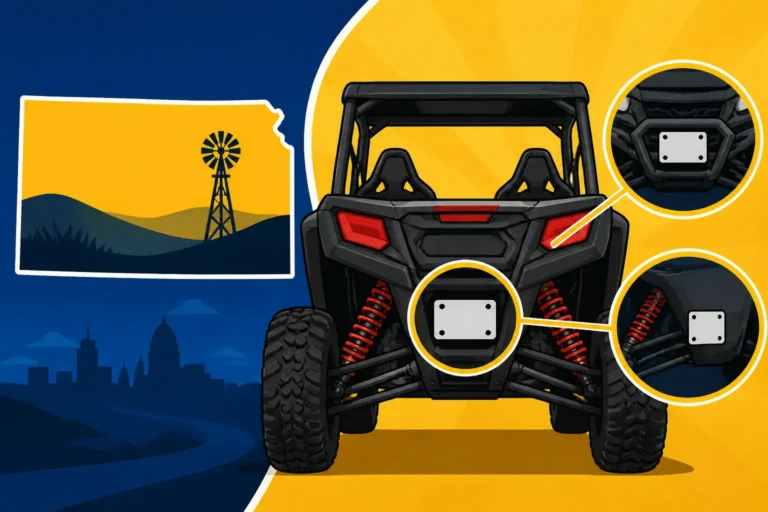
A critical aspect of making any off-road machine road-legal is ensuring it has adequate lighting and visibility features. Most city ordinances will require, at a minimum, headlights, taillights, brake lights, and turn signals – just like a regular car. These lights need to be fully functional, visible from specified distances, and used appropriately, especially during twilight hours or after sunset. [Kansas Lighting Rules After Sunset] emphasizes the need for proper illumination for any vehicle operating on public roads during these times.
Beyond active lighting, passive visibility is also paramount. This often includes rearview mirrors (at least one, often two), and sometimes side mirrors, to give the operator a clear view of traffic. For slower-moving vehicles like many golf carts and some UTVs, a slow-moving vehicle (SMV) emblem—the distinctive orange triangle—is often required, especially on roads with higher speed limits. This emblem serves as a crucial warning to faster traffic, alerting them to the slower pace of your machine. Many riders looking to upgrade their UTV for road use turn to aftermarket companies like SuperATV for comprehensive kits that include mirrors, turn signals, and light bars designed to meet various state and local requirements, making the transition to street-legal status much smoother.
Insurance, Driver's Licenses, and Age Requirements
Even if a city ordinance allows your UTV or golf cart on its streets, it almost certainly comes with stipulations regarding the operator and vehicle insurance. In Kansas, liability insurance is generally only required for UTVs if a specific city ordinance mandates it for street use. Unlike regular automobiles, there is no statewide mandate for ATV or UTV insurance unless the machine is specifically registered for road use where that's an option (which it rarely is for ATVs/UTVs in Kansas) or by local decree. Therefore, checking the specific city's ordinance for [Kansas Insurance Comes From City Ordinances] is vital.
Regarding operator requirements, most cities that permit UTVs on their streets will require the operator to hold a valid driver's license. This isn't just about showing you can drive; it's about demonstrating you understand the rules of the road and have passed the state's driving proficiency tests. Age restrictions also frequently apply, often mirroring the minimum age for a standard driver's license. For youth quads or riders under 16, even if a UTV is allowed on a city street, specific age and supervision rules are almost always in place, which means a parent or guardian might also have responsibilities.
Modifications and Accessories: Are They Road-Legal?
When you buy an off-road machine, it’s typically not configured for street use. This means modifications are almost always necessary to meet local ordinance requirements. Beyond lighting and mirrors, cities might require a windshield, horn, or even specific tire types. It's not uncommon for UTV owners to install DOT-approved tires, for example, if they plan significant road use, even if the ordinance doesn't explicitly state it. Accessories that enhance safety and visibility, like additional reflective tape or a brighter horn, are always a good idea, even if not strictly mandated.
However, riders must also be careful with modifications. While adding a sturdy SuperATV windshield or a turn signal kit can help with compliance, some modifications could inadvertently make your machine non-compliant or even unsafe for road use. For instance, excessively loud exhaust systems might violate noise ordinances. It’s always best to consult the specific city ordinance and even your local law enforcement agency or city clerk if you have questions about specific aftermarket parts. The goal is to make your machine blend in safely with regular traffic, not just to meet the bare minimum of the law.
Common Misconceptions and Penalties for Illegal Road Use
The intricate web of Kansas laws regarding golf carts and UTVs on public roads often leads to understandable confusion, and unfortunately, to some common misconceptions. These misunderstandings can have serious consequences, ranging from costly fines to impoundment of your beloved machine. It’s far better to be informed and cautious than to learn the hard way through a traffic stop or an accident.
"It Has a Title, So It's Street Legal" – A Dangerous Myth
This is perhaps the most pervasive and dangerous misconception among off-road vehicle owners in Kansas. Many believe that because their UTV or ATV has a Kansas title, it somehow grants them permission to drive on public roads. This is absolutely not true. As discussed earlier, [Kansas Titles ATVs as Nonhighway Vehicles], and this classification means the vehicle is not intended or authorized for street use by default. The title simply establishes legal ownership and identifies the machine as a nonhighway vehicle, distinguishing it from, say, a farm implement that might not require a title at all.
Think of it this way: your riding lawn mower probably has a title or some proof of ownership, but you wouldn't assume you can drive it down the highway. The title for an ATV or UTV functions similarly in terms of its purpose – it's a record of the machine and its owner, but it doesn't magically bestow street-legal status. Operating a titled nonhighway vehicle on public roads without a specific, authorizing city ordinance or a valid agricultural exception is still illegal, and deputies often hear this excuse. This is why [Why a Kansas Nonhighway Title Never Comes With a Tag] is a crucial distinction; no tag means no general road use.
What Happens When a Deputy Pulls You Over
If you’re caught operating a golf cart or UTV illegally on a public road in Kansas, the consequences can vary depending on the specific circumstances and the discretion of the law enforcement officer, but they are rarely pleasant. The most common outcome is a traffic citation, which will come with a fine. These fines can be significant, and you'll likely incur court costs on top of the base fine. Repeated offenses can lead to escalating penalties.
Beyond financial penalties, there’s always the risk of your machine being impounded. If a deputy determines that you are operating the vehicle unlawfully and are a danger to yourself or others, they have the authority to have your UTV or golf cart towed and stored, which will incur additional towing and storage fees for you to retrieve it. In the worst-case scenario, if you're involved in an accident while illegally operating your machine, your personal insurance might not cover damages, leading to severe financial liability. It’s simply not worth the risk.
The Importance of Knowing Before You Go
Ultimately, the responsibility for knowing and following the rules falls squarely on the shoulders of the operator. Ignorance of the law is never a valid defense. Before you even think about putting a wheel on a public road, whether it’s a quiet gravel county road or a bustling city street, you must do your homework. This means:
- Identify Your Machine's Classification: Is it a golf cart, a UTV, or an ATV according to Kansas law?
- Understand State Defaults: Remember the general ban on nonhighway vehicles from roads and the narrow agricultural exceptions.
- Check Local Ordinances: If you plan to ride in a city, look up that specific city's current ordinance on UTV or golf cart use. Don't rely on what you heard from a friend. [Kansas Cities With UTV Tags] can be a starting point, but the full ordinance is what matters.
- Equip Your Machine Properly: Ensure your vehicle meets all required safety and equipment standards, potentially utilizing aftermarket parts from reputable providers like SuperATV to ensure compliance.
- Be Prepared: Carry your driver's license, proof of insurance (if required by local ordinance), and any local permits or tags.
Failing to do this groundwork is a recipe for trouble. The patchwork of laws can be confusing, but a little effort beforehand can save you a lot of headache, heartache, and money down the road.
Here's a quick comparison of the general Kansas rules for golf carts and UTVs concerning road access:
| Feature | Golf Carts (State Default) | UTVs (State Default) |
|---|---|---|
| Primary Design | Slow-speed, electric, for golf courses and specific areas | Off-road, utility, recreation, higher speed capabilities |
| Road Use (State) | Prohibited on highways unless by specific local ordinance | Prohibited on highways unless by specific local ordinance |
| Agricultural Exception | Generally not applicable due to primary design | Limited exceptions for bona fide agricultural/work use (up to 5 miles) |
| Highway Crossing | Prohibited unless by specific local ordinance | Permitted at 90-degree angle, safely, without interference |
| Local Ordinances | Cities/counties may permit on certain streets | Cities/counties may permit on certain streets |
| Driver's License | Often required if allowed on roads by ordinance | Often required if allowed on roads by ordinance |
| Insurance | Only if mandated by local ordinance | Only if mandated by local ordinance |
| Required Equipment | Varies by local ordinance (lights, mirrors, SMV emblem often required) | Varies by local ordinance (lights, mirrors, turn signals, etc.) |
Disclaimer
This article is for general informational purposes only and does not constitute professional advice. Laws, prices and regulations vary by location and change over time. Consult a qualified professional for guidance on your specific situation.