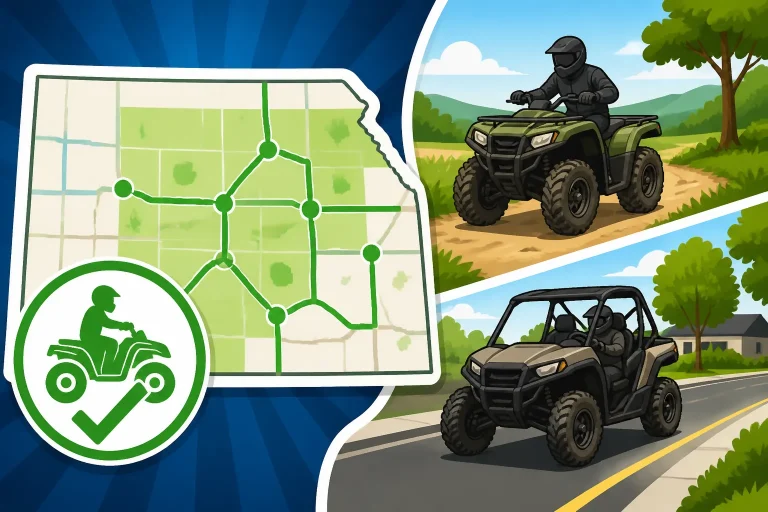
Kansas Department Road Riding Rules
A Kansas Department road can look like an open invitation to ride, but permission depends on the land, the route, the machine and any required permit. A permit for use on Department roads is not a general trail pass or permission to ride on public streets. Here’s how to check where it applies and avoid crossing into a prohibited area.
What counts as a Department road
“Department road” generally refers to a road on property managed by the Kansas Department of Wildlife and Parks, such as a state park or another Department-managed area. It does not mean every gravel road, county road, or public road in Kansas. Nor does the presence of a road on a park map automatically mean every type of off-road machine may use it.
The key distinction is between riding on an authorized road or parking area and riding cross-country or on a trail. Department road access is limited to the routes and uses allowed at that specific property. A permit does not make closed roads, maintenance tracks, shorelines, fields, or marked trails available to motorized vehicles. For the basic limitation, see Kansas Machines on Department Roads Only and Machines Kept to Roads and Parking Areas.
This kind of access also differs from riding at a private off-road park or a designated ORV area. A permit for Department roads does not create a system of public ATV trails. Kansas has no statewide OHV trail pass that grants riders general access across Department land. The separate park permit and its limits are explained in Kansas Unconventional Vehicle Permit and Kansas Park Permit vs Trail Permit.
Before unloading, identify the property boundary and the exact road you plan to use. A road that continues beyond a park or wildlife-area boundary may become a county road, private road, or route governed by a different agency. The same machine may be allowed on one segment and prohibited on the next.
Check the route, not just the property name
A property may include several kinds of routes: open roads, roads closed to public vehicle traffic, maintenance access, walking paths, and trails. A map showing a road’s location is not necessarily a statement that an ATV or UTV may travel on it.
Use posted signs and current information from the property or park office to confirm:
- Whether the specific road is open to the public.
- Whether the road is open to your type of machine.
- Whether a permit is required for that use.
- Whether travel is limited to certain hours or seasons.
- Whether temporary closures or event rules are in effect.
If a sign, gate, or official instruction conflicts with what you expected from a map, follow the current restriction and ask the managing office before riding farther.
Permits allow limited access, not unrestricted riding
Kansas distinguishes between a statewide registration or trail permit and a permit tied to a particular kind of use on Department property. Do not assume a title, city tag, plate, or permit from another state replaces the authorization required for a Department road. Conversely, a Department road permit is not a substitute for a city tag when local street rules require one. See Kansas Has No State OHV Permit and Kansas Requires No Sticker of Visitors for the separate state-permit and visitor questions.
The permit’s practical effect is narrow: it may authorize an eligible machine to use specified roads and parking areas under the property’s rules. It does not make a machine street legal, authorize it on a trail, or override a closure. For more on the difference between road access and trail access, see The Park Permit That Covers Roads, Not Trails.
| Question | What to verify before riding |
|---|---|
| Is the land managed by the Department? | Confirm the property boundary and managing agency. |
| Is this particular road open? | Check signs, gates, maps and current property information. |
| Is your machine eligible? | Ask whether the permit covers your machine’s class and use. |
| Is a permit needed? | Confirm the requirement with the property or park office. |
| When may you ride? | Check operating hours, seasonal restrictions and temporary closures. |
| Can you leave the road? | Assume no unless the property’s rules clearly authorize the route. |
Permit availability, purchase procedures and fees can change. Confirm current details with the property office before making a trip; do not rely on an old receipt, a past visit or another rider’s understanding of the rules. Some permits may be handled through park offices rather than sold as a general state trail pass, so check where and how the required authorization is issued.
A permit also does not waive other obligations. Riders still need to comply with posted speed limits, traffic controls, safety requirements and restrictions that apply to the property and vehicle. If a local rule requires insurance, equipment or a city permit for a public street, a Department road permit does not satisfy that local requirement.
Hours, boundaries and riding conduct
Department property rules may limit road use to certain hours. A published sunrise-to-sunset rule, where applicable, is a meaningful restriction: it is not permission to continue riding after dusk because you are close to a campground or parking area. Check the rules for the specific property rather than assuming the same hours apply everywhere. See Park Road Use Sunrise to Sunset for how park-road hours affect planning.
Plan your return before the allowed riding period ends. Account for the time it takes to travel back, park, load the machine and leave the property. If a route is closed or you are delayed, do not take an unauthorized shortcut across a field, trail or shoreline to get back sooner. Contact staff or follow posted directions.
Stay on the authorized road surface and use parking areas as directed. Even a short detour around a puddle can move a machine onto vegetation, a walking trail or a restricted area. These areas may be closed for habitat protection, erosion control, public safety, construction or other management reasons. A route that appears passable is not necessarily open.
Respect other visitors. Department roads can be shared with passenger vehicles, pedestrians, cyclists, maintenance crews and wildlife. Reduce speed where visibility is limited, yield as signs and conditions require, and avoid making dust or noise an unnecessary problem for nearby visitors. Park in designated spaces without blocking gates, ramps, roadways or emergency access.
Take closures seriously even when they are temporary. A gate may be closed because of weather, damage, maintenance, a special event or a safety issue. Do not move a barrier or ride around it. If road conditions have changed since you checked a map, stop and contact the managing office rather than guessing.
How to confirm access before you go
A short check before loading can prevent a wasted trip and an avoidable citation. Use this sequence for a Department-managed property:
- Name the property and the managing office. Make sure the place you intend to ride is actually Department-managed, rather than a nearby county road, private tract or federal property.
- Ask about your machine. Give the office the machine type and explain how you plan to use it. An ATV, side-by-side, golf cart and other vehicle may not be treated identically.
- Confirm the exact roads. Ask which roads are open to your machine and whether the authorization applies to the road you want, not merely to the property.
- Check the permit process. Confirm whether a permit is required, how to obtain it, where it must be displayed or carried, and whether it applies to the machine or the operator.
- Ask about hours and seasonal limits. Verify daily operating hours, temporary closures and any restrictions that could affect your intended date.
- Review signs when you arrive. Conditions may change after your phone call or map check. Follow the current signs and any instructions from staff.
- Keep proof available. Carry any permit or documentation the property requires, and keep the office’s contact information accessible.
A useful question for staff is: “Can this type of machine use this specific road today, and what permit or other requirements apply?” That is more reliable than asking only whether ATVs or UTVs are allowed at the property.
If you cannot confirm that a route is open, do not ride it on the assumption that a permit covers it. Choose a clearly authorized road or another riding area where the machine and intended activity are allowed. Calling a State Park Office Before You Load Up can help you prepare the right questions.
Department road access is a limited option for getting around on approved routes, not a substitute for a dedicated riding area. Keeping that distinction in mind helps protect access for other visitors and makes it easier to avoid confusing a road permit with trail permission, city street authorization or statewide registration.
Disclaimer
This article is for general informational purposes only and does not constitute professional advice. Laws, prices and regulations vary by location and change over time. Consult a qualified professional for guidance on your specific situation.