The Park Permit That Covers Roads, Not Trails
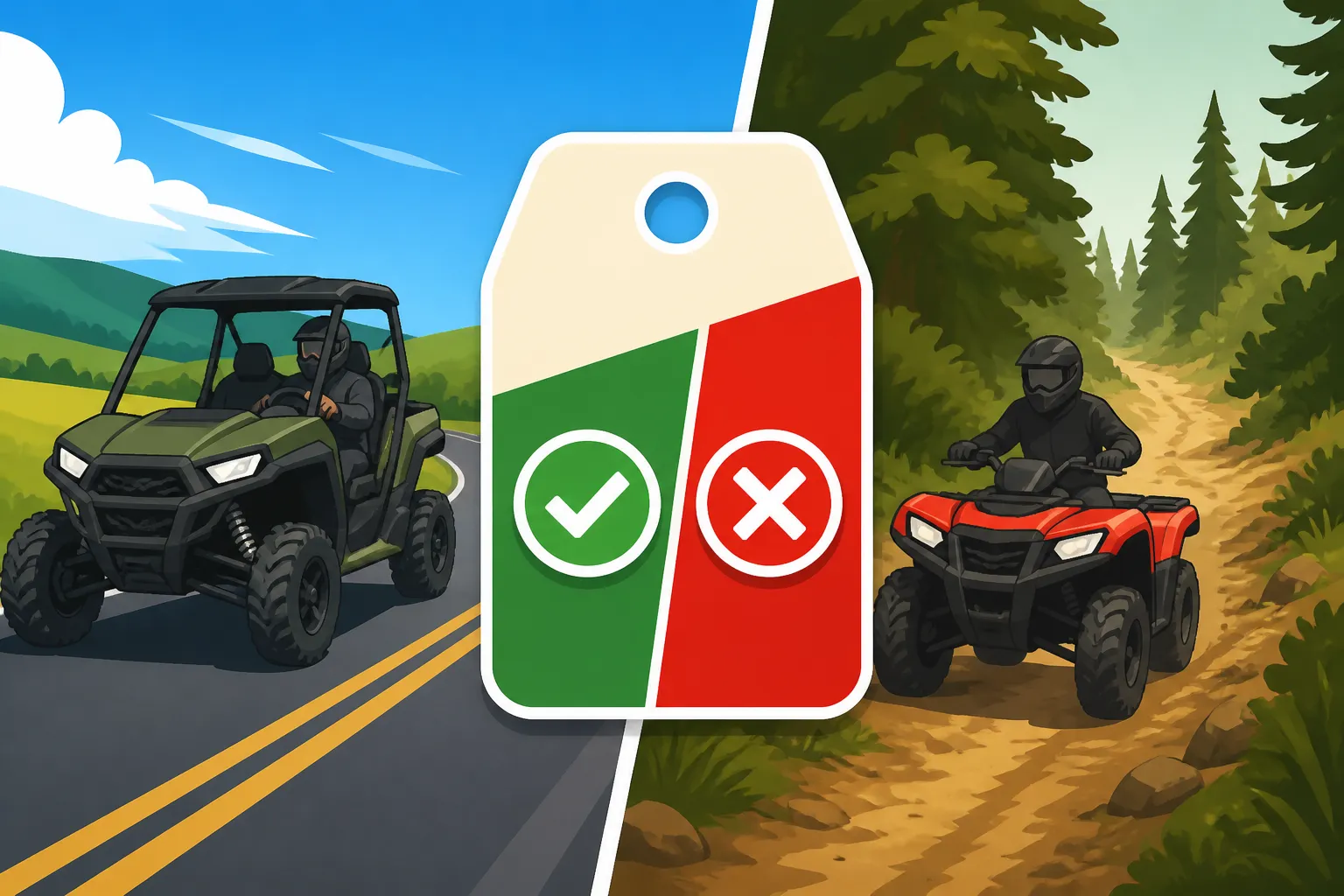
A Kansas park permit can look like a ticket to ride, but it does not open every road, trail, or riding area. The important distinction is that the unconventional vehicle permit covers limited travel on eligible park roads and parking areas—not off-road trail riding. Knowing that boundary before you load up helps prevent a wasted trip or a citation.
What the Kansas park permit covers
Kansas uses an unconventional vehicle permit for certain machine use at state parks. Its purpose is limited: it can allow an eligible vehicle to use designated park roads and parking areas, subject to park rules. It is not a general ATV or UTV registration, and it does not make a machine street legal.
The permit also does not automatically grant access to every road in a park. A posted restriction, closure, or other park rule still applies. The operator must follow signs and directions from park staff, and the machine must stay on the routes where its use is allowed. A permit is permission within a defined setting, not permission to choose any route that looks rideable.
The name of the permit can make its scope easy to misunderstand. “Unconventional vehicle” does not mean “off-road vehicle pass,” and the permit is not a substitute for a trail sticker. Its main use is for approved travel on roads and parking areas at eligible Kansas state parks. For a closer look at its limits, see Where a Park Road Permit Actually Lets You Drive and Kansas Park Permit vs Trail Permit.
Before planning around the permit, confirm that your vehicle qualifies under current Kansas Department of Wildlife and Parks rules. ATVs, UTVs, golf carts, and other machines can be treated differently depending on their design and the rules for a particular location. Do not assume that a permit issued for one type of vehicle automatically applies to another. The park office can clarify what paperwork or vehicle details it needs.
There may be a permit fee, and the fee and purchase process can change. Check with the official park office for current amounts and requirements rather than relying on an old receipt, an online post, or a price quoted for a different season. The title [The $52.50 Unconventional Vehicle Permit] describes the permit by a past listed amount; use the park’s current information when budgeting.
The permit is also distinct from a Kansas title. A title records ownership and does not grant permission to operate on park roads. Similarly, having proof of ownership does not replace a required park permit. The state’s permit does not replace any separate city or local authorization that may apply when you leave park property. For those differences, see Kansas Park Permit for a UTV and [Kansas Park Permit for a Golf Cart].
A practical way to think about the permit is:
- It may authorize a qualifying machine to use approved park roads and parking areas.
- It does not turn park roads into ATV trails.
- It does not override posted signs, closures, or park staff instructions.
- It does not make the machine legal on public streets outside the park.
- It does not replace a title, local city tag, or other requirement that applies in a different setting.
That narrow scope is useful when the goal is getting from a campsite to a permitted destination inside a park. It is not the right permit to buy if the main plan is trail riding.
Why a road permit is not a trail pass
The key distinction is where the vehicle is allowed to travel. A road permit is for specific road and parking-area use under park rules. A trail pass, by contrast, would authorize riding on designated off-road trails. Kansas does not offer a general state OHV trail pass that turns state parks into public ATV trail systems. The article The Trail Pass Kansas Does Not Sell explains that difference.
Kansas state parks do not operate OHV trail systems for general ATV and UTV riding. That means buying a park permit does not create trail access where no authorized trail exists. A dirt track, maintenance route, grassy shoulder, shoreline, or informal path is not automatically an approved route. If it is not an allowed road or designated place for vehicle use, the permit does not make it legal to ride there.
This matters because machines can damage vegetation, disturb other park users, and create safety problems when they leave the allowed route. Park boundaries are not a blank riding area. A route that appears open may be closed to motor vehicles, reserved for maintenance, or intended for pedestrians. Follow posted directions rather than judging access by tire marks or by seeing another rider use a path.
The same distinction applies to wildlife areas and other public land. Rules can limit machines to designated roads, parking areas, or specific access points. A permit for one type of property does not give permission on another. For an overview of road restrictions on wildlife department land, see Machines Must Stay on Wildlife Department Roads.
Nor does the permit automatically give access to nearby private riding parks. Private parks set their own entry rules, fees, vehicle limits, and riding areas. A state park permit will not satisfy a private park’s admission requirements. Likewise, a pass for a private park should not be treated as permission to ride on state park roads.
Before you leave home, identify the exact activity you want to do:
- If you need to drive a qualifying machine on an approved state park road, ask whether the unconventional vehicle permit applies at that park and to your machine.
- If you want to ride off-road trails, find a riding area that expressly allows that activity.
- If you plan to use a Corps area, check that site’s access and riding rules. Some Corps riding areas operate under a different system from Kansas state parks; Why Corps Riding Areas Need No Park Permit explains why a Kansas park permit may not be relevant there.
- If you want to use city streets, check the city’s ordinance and any local tag requirements separately. A state park permit does not make public-road use legal.
A common mistake is to buy the permit first and work out the route later. Reverse that order. Choose the park and destination, confirm that the machine can use the route, then ask whether a permit is needed. The permit is only useful if the planned trip fits the specific permission it provides.
How to check whether your trip qualifies
The most reliable answer comes from the park where you plan to ride. Rules may vary by park, vehicle type, road, season, or temporary closure. A general statement about Kansas permits is not enough to establish that a specific route is open to your machine.
Use this process before hauling the vehicle:
- Name the exact destination. Identify the state park or public area, not just the nearest town or lake. If you plan to visit more than one location, check each one separately.
- Describe the machine accurately. Be ready to give the make and model, vehicle type, and any relevant features such as seating or steering arrangement. If you are unsure how Kansas classifies it, ask rather than guessing.
- Explain the route and purpose. Tell the office whether you need to travel between a campsite and a facility, use a park road, park the machine, or ride off-road. Those are different activities.
- Ask whether a permit is required and where it applies. Confirm whether your vehicle qualifies, what areas or routes are permitted, and whether the permit must be displayed or carried in a particular way.
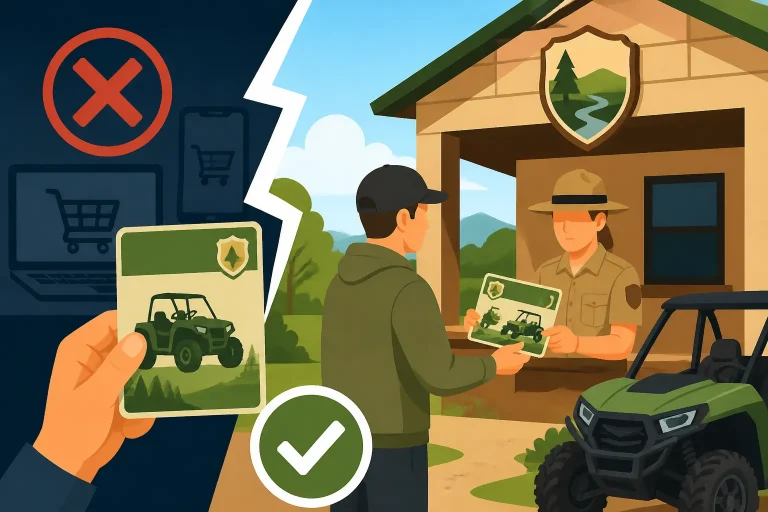
- Check current fees and purchase instructions. Ask where to obtain the permit, whether it is available only through a park office, and what payment methods the office accepts. Current procedures can differ from what another visitor experienced.
- Ask about time limits and closures. Find out when machine use is allowed and whether construction, weather, special events, or seasonal restrictions affect the route.
- Write down the answer. Keep the park’s contact details and any route instructions with your trip information. A quick note can prevent confusion if you arrive at a gate or a signed junction.
For many questions, a park office is a better starting point than a general search result. The title [Why This Permit Is Sold Only at Park Offices] reflects the local nature of the permit process: you need information tied to the park and its current rules, not simply a payment confirmation. For a checklist of questions, see Calling a State Park Office Before You Load Up.
Bring the documents the park tells you to bring. That may include proof of ownership or other vehicle information, but do not assume a particular document is required everywhere. If you have a title, bill of sale, or registration from another jurisdiction, ask whether it is relevant to the permit application. The park permit itself should not be confused with proof that you own the machine.
Once you arrive, read the signs before unloading or driving. A permit does not cancel a road closure or authorize a route that is posted as restricted. If a sign is unclear, stop and ask park staff rather than proceeding based on a guess. Keep the permit available as directed, and use only the route the park confirms.
Operating hours need the same attention. The general guidance for park-road use is restricted by time, and the title Sunrise to Sunset on Park Roads highlights the importance of checking the permitted hours. Confirm the actual schedule and any park-specific exception before planning an early-morning or evening trip. Do not assume that a camping reservation, a gate being open, or permission to park overnight means machine travel is allowed at all hours.
If the office cannot confirm that your intended route is permitted, treat that as a reason to change the plan—not as permission to test the boundary. Choose a legal route, use a different recreation area, or leave the machine unloaded.
How the permit compares with other riding permissions
Kansas has several different systems that can sound similar in casual conversation. The right one depends on the land, the route, the machine, and the activity. A permit for one place is not a statewide pass.
| Setting or permission | What it may allow | What it does not establish |
|---|---|---|
| Kansas state park unconventional vehicle permit | Approved use of a qualifying machine on allowed park roads and parking areas | General trail riding, access to closed routes, or street legality outside the park |
| Kansas title | A record of ownership for a titled machine | Permission to ride on park trails or public roads |
| City authorization or tag | Use allowed by a city ordinance on specified local streets | Access to state park trails or permission in another city |
| Private riding park admission | Access to the areas and activities the private park allows | Access to state land or permission to ride elsewhere |
| Rules for a Corps riding area | Use allowed under that area’s own operating rules | Automatic permission at a Kansas state park |
| Public-land road rules | Travel where the land manager allows motor vehicles | Permission to leave designated roads and ride cross-country |
A title and a permit answer different questions. The title concerns ownership; the park permit concerns limited use at a particular recreation setting. The state permit also does not provide a universal “registration” status for the machine. Kansas has no general OHV registration program that turns the permit into a trail license. For background, see Kansas Has No OHV Registration and Kansas Has No State OHV Permit.
City rules are another separate layer. A city may allow certain machines on some streets under local conditions, or it may not allow them at all. A state park permit does not satisfy a city’s local requirements, and a city tag does not grant park road access. If your route includes public streets before or after the park, check the city rules for each place you will enter. Kansas UTV Street Legal Rules by City covers why the answer can change from one city to another.
Private riding areas work differently again. They can designate trails, set admission rules, and impose their own equipment or age requirements. Before making a reservation or towing a machine, check that park’s rules directly. Do not assume that the state permit covers the private park’s access fee or waives its waiver, helmet, or vehicle requirements.
Corps areas are often a source of confusion because they may offer riding opportunities without being Kansas state parks. Their land management and access rules are separate. Check the specific riding area’s hours, permitted machines, and closures before going. A park permit requirement for one property should not be copied onto another property without confirmation.
This comparison also helps with out-of-state visitors. A sticker, registration, or trail pass from another state does not automatically grant access to Kansas state park roads or trails. Ask the Kansas park what it requires, and ask the riding area what it recognizes. Kansas Requires No Sticker of Visitors addresses the broader question of reciprocity, but that does not mean a visitor can ignore each site’s operating rules.
Mistakes that can turn a permitted trip into a problem
The most frequent mistake is treating the permit name as proof of broad access. “Unconventional vehicle permit” sounds expansive, but the permission is tied to particular uses and places. Confirm the route rather than interpreting the name as a blanket authorization.
Another mistake is assuming that a road is open because it is wide enough for a UTV. Road width is not the same as legal access. A road may be closed to machines, limited to service vehicles, or restricted at certain times. Follow signs and park guidance.
It is also risky to treat an established tire path as an official trail. Repeated use by other visitors does not prove that a route is authorized. If the park does not identify the route as open, stay off it and ask staff.
Some visitors also confuse vehicle access with permission to ride on the ground beside a road. A permit for an allowed road does not necessarily authorize driving on the shoulder, through grass, around a barrier, or across a field to shorten the trip. Stay on the approved surface and do not bypass a gate or barrier.
The permit does not guarantee that every qualifying machine can use every road. A vehicle’s classification, physical dimensions, or other characteristics may affect whether it qualifies. If you have a machine that does not fit a familiar category, describe it to the park office and ask how it is treated. Do not rely on a dealer’s description alone.
Finally, avoid planning a trip around outdated details. An old social post may describe a different fee, purchase location, park schedule, or route. Even a recent visitor’s account may not apply to your destination. Check the official park information before departure, especially if the trip depends on using a particular road or arriving outside ordinary hours.
A short pre-trip checklist can keep the decision simple:
- Confirm the exact park and route.
- Confirm your machine is eligible.
- Ask whether the permit is required and how to obtain it.
- Check current fees and operating hours with the official office.
- Read all signs at the site and obey closures.
- Keep the machine on approved roads and parking areas.
- Use a separate riding area if your goal is off-road trail riding.
If the goal is trail riding, do not buy a road-use permit expecting it to serve as a trail pass. Choose a park or riding area that expressly offers the activity you want, then check that location’s rules.
Frequently Asked Questions
Does the Kansas park permit let me ride ATV trails?
No. It is not a general trail pass. It may cover approved use of eligible machines on designated park roads and parking areas, but it does not create trail access.
Does the permit make my ATV or UTV street legal?
No. Park permission applies only within the park rules and approved routes. Public-road use depends on separate state and local rules.
Can I use the permit at any Kansas state park?
Do not assume so. Check with the specific park about vehicle eligibility, permitted routes, hours, current fees, and any closures.
Does an out-of-state sticker replace the Kansas permit?
Not automatically. Ask the Kansas park what it requires, and check the rules of any other riding area you plan to visit.
Disclaimer
This article is for general informational purposes only and does not constitute professional advice. Laws, prices and regulations vary by location and change over time. Consult a qualified professional for guidance on your specific situation.