Do Kansas Kids Need a Permit?
Kansas parents can easily confuse a permit for a rider with a permit for the ATV or UTV. The distinction matters: Kansas does not require a general state OHV pass for every child who rides, but special rules can apply when a machine is used on Kansas Department of Wildlife and Parks land. Here’s how to tell what your child needs before you unload.
The short answer: permits generally follow the machine, not the child
Kansas does not have a general state OHV permit that every young rider must carry just to ride an ATV or UTV. A child does not ordinarily need a separate permit simply because they are the person operating or riding as a passenger.
A different rule can apply when you want to take an unconventional vehicle onto certain state park roads or other designated areas managed by the Kansas Department of Wildlife and Parks. In that situation, the permit is tied to using the machine in that location. It is not a personal riding permit that a child earns or carries independently.
That distinction is the practical answer to the title question:
- Riding on private land with the owner’s permission: A Kansas state park permit is not generally required just because a child is riding there.
- Riding at a private off-road park: The park sets its own entry, age, supervision, and safety requirements. A state permit does not replace those rules.
- Using an unconventional vehicle on a KDWP property where a permit is required: Check with the property before you go. The permit requirement is about the vehicle and its use on that property, not the rider’s age.
- Riding on a public road: A park permit does not make the ride legal. Road access is governed by separate state and local rules.
Kansas is not a state with a general OHV trail pass that visitors must buy before using any trail. That does not mean every public property is open to off-road riding, or that a child can operate a machine wherever an adult can. Land access, road restrictions, and age or supervision rules are separate questions. For the broader distinction, see Kansas Has No State OHV Permit and Kansas Unconventional Vehicle Park Permits.
When a permit may apply to a child’s ATV or UTV
A permit can matter when a family plans to use a machine on a state-managed property with designated roads or parking areas open to unconventional vehicles. The permit does not turn the property into a trail-riding area. Kansas Department of Wildlife and Parks rules generally limit machines to authorized roads and parking areas, unless signs or staff indicate an exception.
The key question is not simply, “Is my child riding?” Ask instead: “Where will this machine be operated, and does that property require a permit for this kind of vehicle?”
| Where the child rides | Is a Kansas state permit generally the deciding issue? | What to check |
|---|---|---|
| Private property | Usually not for the state park permit discussed here | Landowner permission, safe supervision, and any applicable local rules |
| A private riding park | The park’s own rules control entry | Minimum age, supervision, waiver, helmet, and passenger requirements |
| A KDWP property | A permit may be required for designated vehicle use | Whether the property allows the machine and where it may travel |
| A public street or road | No park permit makes road use lawful | State law and the city or county’s specific rules |
| A trail or area not posted for machines | A permit does not create access | Property rules, signs, and any official guidance |
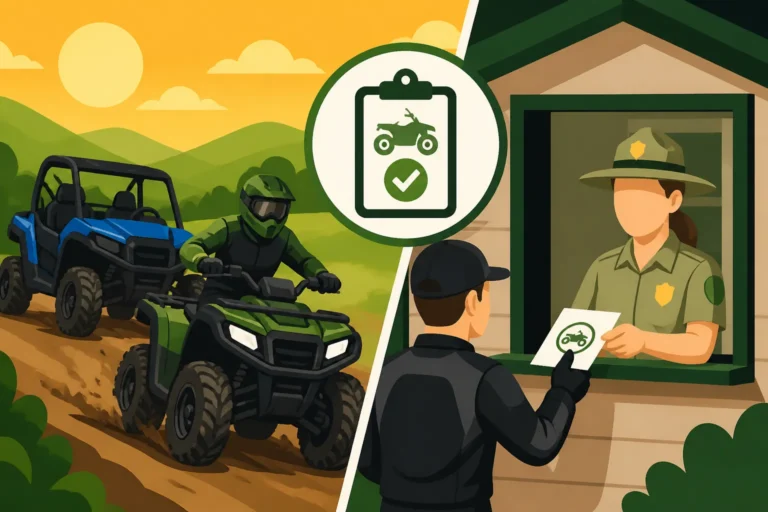
If the machine will be used at a state park, contact that park before loading the trailer. Ask whether the particular machine counts as an unconventional vehicle for the property’s rules, whether a permit is needed, and where the vehicle may be driven. The permit is generally a property-use authorization, not a permit that gives a rider unrestricted access to trails. The Park Permit That Covers Roads, Not Trails explains why that boundary matters.
Do not assume that an ATV, UTV, golf cart, and side-by-side all receive identical treatment simply because they are used for recreation. Kansas classifies off-road machines in different ways, and the vehicle’s design can affect which rules apply. If you are unsure what the machine is classified as, see Four Off-Road Classes Kansas Law Treats Differently.
If the child is a passenger
A child riding as a passenger does not normally need a separate state park permit in their own name. The machine’s status and the property’s rules remain the important permit questions.
Passenger permission is still a separate issue. A vehicle may be allowed on a property but have restrictions on who can ride, how many passengers it can carry, or what age a passenger must be. The machine’s manufacturer may also specify seating positions and capacity. Never treat a permit as confirmation that a child can ride in any seat or on any machine.
If the child is driving
A required property permit does not establish that the child is old enough, trained, or otherwise allowed to operate the machine. It also does not replace supervision requirements set by a private park or the rules of a particular property.
Before letting a child drive, check the rules for the exact riding location. A private park may set minimum ages or require an adult to accompany younger riders. A state-managed property may restrict where machines can go, while local road rules may prohibit or limit operation on streets. These are separate layers of permission, and satisfying one does not automatically satisfy the others.
For children, the safest approach is to verify both questions in advance: Does this machine need permission to enter or operate here? And may this child operate or ride on it under the location’s rules?
What a permit does not allow
A common mistake is to treat a permit like a general license to ride anywhere on public land. It is not. A permit does not automatically allow trail use, off-road travel, or operation on roads that are closed to the machine.
On state-managed land, stay within the routes and areas specifically allowed for the vehicle. A road-use permit does not make an adjacent field, trail, shoreline, or undeveloped area open to riding. Follow signs and any instructions from property staff. If a route’s status is unclear, ask before driving onto it rather than assuming that a permit covers it.
A permit also does not:
- Replace permission from a private landowner.
- Override a private riding park’s age, safety, or supervision policies.
- Make an ATV or UTV street legal.
- Register the machine for general road use.
- Replace a local city tag or other local requirement where one applies.
- Confirm that the child may operate the vehicle.
- Provide permission to ride on every KDWP property or every road within a property.
Road rules are especially easy to confuse with park access rules. Kansas has separate laws about where ATVs and UTVs may be operated on roads, and cities can have their own ordinances. A machine being permitted on a designated park road does not mean it can be driven on a nearby county road or city street. See Having a Title Does Not Make an ATV Street Legal and Kansas Rules for Riding a City Street for those separate issues.
The same caution applies to an out-of-state sticker or pass. Do not assume another state’s OHV permit substitutes for a Kansas property requirement. A sticker from elsewhere also does not grant access to Kansas land that is closed to machines. Visitors should confirm the property’s current requirements with the office that manages it. Kansas Reciprocity Is Not a Question discusses why reciprocity is different from permission to ride on a particular property.
A practical checklist for families
A quick call before a trip can prevent a child from arriving at a gate only to find out the machine is not allowed or the family lacks the required permit. Use this checklist when planning a ride.
- Identify the exact property. “A state park” or “public land” is not specific enough. Rules can vary by property, road, and designated area.
- Describe the vehicle. Tell the office whether it is an ATV, UTV, side-by-side, golf cart, or another type of machine. If you do not know the category, provide the make, model, and basic configuration.
- Ask whether a permit is required for the machine. Make clear that you are asking about property access, not a personal permit for the child.
- Ask where the vehicle may go. Confirm whether access is limited to designated roads and parking areas, and whether any particular routes or areas are closed.
- Check child and passenger rules separately. Ask about minimum age, supervision, passenger seating, helmets, waivers, and any other requirements the property sets.
- Confirm how the permit is obtained and used. Ask where to buy it, whether it must be displayed or carried, and whether the permit applies to the specific machine you are bringing. Requirements and procedures can change, so rely on the property’s current instructions.
- Check road rules for the route to and from the property. A permit for use inside a park does not authorize riding on public roads outside it.
- Bring proof of permission where appropriate. On private property, get the landowner’s approval before riding. For a public property, follow the permit and documentation instructions given by the managing office.
For a private park, use the same approach but contact the park directly. Its entry permit or wristband may cover the facility’s admission rules, while a parent’s waiver, a child’s age, and the machine’s passenger capacity remain separate matters. Private parks set their own conditions, so do not assume that one park’s policy applies at another. Kansas Private Park Age Minimums and Kansas Private Park Waivers and Rules cover the kinds of policies families should verify.
If the child will ride on a public road or street, check the rules for the machine and the specific jurisdiction rather than relying on the park office. Many Kansas road restrictions depend on the type of vehicle and the location. A city’s ordinance can differ from another city’s, and a local tag does not automatically make every road available. For that reason, permit questions and road-use questions should be handled as two separate checks.
The simplest way to remember the rule is this: the permit is generally about the machine’s use at a particular property, not a child’s personal permission to ride. The child may still face age, supervision, passenger, and safety rules set by the location. Confirm both the machine’s access and the child’s eligibility before the trip.
Disclaimer
This article is for general informational purposes only and does not constitute professional advice. Laws, prices and regulations vary by location and change over time. Consult a qualified professional for guidance on your specific situation.