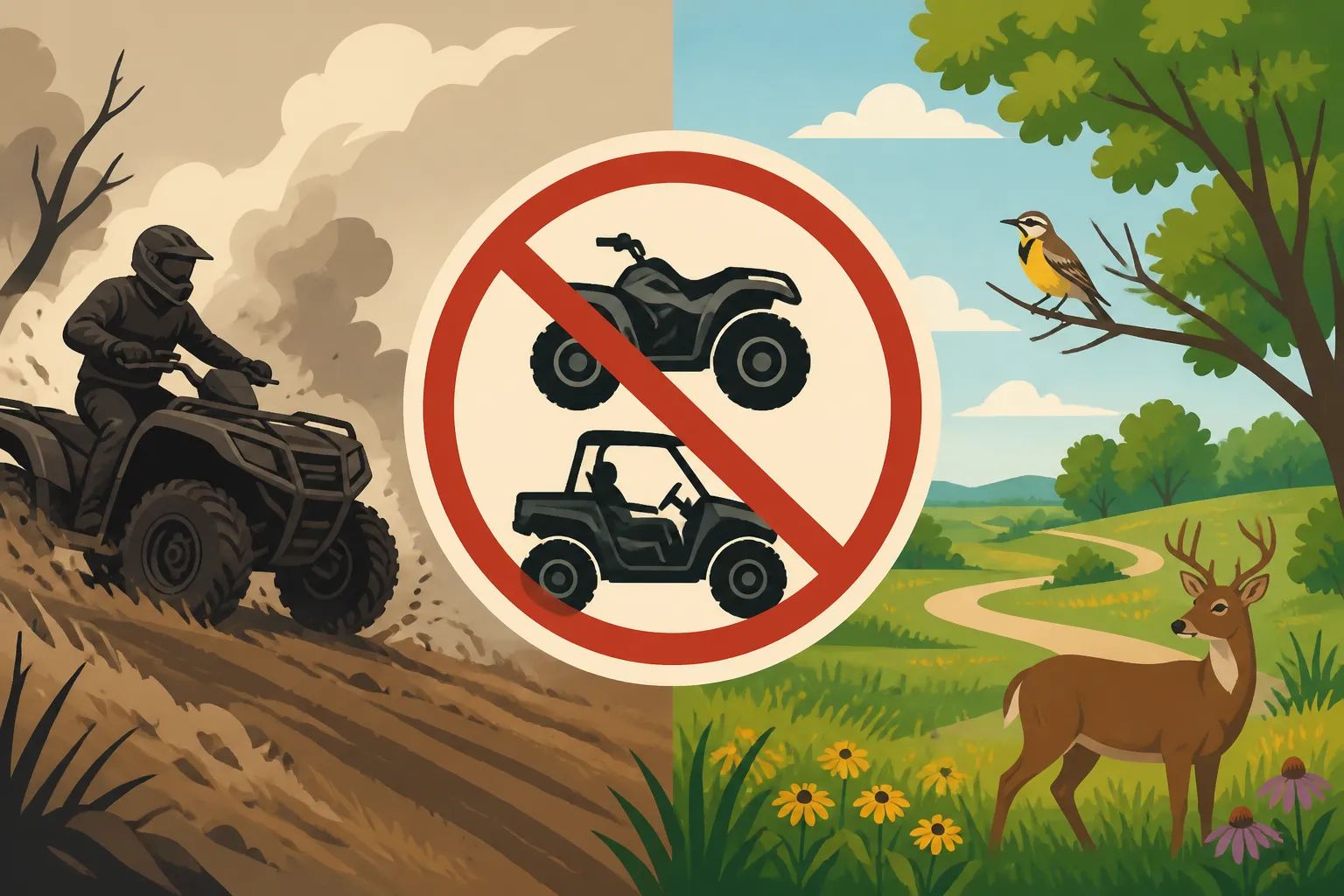
Why Kansas Wildlife and Parks Runs No OHV Trails
Kansas riders often expect Kansas Wildlife and Parks to provide public ATV trails, then discover that state parks and wildlife areas do not offer the kind of OHV trail network they had in mind. The distinction is frustrating but important: KDWP land has specific purposes and access rules, while some riding areas are managed by other agencies or private operators. Here’s why the gap exists and where to look instead.
Why Kansas Wildlife and Parks Does Not Run OHV Trails
The agency’s land serves several purposes
Kansas Wildlife and Parks manages state parks, wildlife areas, fishing lakes, and other public lands for recreation and conservation. Those places may welcome visitors, but they are not automatically open for off-road vehicle riding. A fishing area, campground, or wildlife property can have rules that allow some uses while restricting motorized travel to designated roads or parking areas.
That distinction can be confusing when a place looks ideal for riding. A broad gravel access road or an open-looking patch of ground is not necessarily an authorized ATV route. On wildlife land, restrictions can help protect habitat, reduce disturbance to animals, and prevent damage to soil and vegetation. The same landscape that looks like a tempting shortcut can be a sensitive area or closed to motorized traffic.
This is why it helps to separate “public land” from “public OHV trail.” Kansas has public land, but that does not mean it offers a statewide network of trails maintained for ATVs and UTVs. For more on the limits that apply to agency property, see Kansas KDWP Land Rules for Machines and Kansas Wildlife Area Machine Rules.
Trail maintenance brings practical challenges
An OHV trail needs more than a route across a map. It requires planning, signs, upkeep, and a way to manage erosion, drainage, litter, conflicts between users, and damaged vegetation. In Kansas, heavy rain can turn soil trails into rutted channels, while dry conditions and wind can create dust and visibility problems. Repeated traffic can also widen a route as riders steer around mud or obstacles.
Those problems are easier to manage when a site is specifically designed and staffed for motorized recreation. On a property managed primarily for wildlife, camping, fishing, or other activities, creating an OHV trail system may introduce new demands without fitting the land’s main purpose. A trail can also bring riders close to visitors who came for quieter activities, such as fishing or walking.
This doesn’t mean Kansas has no places to ride. It means the places that accommodate motorized riding may be managed by a different agency or private operator, with their own access rules. Knowing who manages a riding area is the first step toward understanding what’s allowed there.
Who Manages Kansas Riding Areas
Some riding areas are managed outside KDWP
Several Kansas riding options are associated with federal recreation land or private parks rather than a KDWP-operated trail network. Tuttle Creek ORV Area and School Creek ORV Area are commonly considered by riders looking for dedicated places to ride. Kansas Rocks Recreation Park and Syracuse Sand Dunes are private riding destinations, each with its own rules and operating details.
That difference matters at the gate. A private park can establish its own entry requirements and riding rules. A recreation area managed by another public agency may have designated boundaries, permitted uses, or seasonal restrictions that differ from those at a private park. Don’t assume that a rule you followed at one location applies at another.
Before loading the trailer, check the site’s official information for access, machine restrictions, hours, closures, and required permits. For location ideas, start with Kansas ATV Trails: Where You Can Actually Ride, Tuttle Creek ORV Area in Kansas, School Creek ORV Area in Kansas, and Kansas Private Off-Road Parks. Treat listings and maps as a starting point, not a substitute for confirming current site rules.
State park access is not the same as trail access
A state park may allow certain vehicles on designated roads or in parking areas without opening trails to ATVs or UTVs. That can sound like a technical distinction, but it changes where you can drive. A permit that covers use of an authorized park road does not automatically grant permission to leave the road and ride across fields, wooded areas, or informal paths.
Riders sometimes see a machine on a park road and assume the whole park is open to OHVs. The safer approach is to check the exact route and permitted use before unloading. If an area’s rules say vehicles must stay on designated roads, a trail visible on a phone map is not proof that motorized riding is allowed there.
This is especially worth checking when visiting a Kansas state park for camping or fishing. Rules can be different at a Corps recreation area or private park just down the road. The guide Kansas State Parks Have No OHV Trails explains the key distinction, while Kansas Park Permit vs Trail Permit helps clarify what a permit does—and does not—authorize.
| Riding location type | Who may manage it | What to confirm before riding |
|---|---|---|
| State park | Kansas Wildlife and Parks | Whether the machine is allowed, and which roads or areas may be used |
| Wildlife area | Kansas Wildlife and Parks | Whether motorized access is allowed and where |
| Corps recreation area | U.S. Army Corps of Engineers | Site boundaries, access rules, closures, and any local requirements |
| Private riding park | The park operator | Machine limits, admission rules, safety requirements, and operating schedule |
How to Find a Legal Place to Ride
Start with the exact site, not a general map search
A broad search for “ATV trails near Kansas City” or “UTV trails in Kansas” can produce useful leads, but it may also surface old listings, informal routes, or roads that are not open to recreational riding. First identify the actual property you’re considering. Then check the managing agency or operator’s own information to confirm that OHVs are permitted.
A map app can help you plan the drive and understand where roads, trailheads, and access points appear to be. For example, riders may use onX Offroad to explore route information and orient themselves before a trip. Use it as a planning aid rather than permission: map lines and user-submitted details do not override posted signs or the land manager’s rules.
If the route crosses more than one property, check each section separately. A legal route on private land may end at a public road, and a public road may not allow the same kind of riding as the park you just left. The guides Kansas Trail Conditions Before You Tow and Kansas ATV Trail Map Downloads offer useful planning context, but confirm details directly with the site before you travel.
Check machine limits and conditions before leaving home
Not every riding area accepts every kind of machine. Some sites may restrict vehicle width, machine type, or other characteristics. A side-by-side that fits one area’s rules may be too wide for another, while a dirt bike or youth quad may have different access considerations. Confirm your specific machine is allowed rather than relying on a general statement that a park is “open to ATVs.”
Conditions can change a ride plan, too. Rain may make a trail unsafe or lead to a temporary closure. Dry, windy weather can create heavy dust, and a route that seems manageable on a screen may be difficult for a new rider. Before towing, check for notices about closures, weather, and trail conditions. Bring the appropriate gear, enough water, and a paper map if you expect unreliable cell service.
When you use onX Offroad or another mapping tool, save the information you need before you lose reception and compare it with posted signs once you arrive. If a sign and a digital map disagree, follow the posted rules and contact the manager for clarification. Kansas Trail Closures After Rain and Kansas Trail Etiquette Locals Expect are also helpful topics to review when planning a responsible ride.
Why the Distinction Matters for Riders
Public access does not mean unrestricted access
It’s easy to feel disappointed when a public recreation area doesn’t allow the kind of riding you planned. The word “public” can sound like an invitation to use the land broadly, but public property is managed for specific purposes and may have multiple rules for different activities. A trail that is open to hikers or bicycles might not be open to motorized vehicles.
Respecting those boundaries helps protect the places that remain available for riding. Going off-route can damage vegetation, create erosion, disturb other visitors, or lead to access restrictions that affect everyone. If a route is not clearly designated for your machine, pause and verify rather than assuming it is acceptable.
It also helps to keep paperwork and trip details handy. Know the name of the property, who manages it, and where the authorized riding area begins and ends. If a ranger, park employee, or law enforcement officer asks about your route, clear answers are easier when you have checked the rules beforehand. For related planning, see Kansas Proof of Ownership on the Trail and Kansas Permit Questions Riders Ask.
Plan around a managed riding area
Because KDWP does not operate an OHV trail network, a successful Kansas riding weekend often means choosing a specific Corps area or private park and building the trip around its rules. Check the park’s machine requirements and access details before you set out, then plan fuel, food, lodging, and trailer parking around that destination.
If you’re bringing a group, make sure everyone knows the same route and meeting point. A rider who takes an unmarked spur may end up outside the permitted area or separated from the group. Discuss a turnaround plan, carry a charged phone, and keep a backup map for areas where service is spotty. These small steps can prevent a stressful afternoon on unfamiliar ground.
The main takeaway is not that Kansas has nowhere to ride. It’s that riding areas have different owners, missions, and rules, and KDWP land should not be treated as an open OHV trail system. Confirm the manager, verify the permitted route, and make the ride plan fit the site rather than relying on an assumption about what “public land” allows.
Disclaimer
This article is for general informational purposes only and does not constitute professional advice. Laws, prices and regulations vary by location and change over time. Consult a qualified professional for guidance on your specific situation.