Kansas Golf Carts and Slow-Moving Emblems
Riding your golf cart around can be a fantastic way to enjoy a sunny day, whether you're heading to a neighbor's house or just enjoying your property. But when those wheels hit a public street in Kansas, things get a little more complicated, especially when it comes to specific safety gear like the slow-moving vehicle emblem. This guide is here to clear up the confusion, helping you understand exactly what an SMV emblem is, why it's crucial for golf carts on Kansas roads, and how to make sure your cart is compliant and safe.
Understanding the Slow-Moving Vehicle Emblem in Kansas
When you're out cruising on your golf cart, whether for a quick trip down the street in an approved community or just zipping around your property, it can be really confusing to figure out what safety gear Kansas law expects you to have. One of the most common head-scratchers for golf cart owners in certain situations is the "slow-moving vehicle" emblem. It’s not just a suggestion; it’s a crucial piece of safety equipment that plays a vital role in preventing accidents and keeping everyone on the road safe. Let's dig into what this distinctive symbol is all about and why it's so important here in the Sunflower State.
What Exactly Is a Slow-Moving Vehicle Emblem (SMV)?
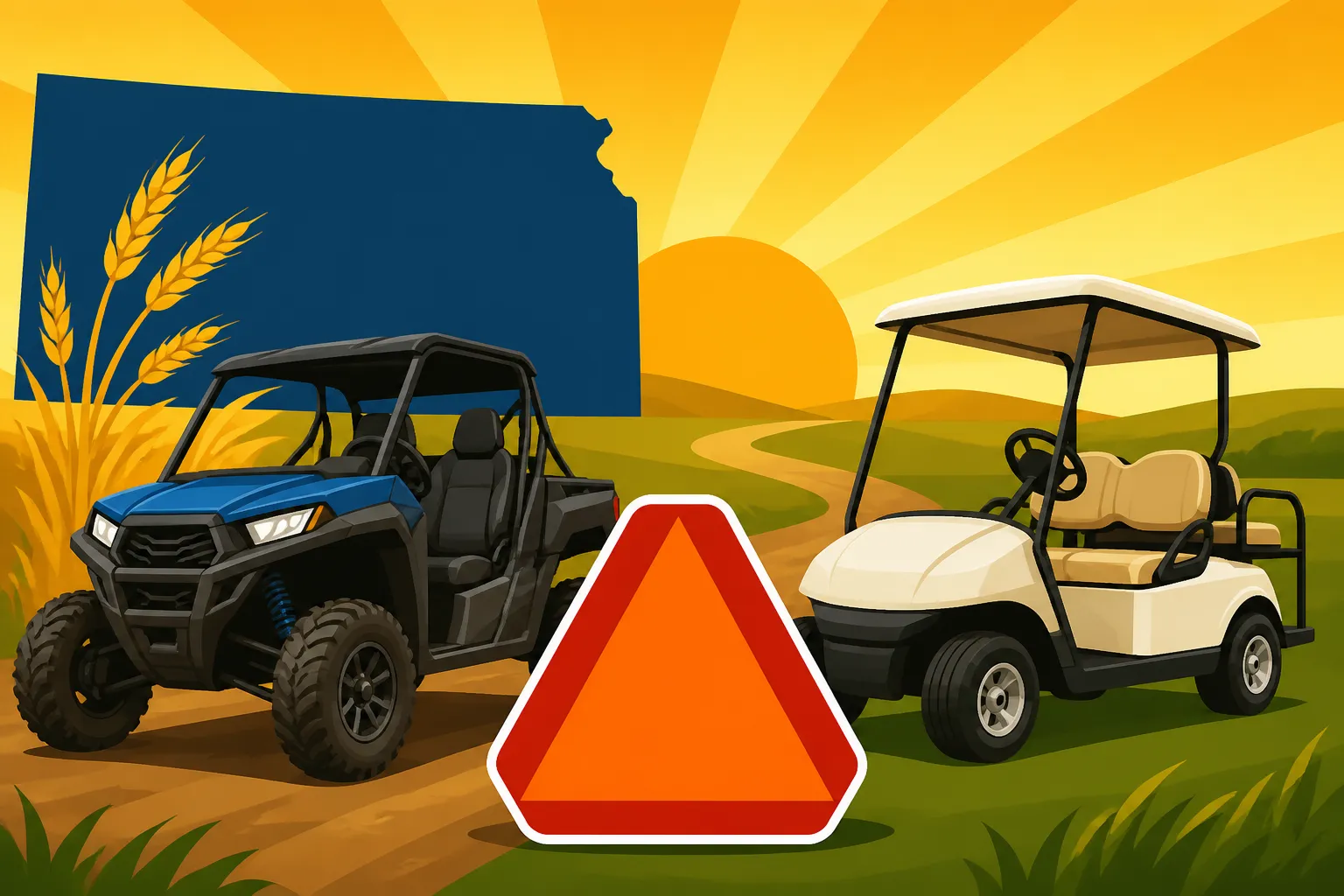
You’ve seen them countless times, usually on the back of farm tractors, horse-drawn buggies, or construction equipment. The slow-moving vehicle emblem is that bright, fluorescent orange triangle with a reflective red border. It’s immediately recognizable, and that’s precisely its purpose: to alert other drivers that the vehicle ahead of them is traveling at a significantly slower speed than regular traffic. In Kansas, the legal definition of a slow-moving vehicle generally refers to any vehicle designed to operate at speeds less than 25 miles per hour. This speed differential is a huge safety concern, especially on roads where cars might be traveling at 45 mph or faster. The SMV gives drivers precious extra seconds to react, slow down, and safely pass.
Think about it: you’re driving down a rural county road, perhaps heading home after a long day, and suddenly you come up on a golf cart. If that golf cart doesn't have an SMV, your brain might register it as a regular vehicle until you’re much closer, leaving you less time to brake or swerve. The fluorescent orange is designed to be highly visible in daylight, while the reflective red border catches headlights at night, ensuring visibility around the clock. It's a simple, yet incredibly effective, visual cue that has saved countless lives by signaling a potential hazard long before it becomes a crisis. For golf cart owners, understanding this basic concept is the first step toward safe and legal operation on any public thoroughfare.
Why Kansas Law Mandates SMVs for Certain Golf Cart Use
Kansas, like many states, has specific statutes and local ordinances designed to enhance road safety for all users, including those operating golf carts. The requirement for a slow-moving vehicle emblem isn't arbitrary; it's rooted in the physics of speed differentials and human reaction times. When a golf cart, which typically maxes out at speeds below 25 mph, shares a road with vehicles capable of much higher speeds, there's an inherent risk. This risk is amplified when visibility is poor, such as at dawn, dusk, or during inclement weather. The SMV requirement directly addresses this by making sure those slower vehicles stand out.
Imagine you're driving your golf cart in a city like Louisburg or Scott City, where ordinances might allow for street use. Even on a road with a 25 mph speed limit, a car might approach from behind doing the full limit, while your golf cart might only be doing 15 mph. That 10 mph difference, while seemingly small, can close distances rapidly. The SMV acts as a proactive warning system. It tells the driver behind you, "Hey, this vehicle is going to be slow, so be prepared to adjust your speed." Without it, a driver might assume your golf cart is just a small car or UTV that will eventually pick up speed, leading to a dangerous miscalculation. It's all about providing clear, unambiguous information to prevent rear-end collisions, which can be particularly devastating for golf cart occupants due to their lighter construction. [Why a Golf Cart Needs a Slow-Moving Vehicle Emblem] goes deeper into the specific rationale behind this mandate.
What an Approved SMV Emblem Looks Like
Not just any orange triangle will do when it comes to meeting Kansas's legal requirements for a slow-moving vehicle emblem. There are specific design and material standards that these emblems must meet to ensure maximum effectiveness and uniformity. Typically, an approved SMV emblem will be a truncated triangle, meaning the top point is cut off, making it a trapezoid. It usually measures about 14 inches high and 16 inches wide at the base, though specific dimensions can vary slightly while still meeting compliance. The center portion is a vivid, fluorescent orange or red-orange material, designed for high daytime visibility. This fluorescent material absorbs UV light and re-emits it as visible light, making it appear brighter than ordinary colors.
Around the perimeter of this fluorescent center is a reflective red border, typically about 1.75 inches wide. This red border is crucial for nighttime visibility, as it reflects light from vehicle headlights back to the driver, making the emblem easily discernible even in the dark. These emblems are usually made from durable, weather-resistant materials like aluminum or plastic, designed to withstand the elements without fading or deteriorating too quickly. When you're purchasing an SMV emblem, look for ones that explicitly state compliance with ASAE S276.6 or similar federal/state standards. This ensures you're getting a quality, legally compliant product that will perform its critical safety function. Aftermarket providers like SuperATV often stock these regulation-compliant emblems and mounting kits designed for various off-road vehicles, including golf carts.
Navigating Kansas Laws: When Your Golf Cart Needs an SMV
The big question on most golf cart owners' minds is, "Do I need an SMV on my golf cart?" The answer, as is often the case with Kansas vehicle laws, depends heavily on where and how you plan to use it. While your golf cart might be exempt from a full motor vehicle title in many cases, its operational rules on public roads are much stricter. Generally, if your golf cart is going to be driven on any public street, road, or highway in Kansas, and it's designed to travel under 25 mph, an SMV emblem is highly likely to be required, especially if your local city has passed an ordinance allowing golf cart use on its streets.
Golf Carts on Public Roads in Authorized Communities
Here’s where it gets a little tricky, and frankly, a bit frustrating for many folks. Kansas law, under K.S.A. 8-15,100, generally prohibits the operation of golf carts and other recreational off-highway vehicles on public roads unless a specific exception applies. One of the most significant exceptions is when a city or county passes its own ordinance to allow such vehicles on specific roadways within its jurisdiction. When a city "opts in" to allow golf carts on certain streets, they almost invariably come with a list of safety requirements that often include an SMV emblem. [Kansas Golf Cart Ordinances by City] highlights how varied these rules can be across the state.
For example, a city might allow golf carts on streets with a speed limit of 30 mph or less. In such a scenario, your golf cart, operating at its typical 15-20 mph, becomes a slow-moving vehicle relative to other traffic, making the SMV emblem a non-negotiable safety feature. You'll often find these requirements alongside mandates for headlights, taillights, turn signals, and sometimes even insurance. The intent is to integrate golf carts into the existing traffic flow as safely as possible, and the SMV is a cornerstone of that strategy. Always check with your local city hall or police department for the precise ordinance details if you plan to drive your golf cart on public streets. Failing to do so can lead to citations and even accidents. For more on the general rules, check out [Kansas Golf Cart Road Rules].
Exemptions and When an SMV Might Not Be Needed
While the general rule leans towards requiring an SMV for road use, there are situations where your golf cart might not need one. The most common exemption, and perhaps the least surprising, is when your golf cart is operated exclusively on private property. If you're only using it to traverse your sprawling backyard, move equipment around your farm, or get from hole to hole on a private golf course, then state and local public road requirements, including the SMV emblem, typically don't apply. The moment your wheels touch a public right-of-way, however, the rules change dramatically.
Another less common scenario might involve specialized golf carts that are legally classified differently or have been modified to meet higher speed or safety standards, thus removing them from the "slow-moving vehicle" category. However, these are rare and usually involve extensive modifications and re-classification processes that are beyond the scope of a typical golf cart owner. For the vast majority of Kansas golf cart users, if your cart is hitting public asphalt, assume an SMV is required unless a very specific and explicit local ordinance or state statute says otherwise for your particular use case. It's always better to be safe than sorry, especially when it comes to road safety. The small cost and effort of adding an SMV far outweigh the potential risks and penalties of not having one. For a general overview, see [Kansas Rules for a Golf Cart on a Street].
Proper Installation of Your Slow-Moving Vehicle Emblem
So, you've determined your golf cart needs a slow-moving vehicle emblem. Great! Now, just slapping it on with some duct tape isn't going to cut it, both for safety and legal compliance. Proper installation is key to ensuring the emblem is highly visible, secure, and effective. A poorly mounted emblem that falls off mid-ride, or one that's obscured, defeats its entire purpose and could still land you in trouble with law enforcement. Let's walk through how to do it right, so your golf cart is clearly seen and you stay on the good side of Kansas law.
Best Placement for Maximum Visibility
The primary goal of an SMV emblem is to be seen. This means mounting it in a location that is unobstructed and clearly visible from the rear of your golf cart. The ideal spot is typically centered on the back of the cart, as low as possible without being obscured by the ground or other components, but high enough to be above any potential mud or debris thrown up by the wheels. Avoid placing it too high, where it might be above the sightline of a car driver, or too far to the side, where it could be missed. Centered and clear is the name of the game.
Consider the common attachments on a golf cart, like a rear cargo basket or a golf club bag holder. If you have these, the SMV needs to be mounted on top of or behind these accessories so that it's always the first thing another driver sees. Some golf cart designs may even require a small bracket or extension to get the emblem into an optimal, unobstructed position. Remember, its job is to stand out. Take a moment to step back and look at your golf cart from various angles, especially from a typical car's perspective, to confirm the emblem is unmistakably visible. If you're looking for sturdy mounting hardware, SuperATV provides universal mounting brackets and hardware designed to securely attach accessories like these to different vehicle types.
Ensuring Secure Attachment for the Long Haul
Once you've found the perfect spot for your SMV emblem, the next critical step is to ensure it's securely fastened. These emblems are exposed to wind, vibration, and sometimes even light bumps, so a strong, durable attachment method is essential. Most SMV emblems come with pre-drilled holes, usually two at the top corners or one in the center, designed for bolt-on installation. Using bolts, washers, and lock nuts is generally the most reliable method. Avoid self-tapping screws directly into plastic if possible, as they can loosen over time, especially with the vibrations inherent in golf cart operation.
If your golf cart frame is metal, drilling small pilot holes for bolts is usually straightforward. If you're attaching it to a plastic body panel, reinforcing the area with a small backing plate on the inside can prevent the plastic from cracking or the bolts from pulling through. You want the emblem to be flush against the surface or bracket, without any wobbling or flapping. Check the attachment periodically, especially after rough rides or significant weather, to make sure everything is still tight and secure. A loose emblem is not only ineffective but could also become a road hazard if it detaches completely. Investing a little extra time in secure mounting will ensure your SMV emblem does its job consistently and reliably.
Beyond the Emblem: Other Requirements for Road-Legal Golf Carts
While the slow-moving vehicle emblem is a vital component for golf cart safety on Kansas roads, it's almost never the only thing you'll need. Cities that allow golf cart operation on their streets typically impose a comprehensive set of requirements to ensure these smaller, slower vehicles can safely coexist with cars and trucks. Thinking holistically about your golf cart's road-readiness is crucial. It’s not just about meeting a single standard, but about creating a fully visible and safely operable machine. Many of these additional requirements are designed to mimic basic automotive safety features, ensuring your cart can signal its intentions and be seen in all conditions.
Essential Lighting and Reflectors
If you plan to drive your golf cart on public roads, especially after sunset or before sunrise, proper lighting is absolutely non-negotiable. Kansas law, and local ordinances, will almost certainly require your golf cart to have working headlights, taillights, and brake lights. [Kansas Lighting Rules After Sunset] are strict for all vehicles sharing the road, and golf carts are no exception. Headlights need to illuminate the road ahead adequately, and taillights must be visible from a specified distance from the rear. Brake lights are critical to alert following drivers when you're slowing down or stopping, preventing rear-end collisions.
Beyond these basics, many city ordinances also mandate turn signals, both front and rear. This allows you to clearly communicate your intentions when making turns or changing lanes, which is a fundamental aspect of safe driving. Reflectors, often red in the rear and amber on the sides, can also be required to enhance passive visibility, especially if your electrical system fails. When upgrading your golf cart's lighting, look for integrated kits that include all these components. Aftermarket suppliers, like SuperATV, offer comprehensive street-legal kits specifically designed for golf carts and UTVs, making it easier to ensure all bases are covered. Always test all your lights before each ride, just like you would with a car. This is especially true if you are crossing a road where you could interact with faster traffic, such as described in [Kansas Golf Carts Crossing a 30 mph Road].
Mirrors, Seatbelts, and Other Safety Features
To truly be road-ready and compliant with most city ordinances, your golf cart will likely need more than just lights and an SMV. Rearview mirrors are another common requirement. Just like in a car, these allow you to monitor traffic behind you and make safe lane changes or turns. You might need both a center rearview mirror and side mirrors, depending on the specific local rules. Having a clear view of what's happening behind you is paramount for safe operation on shared roadways.
Seatbelts are another safety feature often mandated, especially if your golf cart is designed with forward-facing seats. While golf carts might not travel at highway speeds, even a low-speed collision can result in serious injury if occupants are not restrained. Check your local ordinance for specifics on seatbelt requirements, including the type (lap belts vs. three-point harnesses) and for which seating positions. Other potential requirements could include a horn (to alert pedestrians or other drivers), a parking brake, and a windshield. Some cities even have specific tire requirements or demand a vehicle inspection before issuing a permit to operate on city streets. It's a comprehensive list of safety features designed to make your ride as secure as possible for you and everyone else on the road. Don't forget that cities like those mentioned in [Kansas Cities That Authorize ATV Street Use] can have their own unique regulations.
Here's a quick look at common safety features and why they're important for road-legal golf carts:
| Safety Feature | Why It's Needed | Common Kansas Requirement |
|---|---|---|
| Slow-Moving Vehicle Emblem | Alerts faster traffic to slow speed | Yes, for public road use |
| Headlights | Illuminates road & makes cart visible forward | Yes, especially after dark |
| Taillights/Brake Lights | Makes cart visible from rear, signals stopping | Yes, especially after dark |
| Turn Signals | Communicates turning intentions | Often required by local ordinances |
| Rearview Mirrors | Allows driver to see traffic behind | Often required (center & side) |
| Seatbelts | Secures occupants in case of sudden stop/collision | Often required, especially for passengers |
| Horn | Alerts pedestrians/other drivers | Sometimes required |
| Windshield | Provides protection from wind & debris | Often required |
The Cost of Non-Compliance: Penalties and Safety Risks
Ignoring the requirement for a slow-moving vehicle emblem on your golf cart, or any other road-legal equipment, isn't just a minor oversight in Kansas; it can have significant consequences. From legal penalties that hit your wallet to severe safety risks that could impact your well-being, taking shortcuts on road readiness is never worth it. Understanding these potential repercussions can reinforce why adhering to the rules isn't just about avoiding a ticket, but about genuinely protecting yourself and others.
Fines and Legal Ramifications for Missing Equipment
If you're caught operating a golf cart on a public road in Kansas without the required SMV emblem or other mandated safety equipment (like proper lighting or mirrors), you could face fines. These penalties can vary by city and county, but they are often comparable to minor traffic infractions. A deputy performing [Kansas Equipment Checks by Deputies] on a county road or a city police officer could pull you over, issue a citation, and potentially even impound your vehicle if it's deemed unsafe or illegally operated. These fines can quickly add up, easily costing you more than the price of the emblem itself.
Beyond the initial fine, there could be other legal headaches. An officer might require you to correct the violation before you can operate the golf cart on public roads again. This means you might have to get the SMV installed and then show proof to the court or police department. Repeated offenses could lead to higher fines or other legal actions. Remember, if a city has an ordinance allowing golf carts on its streets, it's a privilege, not a right. Failure to comply with the terms of that ordinance can lead to its revocation, not just for you, but potentially for the entire community if compliance becomes a widespread issue. It's much simpler, and cheaper in the long run, to just follow the rules from the start. For more on the consequences, see [Kansas Penalties for Illegal Road Riding].
The Real-World Safety Implications of Being Unseen
Legal penalties are one thing, but the most critical consequence of not having an SMV emblem or proper lighting on your golf cart is the increased risk of an accident. When you're driving a slow-moving vehicle, especially one as compact as a golf cart, your visibility to other drivers is your first and most important line of defense. Without that bright orange triangle, particularly on a curvy rural road or in conditions with reduced visibility, you become a ghost on the road. Drivers of faster vehicles simply won't have enough time to see you, react, and slow down.
Rear-end collisions are a common and severe risk for slow-moving vehicles. Imagine a scenario where a car crests a hill or comes around a bend, expecting to see traffic moving at a similar speed. If your golf cart is suddenly there, unseen until the last moment, the closing speed can be devastating. Golf carts offer minimal protection in a collision with a full-sized vehicle, meaning occupants are at high risk of serious injury or worse. An SMV emblem is a low-tech, high-impact safety device designed specifically to prevent these types of accidents. Don't gamble with your safety or the safety of your passengers; make sure your golf cart is always as visible as possible whenever it shares the road with other vehicles. [Kansas Rules for Riding After Dark] highlights the extreme importance of visibility in low-light conditions.
Conclusion
Navigating the rules for golf carts on Kansas roads can feel like a maze, but understanding the requirement for a slow-moving vehicle emblem is a crucial piece of the puzzle. This fluorescent orange and reflective red triangle isn't just another accessory; it's a life-saving warning signal for other drivers, bridging the speed gap between your golf cart and faster vehicles. Whether you're in an approved city or just considering venturing onto public streets, ensuring your golf cart is properly equipped with an SMV and other necessary safety features like lighting and mirrors is paramount. Don't underestimate the power of visibility; it’s your best defense against accidents and the easiest way to stay compliant with Kansas law. Prioritize safety, equip your golf cart correctly, and enjoy your ride knowing you're doing your part to keep Kansas roads safe for everyone.
Disclaimer
This article is for general informational purposes only and does not constitute professional advice. Laws, prices and regulations vary by location and change over time. Consult a qualified professional for guidance on your specific situation.