Kansas ATV Road Rules Under 8-15,100
It's a familiar feeling for many of us who love our ATVs and UTVs here in Kansas. You've got your machine, you've got places you want to go, and sometimes, those places are just a short hop across a county road or through a small town. But then the questions hit: Can I actually ride my quad or side-by-side on the road? What's the law on this? It feels like a confusing maze, doesn't it? This guide is here to untangle the complexities of Kansas ATV road rules, especially under the much-discussed statute 8-15,100, so you can ride with confidence and stay on the right side of the law.
The Blanket Ban: Understanding Kansas Statute 8-15,100
When you're looking at Kansas law regarding off-road vehicles on public roads, you'll quickly run into Kansas Statute 8-15,100. This is the big one, the foundational rule that sets the stage for almost everything else. It can be a real head-scratcher because it seems to start with a firm "no," which can be frustrating if you're just trying to get from your pasture to the neighbor's field.
Why Kansas Law Starts with a "No"
The initial reaction for many ATV and UTV owners is often surprise, even a bit of annoyance, when they discover that, by default, Kansas law prohibits these machines from being operated on public streets, roads, and highways. This isn't unique to Kansas; many states have similar starting points. The underlying intent of this blanket ban is primarily safety and infrastructure protection. Public roads are designed for vehicles that meet specific safety standards – think headlights, taillights, turn signals, seatbelts, airbags, and robust braking systems – vehicles that are generally heavier, wider, and more stable at higher speeds.
ATVs and UTVs, while incredibly capable off-road, often lack some of these features or behave differently on paved surfaces. Their suspension is typically designed for rough terrain, not smooth asphalt, which can make them less stable, especially during emergency maneuvers or at higher speeds. Plus, they're often smaller and harder for other motorists to see. The legislature, in its wisdom, has generally erred on the side of caution, assuming that most off-road machines aren't built for the rigors of highway travel and could pose a risk to both their operators and other drivers. It’s not about singling out our machines; it’s about a broad safety measure for all road users.
What Counts as an ATV or UTV Under This Statute
To understand the ban, it's crucial to know how Kansas law defines an ATV and a UTV within the context of road use. An All-Terrain Vehicle (ATV) is typically described as a motorized vehicle, designed to travel on four low-pressure tires, having a seat designed to be straddled by the operator, and handlebars for steering. Think your typical sport or utility quad. A Utility Terrain Vehicle (UTV), or side-by-side, generally refers to a motorized vehicle that's not an ATV, typically with four or more wheels, bench or bucket seating for passengers, and a steering wheel.
For the purposes of this statute, these definitions are broad and encompassing. If your machine fits these descriptions, it's generally subject to the road ban unless a specific exception or local ordinance applies. It's important to differentiate these from other vehicle classifications that have their own set of rules, such as golf carts, micro utility trucks, or [Work-Site Utility Vehicles Explained]. While a side-by-side might look like it could be a work-site utility vehicle, the legal definitions are very precise, often hinging on factors like width, weight, and specific design features. Trying to stretch your UTV into one of these other categories to gain road access could lead to legal trouble, so it's always best to understand [An ATV Defined in Chapter 8] and similar definitions clearly.
Navigating the Exceptions: When You Can Legally Ride on Kansas Roads
While Statute 8-15,100 sets a general prohibition, the law isn't entirely without nuance. Kansas recognizes certain specific scenarios where an ATV or UTV can legally operate on public roads. These exceptions are critical for farmers, ranchers, and those living in communities that have chosen to embrace these machines.
The Agricultural Exception: Farm to Field and Beyond
Perhaps the most significant exception, and one that greatly benefits our rural communities, is the agricultural exception. This provision allows ATVs and UTVs to be operated on public roads when used for legitimate agricultural purposes. Think of a farmer needing to quickly move a utility quad from one field to another down a county road, or a rancher checking fence lines that span across a small rural highway. This is about practical utility, not recreational joyriding.
The law is fairly clear: if you're using your machine for tasks directly related to farming, ranching, or other agricultural operations, you have some leeway. This includes transporting tools, checking livestock, or moving between parcels of land. However, it’s not a free pass. You can't just slap a bale of hay on your UTV and declare every trip an "agricultural purpose." The trip needs to have a genuine, demonstrable connection to your farming or ranching activities. For example, driving your side-by-side into town to pick up groceries, even if you live on a farm, typically wouldn't qualify. But moving equipment to spray a field? Absolutely. It’s about the specific intent and nature of the trip. You'll find more details on this in [Kansas's Agricultural Exception for Road Use] and [What Counts as an Agricultural Trip on a Highway].
Local Ordinances: Cities That Opt-In to ATV/UTV Road Use
This is where things get truly interesting, and often, a bit complicated. While the state law generally prohibits ATVs and UTVs on roads, it also grants local municipalities – cities and counties – the authority to pass their own ordinances that permit the use of these vehicles on their public streets within their jurisdiction. This means that what's legal in one town might be completely illegal in another just down the road.
If you live in or plan to visit a specific city, it is absolutely paramount to check their local ordinances. These local rules often come with their own set of requirements: specific speed limits, hours of operation, mandatory safety equipment (like turn signals or windshields), and sometimes even local registration or permit fees. For instance, some cities, like Louisburg, have embraced UTVs on their streets, but they've done so with strict guidelines, including specific fees and insurance requirements. [Kansas UTV Street Legal Rules by City] and [Kansas Cities That Opt In by Ordinance] are excellent resources to help you understand this patchwork of regulations.
It's here that products from companies like SuperATV become incredibly relevant. If your local city or county does allow street-legal UTVs, you'll likely need to modify your machine to meet their requirements. SuperATV offers a wide range of accessories, from turn signal kits and horns to DOT-approved windshields, that can help you get your UTV up to snuff for local street-legal conversion, making it easier to comply with those city-specific rules.
Crossing State Highways: A Limited Privilege
Another specific exception within Kansas law addresses the ability to cross a state highway. This is a very narrow allowance and is often misunderstood. The law generally permits ATVs and UTVs to cross a state highway, but it absolutely does not grant permission to ride along a state highway or any federal highway like an interstate.
This exception is designed for situations where, for instance, a farm property is divided by a state highway, and the operator needs to move their machine from one side to the other. When exercising this privilege, you must do so safely and directly. This means crossing at a right angle to the highway, yielding to all oncoming traffic, and not lingering on the pavement. You should minimize your time on the highway itself to the bare minimum required for the crossing. This isn't an invitation to travel down the shoulder for a mile; it's strictly for a perpendicular crossing. Understanding the limitations of [Crossing a State Highway in Kansas] is vital to avoid a citation.
Essential Equipment and Requirements for Street-Legal ATVs/UTVs
Even when an exception allows for road use, it's rarely as simple as just hitting the pavement. Kansas law, and more frequently, local ordinances, will impose specific equipment requirements to ensure the safety of the ATV/UTV operator and other motorists. These aren't just suggestions; they are often mandatory for legal operation.
Lights, Signals, and Reflectors for Road Use
If you're operating an ATV or UTV on a public road, especially when light conditions are less than ideal (think dawn, dusk, or nighttime), adequate lighting is non-negotiable. Kansas law, even for farm-exempt vehicles, generally requires specific lighting during these periods. This typically includes a headlight visible from a certain distance and a taillight visible from the rear.
Many city ordinances go much further, often mandating equipment comparable to what you'd find on a low-speed vehicle or even a motorcycle. This can include turn signals for both front and rear, brake lights, and sometimes even hazard lights. If your city has an ordinance allowing UTVs, they'll often specify that your machine needs proper illumination for [Kansas Lighting Rules After Sunset] and even standards similar to [Kansas Motorcycle Lighting Standards]. This is where a company like SuperATV really shines, as they offer comprehensive street-legal kits that include all the necessary lighting, horns, and mirrors to get your off-road machine compliant with these stricter road use regulations. Don't skimp on this; visibility is your best defense against accidents on shared roadways.
Slow-Moving Vehicle Emblems and Other Safety Gear
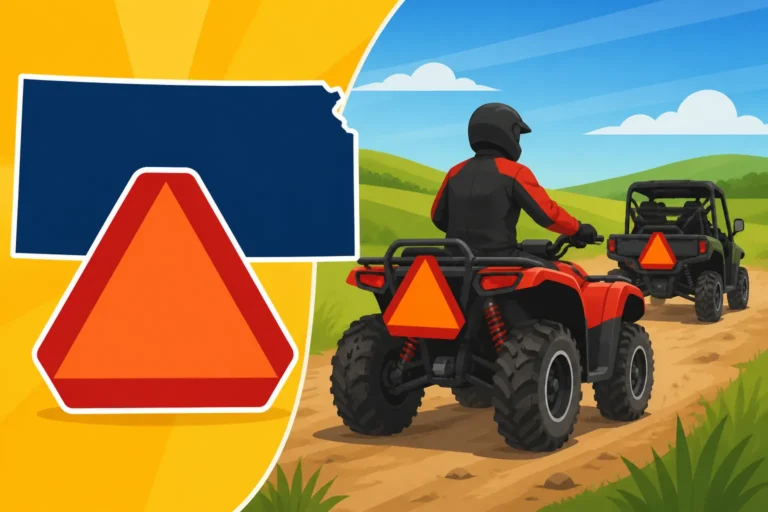
For certain types of road use, particularly agricultural operations on slower county roads, Kansas law may require a slow-moving vehicle (SMV) emblem. This is a reflective orange triangle that clearly indicates to other drivers that your vehicle is operating at speeds of 25 mph or less. It's a critical safety device, especially on rural roads where higher-speed traffic might not expect a slower-moving vehicle around a bend.
Beyond the SMV emblem, local ordinances often add a host of other safety requirements. These can include a rearview mirror, a windshield (sometimes DOT-approved), a horn audible from a certain distance, and even seatbelts (though most modern UTVs come standard with these). While the state might not mandate a helmet for ATV riders on private land, if a city opens its streets, they might impose helmet requirements or other personal protective equipment rules. Always assume that the more you integrate your machine into road traffic, the more safety equipment will be expected. Check out [Kansas Slow-Moving Emblem Rules] for details on when and where these are necessary.
Driver Licensing, Age Restrictions, and Insurance
This is a common point of confusion: if you can ride an ATV or UTV on a public road, do you need a driver's license? The answer is almost always yes. Any time you operate a motorized vehicle on a public roadway in Kansas, you are generally required to possess a valid driver's license. This applies whether you're using the agricultural exception or operating under a city ordinance. The logic is simple: if you're sharing the road with licensed drivers, you should also be a licensed driver who understands traffic laws.
Age restrictions also come into play. While Kansas law has specific age guidelines for operating ATVs off-road (often requiring supervision for younger riders), these rules become stricter when public roads are involved. Most city ordinances permitting road use will mirror the state's driver's license requirements, meaning an operator must be at least 16 years old and hold a valid license.
Finally, let's talk about insurance. Unlike passenger vehicles, Kansas does not have a statewide mandate for ATV or UTV insurance unless the vehicle is tagged for road use (which, for ATVs, is rare, as [Kansas Has No OHV Registration] and [Why an ATV Is Exempt From Registration Entirely] clarifies). However, this changes drastically if a city or county passes an ordinance allowing road use. Many of these local ordinances will explicitly require proof of liability insurance, often setting minimum coverage limits. If you plan to operate your UTV on city streets, you absolutely need to check [Kansas Insurance Comes From City Ordinances] and ensure you have adequate coverage before you roll out. Being uninsured could lead to fines, vehicle impoundment, or catastrophic financial liability in the event of an accident.
The Nitty-Gritty of City Ordinances: What to Expect
When it comes to legal ATV and UTV road use in Kansas, the saying "all politics is local" truly applies. While the state provides the framework, it's often your local city council or county commission that determines whether you can legally ride on the streets. This means navigating a patchwork of rules that vary wildly from one community to the next.
How a City Council Opens Its Streets
The process for a city to allow ATV and UTV use on its streets typically involves the city council passing a specific ordinance. This isn't a simple handshake agreement; it's a formal legislative process that often includes public hearings, discussions about safety, and a detailed outline of rules and restrictions. The council weighs the potential benefits (like convenience for residents, economic impact for local businesses) against concerns such as public safety, noise, and potential wear and tear on roads.
It’s crucial to understand that unless your specific town has passed such an ordinance, the state’s general prohibition remains in effect. Just because a neighboring town allows it doesn't mean yours does. There's no statewide "opt-in" by default. The power to permit resides entirely at the local level. This means if you want to see UTVs on your town's streets, you might need to engage with your local city council and advocate for such an ordinance. Getting insight from [How a City Council Opens Its Streets to UTVs] can show you the process.
Common Requirements and Restrictions in Opt-In Cities
Once a city passes an ordinance, it usually comes with a litany of requirements and restrictions designed to integrate these off-road machines into street traffic as safely as possible. These commonly include:
- Annual Permits/Tags: Many cities require an annual permit or a special local tag to be displayed on the UTV. This typically involves a fee.
- Safety Inspections: Before a permit is issued, your machine might need to pass a safety inspection to ensure it has all the mandated equipment (lights, signals, mirrors, horn, etc.). For instance, Louisburg requires police inspection before a tag issues.
- Designated Routes/Speed Limits: Some ordinances restrict UTVs to certain streets (e.g., no state highways within city limits) or impose specific speed limits, often lower than the posted limit for cars. [Louisburg's 45 mph Street Limit in Kansas] is a good example.
- Hours of Operation: Restrictions on when UTVs can be operated (e.g., no late-night riding).
- Insurance: As mentioned before, liability insurance is almost always a requirement. [Louisburg's Insurance Requirement in Kansas] is a prime example.
- Driver's License: A valid state-issued driver's license is universally required for operators.
- Passenger Limits: Following manufacturer's recommendations for passenger capacity.
It's a lot to keep track of, but these rules are in place for a reason. Ignoring them can lead to citations, fines, or even having your machine impounded. Checking the specific ordinance for your city, like [Scott City's Ordinance in Kansas], is your responsibility before you hit the pavement.
Understanding City-Specific Tagging and Fees
If your city has an ordinance, you'll almost certainly encounter city-specific tagging and associated fees. These are not state registrations; they are purely local administrative requirements. The fees can vary, covering the cost of administration, local law enforcement oversight, and sometimes, a contribution to road maintenance.
For example, [Louisburg's UTV Tag Fees in Kansas] can involve an initial fee for the first year, with a slightly lower renewal fee annually. This city tag typically needs to be prominently displayed on the machine, often on the rear. It's important to remember that these tags are only valid within the issuing city's jurisdiction. They don't grant you permission to ride on roads in other cities or unincorporated county areas unless those areas also have their own specific ordinances or exceptions. Budgeting for these fees, along with potential insurance costs, is an important part of making your UTV street-legal in an "opt-in" community.
Here's a quick look at some common city requirements:
| Requirement | Typical City Ordinance Specification |
|---|---|
| Driver's License | Required, valid state-issued |
| Insurance | Required, often liability minimums specified |
| Headlights | Required, functional, visible from specified distance |
| Taillights/Brakes | Required, functional, visible from specified distance |
| Turn Signals | Often required (front and rear) |
| Rearview Mirror | Often required |
| Horn | Often required, audible from specified distance |
| Windshield | Sometimes required, sometimes DOT-approved |
| Annual Tag/Permit | Required, fee applies, specific display location (e.g., Where to Mount a City UTV Plate) |
| Speed Limit | Restricted (e.g., 30 mph, 45 mph), usually lower than posted car speed |
| Inspection | Often required by local law enforcement before permit issuance |
| Hours of Use | Sometimes restricted (e.g., sunrise to sunset, or specific evening cut-off) |
| Roads Permitted | Usually only city streets, with explicit bans on state/federal highways and high-speed arterial roads |
This table provides a general overview, but you should always consult the exact ordinance for your specific city to ensure compliance.
Distinguishing ATV/UTV Road Rules from Other Vehicle Classes
One of the biggest sources of confusion for off-road enthusiasts in Kansas is misunderstanding the distinctions between different types of unconventional vehicles. An ATV is not a golf cart, and a UTV is not necessarily a Work-Site Utility Vehicle (WSUV). Each category has its own unique set of definitions and, more importantly, its own specific rules regarding road use. Getting this wrong can lead to tickets and frustration.
Golf Carts, Micro Utility Trucks, and Work-Site Utility Vehicles
Kansas law defines several "unconventional vehicles," and it's essential to know where your machine fits in.
- Golf Carts: These are typically defined as four-wheeled vehicles designed and manufactured for operation on a golf course for sporting or recreational purposes. They have specific dimensional and speed limits. [Kansas Golf Cart Road Rules] are distinct from ATV rules, often allowing more widespread (though still restricted) road use in areas with specific ordinances, especially on slower streets. They often need [Kansas Golf Carts and Slow-Moving Emblems].
- Micro Utility Trucks: These are small, imported, foreign-made vehicles, commonly known as "kei trucks" from Japan. They are very narrow, low-speed, and have cargo beds. Kansas has specific rules governing their operation, which allow them on certain public roads but with strict equipment and speed requirements. [Kansas Micro Utility Truck Road Rules] outlines their unique status.
- Work-Site Utility Vehicles (WSUVs): This category is particularly important because many UTV owners mistakenly believe their side-by-side qualifies as a WSUV. Kansas law defines a WSUV very precisely: a motor vehicle that is not an all-terrain vehicle, designed for off-highway use, having four or more wheels, a steering wheel, and seating for two or more persons side-by-side, with an unladen weight of more than 800 pounds, and not exceeding 48 inches in width. The key here is the 48-inch width limit and the 800-pound weight minimum, which excludes many popular, wider UTV models. [Kansas Work-Site Utility Vehicles Explained] and [48 Inches and 800 Pounds] dive deep into these specifics. WSUVs have their own [Kansas WSUV Road Rules], which can be more permissive than general ATV/UTV rules, but only if your machine truly meets the definition.
The crucial takeaway is that you cannot simply decide your UTV is a WSUV if it doesn't meet the statutory definition. Manufacturers design these vehicles, and their intended purpose and specifications often dictate their legal classification.
Why the Definitions Matter for Road Use
The precise definitions of ATVs, UTVs, golf carts, micro utility trucks, and WSUVs are not academic exercises; they are the bedrock of road legality. [Why the Definitions Matter for Roads] is simple: each class has been assessed differently by lawmakers regarding its suitability for sharing public roadways.
For instance, a golf cart might be allowed on residential streets with a 25 mph speed limit because its lower speed and predictable handling are deemed safe for those environments. A WSUV, with its specific dimensions and weight, might be allowed on certain county roads for work-related tasks. However, a wider, faster UTV that doesn't fit the WSUV definition is, by default, treated as a general off-road vehicle under Statute 8-15,100, subject to the blanket ban unless a specific local ordinance overrides it. Attempting to fit a square peg into a round hole by mislabeling your machine can have serious repercussions. For example, a SuperATV custom-built side-by-side that's 64 inches wide, while fantastic off-road, simply cannot meet the 48-inch WSUV definition, regardless of its utility.
Consequences of Misclassification or Illegal Road Use
The penalties for operating an ATV or UTV illegally on Kansas roads can range from irritating to severe. You might face:
- Traffic Citations and Fines: This is the most common outcome. A law enforcement officer can issue a ticket for operating an unregistered or illegal vehicle on the roadway. Fines can add up quickly, especially when court costs are factored in. [Kansas Penalties for Illegal Road Riding] details these.
- Vehicle Impoundment: In some cases, especially for repeat offenses or particularly egregious violations, your machine could be impounded, leading to towing and storage fees on top of any fines.
- Lack of Insurance Coverage: If you have an accident while operating your ATV/UTV illegally on a public road, your insurance policy (if you even have one) may deny coverage, leaving you personally liable for damages, injuries, and legal fees.
- Driver's License Points/Suspension: Depending on the severity of the violation, points could be assessed against your driver's license, potentially leading to suspension, particularly if you're already near the limit.
It's simply not worth the risk. Understanding and adhering to the correct classification and associated road rules protects your wallet, your machine, and most importantly, your safety and legal standing.
Practical Advice for Kansas ATV/UTV Owners
Navigating the intricacies of Kansas ATV and UTV road rules requires diligence and a proactive approach. It's not enough to simply hope you're compliant; you need to know for sure. Here's some practical advice to keep you on the right side of the law and ensure safe operation.
Researching Local Ordinances Before You Ride
This cannot be stressed enough: do your homework before you ever put a tire on a public road. The default assumption in Kansas is that ATVs and UTVs are not permitted on public roads unless a specific exception or local ordinance allows it. This means you need to be familiar with the rules of every jurisdiction you plan to ride in.
If you live in a city or plan to use your machine on city streets, your first step should be to contact your city hall or municipal clerk's office. Ask specifically about ordinances related to "unconventional vehicles," "utility terrain vehicles," or "off-road vehicles" on public streets. Don't just rely on hearsay from a neighbor; get the information directly from the source. Many cities now publish their ordinances online, so a quick search of "[Your City Name] UTV ordinance Kansas" might yield results. For county roads outside city limits, you would typically look for county commission resolutions or contact the county sheriff's office for clarification. Resources like [Kansas Ordinance Lookups Before You Ride] can point you in the right direction, and [How to Tell If Your Kansas Town Allows UTVs] offers practical tips. It's a bit of legwork, but it's far better than getting pulled over and fined.
Essential Documents to Carry While Riding
Just like driving your car, if you're operating an ATV or UTV on a public road where it's legally permitted, you should carry certain documents with you. This prepares you for any interaction with law enforcement and ensures you can prove your compliance.
Here's a checklist of what you should generally have on hand:
- Valid Driver's License: This is non-negotiable for operating any motor vehicle on a public road in Kansas.
- Proof of Insurance: If your local ordinance or the nature of your trip (e.g., agricultural exception in some cases) requires insurance, have your current insurance card or policy declaration readily available.
- City Permit/Tag Documentation: If your city requires a special permit or tag for road use, carry the permit card or documentation that proves your machine is legally allowed on their streets.
- Proof of Ownership/Registration: While Kansas doesn't register ATVs or UTVs annually, having a copy of your [Kansas Titles ATVs as Nonhighway Vehicles] or bill of sale can be helpful to prove ownership.
- Written Landowner Permission (if applicable): If your road use involves accessing private land, having written permission can be useful, especially in rural areas where deputies might inquire about your presence.
These documents don't need to be originals; clear copies are usually sufficient. Keep them in a waterproof pouch or a secure compartment on your machine. [What a County Sheriff Can Ask a Rider to Show] often includes these items, so being prepared can make a stop much smoother.
Safety First: Beyond the Legal Requirements
Even when you're legally permitted to ride your ATV or UTV on the road, safety should always be your paramount concern. Just because it's legal doesn't mean it's without risk. Off-road machines handle very differently on pavement than they do on dirt, and they are significantly less protected than a typical automobile.
- Be Highly Visible: Wear bright clothing, use your headlights and taillights even during the day, and consider adding additional reflective tape to your machine. For machines that meet specific city requirements, ensuring your turn signals, brake lights, and horn are always functional is critical. SuperATV also offers a wide array of lighting accessories and reflective elements that can enhance your visibility.
- Drive Defensively: Assume other drivers don't see you. Be extra vigilant at intersections, when making turns, and when sharing the road with larger vehicles. Maintain a safe following distance and avoid sudden maneuvers.
- Watch Your Speed: Even if a city ordinance allows you to ride on a 45 mph street, your ATV or UTV might not be designed for sustained speeds on pavement. Drive at a speed that allows you to maintain full control and react to unexpected hazards.
- Wear a Helmet and Eye Protection: While [Does Kansas Have an ATV Helmet Law at All?] might not mandate helmets for all ATV riding, it is unequivocally the smartest piece of safety gear you can wear, especially on public roads. Even if your city doesn't require it, your brain is worth protecting. Eye protection is also crucial to prevent debris from impairing your vision.
- Understand Road Hazards: Potholes, gravel shoulders, oil slicks, and even painted lines can be more hazardous for ATVs and UTVs than for cars. Be aware of your surroundings and adjust your riding accordingly.
Riding your ATV or UTV on Kansas roads can be a convenient and enjoyable experience when done legally and safely. By understanding Statute 8-15,100, checking local ordinances, properly equipping your machine, and always prioritizing safety, you can confidently explore the Sunflower State's byways.
Disclaimer
This article is for general informational purposes only and does not constitute professional advice. Laws, prices and regulations vary by location and change over time. Consult a qualified professional for guidance on your specific situation.