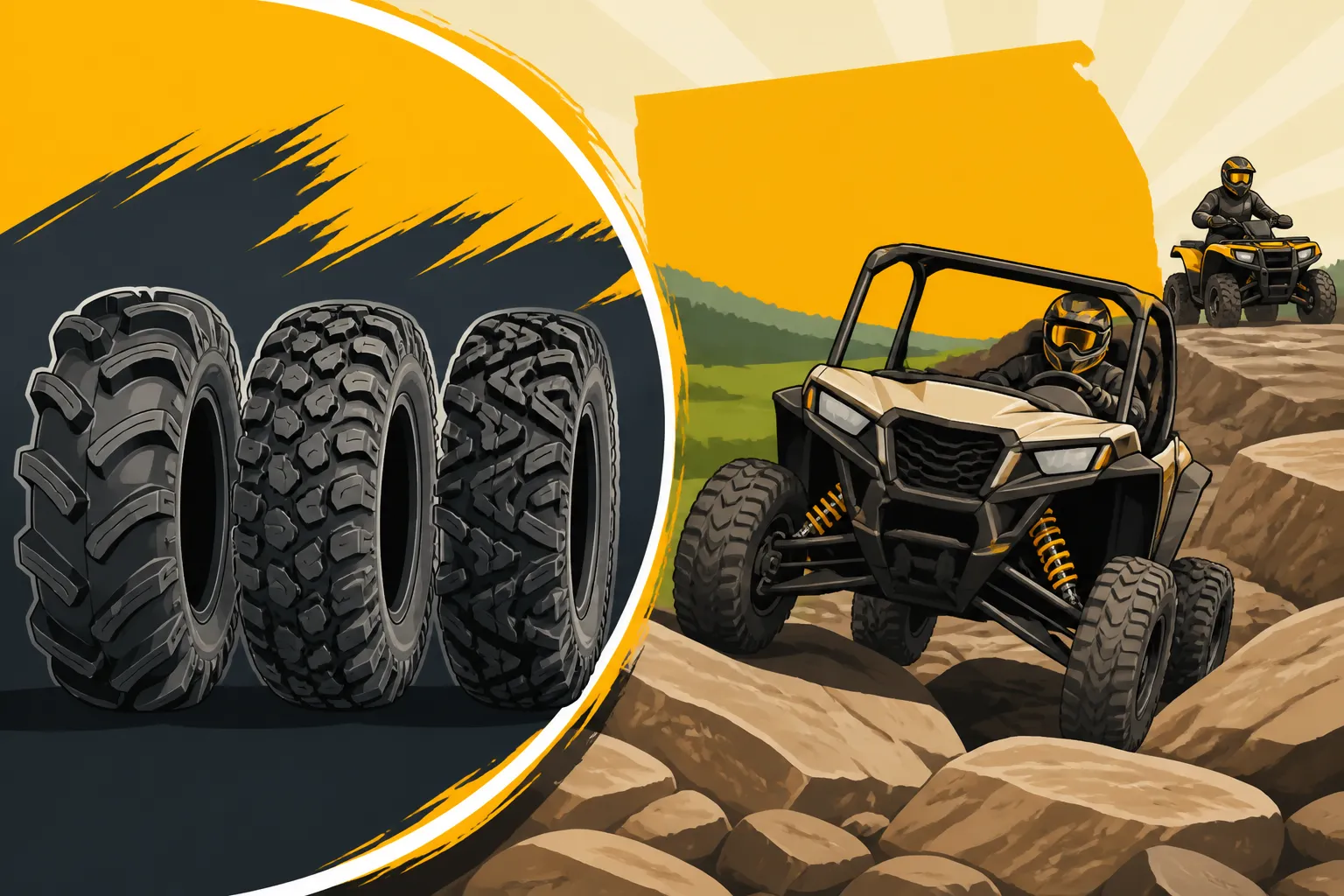
Choosing Tires for the Rock at Mapleton
Rocky trails can punish the wrong ATV or UTV tires: sharp edges can cut sidewalls, loose stone can rob you of grip, and a tread built for mud may feel clumsy on hard ground. At Kansas Rocks Recreation Park near Mapleton, choosing tires means balancing traction, puncture resistance, clearance, and ride comfort. This guide walks through those trade-offs and helps you prepare before unloading.
Understand the rocky terrain before choosing tires
Why rock trails ask more of a tire
Rock riding is not just a matter of picking the most aggressive tread. A tire needs to grip uneven surfaces while resisting cuts and bruises from sharp edges. The tread blocks, sidewall construction, rubber compound, and tire pressure all influence how confidently a machine crawls across rock.
At a place like Kansas Rocks, expect conditions to vary across a ride. One section may be hard and grippy, while another has loose stone, dirt, or an awkward ledge. A tire that performs well on one surface may spin or bounce on another. That’s why it helps to think about your usual riding style and machine, rather than buying based on a dramatic-looking tread pattern alone.
Your priorities may differ depending on whether you ride an ATV or a side-by-side. A lighter ATV may benefit from a tire that flexes and conforms to the ground. A heavier UTV puts more load on each tire, so casing strength and the manufacturer’s load guidance deserve extra attention. If you’re still learning where your machine fits in Kansas’s vehicle classifications, Four Off-Road Classes Kansas Law Treats Differently offers useful context.
Think beyond the tire’s appearance
Large, widely spaced lugs can look reassuring, but deep tread is not automatically better for rock. A tire designed primarily for mud may have tall knobs that feel less stable on hard surfaces, especially when the tread blocks are widely separated. On a rocky trail, a more closely spaced tread can provide a steadier contact patch, though the right choice still depends on the particular tire and terrain.
A flexible sidewall can help the tire conform to uneven surfaces, but flexibility is only one part of the equation. Too much flex for the machine’s load or riding conditions can increase the risk of damage. Look for a tire intended for your vehicle type and use, and check the manufacturer’s guidance for load capacity and operating pressure.
It is also worth considering how often you ride outside rocky terrain. If most of your outings involve mixed trail surfaces, a balanced all-terrain tire may be more useful than a specialized rock or mud tire. If you regularly seek out ledges and rough stone, prioritize construction and grip for that purpose, while accepting that the tire may feel less suited to other surfaces.
Match tire features to your machine and riding style
Compare construction, tread, and fitment
Before comparing brands or tread patterns, confirm the tire size recommended for your ATV or UTV. The size printed on the sidewall needs to match your machine’s fitment requirements, and the tire must clear suspension components and bodywork through the range of steering and suspension movement. A larger tire can change gearing, handling, and clearance; it is not simply a free upgrade.
| Tire feature | What it can help with on rock | What to consider |
|---|---|---|
| Reinforced sidewall | Better resistance to cuts and impacts | Confirm the tire is appropriate for the machine’s weight and use |
| Closely spaced tread blocks | A steadier feel on hard surfaces | Performance still depends on rubber compound and trail conditions |
| Flexible casing | Better contact over uneven ground | Follow the tire maker’s load and pressure guidance |
| Taller tread lugs | Grip in loose dirt or mixed conditions | Mud-focused patterns may feel less settled on hard rock |
| Larger overall diameter | Added clearance in some setups | May affect gearing, steering, and fitment |
The table is a starting point, not a guarantee. Two tires with similar patterns can behave differently because of construction, rubber, and the way each one is sized. Read the manufacturer’s intended-use information and compare the tire to your actual machine, not just to another rider’s setup.
For a side-by-side, account for the vehicle’s loaded weight, passengers, cargo, and accessories. A winch, roof, spare tire, or packed cooler adds weight that may affect how the tires behave. ATV riders should also consider whether they ride alone, carry gear, or regularly encounter uneven sections that put more pressure on one wheel than another.
Choose for control, not just maximum grip
On rock, predictable steering and controlled traction can be more useful than a tire that grabs aggressively in every situation. A tire that hooks up suddenly may make it harder to ease over an obstacle smoothly. A tire with a more consistent feel can help you maintain control as the surface changes, especially when you’re moving slowly and choosing a careful line.
Consider your own experience, too. If you are new to rocky trails, a forgiving setup that feels stable may be easier to manage than a specialized tire that rewards precise throttle and steering. Experienced riders may choose a more targeted design based on the obstacles they like to tackle, but even then, tire choice cannot replace sound judgment or a line that suits the machine.
When comparing options, check the complete tire specification rather than relying on a product photo. Confirm size, intended vehicle type, load guidance, and any recommendations for pressure or terrain. If you are planning a first trip, Best Kansas ATV Trails for Beginners can help you think about the broader question of matching a ride to your comfort level.
Set up and inspect tires for a rock ride
Use pressure guidance carefully
There is no single tire pressure that works for every ATV, UTV, tire, rider, and trail. Start with the vehicle and tire manufacturers’ recommendations. Then consider the machine’s load and the terrain you expect to encounter. If you make a pressure adjustment, do it cautiously and in small steps, using a reliable gauge rather than guessing by feel.
Lower pressure can sometimes help a tire conform to uneven ground, but going too low can create problems. The tire may flex excessively, become more vulnerable to damage, or risk losing its bead depending on the wheel and setup. A heavier side-by-side carrying passengers and cargo should not be treated like a lightly loaded ATV simply because both are headed to the same park.
Before changing pressure, understand your wheels and setup. Beadlock wheels, standard wheels, and different tire constructions have distinct limitations. Follow the manufacturers’ instructions, and avoid copying another rider’s numbers without knowing their vehicle weight, tire model, wheel type, and load.
Inspect before and after riding
A quick inspection before the trailer leaves home can catch issues that are easy to miss in the excitement of a ride. Look for cuts, cracks, punctures, uneven wear, and objects lodged in the tread. Check that each tire is properly seated and that the wheels and hardware appear secure. If your machine has a spare, make sure it is usable and compatible with the vehicle.
After riding, inspect the sidewalls and tread again. Rock can leave damage that is not obvious from a few feet away. Clear out trapped stones and look for fresh cuts or bulges. If a tire has a suspicious spot, do not assume it is safe just because it held air during the ride; have it assessed according to the manufacturer’s guidance or by a qualified tire professional.
Bring a repair kit suited to your tire type, along with the tools you know how to use. A repair kit is not a substitute for a safe spare or a plan for getting help, but it can make a minor puncture less stressful. If you’re hauling to the park, Kansas Trailheads With Trailer Parking can help you plan the practical side of getting your machine to a riding area.
Prepare for Kansas Rocks Recreation Park
Plan for changing conditions and terrain
Even when tires are well chosen, a trail can feel different after rain, repeated traffic, or a change in route. Check the riding area’s current rules and conditions before you head out, and be ready to change your plan if a section is beyond your comfort level. A route that looks straightforward on a screen may include obstacles that feel very different from the seat.
A mapping tool such as onX Offroad can help with pre-trip planning and keeping track of your route, but it should not replace posted signs, park guidance, or local instructions. Download or prepare the information you need before arriving, and don’t assume your phone will have reliable service throughout a ride. Keep a basic plan for where your group intends to go and how you’ll reconnect if someone gets separated.
If you want to compare the park with other local options, Kansas Private Off-Road Parks gives a broader view of private riding areas. You can also review Kansas Rocks Park Rules for Riders before unloading, since park-specific requirements matter as much as tire choice.
Ride smoothly and protect your tires
Rock riding rewards patience. Slow down enough to pick a line, keep your eyes on the route ahead, and avoid charging into an obstacle that you have not assessed. Spinning tires can reduce control and may expose the tread and sidewalls to unnecessary impacts. If a line feels wrong, pause and choose another rather than relying on throttle to force the machine through.
Give the tire a chance to work with the ground. Smooth, measured inputs are usually easier on the machine than abrupt acceleration or steering. In a side-by-side, account for passenger and cargo weight when approaching an obstacle. On an ATV, shift your body position as needed, while keeping a stable stance and following safe riding practices for your machine.
Do not make a tire decision in isolation from the rest of your setup. Ground clearance, suspension, vehicle weight, wheel condition, and rider skill all affect how the machine handles rock. A tire upgrade cannot make an unsuitable line safe or turn an overloaded machine into a well-balanced one. For a larger trip-planning checklist, Kansas Trail Etiquette Locals Expect and Kansas Trail Conditions Before You Tow are useful companion topics.
A practical pre-ride decision checklist
Before buying tires or heading to Mapleton, work through these questions:
- What does the manufacturer recommend? Confirm approved size, load guidance, and tire-pressure instructions for your machine.
- What surfaces do you ride most? Choose a tire for your regular mix of hard rock, dirt, mud, and other terrain rather than one memorable obstacle.
- How heavy is the loaded machine? Include passengers, cargo, and accessories when considering tire construction and load.
- Will the tire fit safely? Check clearance at full steering lock and through suspension movement, and consider possible handling changes.
- Can you manage a trail-side problem? Carry suitable repair supplies, inspect your spare, and make a plan for communication and recovery.
- Have you checked park guidance? Confirm rules and conditions before the trip, and use onX Offroad or another planning tool as a supplement to official instructions, not a replacement.
- Are you comfortable with the route? Choose a line and pace that suit your experience, and turn around when conditions exceed your limits.
The best tires for rock at Mapleton are the ones that fit your machine correctly, suit the terrain you actually ride, and let you maintain steady control. Durable construction matters, but so do sensible pressure, careful inspection, and patient riding. Make those decisions together and you’ll be better prepared for the rough sections without expecting a tire to solve every trail challenge.
Disclaimer
This article is for general informational purposes only and does not constitute professional advice. Laws, prices and regulations vary by location and change over time. Consult a qualified professional for guidance on your specific situation.