Kansas Rules for an Out-of-State Machine
It's incredibly frustrating, isn't it, when you want to take your beloved ATV or UTV on a trip to a new state, only to realize that what's perfectly legal back home might land you a hefty ticket somewhere else? Navigating the patchwork of rules for off-road machines can feel like trying to solve a puzzle with half the pieces missing. This guide is here to shed some light on the specific Kansas rules you need to know when bringing your out-of-state machine to the Sunflower State, helping you understand what's allowed and what's definitely not.
Understanding Kansas's Approach to Off-Road Machines
Kansas has a unique way of classifying and regulating ATVs and UTVs, which often differs significantly from other states. This can be a major source of confusion for visitors, especially if your machine is "street legal" or registered for road use where you live.
The Core Difference: Titling vs. Registration
First things first, let's talk about the big distinction: titling versus registration. In Kansas, ATVs and UTVs are primarily considered nonhighway vehicles. This means that while they generally need to be titled, they are not registered for general road use like a car or motorcycle. The state issues a special nonhighway title for these machines, which essentially acknowledges ownership but doesn't grant widespread permission to hit the pavement. This is a crucial point that trips up many out-of-state riders. You see, your home state might require both a title and an annual registration sticker to identify your machine, especially if it's considered street legal. Here in Kansas, that annual registration for off-road use just isn't a thing.
For many years, Kansas has maintained this stance, choosing to title these vehicles for ownership records rather than creating a broad registration system for off-road operation. This is why you won't find a statewide OHV registration requirement or a state trail pass that's equivalent to what you might see in states with extensive public trail systems. So, while you'll likely need your title or proof of ownership from your home state, don't expect to be asked for a Kansas OHV registration sticker because, well, [Kansas Has No OHV Registration]. It simply doesn't exist for these machines. This can be a relief in some ways, but it also means the rules for where you can ride are very different from states that actively register and manage off-road vehicles.
Why Your Home State's "Street Legal" Tag Might Not Apply Here
Now, this is where it gets really tricky for many riders, especially those coming from states known for their more relaxed street-legal UTV laws. You might have gone through all the hoops in Arizona, Utah, or even Oklahoma to get your UTV equipped with turn signals, a horn, and a license plate, believing it makes your machine street legal everywhere. You’ve added some fantastic aftermarket parts, maybe even a lift kit and upgraded tires from a company like SuperATV, which are perfect for hitting the trails and cruising local streets back home. However, in Kansas, that "street legal" tag from another state generally won't grant you carte blanche to drive on public roads.
Kansas's default position, enshrined in state statute, is that ATVs and UTVs are banned from public roads, streets, and highways. The exceptions to this rule are very specific, often narrowly defined, and almost always come down to local city ordinances or certain agricultural uses. So, while your machine might be fully compliant with another state's motor vehicle laws for street use, Kansas doesn't automatically honor that status for general road access. This means a deputy in Kansas might not care that your machine has a valid tag from Colorado; if you're on a prohibited road, you could still be ticketed. It's a classic case of different states having different interpretations of what constitutes a "highway vehicle" and where off-road machines belong.
What to Expect When Riding in Kansas with an Out-of-State Machine
When you bring your out-of-state machine to Kansas, understanding where you can and cannot ride is paramount. The rules are not always intuitive, especially if you're used to a different regulatory environment.
Road Use: The Default Ban and Local Exceptions
As we've touched on, the baseline rule in Kansas is that ATVs and UTVs are generally prohibited from state highways, county roads, and city streets. This can be a rude awakening for visitors who see their off-road machine as a viable mode of transportation back home. The state law starts with a ban, and then carves out very specific, limited exceptions.
However, there's a significant nuance: individual Kansas cities have the authority to pass their own ordinances to allow UTVs (and sometimes ATVs) on their local streets. These cities are effectively "opting in" to permit road use within their municipal boundaries, but they set their own conditions. These conditions often include requirements for a city-issued tag (which typically has an annual fee), proof of insurance, a valid driver's license, and specific equipment like headlights, taillights, brake lights, and turn signals. So, if you're planning to visit a specific town and ride your UTV on their streets, you absolutely must check their local ordinance first. [Kansas Cities That Authorize ATV Street Use] are the exception, not the rule. Even then, your out-of-state street legal plate usually won't suffice; you'll likely need to obtain their local permit.
There are also specific exemptions for agricultural purposes. Farmers and ranchers can often use their ATVs and UTVs on public roads for very short distances or to cross certain roadways to get from one part of their property to another. This is a crucial exception for the rural landscape of Kansas, acknowledging the practical needs of those working the land. However, these are not general-purpose road use permissions. For example, [Kansas Agricultural Trips on a 65 mph Road] have very specific limitations on duration and purpose, and they certainly don't extend to recreational cruising. Always err on the side of caution and assume general road use is prohibited unless you have verified a specific local ordinance.
Public Riding Areas and Permits
For many out-of-state riders, the primary reason for visiting Kansas might be to explore its designated off-road riding areas. Unlike some other states, Kansas doesn't have an extensive network of state-managed OHV trails. Instead, most public riding opportunities are found at a few Corps of Engineers-managed areas or private parks.
When you head to places like Tuttle Creek ORV Area near Manhattan or the Syracuse Sand Dunes, the focus shifts away from your machine's street-legal status. These areas have their own specific rules for operation, which typically revolve around safety, sound limits, spark arrestors, and sometimes even flags for visibility in open dune areas. What matters here is that your machine meets the park's requirements, not whether it has an out-of-state street legal plate. For example, School Creek ORV Area has a 50-inch width restriction, which would apply regardless of where your UTV is from. If you're riding on state park property, even just on designated roads within the park, you might be surprised to learn about the [Kansas Unconventional Vehicle Permit]. This permit is specifically for golf carts, UTVs, and similar machines to be driven on park roads and parking areas, not for trail riding, and it applies to everyone, resident or not. Always check the specific rules of any riding area before you unload, as private parks like Kansas Rocks Recreation Park will have their own set of waivers and entry fees.
Safety Gear and Age Requirements
Kansas's approach to safety gear and age requirements for off-road machines can also differ from what out-of-state riders are accustomed to. For helmets, Kansas law generally mandates helmet use for motorcycles, but there isn't a statewide helmet law specifically for ATVs or UTVs. However, this doesn't mean you should forgo one. Many private riding parks or specific city ordinances will require helmets, especially for younger riders. Even when not legally required, wearing a helmet is always a smart choice, particularly when navigating challenging terrain or trying out new accessories from SuperATV that enhance your machine's capabilities.
When it comes to age, Kansas law has provisions for youth riders. Generally, children under a certain age are prohibited from operating ATVs and UTVs on public lands or roads, and there are often requirements for adult supervision for younger riders on private property. For instance, kids under 16 may not operate an ATV on public lands, and there are specific rules about carrying passengers. If you're riding in a city that permits UTVs on its streets, the driver will almost always need a valid driver's license, which means they must meet the state's minimum age for licensed drivers. Always confirm the specific age restrictions for any riding area or municipality you plan to visit, as they can vary.
Essential Paperwork and What Deputies Look For
Even if you're just passing through or staying for a short visit, being prepared with the correct documentation for your out-of-state machine can save you a lot of hassle. Kansas law enforcement may not be familiar with every state's nuances, so clarity is key.
Proof of Ownership and Identification
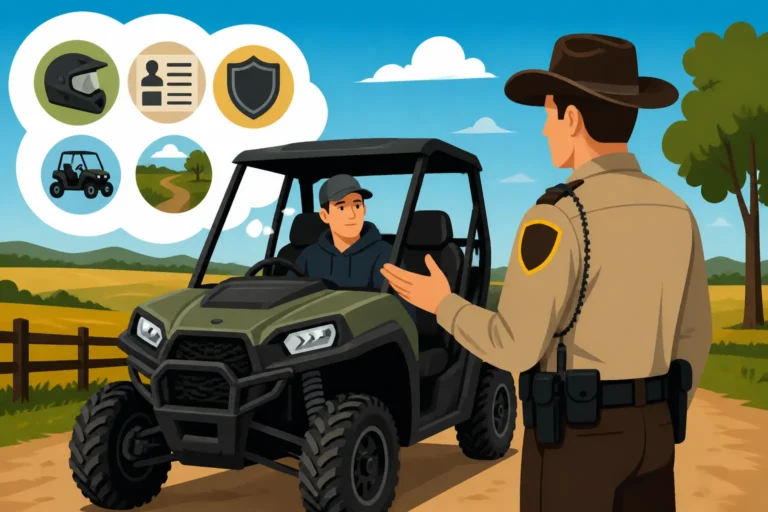
When you're out riding your ATV or UTV in Kansas, whether on private land, a designated riding park, or a rare city street where it's allowed, you should always carry proof of ownership. This typically means your title or registration from your home state. Think of it as carrying your vehicle registration for your car; it's a fundamental piece of documentation. Along with that, always have your personal identification, like a driver's license or state ID. If you've just recently purchased the machine, a bill of sale can also be very helpful, especially if you haven't received your new title yet. Deputies will want to confirm that the machine you're operating actually belongs to you and isn't stolen.
Having these documents readily available can streamline any interaction with law enforcement, should you be stopped or if there's an incident. It helps establish your legitimacy as an operator and owner. The county treasurers in Kansas are the ones who handle titles, and while you won't be titling your out-of-state machine unless you become a resident, their offices are central to understanding ownership here. If you have any questions about documentation, local county treasurer offices can be a good resource, as [Kansas Title Questions Clerks Hear] often involve verification of ownership.
Insurance Considerations
This is another area where Kansas deviates significantly from many other states. Kansas does not have a statewide mandatory insurance law specifically for ATVs or UTVs for general off-road use. This means that if you're riding exclusively on private land or in an ORV park, you aren't legally required by the state to carry insurance.
However, this lack of a statewide mandate is misleading. If you plan to ride your UTV on city streets where an ordinance permits it, that city will almost certainly require proof of insurance. Many local ordinances explicitly state that you must carry liability insurance, similar to what's required for automobiles. Failing to have this could result in a fine or even your machine being impounded. So, while the state itself might not demand it, local rules often do. If your machine is insured in your home state, make sure that policy extends to your travels and specifically covers ATV/UTV operation in Kansas, especially for any road use. It's always a good idea to have some form of coverage, even for off-road riding, to protect yourself from liability in case of an accident. [Kansas Insurance Comes From City Ordinances], not a state blanket law, so always confirm local requirements.
Equipment Checks by Law Enforcement
When you're riding an out-of-state machine in Kansas, especially if you're on or near public roads where you shouldn't be, law enforcement might perform equipment checks. While Kansas doesn't have an extensive list of mandatory equipment for all off-road machines, deputies will still look for basic safety items, especially if they suspect you're violating road use laws.
For example, if you're operating at dusk or night, proper lighting is crucial. Headlights and taillights are generally expected. Functional brakes are a must for obvious safety reasons. If you have a UTV, seatbelts should be in working order and used by all occupants. These are the kinds of common-sense safety features that any law enforcement officer would expect to see on a vehicle. While aftermarket accessories from a brand like SuperATV can significantly enhance your machine's performance and utility, making it a powerful off-road machine, these additions don't automatically confer street-legal status in Kansas. If a city ordinance does allow street use, it will specify the exact equipment required, which can include turn signals, a horn, mirrors, and sometimes even a windshield. [Kansas Equipment Checks by Deputies] usually focus on fundamental safety and compliance with the specific rules of the road or area you're in.
When to Consider Titling Your Machine in Kansas
While you can ride your out-of-state machine in Kansas under specific circumstances, there are times when obtaining a Kansas title might be beneficial or even legally required. This primarily depends on your residency status and how often you plan to use the machine in the state.
Becoming a Kansas Resident
If you make the move to the Sunflower State and become a bona fide Kansas resident, then yes, you will be required to title your ATV or UTV in Kansas. Just like with your car or truck, there's a deadline for new residents to transfer their out-of-state titles to Kansas titles. Typically, you'll have 60 days from the date you establish residency to apply for a Kansas nonhighway title. This is a pretty standard requirement across states to ensure that all vehicles owned by residents are properly recorded within the state's system.
The process involves visiting your local county treasurer's office, bringing your out-of-state title, and completing the necessary paperwork. You'll also pay a small titling fee. It's an important step for integrating into the state, and failure to title your machine within the specified timeframe could lead to penalties. So, if you're packing up your life and heading to Kansas, make sure your ATV or UTV is on your checklist for things to title promptly. You'll find more detailed information on this process in guides like [Kansas Title for a New Resident].
Long-Term Stays or Frequent Use
Even if you don't officially become a Kansas resident, if you plan to keep your out-of-state machine in Kansas for an extended period, or use it very frequently within the state – perhaps at a family farm, a hunting lease, or a seasonal property – considering a Kansas title might simplify things. While not strictly required for non-residents, having a Kansas title can sometimes make interactions with local authorities smoother. It provides a clear, locally recognized proof of ownership that they are familiar with.
Imagine you're staying for several months on a ranch in western Kansas, using your UTV daily for chores. While your out-of-state title is legally valid, having a local Kansas nonhighway title on record means local officials are less likely to question its legitimacy, especially if you ever need to report it stolen or involve local law enforcement. It just eliminates a layer of potential confusion. The cost for a Kansas nonhighway title is quite low, making it a relatively inexpensive way to solidify your machine's status here if you plan to be around for a while. As a matter of fact, [Kansas Charges $10 for a Title], which is a pretty minimal investment for long-term peace of mind.
Local Ordinances Requiring a Kansas Tag
This point ties back to the local street-legal ordinances. If you find yourself frequently riding your UTV on the streets of a particular Kansas city that has an ordinance allowing it, you'll inevitably need to obtain that city's local UTV tag. While some cities might be flexible with an out-of-state title for issuing their city tag, many will prefer or even implicitly require a Kansas title as part of the application process. This ensures that the vehicle is recognized within Kansas's own system before they grant it local road privileges.
It's a practical consideration. City clerks are accustomed to dealing with Kansas titles and registration procedures. Presenting an unfamiliar out-of-state document for a local tag might introduce delays or additional requirements. Furthermore, if you plan on riding on [Kansas Rules for Riding a County Road] under one of the agricultural exceptions, while not requiring a specific title, having consistent Kansas paperwork helps. While Kansas doesn't register ATVs or UTVs for statewide road use, the city-specific tags are a form of local registration, and they want to tie that to a clear ownership record within Kansas. Therefore, if you anticipate heavy use on permissible city streets, it's worth inquiring with that city's clerk about whether a Kansas title would be expected or required as part of their local tagging process.
| Item | On Your Person (Always) | If Riding on Public Roads (City Ordinances) | If Riding in a Designated ORV Park |
|---|---|---|---|
| Photo ID | Yes | Yes | Yes |
| Proof of Ownership | Yes (Title/Registration) | Yes (Title/Registration) | Yes (Title/Registration) |
| Bill of Sale (New Buy) | Recommended | Recommended | Recommended |
| Driver's License | Yes (if on roads) | Yes | No (unless driving to/from) |
| Proof of Insurance | No (Statewide) | Yes (City-Specific) | No (Park-Specific) |
| Kansas City Tag | No | Yes (City-Specific) | No |
| Kansas Park Permit | No | No | Yes (State Park roads) |
| Helmet | Recommended | Recommended | Recommended |
Disclaimer
This article is for general informational purposes only and does not constitute professional advice. Laws, prices and regulations vary by location and change over time. Consult a qualified professional for guidance on your specific situation.