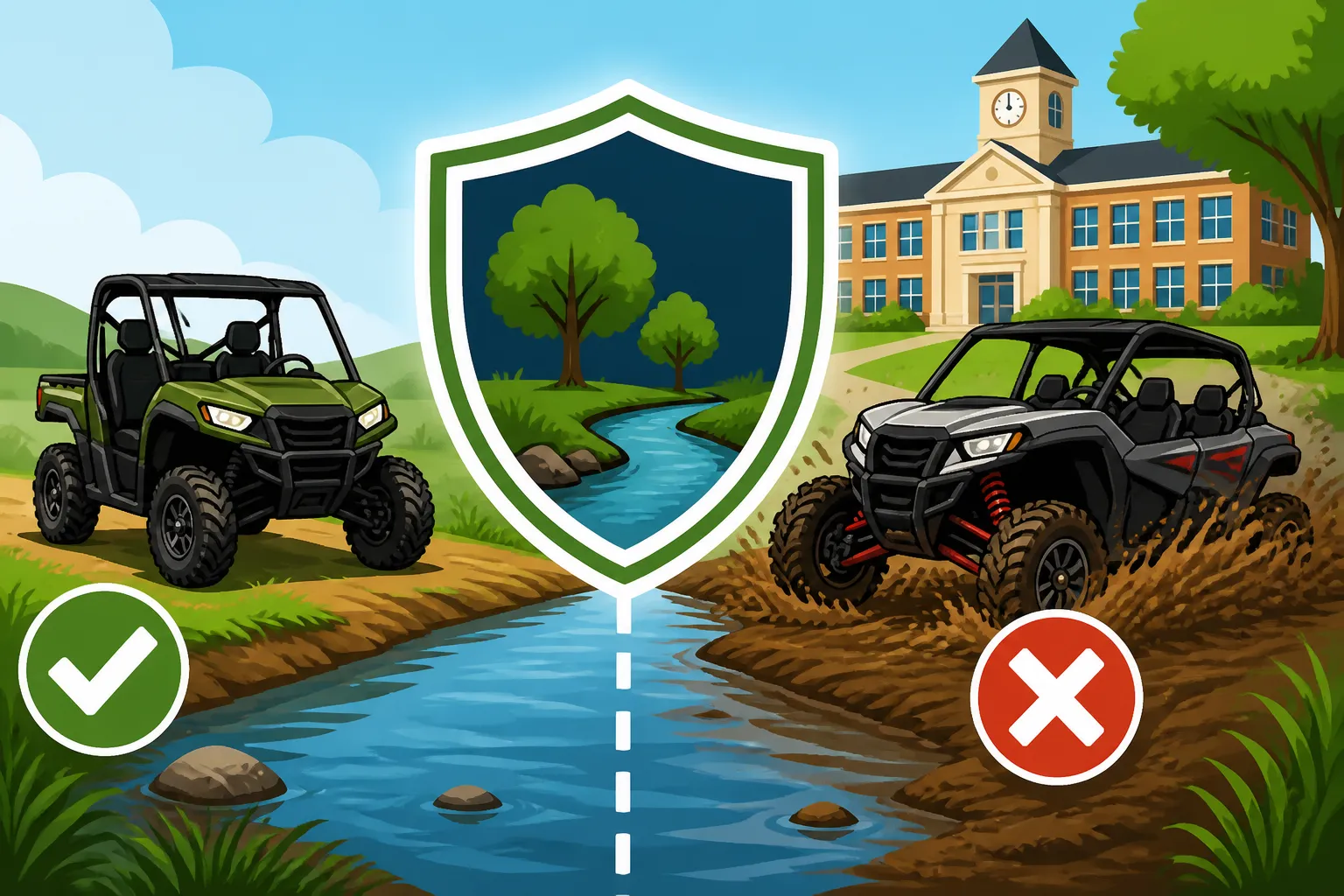
Why 50 Inches Keeps Wide Machines Out of School Creek
School Creek’s width limit can catch UTV owners off guard: a machine may fit Kansas’s legal definition of an ATV and still be too wide for the riding area. The key is to separate statewide vehicle classification from a site’s access rules. Here’s what the 50-inch restriction means, how to check your machine, and why permits or titles do not change it.
Why the School Creek limit is narrower than Kansas’s ATV definition
According to the U.S. Army Corps of Engineers, Kansas City District, School Creek ORV Area has a maximum vehicle width of 50 inches and prohibits side-by-sides and full-size vehicles. The agency describes its paths as intended for narrow, single-rider, handlebar-steered ATVs and motorcycles that suit the terrain. Its published information does not give a more specific environmental or engineering explanation for the cutoff.
That site rule is narrower than Kansas’s statewide definition of an ATV. The Kansas Office of Revisor of Statutes defines an ATV as a motorized nonhighway vehicle, excluding electric-assisted bicycles, that is 55 inches or less in width, has a dry weight of 1,500 pounds or less, and travels on three or more nonhighway tires.
Those definitions answer different questions. Kansas’s legal definition identifies a type of vehicle; School Creek’s limit determines what width the riding area allows. A machine can meet the state definition of an ATV and still exceed School Creek’s maximum. Being titled, owned, or used as an ATV does not make it eligible for a site with a stricter width rule.
| Question | What the rule tells you |
|---|---|
| Does my machine meet Kansas’s ATV definition? | The Kansas Office of Revisor of Statutes uses the ATV requirements of 55 inches or less in width, a dry weight of 1,500 pounds or less, and three or more nonhighway tires. |
| Can I take it to School Creek? | The U.S. Army Corps of Engineers, Kansas City District, sets a maximum width of 50 inches and prohibits side-by-sides and full-size vehicles. |
| Does a title or permit override the site limit? | No. A title or permit does not change the School Creek width restriction. |
The difference matters most for owners of wider sport ATVs, utility quads, and side-by-sides who assume that “ATV” or “off-road vehicle” means access to every off-road area. School Creek’s policy is about the machine’s fit for that area, not merely its paperwork or its general legal category. For a focused explanation of the width cap, see Kansas’s 50-Inch Limit at School Creek. If a side-by-side is part of your riding plans, check Kansas Trails That Allow Side-by-Sides before choosing a destination.
How Kansas’s vehicle classes differ from a trail’s access rules
Width is only one part of how Kansas classifies a nonhighway vehicle. The Kansas Office of Revisor of Statutes defines a work-site utility vehicle as a motor vehicle at least 48 inches wide, weighing more than 800 pounds unladen including fuel and fluids, with four or more nonhighway tires, a steering wheel, and side-by-side bench or bucket seating for at least two people. The definition allows an optional bed or cargo box and excludes micro utility trucks.
That definition is useful when identifying a UTV under Kansas law, but it is not a School Creek admission standard. A vehicle can fit the state definition of a work-site utility vehicle while remaining prohibited at School Creek. The U.S. Army Corps of Engineers, Kansas City District, specifically prohibits side-by-sides there.
The categories also show why width by itself may not settle a machine’s legal classification. Kansas’s ATV definition includes vehicles up to 55 inches wide, while the work-site utility vehicle definition starts at 48 inches wide and also depends on weight, tires, steering, and seating. A vehicle’s design and other characteristics matter. If you are unsure how Kansas categorizes a machine, How Kansas Law Defines a Nonhighway Vehicle explains the distinction.
| Statewide question | Site-access question |
|---|---|
| What kind of vehicle is it under Kansas law? | Is this specific vehicle allowed at this riding area? |
| Does the vehicle meet the applicable legal definition? | Does it meet the area’s width and vehicle-type restrictions? |
| What title or other paperwork applies? | What current rules does the land manager enforce? |
Do not use the manufacturer’s label alone as proof that a vehicle is allowed. “ATV,” “utility quad,” and “UTV” can be used casually in sales listings, but site rules may distinguish vehicles by width, seating, steering, or type. At School Creek, a side-by-side is prohibited even if a particular model’s width seems close to the limit. Check both the site’s written rules and any clarification the land manager provides for your exact machine.
How to check whether your machine is within the limit
Start with the machine’s manufacturer specifications. Look for a stated overall width rather than relying on an informal description such as “compact” or “trail-sized.” If the specification is missing, unclear, or close to the School Creek limit, contact the Corps area before towing there.
A tape measure, including one purchased through Amazon, can help you check the machine yourself. But a home measurement is only a useful first check if you know what points the site uses to judge width. The available School Creek information states the maximum, but does not explain a detailed measurement method. Do not assume that measuring only the tires, body panels, or another particular component will match the Corps’ interpretation.
When asking for clarification, have the make and model available and describe any changes that could affect the machine’s width. Ask whether the area measures the widest part of the vehicle and how it treats installed accessories. Get a clear answer before making the drive if the measurement is close or uncertain.
A practical check looks like this:
- Find the manufacturer’s width specification for the exact model and configuration.
- Compare that figure with the School Creek restriction published by the U.S. Army Corps of Engineers, Kansas City District.
- If the stated width is near the limit, or if the machine has width-changing accessories, contact the area to confirm how it applies the rule.
- If the machine is a side-by-side or full-size vehicle, do not plan on riding it at School Creek; the Corps identifies those vehicles as prohibited.
- If the answer remains unclear, choose a different riding area whose rules expressly fit your machine.
This is a better approach than relying on a seller’s claim that a machine is “small enough” or assuming that a vehicle that fits a state category will fit the trail. For help preparing for a trip, Kansas Trail Conditions Before You Tow covers the value of checking site information before loading up. Riders considering a motorcycle or a narrower ATV can also check Kansas Trails That Allow Dirt Bikes for areas with rules suited to those machines.
Permits, titles, and public-road rules do not change School Creek access
A Kansas title proves ownership; it does not grant access to a particular trail system. The Kansas Department of Revenue says nonhighway titles for off-road vehicles such as ATVs are handled through the local county treasurer’s office under the state revenue department’s authority. The Kansas Office of Revisor of Statutes also requires a purchaser to obtain a nonhighway certificate of title when an ATV or UTV is sold or transferred. For the paperwork side, see Kansas Has No OHV Registration and Kansas Proof of Ownership on the Trail.
Likewise, Kansas does not have a statewide OHV trail permit system or general public-land trail pass, according to the Kansas Department of Wildlife and Parks. That does not mean every public riding area has identical rules or that every machine is allowed at every site. The U.S. Army Corps of Engineers, Kansas City District, sets School Creek’s width and vehicle-type restrictions; those access rules still apply whether or not you have a title or another permit.
State parks have a separate permit situation. The Kansas Department of Wildlife and Parks says that Kansas state parks do not feature ATV or UTV trails, and that non-residents using qualifying unconventional vehicles on allowed improved roads and parking areas within state parks must obtain the applicable state park vehicle permit and unconventional vehicle permit. Those state-park road permits are not a way to gain access to School Creek’s ORV paths. For the distinction, see Kansas Park Permit vs Trail Permit.
It is also worth separating off-road access from limited public-road use. A city ordinance permitting a UTV on certain streets does not make the vehicle generally street-legal or establish access to a Corps riding area. Kansas law prohibits ATVs and work-site utility vehicles on interstate highways, according to the Kansas Legislature. The Kansas Highway Patrol explains that off-road vehicles cannot be made fully street-legal for general operation on public roadways, though limited exceptions exist for certain roads and circumstances.
Before setting out, treat each question separately: identify the machine’s Kansas class, confirm its title and paperwork, check the site’s vehicle restrictions, and confirm any permit requirement with the land manager. For School Creek, the decisive point is straightforward: the Corps’ maximum width is 50 inches, and side-by-sides and full-size vehicles are prohibited. A machine that exceeds the limit needs a different riding destination, not a different title or permit.
Sources
- Kansas Office of Revisor of Statutes — 8-1402a. "All-terrain vehicle" defined (checked November 2, 2026)
- Kansas Office of Revisor of Statutes — 8-1493. "Work-site utility vehicle" defined (checked November 2, 2026)
- Kansas Department of Wildlife and Parks — Kansas State Park Entrance and Camping Fees (checked November 2, 2026)
- U.S. Army Corps of Engineers, Kansas City District — Milford Lake – Kansas City District (checked November 2, 2026)
Disclaimer
This article is for general informational purposes only and does not constitute professional advice. Laws, prices and regulations vary by location and change over time. Consult a qualified professional for guidance on your specific situation.