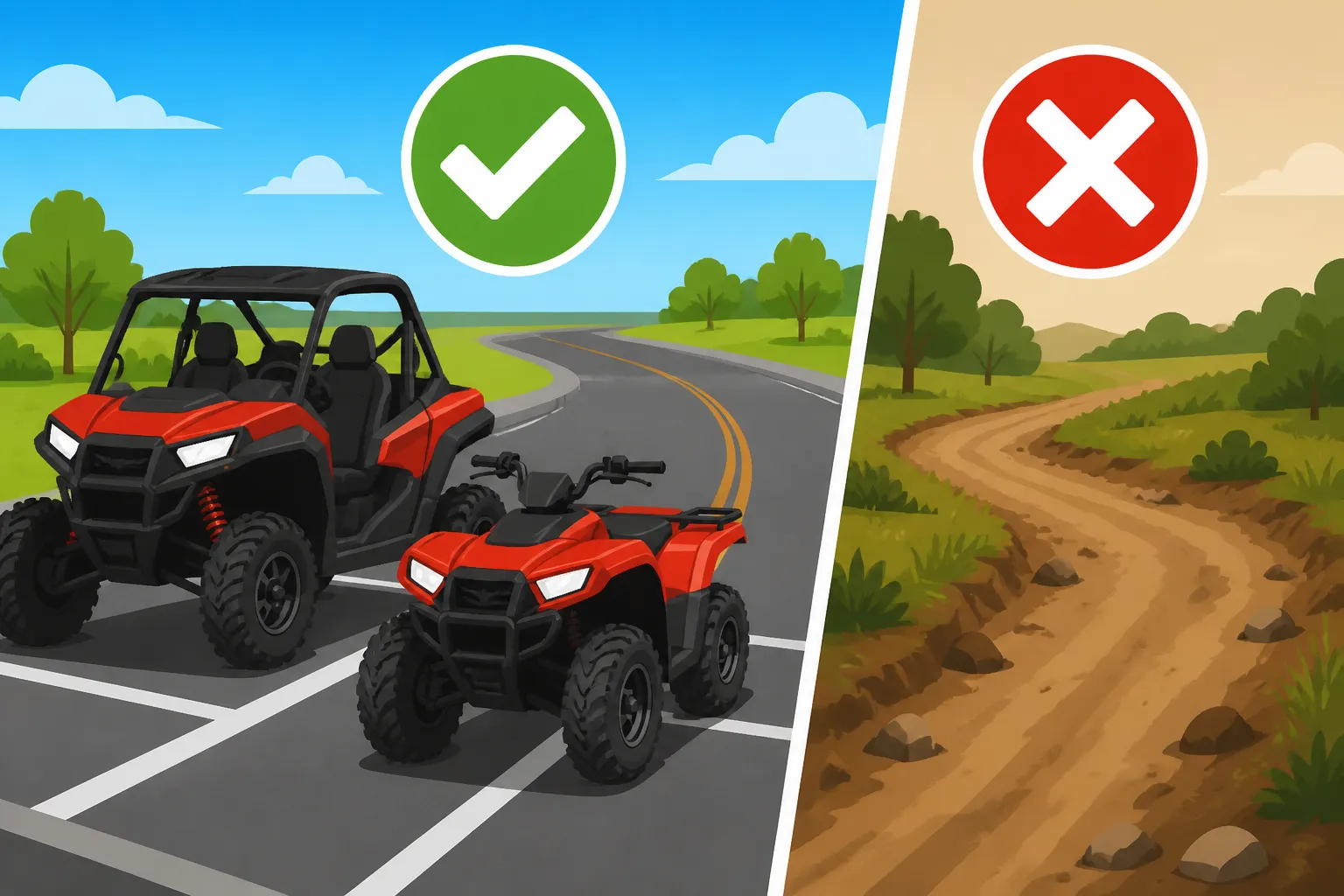
Roads and Parking Areas Only
A Kansas state park sign or map showing roads and parking areas does not mean an ATV or UTV can use every route on the property. The key is to separate permitted travel on improved roads from trail riding, then confirm which permits and operating rules apply to your machine before unloading.
What “roads and parking areas only” means
Kansas does not offer state-park ATV or UTV trail riding. The Kansas Department of Wildlife and Parks says no Kansas state parks feature ATV or UTV trails, and off-road vehicle use is also prohibited on state wildlife areas. A road-use permit is not a trail pass: it does not turn a trail, field, shoreline, or closed route into an authorized riding area.
For a UTV, the permitted use discussed here is limited to allowed improved roads and parking areas within a Kansas state park. The vehicle must stay on routes where that use is allowed, and posted signs or closures still matter. A road that appears on a map may not necessarily be open to UTVs, so check the park’s current directions and ask staff if the route is unclear.
| Question | Practical answer |
|---|---|
| Are there ATV or UTV trails in Kansas state parks? | No. The Kansas Department of Wildlife and Parks says state parks do not feature ATV or UTV trails. |
| Can a UTV use an improved road or parking area in a state park? | Yes, where that use is allowed and the required unconventional vehicle permit is in place, according to the Kansas Department of Wildlife and Parks. |
| Does a park-road permit authorize trail riding? | No. The Kansas Department of Wildlife and Parks describes the permit as applying to allowed improved roads and parking areas, not as a general trail pass. |
| Can an ATV or UTV use a state wildlife area as an off-road riding area? | No. The Kansas Department of Wildlife and Parks says off-road vehicle use is prohibited on state wildlife areas. |
| Is there a statewide OHV trail pass? | No. The Kansas Department of Wildlife and Parks says Kansas has no statewide OHV trail permit system or general public-land trail pass. |
That distinction matters because the word “permit” can sound broader than it is. Here, a permit may let a qualifying vehicle travel on certain park roads; it does not create access to off-road terrain. For a broader explanation of what the state permit does and does not cover, see Kansas Park Permit vs Trail Permit. For restrictions on state-managed department roads and lands, Kansas Machines on Department Roads Only and Kansas Wildlife Area Machine Rules cover related rules.
Also keep state parks separate from other riding areas. A state park’s road-use rules do not automatically apply to a private riding park or a Corps-managed riding area. Each place can have its own access rules, route limits, and entry requirements. Check the rules for the specific property rather than assuming that a permit or permission from one site carries over to another.
Which permits to check before you unload
Kansas does not require annual standard vehicle registration for ordinary ATVs and work-site utility vehicles classified as nonhighway vehicles, according to the Kansas Department of Revenue Division of Vehicles. That does not settle the separate question of park access. In particular, a UTV operating on allowed improved roads and parking areas within a state park needs a specialized unconventional vehicle permit, according to the Kansas Department of Wildlife and Parks.
Nonresidents operating qualifying unconventional vehicles, including UTVs or golf carts, on improved roads and parking areas within Kansas state parks must purchase a state park vehicle permit and an unconventional vehicle permit, according to the Kansas Department of Wildlife and Parks. If you are a Kansas resident, do not assume that the nonresident rule answers every question about your own permit obligations. Confirm the requirements for your vehicle and destination with the park before you travel.
A few separate documents and permissions can be easy to confuse:
- A nonhighway title is proof of ownership. The Kansas Department of Revenue says a purchaser applies through the local county treasurer’s office and must provide a properly assigned title, a manufacturer’s statement of origin, or a bill of sale accompanying the application.
- Standard vehicle registration is not an annual state requirement for standard ATVs and work-site utility vehicles classified as nonhighway vehicles, according to the Kansas Department of Revenue Division of Vehicles.
- A state park vehicle permit and an unconventional vehicle permit are distinct from an ownership title. For nonresidents using qualifying unconventional vehicles on state-park improved roads and parking areas, the Kansas Department of Wildlife and Parks requires both.
- A city permit or license may apply when an ATV or UTV is operated on public streets under a local ordinance. The Kansas Department of Revenue Division of Vehicles says cities that allow this use typically require a local permit or license renewed annually.
A title does not authorize riding in a park, and a park permit does not replace proof of ownership. If you recently bought a machine, handle the title paperwork separately from park-access requirements. Kansas Proof of Ownership on the Trail explains why ownership documents matter, while Kansas Park Permit for a UTV focuses on the park permit question.
Kansas has no general public-land trail pass, according to the Kansas Department of Wildlife and Parks. That means you should not buy or rely on a generic “Kansas OHV pass” as though it automatically opens state land to riding. For a closer look at that distinction, see Kansas Has No State OHV Permit.
Before leaving home, ask the park office which permit applies to your machine, whether the intended road is open to it, and where the permit must be obtained or displayed. The Kansas Department of Wildlife and Parks says permits for unconventional vehicles are sold through park offices, so confirming the process with the destination can prevent a wasted trip. Check current park instructions rather than relying on an old receipt, a seller’s assurance, or a permit from another property.
Operating legally on a permitted route
A park permit is only one part of the trip. It does not make an off-road machine street-legal for unrestricted travel, and it does not override ordinary traffic and safety requirements on roads where the machine is allowed.
Kansas does not allow ATVs or work-site utility vehicles on interstate highways, including the Kansas Turnpike, according to the Kansas Legislature. The Kansas Highway Patrol also explains that vehicles manufactured for off-road or nonhighway use cannot be made fully street-legal for general public-road operation, although limited exceptions may allow use on certain roads, including under qualifying agricultural conditions or local ordinances. A state-park road permit should not be treated as permission to ride on an interstate, a public road outside the park, or any route that is not authorized for your vehicle.
If you are using a permitted route that is also a public road, equipment rules may apply. Kansas law requires a motor vehicle operated on public roads to have a mirror on the left side and an additional mirror inside at the center or on the right side, according to the Kansas Office of Revisor of Statutes. Local rules authorizing UTV use on public streets may add equipment requirements. Confirm the requirements for the particular road and municipality; do not assume a park permit substitutes for them.
Lighting is another point to get right. An ATV operated on a public highway, street, or road between sunset and sunrise must have lights required by law for motorcycles, according to the Kansas State Legislature. The Kansas Office of Revisor of Statutes says headlights are not required to be illuminated at all times; they must be equipped and used when operating on public roads between sunset and sunrise. For more detail, see Kansas Lighting Requirements on a Machine and Kansas Rules for Riding After Dark.
Alcohol rules apply as well. The Kansas Legislature sets the legal blood alcohol concentration limit for operating an ATV, UTV, or other motor vehicle at 0.08% or more. Do not operate a machine after drinking. A route inside a park is not a reason to treat the trip as exempt from safe, lawful operation.
The Kansas Department of Wildlife and Parks Law Enforcement Division enforces public-land regulations and off-road vehicle rules on state-managed public lands. Follow signs, remain on the authorized improved road, and stop if a route is marked closed or its status is uncertain. If a park employee or enforcement officer directs you to leave a route, follow that instruction and ask where vehicle use is allowed instead.
A practical pre-trip check
A short check before loading can resolve most access questions. Confirm the exact destination and machine type, then verify the permitted route and documents with the park. This is especially useful when a group has different machines: a rule that applies to one class may not automatically apply to another.
- Identify the vehicle. Kansas uses different definitions for ATVs and work-site utility vehicles. An ATV definition is based on features such as width, dry weight, and tire configuration; a work-site utility vehicle definition includes features such as width, unladen weight, four or more nonhighway tires, a steering wheel, and side-by-side seating. The Kansas Office of Revisor of Statutes sets those definitions. If you are unsure how your machine is classified, ask the dealer or a knowledgeable county treasurer’s office rather than guessing from the model name.
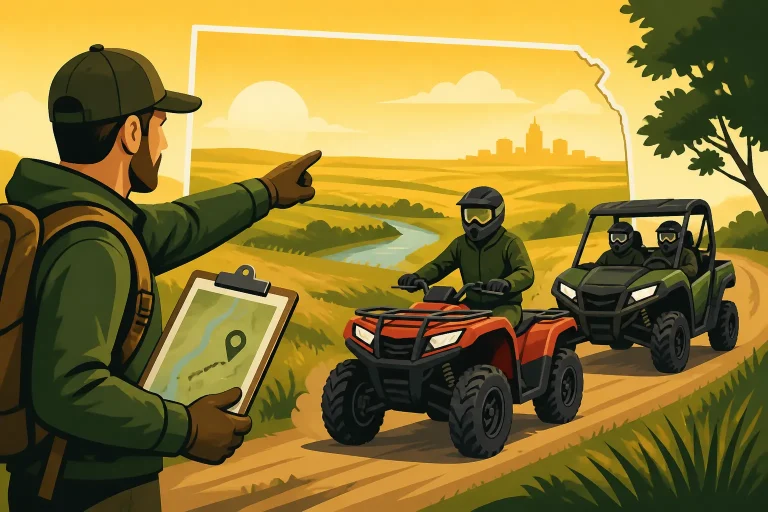
- Call the park you plan to visit. Ask whether your vehicle may use the specific improved road and parking area you intend to reach. Confirm current closures, route limits, permit requirements, and where to obtain the permit.
- Keep the documents separate. Bring the ownership documents you need for the machine and the park permits required for your trip. A title proves ownership; it does not grant trail or park access.
- Check the vehicle before departure. Verify that mirrors, lights, signals, and other required equipment are in working order for the route and time of travel. If the trip could extend into darkness, plan for the applicable lighting requirements before setting out.
- Plan a legal return route. Do not assume a machine can travel from a park to a nearby business or another road. Kansas prohibits ATVs and work-site utility vehicles on interstate highways, and general street use may be limited by state law or local ordinances. Arrange to haul the machine if the connecting route is not authorized.
A paper copy of the park’s route information can be useful if phone service is unreliable. If you need a map sleeve or other way to keep documents dry, Amazon is one place to compare options, but use the park’s own current route information rather than a generic riding map.
When a route is unclear, the safest practical choice is to stop and ask the park office. Do not rely solely on tire tracks, an open gate, or a line on a general map as proof that UTV or ATV travel is allowed. Kansas Permit Questions Parks Hear offers more questions to raise before a visit, and Kansas Department Road Riding Rules is useful when your planned route involves department roads rather than a state-park access road.
Sources
- Kansas Legislature — Chapter HB (checked November 2, 2026)
Disclaimer
This article is for general informational purposes only and does not constitute professional advice. Laws, prices and regulations vary by location and change over time. Consult a qualified professional for guidance on your specific situation.