Kansas Proof of Ownership on the Trail
A Kansas trail ride can raise a practical question: should you carry your ATV or UTV title, and will it get you through a park gate? The answer depends on what you mean by proof of ownership. A title documents ownership; it is not a statewide trail permit, a registration sticker, or permission to ride on a particular property.
What counts as proof of ownership in Kansas
For a Kansas machine that must be titled, the title is the clearest official record of ownership. Kansas titles certain off-road machines as nonhighway vehicles, but a title does not function like a road registration or trail pass. The distinction matters: having ownership paperwork does not automatically make a machine legal to ride in a particular place.
Kansas does not have general OHV registration in the way some states do. That does not mean paperwork is irrelevant. A title can help establish who owns the machine, support a sale or transfer, and clear up questions if a machine’s identity or ownership is challenged. For a closer look at the state’s system, see Kansas Has No OHV Registration and Kansas’s Nonhighway Title Explained.
Common ownership records include:
- Kansas title: The strongest routine document for a titled machine. Check that the owner name and vehicle identification number match the machine.
- Manufacturer’s certificate of origin: Often called an MCO or MSO, it is commonly part of the paperwork for a new machine before a title is issued.
- Signed bill of sale: Useful evidence of a purchase, especially for a private sale, but it is not the same as a title.
- Title application or treasurer’s receipt: Can help show that paperwork is being processed, but may not satisfy every park or official.
- Prior-state title or registration: Relevant for a machine brought from elsewhere. A prior-state document may help establish its history, but Kansas title requirements can still apply.
- Lien or financing records: These can clarify who has a financial interest in the machine, though they do not replace the title as proof of ownership.
| Record | What it can help establish | What it does not automatically provide |
|---|---|---|
| Kansas title | Named ownership and the machine’s identifying information | A trail pass, street access, or landowner permission |
| MCO or MSO | Manufacturer and initial ownership paperwork | Proof that Kansas title steps are complete |
| Bill of sale | Evidence of a transaction between buyer and seller | A replacement title or permission to ride |
| Title application receipt | That an application or transaction was submitted | A guarantee that a park will accept it |
| Out-of-state title or registration | Ownership or prior status in another state | Exemption from Kansas rules or property rules |
A bill of sale is particularly easy to overestimate. It can be helpful if the title is delayed or missing, but it may not settle a dispute about whether the seller had the right to sell the machine. Before buying a used quad or side-by-side, compare the machine’s identification number with the paperwork and make sure the seller’s name and documents make sense together. Kansas Titles After a Private Sale and Kansas Title Without a Bill of Sale cover common paperwork situations.
For a machine that Kansas requires to be titled, do not treat a bill of sale as a long-term substitute for completing the title process. If the transaction is new, check the applicable deadline and required documents with the county treasurer before riding far from home. Kansas title applications are handled through county treasurer offices, and requirements can depend on the machine and how it was acquired. See What to Bring to the Treasurer’s Office to Title if you are still sorting out the paperwork.
What to carry on a Kansas ride
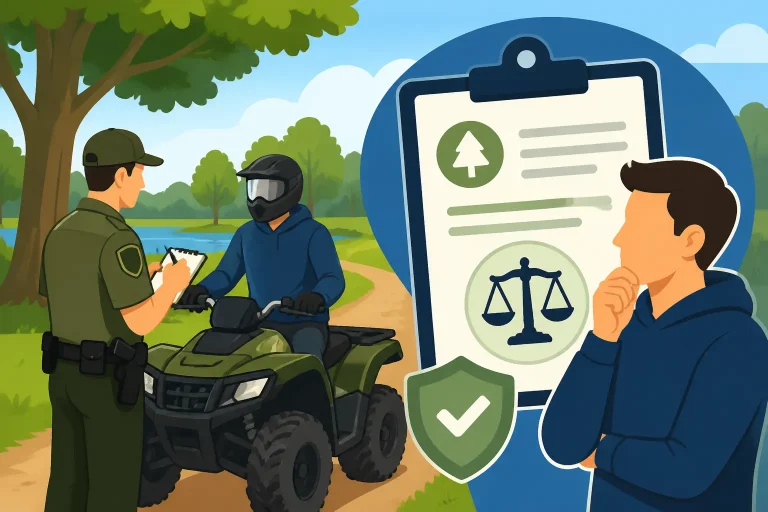
For an ordinary ride, it is sensible to keep enough information available to answer basic questions without carrying your original title in a place where it could be lost, soaked, or stolen. A clear copy of the title and a bill of sale or purchase record can be useful. Keep the original title secured at home unless a specific transaction or official request makes it necessary to bring it.
Do not assume that every agency, park, or private operator will accept a phone photo, photocopy, or receipt as a substitute for an original document. Their policies can differ, and a digital image may be difficult to read or unavailable when a phone loses service or power. If a park says it requires proof of ownership, ask what forms it accepts before loading the machine.
A practical approach is to prepare a small document kit:
- Keep a readable copy of the title or other ownership record.
- Include a bill of sale or purchase receipt if the title is new, pending, or not in your name yet.
- Make sure the machine’s VIN or serial number is legible on the paperwork.
- Store the copy in a waterproof pouch, separate from the original title.
- Save a backup image on your phone, but do not rely on the phone copy as the only record.
- Check the riding area’s rules for any additional documents, permits, or check-in requirements.
A basic waterproof document pouch can help protect copies from rain, mud, and spilled water. If you shop on Amazon or elsewhere, choose one that seals securely and is large enough for folded paperwork. Keep the original title protected at home rather than treating the pouch as a reason to bring the original on every ride.
Ownership paperwork also does not prove that you are entitled to ride on the land. A title identifies the owner; it does not show that the owner of a field, trail, or recreation area has given permission. If you ride on private property, get permission from the landowner or authorized manager. If you use a private riding park, follow its entry and document rules even when Kansas does not require a statewide OHV sticker.
That difference is worth remembering during a roadside conversation, too. A title may answer “Who owns this machine?” It does not answer “Is this road open to this machine?” or “Does this rider have permission to be here?” Kansas’s roadway restrictions and local rules are separate from proof of ownership. Having a Title Does Not Make an ATV Street Legal explains why those questions should not be blended together.
What visitors and riding areas may ask for
A visitor bringing an ATV or UTV into Kansas should not assume that an out-of-state sticker is a Kansas trail pass. Kansas does not require a general state OHV sticker from visitors, but an out-of-state registration or permit does not override Kansas law or the rules of the property where the machine will be used. Visitors should check the rules that apply to their home state as well as Kansas requirements for the machine and intended riding location. See Kansas Rules for an Out-of-State Machine and Kansas Requires No Sticker of Visitors.
The type of riding area matters. Kansas has public and private places with different access systems. Some areas have specific operating limits or permit rules, while private parks set their own admission and safety requirements. A title does not replace any permit that applies to a particular site, and a state permit for a limited use does not necessarily authorize trail riding. For example, a permit that covers designated park roads should not be read as permission to ride off those roads. Kansas Park Permit vs Trail Permit explains that distinction.
Before leaving home, confirm the rules directly with the place where you plan to ride. Ask practical questions rather than just asking whether “papers” are needed:
- Do you require proof of ownership at entry?
- Will you accept a copy, a bill of sale, or a title application receipt?
- Do you require a permit or sticker for this machine or rider?
- Are there machine-size, age, passenger, helmet, or equipment rules?
- Is the area open to this type of ATV, UTV, or dirt bike?
- Do you require proof of landowner permission, insurance, or a signed waiver?
Those questions are especially useful at private parks, where admission policies may include proof-of-ownership checks or other conditions. A park can set entry rules that are different from the state’s general requirements. The fact that Kansas does not issue a general OHV trail pass does not require a private operator to admit every rider or every machine.
Public lands also have boundaries and restrictions. A machine may be allowed on a designated road but not on a trail, field, shoreline, or closed access route. Check signs and posted conditions, and do not treat ownership paperwork as a substitute for confirming where riding is allowed. Kansas KDWP Land Rules for Machines and Kansas Corps of Engineers Riding Areas offer more detail on access rules for different kinds of public riding locations.
When hauling a machine across state lines, bring the ownership documents that fit its status. A recently purchased machine might have a bill of sale and an application receipt instead of a completed Kansas title. A machine titled in another state should travel with its existing paperwork, while its owner checks whether Kansas titling steps apply. If there is a lien, keep the relevant financing information available too. These documents can help explain the machine’s history, but they do not guarantee that a riding area will accept a particular document in place of its own required paperwork.
If your paperwork is missing or does not match
If you cannot locate a title, or the name on it does not match the seller’s documents, pause before relying on the machine for a trip where ownership might be questioned. First compare the VIN or serial number on the machine with the available records. A mismatch can be a clerical issue, an old record, or a more serious problem; do not alter the machine’s identification marking or assume the difference will be ignored.
For a Kansas-titled machine, ask the county treasurer how to correct the record or apply for a replacement. The right path depends on why the paperwork is missing and what records you have. A machine bought without a title may require additional documentation or an affidavit, and the process can differ from replacing a title that was simply lost. See Replacing a Lost Kansas Nonhighway Title, Kansas Nonhighway Affidavits, and Kansas Machines With No Paperwork.
If you have recently bought the machine, contact the seller promptly. Ask for the title or the documents needed to complete the transfer, and keep written records of the request. Do not assume that a text message, online listing, or payment record alone will resolve an ownership problem. If a seller cannot provide a title, ask the treasurer what evidence is acceptable before paying for repairs, accessories, or transport.
If the name on the title is a family member who has died, or if two people are named as owners, the issue may require specific transfer documents rather than an ordinary bill of sale. Avoid riding on the assumption that a family relationship proves the right to use or transfer the machine. Kansas Titles for an Inherited Machine and Kansas Title With Two Owners address those situations.
Before heading to a trail, use a simple readiness check:
- The machine’s VIN or serial number is readable and matches the paperwork.
- You have a copy of the best ownership record available.
- Any sale or title application documents are organized and legible.
- You have checked whether the destination requires particular documents or a permit.
- You have confirmed that the route and riding area allow your kind of machine.
- You have landowner permission wherever the ride crosses private property.
The central point is straightforward: carry useful evidence of ownership, but do not confuse it with permission to ride. A title can establish an important part of the machine’s history. Access depends on the property, the route, and the applicable riding rules.
Disclaimer
This article is for general informational purposes only and does not constitute professional advice. Laws, prices and regulations vary by location and change over time. Consult a qualified professional for guidance on your specific situation.