Snorkels for a Reservoir Crossing
A muddy approach beside a Kansas reservoir can look like a simple shortcut until the water hides a rut, a soft bank, or a sudden drop. A snorkel can help protect an ATV or UTV’s intake and breathing systems in certain conditions, but it does not make deep water safe or turn an unauthorized route into a legal one. This guide explains what snorkels do, how to prepare, and when to turn back.
What an ATV or UTV snorkel does near water
The systems a snorkel may protect
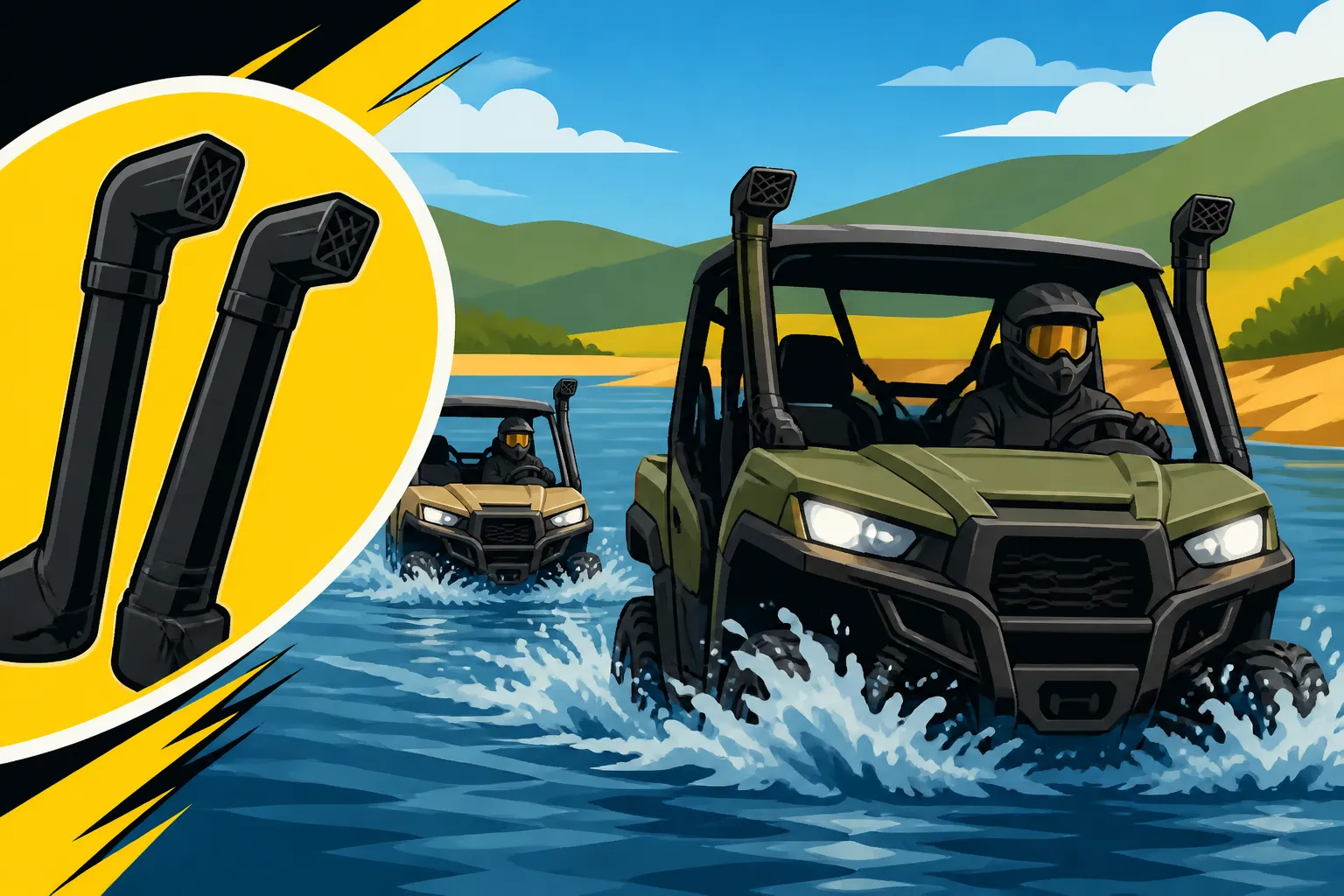
A snorkel kit generally relocates one or more openings that draw air into a machine. Depending on the model and kit, that can include the engine air intake, the continuously variable transmission or CVT intake, and vent lines for components such as the differentials. Raising these openings may reduce the chance of drawing in water when a machine passes through shallow water or splashes through a wet, rutted trail.
The details vary by machine. An ATV’s intake layout is not necessarily the same as a side-by-side’s, and aftermarket kits may handle vents differently. Before buying or installing anything, check the manufacturer’s guidance and the kit’s instructions for your exact year, make, and model. A snorkel designed for one machine may not fit another, even when the machines look similar.
It is also important to distinguish between a raised air intake and a fully waterproof machine. A snorkel does not automatically seal the airbox, electrical connectors, bearings, clutch housing, or every other vulnerable area. Water can still enter through low openings, damaged seals, loose fittings, or a poorly installed extension. If you are planning a ride near a reservoir, treat a snorkel as one part of preparation—not as permission to take on a deeper crossing.
What a snorkel does not make safe
A snorkel cannot show you what is under the surface. A pool of water may conceal a washed-out edge, a large rock, a branch, a deep rut, or soft mud that can trap a machine. Even a crossing that appears calm can have a current or a changing bottom. Water that reaches an ATV’s engine intake can cause severe damage, and water entering a CVT or other components can create problems even when the engine keeps running.
A snorkel also does not make it safe or lawful to ride into a reservoir. Stay on routes that are open to vehicles and follow posted signs, barriers, and land-manager instructions. A shoreline, boat ramp, dam, spillway, or access road should not be treated as an off-road route unless vehicle use is specifically allowed there. For public-land planning, review Kansas Corps of Engineers Riding Areas and check the rules for the particular property before unloading.
This distinction matters around Kansas riding areas such as Tuttle Creek or Perry Lake. Their proximity to water does not mean every wet track, shoreline, or drainage is open to motorized riding. Start with information for the specific area, such as Tuttle Creek ORV Area in Kansas or Perry Lake Spillway Riding in Kansas, then confirm current access and conditions with the managing agency. If the route is unclear, do not assume it is permitted.
How to decide whether a crossing is within your limits
There is no single safe water depth for every ATV or UTV. The machine’s design, the height and location of its air intake, the condition of its seals, the bottom surface, the water’s movement, and the rider’s experience all matter. Your owner’s manual is a better starting point than another rider’s video or a claim that a particular snorkel kit makes a machine “waterproof.”
Before approaching water, stop on firm ground and look for a marked, authorized route. Consider whether you can see the full crossing and the exit. If you cannot judge the depth or bottom, if the water is moving, or if the far bank looks steep or unstable, turn around. A snorkel does not reduce the risk of a machine floating, tipping, losing traction, or becoming stuck.
If a route is permitted but conditions look uncertain, choosing a longer dry route is often the sensible call. That can feel frustrating when a group is eager to keep moving, especially after towing to a riding area, but a few minutes of detouring is better than trying to recover a submerged or immobilized machine.
Preparing your machine before a wet ride
Check the kit and the machine together
A snorkel is only as reliable as its installation. Look over every connection for loose clamps, cracked tubing, damaged seals, or openings that have been left exposed. Confirm that the snorkel terminates where the kit specifies, and make sure the openings are not blocked by cargo, a cover, mud, or gear strapped to the machine. Do not assume a recently installed kit has been tested or sealed correctly.
Inspect the airbox and its drain plugs, and check that service covers are properly seated. Review the routing of CVT and differential vents if your machine has them. Keep hoses away from hot exhaust components, moving parts, and pinch points. If a hose has been extended, kinked, or routed downward in a way that can collect water, it may not work as intended.
An experienced mechanic can be useful if the kit requires changes to the intake, clutch housing, or electrical system. If you are not confident about the installation, ask a qualified shop to inspect it before the ride. A quick visual check in the driveway is easier than discovering a loose connection beside a muddy watercourse.
Make a route and weather plan
Plan the ride around known, authorized trails rather than looking for a shortcut when you arrive. Check Kansas Trail Conditions Before You Tow and contact the park or land manager when recent rain could have changed access. Heavy rain can deepen ruts, soften approaches, cover trail markers, or cause closures. A route that was manageable during a dry weekend may be a poor choice after a storm.
A trail map can help you understand where routes go, but it is not a substitute for current signs or land-manager rules. Some riders use onX Offroad to review mapped routes and orient themselves before a trip. Use it as a planning aid, not proof that a road or crossing is open. Compare what you see on the map with official information, posted restrictions, and conditions on the ground. If the map and signage disagree, follow the posted restriction and ask the property manager.
Before leaving, tell someone where you plan to ride and when you expect to return. Carry a charged phone, but do not rely on cell service near a remote trail or reservoir. A paper map or saved offline map can be useful if reception drops. For a group ride, agree on a turnaround point and make it clear that any rider can call off a crossing without pressure to continue.
Use a simple go-or-turn-back checklist
A short check before reaching water can prevent a rushed decision. Stop well before the edge, keep the group together, and assess the route from a safe, firm location.
| Check | Better conditions | Reasons to turn back |
|---|---|---|
| Route access | Clearly marked and open to motorized vehicles | Signage is missing, unclear, or prohibits entry |
| Water and bottom | Crossing is visible and the bottom appears firm | Depth, current, holes, or footing cannot be judged |
| Entry and exit | Both banks look stable and manageable | Steep, undercut, muddy, or obstructed approach |
| Machine readiness | Intake and snorkel connections are secure | Loose fittings, damaged seals, or unknown setup |
| Weather | Conditions are stable and the route is open | Recent rain, rising water, or a closure notice |
| Group readiness | Riders and machines are prepared to turn around | Anyone feels rushed, uncertain, or unequipped |
No checklist can make an unknown crossing safe. Its purpose is to help you recognize when the information you need is missing. If you cannot confidently assess the route, do not test it with the machine.
Riding near a reservoir without taking needless risks
Keep to open routes and respect closures
Reservoir recreation areas may include roads, trails, boat access, wildlife areas, and private or restricted land close together. A route that looks continuous on a screen may cross a boundary or lead into an area where vehicles are not allowed. Follow signs at the entrance and along the route, and check park-specific rules before riding. The guidance in Kansas Private Park Waivers and Rules is a useful reminder that riding areas can set their own conditions, even when you have visited before.
Do not ride around a gate or closure sign because the ground looks passable. Closures may protect riders from unsafe surfaces, flooding, maintenance work, or environmental damage. Check Kansas Trail Closures After Rain before loading up when the forecast has been wet, and call ahead if the trail status is uncertain. A closed route is not an invitation to find an informal way around it.
Keep distance from water’s edge, especially on soft or sloping ground. A bank that holds a person’s weight may not support a heavy side-by-side, and a tire sliding sideways can quickly put a machine in a dangerous position. Avoid driving along a shoreline simply because it appears firm. If you need to reach another section of an authorized trail, use the designated route rather than improvising across the edge.
Cross only when the route is authorized and clearly manageable
If a legal crossing is visible and conditions are suitable, approach slowly and steadily. Keep your wheels aligned with the route, avoid sudden throttle changes, and do not stop in moving water. Do not follow another rider blindly; their machine, tires, weight, and experience may differ from yours. Let the lead rider assess the crossing, then leave enough space that each person can make an independent decision.
Do not use a snorkel as a reason to go farther into water than you otherwise would. Water can reach vulnerable components that the kit does not protect, and a machine can lose traction or become difficult to control before water reaches the intake. A passenger, cargo load, or towing setup can change how the machine handles. If a crossing demands speed, a running start, or pushing through a place you cannot see, choose another route.
A winch can help with some recovery situations, but it is not a safety plan for entering unknown water. A buried machine may be difficult to recover without suitable anchors and equipment, and a recovery attempt can put people in danger. Read Picking a Winch for a Machine Stuck in Mud before relying on a winch as part of your setup. The safest recovery is often the one you avoid by turning around early.
Protect people as well as the machine
Water crossings can be especially risky for passengers and less experienced riders. Do not ask someone to stand in unstable water to guide a machine, and do not have riders crowd the bank while another vehicle crosses. Keep children and bystanders well back from the route. If the machine becomes stuck, stop and assess the situation before anyone attempts a pull or steps into water.
Wear appropriate protective gear even on a short ride near a reservoir. A helmet, eye protection, gloves, and suitable boots can matter when a machine slips on wet ground or throws debris. Carry basic first aid and let the group know who has it. The goal is not to turn a recreational ride into an expedition; it is to be ready for ordinary problems such as a fall, a cut, a dead battery, or a machine that needs time to cool.
What to do after a wet crossing
Inspect before continuing
Once you are back on firm ground, stop and look over the machine. Check the airbox for water, examine snorkel connections, and look for moisture or unusual noises around the CVT and other areas described in your owner’s manual. If you suspect water entered the engine intake, do not keep restarting the machine. Starting an engine with water inside can make the damage worse. Get qualified service advice before proceeding.
Pay attention to warning lights, rough running, unusual belt behavior, or a change in steering or braking. Mud and water can conceal damage, so a machine that seems to run normally at first may still need inspection. If you are riding with a group, tell the others that you are stopping and give yourself time to check carefully rather than trying to keep pace.
A wet crossing can also leave mud packed around the radiator, suspension, or underbody. Once the machine is safe to clean, follow the manufacturer’s washing and maintenance directions. Washing Sand Out of a Machine covers a related cleanup concern: grit and debris left in the wrong places can wear components or interfere with cooling.
Learn from the ride before the next one
After the trip, note what conditions you encountered and what you would change. If the trail was muddy, the route unclear, or the snorkel installation questionable, address that before the next ride. A simple note in your maintenance log can be more useful than relying on memory months later, especially when several people share a machine.
If water entered a component or you found a loose fitting, have the issue repaired before riding again. Review the kit instructions and owner’s manual, and consider having an experienced technician check the work. Do not treat a successful crossing as proof that the setup can handle deeper water next time. Conditions change, and one uneventful ride does not establish a safe limit.
The practical rule is straightforward: a snorkel may give an ATV or UTV more protection in certain wet conditions, but it cannot replace route permission, a visible and manageable crossing, sound equipment, and a willingness to turn back. Around Kansas reservoirs, staying on open routes and choosing dry ground when conditions are uncertain is often the best way to protect both your machine and the day’s ride.
Disclaimer
This article is for general informational purposes only and does not constitute professional advice. Laws, prices and regulations vary by location and change over time. Consult a qualified professional for guidance on your specific situation.