Kansas Rules Riders Get Wrong
It's incredibly frustrating when you invest in an ATV or UTV, dreaming of open-air adventures or efficient farm work, only to discover the road rules in Kansas are far more complex and restrictive than you first imagined. Many riders assume that because they own a vehicle, they can take it anywhere, or that a title means it's road-legal. This guide will walk you through the most common misunderstandings about off-road vehicle laws in the Sunflower State, helping you avoid costly tickets and keep your riding experiences fun and legal.
The Statewide Road Ban and Its Tricky Exceptions
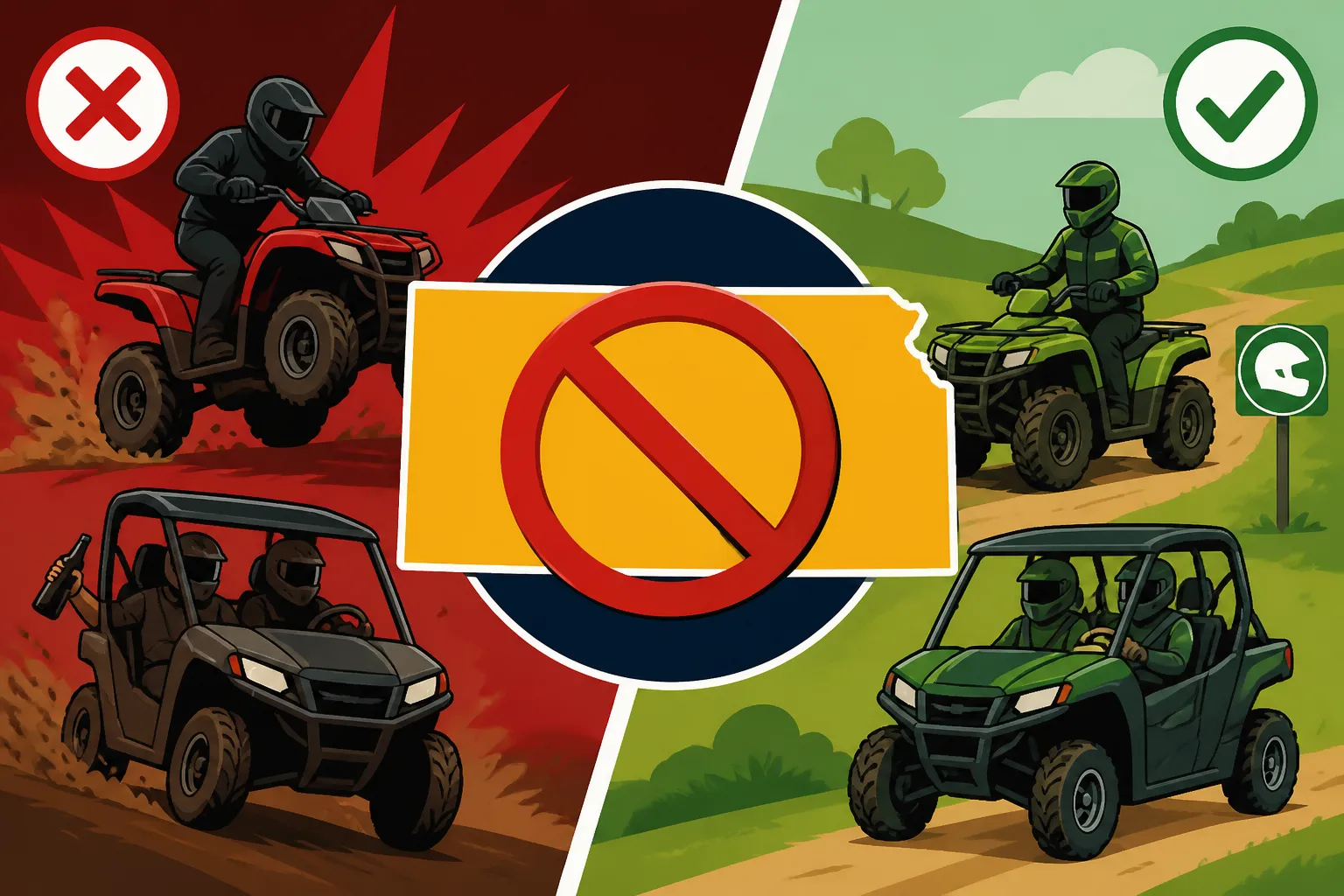
One of the biggest misconceptions Kansas ATV and UTV owners grapple with is the idea that they can simply drive their machines on any public road. The truth is, Kansas law generally prohibits ATVs and UTVs from being operated on public streets, roads, and highways. This isn't just a suggestion; it's a foundational rule, and misunderstanding it can lead to fines and even impoundment. It’s a bitter pill to swallow for many, especially those who come from states with more lenient rules or who see their neighbors occasionally bending the rules. The problem is, that occasional bending can quickly become a serious legal issue.
Why the General Ban Catches Riders Off Guard
Most riders buy their ATVs and UTVs for recreation, farm work, or hunting, not for street commuting. However, the convenience of taking a quick trip down the road to a friend's house, cross a highway to another field, or just run to the corner store often feels irresistible. Yet, this is precisely where many people get it wrong. The general ban applies to nearly all "nonhighway vehicles," which is how most ATVs and UTVs are classified in Kansas. [Kansas Titles ATVs as Nonhighway Vehicles] This classification means they are designed for off-road use, not for sharing lanes with cars and trucks. The state's primary concern is safety, as these machines lack many of the safety features and visibility requirements of street-legal vehicles. It's not about punishing riders, but about preventing accidents on high-speed roads where ATVs and UTVs are simply outmatched.
You might be thinking, "But I see people on gravel roads all the time!" And yes, you probably do. But that doesn't make it universally legal. The law often hinges on specific circumstances and local ordinances, which can be a real headache to navigate. This is where many riders fall into a trap, assuming that what they see others doing must be permissible. It's a classic example of "everyone else is doing it," which unfortunately doesn't hold up in a court of law.
The Agricultural Exception: More Nuance Than You Think
Now, here's where things get really nuanced, and a lot of farmers and rural residents get confused: the agricultural exception. Kansas law does provide an exception that allows ATVs and UTVs to be operated on public roads and highways if they are being used for an agricultural purpose. Sounds simple, right? Wrong. The devil is in the details, and the interpretation of "agricultural purpose" can be surprisingly strict, or at least interpreted differently by various law enforcement officers. [Kansas's Agricultural Exception for Road Use]
For instance, driving your UTV from one field to another to check livestock or move tools is generally covered. Hauling hay bales a short distance down a county road? Likely okay. But what about driving your side-by-side to the local co-op to pick up feed, or taking it to town for parts? This is where the line blurs for many. While it might seem "farm-related," some interpretations define agricultural purposes more narrowly to direct field operations, rather than general errands. It’s easy to assume any trip that supports your farm is an "agricultural purpose," but a deputy might see a trip to the hardware store for personal items as distinctly not agricultural, even if you planned to use the items on your farm later. Always err on the side of caution, and if possible, use a tagged truck and trailer for anything that could be questioned. This exception is not a free pass to drive your machine on the highway whenever you're doing something farm-related; it's specifically for operations that require the use of the machine on the roadway as part of the agricultural work itself.
City Ordinances: Your Best Bet for Limited Road Use
If you're looking to ride your UTV on city streets, your only real hope is a local city ordinance. Kansas state law gives individual cities the authority to create their own ordinances allowing the operation of certain types of off-road vehicles on their streets. This means what's legal in one town, like Louisburg or Scott City, might be completely illegal in a neighboring community. [Kansas Cities That Authorize ATV Street Use] It's a patchwork quilt of regulations, and it can be incredibly confusing. Riders often mistakenly believe if one city allows it, then all cities do, or that county roads are automatically fair game within city limits. This is a crucial mistake.
Before you even think about riding your UTV on a city street, you must check with that specific city's hall or police department. Do not rely on hearsay or what you've seen others do. Many cities that do allow UTVs require specific equipment, such as turn signals, brake lights, headlights, taillights, mirrors, and even a slow-moving vehicle emblem. They might also require a special city permit or tag, proof of insurance, and that the driver hold a valid driver's license. For example, Louisburg requires a special UTV tag and proof of insurance, with specific rules about where the UTV plate must be mounted. These aren't just suggestions; they are legal requirements, and you'll be ticketed if you don't comply. This means your awesome light bar or custom exhaust from SuperATV might be great for the trails, but you'll need additional, specific equipment for city streets if an ordinance exists.
Understanding What Makes Your Machine a "Nonhighway Vehicle"
Another major point of confusion for Kansas riders revolves around the classification of their machines. Many people purchase what they call a "UTV" or "side-by-side" and assume it falls under one blanket set of rules. However, Kansas law actually defines several distinct categories of off-road vehicles, and these definitions dictate how, or if, you can ever legally operate them beyond private property. Knowing where your machine fits is the first step to understanding the rules.
ATVs and Standard UTVs: The Nonhighway Vehicle Class
The vast majority of ATVs (all-terrain vehicles) and standard UTVs (utility terrain vehicles) fall under the legal definition of "nonhighway vehicles" in Kansas. This classification is key because it's what triggers the general ban on public road use. A nonhighway vehicle is generally defined as any motorized vehicle that is manufactured and used exclusively for off-highway use, weighing 2,000 pounds or less, and having a width of 60 inches or less, with a nonstraddle seat. The weight and width thresholds are critical here. Most ATVs and many UTVs easily fit these parameters, especially smaller, sportier models. [How Kansas Law Defines a Nonhighway Vehicle]
When you purchase one of these machines, it comes with a Manufacturer's Certificate of Origin (MCO) that usually designates it for off-road use only. When you go to title it at your county treasurer's office, it will be issued a "nonhighway title." This title is proof of ownership, but it does not mean the vehicle is legal to drive on public roads. [Kansas Nonhighway Title Explained] It's a common mistake for new owners to think, "Well, I have a title, so it must be fine." Unfortunately, that's not how it works. The title merely tracks ownership; it doesn't grant road privileges. It simply confirms your machine is a nonhighway vehicle, reinforcing its off-road-only status by default.
Work-Site Utility Vehicles (WSUVs): A Niche Exception
Kansas has a specific classification for what it calls a "Work-Site Utility Vehicle" (WSUV), and this is where some UTV owners might find a sliver of state-level road legality, though still highly restricted. A WSUV must meet very specific criteria: it must be at least 48 inches wide, weigh more than 800 pounds, have four or more nonhighway tires, a steering wheel, and bench or bucket seating designed for side-by-side passengers. [Kansas Work-Site Utility Vehicles Explained] If your UTV meets these exact specifications, it may be operated on public roads, but only within three miles of a farm, ranch, oil or gas well site, or construction site, and only for purposes directly related to work at that site. This is a very narrow window, and it's not a general permission to ride your UTV around town.
For example, a rancher using a large, heavy-duty UTV from SuperATV equipped with a full cab and a plow attachment might qualify if they're moving it between fields or to a neighboring property for work. However, using that same UTV for a casual ride into the nearest small town, even if it's within three miles, would likely still be illegal if it's not directly related to the work site. The intent and location of use are paramount here. Many riders mistakenly believe that simply having a large UTV that could qualify means they are exempt. Always verify your vehicle's specific dimensions and weight, and understand that the "work-site" aspect is a strict limitation.
Golf Carts and Micro Utility Trucks: Different Rules Entirely
It's also crucial to distinguish ATVs and UTVs from golf carts and micro utility trucks, as these vehicles fall under different legal frameworks in Kansas. A golf cart, for instance, has distinct definitions regarding speed, design, and intended use, and generally has more restrictive road use rules than even a WSUV. [What the Law Counts as a Golf Cart] Micro utility trucks are another class, often imported and designed for very low-speed, specific tasks, with their own set of rules.
The common mistake here is lumping all small, off-road-capable vehicles into one category. Just because it has four wheels and carries people or cargo doesn't mean it's treated the same. A golf cart might be permitted on specific residential streets within a community that has an ordinance, often with strict speed limits (e.g., 25 mph or less) and specific equipment requirements like a slow-moving vehicle emblem. An ATV, even a small one, will almost never be allowed on the same streets as a golf cart. Understanding these distinctions is vital for knowing [Why Road Rules Change With the Machine You Ride] and avoiding accidental violations.
What Riders Overlook: Equipment, Licensing, and Penalties
Even when an ATV or UTV is allowed on a public road under an exception or city ordinance, there's a whole new set of rules regarding equipment, driver qualifications, and insurance that often get overlooked. Many riders simply don't realize the extent of what's required, assuming their machine, as it came from the factory, is good to go. This can be a rude awakening during a traffic stop.
Essential Equipment Beyond the Basics
If you're lucky enough to live in a city with a UTV ordinance, or if you're operating your WSUV under the agricultural exception, your machine needs to meet specific equipment standards. These usually go far beyond what's typically included on a stock off-road vehicle. For operation on public roads, you'll generally need:
- Headlights and Taillights: Functioning headlamps that meet motorcycle lighting standards and taillights visible from a certain distance. This isn't just for night; many ordinances require lights to be on even during the day.
- Brake Lights: Clearly visible when braking.
- Turn Signals: Often required, even if your machine didn't come with them. Kits are available from aftermarket suppliers like SuperATV to add these.
- Mirrors: At least one rearview mirror, and often two, to provide a clear view to the rear.
- Horn: A functioning horn to alert others.
- Slow-Moving Vehicle Emblem: A bright orange triangle emblem on the rear, particularly for WSUVs or golf carts, indicating speeds of 25 mph or less. [Kansas Slow-Moving Emblem Rules]
- Seatbelts: If your UTV has factory-installed seatbelts, they must be used.
- Windshield: Some ordinances may require a windshield.
Many of these items, like turn signals or mirrors, aren't standard on an ATV or a recreational UTV. Riders often think their existing lights are sufficient, but highway-legal requirements are often more stringent. Failing to have proper equipment, even if you're otherwise riding legally, can still result in a ticket. It's a good idea to create a checklist and ensure your machine is fully compliant before heading out.
Driver's License and Insurance: Not Optional
Another major area of misunderstanding is the need for a valid driver's license and insurance. Many assume that because it's an off-road vehicle, the same rules don't apply as they do to cars. This is incorrect. If you're operating an ATV or UTV on any public road in Kansas, even under an exception or local ordinance, you must possess a valid driver's license. The agricultural exception for road use, for example, explicitly states this. [The Farm Exception Still Requires a Driver's License] This means that minors without licenses, or adults with suspended licenses, cannot legally operate these machines on public roads, even for farm work.
Insurance is also a big one. While Kansas doesn't have a statewide mandatory ATV insurance law for off-road use, cities that authorize UTVs on their streets almost always require proof of liability insurance. [Kansas City Insurance Requirements] This protects you and others in case of an accident. Even if your city doesn't require it, carrying insurance is always a wise decision. Imagine getting into a collision on a county road; without insurance, you could be personally liable for significant damages. It's a risk many riders don't consider until it's too late. [Do You Need ATV Insurance in Kansas?]
Penalties for Getting It Wrong
The consequences of misunderstanding or ignoring Kansas's ATV and UTV road rules can range from inconvenient to severe. At a minimum, you're likely looking at a traffic citation, which comes with a fine and potentially court costs. These aren't just minor infractions; they can add up quickly.
More serious situations could involve:
- Vehicle Impoundment: If you're caught riding illegally, especially in a city that prohibits it, law enforcement has the authority to impound your machine. Getting it back means paying towing fees, storage fees, and any associated fines, which can easily run into hundreds or even thousands of dollars.
- Accident Liability: As mentioned, if you're involved in an accident while operating illegally, your insurance might not cover you, leaving you personally responsible for damages, injuries, and legal fees.
- Criminal Charges: Depending on the specific circumstances, such as reckless driving or operating under the influence (yes, DUI laws apply to off-road vehicles on public roads!), you could face criminal charges beyond just a traffic ticket.
- Loss of Privileges: Repeated violations could lead to suspension of your driver's license, even if the initial offense wasn't in a car.
It’s easy to think, "Oh, I'll just get a warning," but law enforcement officers are tasked with upholding safety laws. [Kansas Penalties for Illegal Road Riding] They often see the dangerous consequences of ATVs and UTVs on roads not designed for them. It's far better to educate yourself fully, understand the specific rules for your machine and location, and invest in any necessary modifications from trusted suppliers like SuperATV to ensure you're compliant, rather than facing these steep penalties.
| Kansas Off-Road Vehicle Class | Default Road Legality | Common Exceptions for Road Use | Key Distinguishing Features |
|---|---|---|---|
| ATV (All-Terrain Vehicle) | Generally BANNED | None (statewide); City ordinances may create limited routes in specific towns (very rare). | Straddle seat, handlebars, 3-4 wheels, <= 60" wide. |
| Standard UTV (Side-by-Side) | Generally BANNED | Agricultural Exception; City ordinances (more common for UTVs than ATVs). | Side-by-side seating, steering wheel, >= 4 wheels, <= 60" wide, <= 2,000 lbs. |
| Work-Site Utility Vehicle (WSUV) | Restricted within 3 miles of work site | Must be for direct work-related purpose; Specific equipment requirements apply. | >= 48" wide, > 800 lbs, steering wheel, bench/bucket seating. |
| Golf Cart | Generally BANNED | City ordinances; Very low-speed operation on specific local streets. | Max speed typically 25 mph, distinct design. |
| Micro Utility Truck | Generally BANNED | City ordinances; Low-speed operation for specific tasks. | Small, often imported, distinct design. |
Disclaimer
This article is for general informational purposes only and does not constitute professional advice. Laws, prices and regulations vary by location and change over time. Consult a qualified professional for guidance on your specific situation.