Kansas Riders Must Keep to the Right
Kansas ATV and UTV riders often feel a deep sense of frustration trying to decipher the complex web of rules governing where and how they can operate their machines on public roads. It's not enough to know if your county or city allows UTVs on certain streets; you also need to understand the fundamental traffic laws that apply, like the crucial requirement that Kansas riders must always keep to the right. This guide will meticulously break down what "keeping to the right" truly means for off-road enthusiasts in the Sunflower State, helping you navigate the roads safely and legally.
The Foundational Rule: Why "Keep to the Right" Matters in Kansas
Operating an off-road machine on public roads in Kansas, even where permitted, requires adherence to the same basic traffic laws that govern cars, trucks, and motorcycles. One of the most foundational and universally applied principles is the requirement to keep to the right side of the road. This isn't just a suggestion; it's a legal mandate designed for safety and traffic flow, especially critical when sharing roadways with larger, faster vehicles. Ignoring this rule can lead to dangerous situations and legal repercussions.
Understanding Kansas's General Roadway Principles
Kansas state statutes lay out the general rules for vehicles operating on public roadways. For instance, [Kansas ATV Road Rules Under 8-15,100] outlines many of the core provisions that apply to these unconventional vehicles when they venture onto authorized paths. While ATVs and UTVs have distinct characteristics, when they are allowed to share the pavement or gravel with other traffic, they are generally expected to behave like other motor vehicles. This includes driving on the right half of the roadway, a principle deeply embedded in traffic law to prevent head-on collisions and facilitate smooth traffic flow in opposing directions. Think of it from the perspective of a farmer pulling a wide piece of equipment; they expect oncoming traffic to be on their proper side, just as you should expect the same.
The Legal Basis for Riding on the Right
The mandate to keep to the right isn't unique to Kansas or ATVs; it's a standard rule of the road across North America. When it comes to specific wording, Kansas law often uses phrases like "operate a vehicle as near the right-hand curb or edge of the roadway as practicable." This phrasing is important because it acknowledges that sometimes, strict adherence right up against the very edge might not be safe or possible. However, the general intent is clear: unless conditions absolutely dictate otherwise, your machine should be positioned to the far right. This rule is particularly vital on rural roads, where visibility can be limited, and speeds of other vehicles may be high. It helps to define expectations for all drivers and ensures a predictable pattern of movement, which is the cornerstone of road safety.
Navigating Different Road Types While Keeping Right
The practical application of the "keep to the right" rule can vary slightly depending on the type of road you're riding on and the specific conditions you encounter. Kansas is a state of vast open spaces, and its road network includes everything from dirt trails to multi-lane highways (though ATVs are generally banned from the latter). Understanding how this rule translates to each environment is crucial for any rider.
Gravel and Unpaved County Roads
Gravel and unpaved county roads are where many ATV and UTV riders spend a significant amount of their time in Kansas. When you're on these roads, the "keep to the right" rule is paramount. Dust, loose gravel, and limited visibility due to terrain or vegetation can make these roads treacherous. Sticking to the far right side of the road, even if it feels like you're hugging the ditch, reduces the chance of a head-on encounter with an approaching vehicle, be it a pickup truck, another UTV, or a tractor. Sometimes, the road itself may be poorly maintained, with potholes or washouts on one side. While you might need to briefly move slightly off the absolute edge to avoid such hazards, your default position should always be as far right as safely possible. Consider how much room a large farm truck needs, or even a semi on a township road; by keeping right, you're not forcing them into a dangerous situation.
Paved County Roads and Shared Lanes
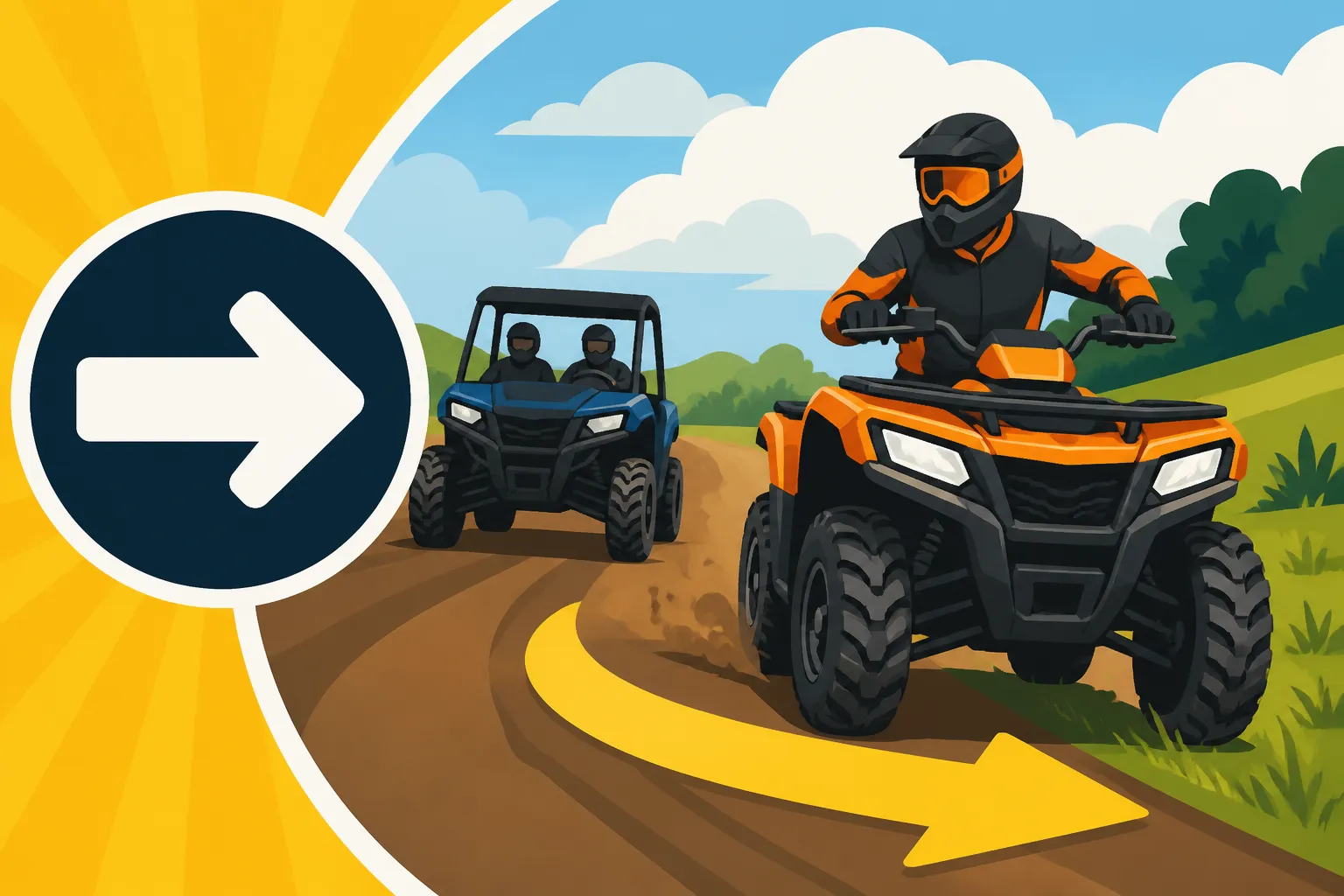
While less common for direct ATV use, UTVs are increasingly being allowed on paved county roads through local ordinances. On these roads, especially those that might be narrower or lack clear shoulders, keeping to the right means maintaining a predictable lane position. If the road is wide enough for two vehicles to pass comfortably, you should occupy the right-most portion of the right lane. If the road is very narrow and essentially a single lane for both directions (which can happen in very rural areas), then "keeping to the right" implies pulling over or exercising extreme caution when meeting oncoming traffic, almost as if you're a bicycle sharing the road. In all cases, drivers behind you will expect you to be on the right, and moving erratically into the center of the lane can cause confusion and potential accidents. Products like turn signals and wide-angle mirrors from companies like SuperATV can greatly enhance your ability to maintain a safe, predictable position and communicate your intentions to other drivers.
Crossing State Highways and Intersections
Even when a state highway is generally off-limits for continuous riding, [Crossing a State Highway in Kansas] is often permissible to get from one legal riding area to another, or to access an adjacent property. When making such a crossing, the "keep to the right" rule still applies as you approach and navigate the intersection. You must approach the intersection on the right side of the road you are currently on, and if you are turning, you must yield to through traffic and make your turn into the proper lane, which is generally the rightmost lane available for your direction of travel. Never cut across multiple lanes or make a wide turn from the left lane unless specifically marked to do so. These brief moments on higher-speed roads are particularly risky, and strict adherence to traffic laws, including staying to the right, is critical for your safety.
The "As Near the Right As Practicable" Clause
Kansas law, like many states, doesn't demand you scrape the paint off your machine on the white line. Instead, it often uses the phrase "as near the right-hand curb or edge of the roadway as practicable." This isn't a loophole to ride wherever you please, but rather a realistic acknowledgment that road conditions, obstacles, and safety sometimes require minor adjustments from the absolute far edge. However, the interpretation of "practicable" is often up to an officer's discretion and should always prioritize safety.
Interpreting Practicality in Diverse Conditions
What does "practicable" truly mean? It implies what is reasonable and safe under the specific circumstances. On a pristine, wide paved road with a clear shoulder, "as near the right as practicable" means you should be very close to that edge. However, on a heavily rutted gravel road, or one with a soft shoulder that could cause you to lose control, moving a foot or two inward might be "practicable" to maintain stability and prevent an accident. The key is that your deviation from the extreme right should be minimal, temporary, and only for legitimate safety reasons. It's not an excuse to ride in the middle of the road just because you feel more comfortable there. The burden of proof would typically fall on you to justify why you weren't further to the right.
When Obstacles or Road Conditions Dictate Your Position
Imagine you're riding your UTV down a county road, staying diligently to the right, when you encounter a significant pothole or a patch of deep mud right at the edge of the road. In such a scenario, it would be impracticable to maintain your exact position. Briefly moving slightly left to safely navigate around the hazard is permissible. The same applies if there's a parked vehicle, a disabled farm implement, or road construction blocking the far right portion of the lane. Once you've safely passed the obstruction, you are expected to return to your position as near the right as practicable. This brief adjustment must be done with extreme caution, checking for oncoming traffic and signaling if you have proper road-legal turn signals installed, perhaps from a SuperATV kit, to clearly communicate your intentions to anyone behind you.
| Road Condition / Obstacle | Default Position | "Practicable" Adjustment | Return to Right |
|---|---|---|---|
| Smooth Paved Road | Far Right Edge | N/A | N/A |
| Deep Pothole at Edge | Far Right Edge | Briefly move left to clear | Immediately |
| Soft/Broken Shoulder | Far Right Edge | Shift slightly left for stability | As safe to do so |
| Farm Equipment Ahead | Far Right Edge | Move left to pass safely (if legal) | Immediately |
| Blind Curve/Hill Crest | Far Right Edge | Maintain position, extreme caution | N/A |
| Loose Gravel/Dust | Far Right Edge | Shift slightly left for traction | As safe to do so |
Safety Implications of Riding to the Right
Adhering to the "keep to the right" rule isn't just about following the law; it's a critical component of rider safety. ATVs and UTVs are often smaller and less visible than typical road vehicles, and they handle differently. Positioning your machine correctly on the road significantly reduces the risk of accidents, especially in areas where other drivers might not expect to encounter off-road vehicles.
Maximizing Visibility for Other Drivers
When you stay to the far right, you create the maximum possible distance between your machine and oncoming traffic. This gives drivers more time to see you, react, and adjust their own position. On a long, straight stretch of Kansas highway, your machine might be a small speck in the distance. If you're drifting towards the center, it could be misjudged, or a driver might not realize you're there until it's too late. Moreover, staying right also means that vehicles approaching from behind have more room to pass you safely. Many off-road vehicles don't have the same acceleration or top speed as cars, so providing ample space for others to maneuver around you is a courtesy and a safety measure. [Kansas Lighting Rules After Sunset] are particularly important to consider here, as enhanced lighting makes your machine more visible, even when positioned correctly.
Minimizing Collision Risk on Rural Roads
Rural roads in Kansas often have blind spots, curves, hills, and little to no shoulder. Large farm equipment frequently uses these roads, and dust can reduce visibility dramatically. In such environments, the consequences of a head-on collision are severe. By consistently riding as far to the right as practicable, you are actively minimizing your exposure to these risks. This practice is especially important when cresting a hill or entering a blind curve, where you have no idea what might be coming from the other direction. Furthermore, [Kansas Rules for Riding a County Road] stipulate that you are sharing these roads with full-sized vehicles, and they expect you to be on your side. Even if you're riding a nimble machine, it's always best to be predictable and maintain your designated lane position to prevent accidents.
Local Ordinances and Exceptions to the Right-Hand Rule
While "keep to the right" is a statewide standard, the context in which ATVs and UTVs can even be on roads is heavily influenced by local ordinances. Many cities and counties have taken advantage of state law allowing them to open certain streets to UTVs. These local rules can sometimes add layers of complexity, but the fundamental principle of keeping right almost always remains.
How City Rules Might Influence Riding Position
When a city passes an ordinance allowing UTVs on its streets, it's typically done with a set of specific conditions. [Kansas Cities That Opt In by Ordinance] will often detail speed limits, equipment requirements, and specific roads where operation is permitted. However, it's exceedingly rare for a city ordinance to override the fundamental "keep to the right" rule. In fact, most ordinances will explicitly state that UTVs must adhere to all state traffic laws, which includes the right-hand rule. For instance, if a city allows UTVs on its two-lane main street, you'll still be expected to stay in the right-hand lane, as far right as practicable. If the street has parking, you might be expected to ride alongside the parked cars, but still within the rightmost lane of travel.
Specific Scenarios: Agricultural Use and Noxious Weed Crews
There are specific statutory exceptions where ATVs and UTVs might legally operate on state and county roads, even when generally prohibited. [Kansas Agricultural Trips on a 65 mph Road] describes one such exception for legitimate farm purposes. In these cases, the requirement to keep to the right is just as strong, if not stronger, due to the potentially slower speeds and larger sizes of agricultural machines. The law states that machines used for agriculture must travel "as near the right-hand side of the roadway as practicable." Similarly, crews engaged in noxious weed control or other specific municipal or utility tasks are often granted permission to operate their machines on road rights-of-way. Even then, they are typically expected to maintain safe road positions, which includes keeping right, especially when actively moving along the roadway. They might use warning lights or flags to enhance visibility, but their operational zone still demands a predictable path.
Consequences of Failing to Keep Right
Ignoring the "keep to the right" rule is not just a minor infraction; it can have serious legal and financial consequences. Law enforcement officers are trained to enforce basic traffic laws, and off-road riders are not exempt. Understanding the potential penalties can help reinforce the importance of safe and legal operation.
Potential Legal Penalties and Fines
If a law enforcement officer observes you failing to keep to the right on a public road where your ATV or UTV is otherwise permitted, you could be cited for a traffic infraction. [What a Deputy Asks at a Rural Traffic Stop] will often include proof of your legal right to be on that road, and then they will assess your adherence to traffic laws. The specific fine for such an infraction can vary, often depending on the county or city, but it can be a noticeable hit to your wallet. More importantly, accumulated traffic violations can sometimes impact your standard driver's license record, even if you weren't operating a standard vehicle. Beyond a simple fine, repeat offenses could lead to more severe penalties or restrictions on your right to operate your machine on public ways.
Increased Liability in an Accident
Perhaps the most significant consequence of failing to keep to the right is the increased liability you face in the event of an accident. If you are involved in a collision and it's determined that you were not on your proper side of the road, you would likely be found at fault, or at least bear a significant portion of the blame. This can have profound financial implications, covering damages to other vehicles, medical expenses for injured parties, and potential lawsuits. Even if your machine is insured (which [Kansas Insurance Comes From City Ordinances] only requires in specific cities, but is always a good idea), your insurance company may deny coverage or pay a reduced amount if you were operating illegally at the time of the crash. Always remember that even on a quiet county road, you are operating a machine that can cause significant harm, and adherence to all traffic laws, including staying to the right, is your responsibility.
Disclaimer
This article is for general informational purposes only and does not constitute professional advice. Laws, prices and regulations vary by location and change over time. Consult a qualified professional for guidance on your specific situation.