Kansas Game Retrieval by Machine
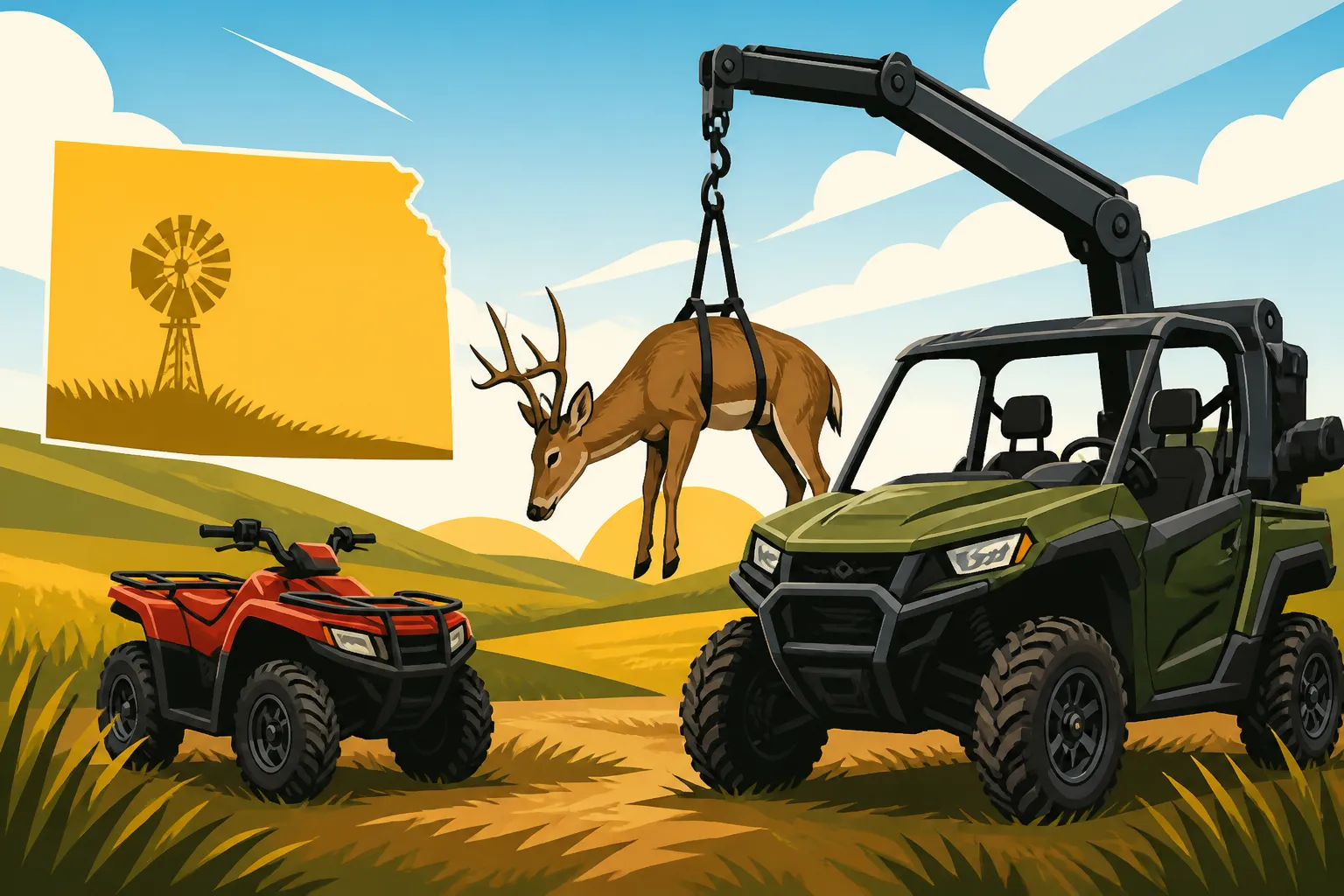
Recovering harvested game with an ATV or UTV can save time and effort, but owning a machine does not give you permission to drive wherever an animal falls. In Kansas, the answer depends on where you are, who controls the land, which routes are open, and the current hunting rules. Here’s how to think through those separate permissions before you ride.
Separate hunting permission, land access, and machine use
A lawful hunt does not automatically authorize an ATV or UTV trip to retrieve game. You need to consider three questions separately: Are you authorized to hunt there? Are you allowed to enter the land with a machine? And is machine travel allowed on the route you plan to use?
A Kansas hunting license or permit addresses hunting eligibility and authorization. It does not, by itself, grant access to private property or make off-road travel permissible on public land. Likewise, having a titled machine or a permit required for a particular recreation area does not establish hunting access. For background on those distinctions, see Kansas Hunting License and Land Access and Kansas Hunting Land Access by Machine.
The landowner or managing agency matters. On private property, get permission from the person who controls the land before entering, including to retrieve an animal. Ask specifically whether you may drive a machine, where you may drive it, and whether the permission covers the route to the animal. Permission to hunt does not always mean permission to drive across a field, through a gate, or along a pasture road. Written permission can help avoid misunderstandings; [Kansas Landowner Permission Forms] explains why it is useful to document access.
On public land, follow the rules for that specific area. A road that appears drivable is not necessarily open to motorized use, and a hunting purpose does not automatically create an exception. Wildlife areas and other public properties may limit machines to designated roads, parking areas, or signed routes. Check the area’s current rules before you head out, and do not assume you can leave a road to reach an animal.
| Situation | What to check before retrieval | Practical approach |
|---|---|---|
| Private land | Permission to enter and to use a machine on the intended route | Ask the landowner or authorized manager before driving in |
| Public wildlife area | Posted restrictions, designated routes, and area-specific rules | Stay on routes expressly open to motor vehicles |
| Walk-in hunting property | Access conditions and any limits on vehicles | Treat “walk-in” as no machine access unless an authorized person confirms otherwise |
| Roadside or adjoining property | Road rules and permission for any off-road portion | Do not leave the road or cross onto property without authorization |
| Hunting across state lines | Kansas hunting requirements and the rules for the place where the animal lies | Follow the laws and access terms for the location, not just your home state’s rules |
A walk-in hunting access arrangement should not be treated as permission to drive in. These properties are intended for access on foot unless the property’s rules or the person managing it explicitly say otherwise. Check Kansas Walk-In Hunting Access Rules before planning a machine-assisted recovery.
Where a machine may be used to retrieve game
Private land
Private land may offer the simplest route for machine retrieval, but permission still has to cover the actual use. Before the hunt, ask whether you may use an ATV or UTV to retrieve game and identify any limits: a particular field entrance, an established lane, a maximum number of machines, or a requirement to avoid crops and livestock.
If an animal crosses a boundary, do not assume your hunting permission follows it. Contact the landowner or authorized occupant of the adjoining property and request access before entering. A machine can cause more damage than a person walking, particularly in wet ground or planted fields, so respect any restrictions even when the route seems short. If permission is denied or you cannot reach the right person, do not drive across the property to recover the animal.
The same care applies to leased hunting ground. A lease may define who can hunt, when they may enter, and what vehicles are allowed. Confirm that the person granting access has authority to approve machine use and that the agreement covers the route you intend to take.
Public land and wildlife areas
On public land, the managing agency’s rules control. Motorized access may be limited to signed or designated routes, and an animal’s location does not necessarily make an otherwise closed route available. Follow posted signs and area instructions, and contact the manager if the rules are unclear.
The distinction between driving on a designated road and driving off-road is important. A route may be open for ordinary access but still not permit travel across grass, through timber, or around a barrier. Do not move a gate, drive around a closure, or treat a nearby parking area as permission to continue overland. Rules for machines on department-managed land are covered in Kansas Machines on Department Roads Only.
If you hunt on walk-in property within or near a larger public area, check both sets of restrictions. A public road or parking lot nearby does not mean a machine can be driven onto the walk-in parcel. Similarly, an open route through one part of an area does not necessarily permit travel into a different parcel.
Roads and the last stretch
A road may get you closer without getting you all the way to the animal. Before you leave it, confirm that the land beyond the road is open to you and that machine use is allowed there. If the final stretch crosses private land, a closed public-land area, or a restricted field, stop and choose a lawful alternative.
Do not assume a road’s appearance tells you its legal status. A farm lane, section road, levee, or access track can be subject to different ownership and use rules. For road-use questions, see Kansas Rules for Riding a County Road and Kansas Rules for Riding Farm Ground. Those rules are separate from the hunting rules that apply to taking or transporting game.
A practical retrieval plan
Planning retrieval before the shot can prevent a rushed decision when the animal is down. Consider the distance, terrain, weather, available help, and the access rules for the property. If the only feasible route depends on driving somewhere you have not been authorized to go, make another plan before hunting.
- Confirm the land and its boundaries. Know where the animal may cross a property line and who to contact for access. Do not rely on a map alone to establish permission.
- Ask about machine use directly. Confirm that the permission includes an ATV or UTV, not just hunting or walking access. Clarify where the machine may travel and where it must be parked.
- Check current area rules. For public land, review the restrictions for that specific area and look for signs at access points. If a rule is unclear, contact the manager before relying on an exception.
- Choose the route before riding. Use only a route you are authorized to travel. Avoid soft ground, standing crops, sensitive habitat, and livestock areas unless the land manager has approved the route.
- Follow hunting and tagging requirements. Handle, identify, and transport the game as required by the current Kansas rules for the species and season. Do not assume a machine changes those requirements. For deer-specific considerations, see Kansas Deer Season and Machine Use.
- Ride with care and keep the load secure. Use a suitable trailer or other lawful method for the machine and the animal. Keep the load stable, avoid blocking roads, and do not overload the vehicle or tow equipment beyond its rated capacity.
- Stop if access is uncertain. If you encounter a closed route, boundary, gate, or sign that conflicts with your plan, do not improvise around it. Contact the landowner or area manager, or retrieve the animal by a permitted route.
A small recovery kit can make a planned trip more manageable. Useful items may include gloves, a rated strap, a first-aid kit, a light, and a way to communicate when cell service is limited. If you shop through Amazon or another retailer, check the equipment’s stated capacity and intended use rather than choosing by appearance. A strap meant for light cargo is not automatically appropriate for vehicle recovery.
Avoid using a machine to drag an animal across a route where driving is prohibited. Even a short trip can damage land, disturb other hunters, or create a safety problem. Where machine access is not authorized, consider carrying the animal by hand, using a hand-pulled cart on an allowed route, or asking the landowner or manager what options are acceptable.
Visitors, permits, and common mistakes
Visitors must follow Kansas hunting rules and the access conditions that apply where they hunt. A license from another state does not replace any Kansas license or permit required for the hunt. Nor does a home-state vehicle sticker or registration establish a right to ride on Kansas land. For visiting hunters, Kansas Visitors From Missouri, Kansas Visitors From Nebraska, Kansas Visitors From Oklahoma, and Kansas Visitors From Colorado offer related context.
Do not confuse a hunting permit, a machine document, and a park or recreation permit. They serve different purposes. A hunting permit does not grant land access; a machine title does not authorize off-road travel; and a recreation permit, where required, does not override a property’s hunting or vehicle restrictions. Check the requirements that apply to the exact location and activity. Kansas Has No State OHV Permit explains why a general state off-highway sticker should not be mistaken for permission to ride wherever you choose.
Common mistakes include assuming that a downed animal creates an automatic right to cross a boundary, treating walk-in access as vehicle access, and driving off a designated route because the destination is close. Another mistake is relying on a past visit or a neighbor’s understanding of the rules instead of checking current signs and instructions. Rules can differ from one property or area to another.
If a recovery plan changes in the field, pause and reassess. Contact the landowner or manager when possible. If access cannot be confirmed, use a route that is clearly allowed or seek another lawful way to retrieve the animal. The inconvenience of asking is smaller than the consequences of unauthorized entry, property damage, or a violation.
Disclaimer
This article is for general informational purposes only and does not constitute professional advice. Laws, prices and regulations vary by location and change over time. Consult a qualified professional for guidance on your specific situation.