Kansas Requires No Sticker of Visitors
Kansas does not require out-of-state ATV and UTV riders to buy a statewide off-highway sticker just to ride in the state. That can simplify a trip, but it does not grant access to every road or trail. The important distinction is between a Kansas-wide sticker and the rules of the specific place where you plan to ride.
What Kansas Requires From Visiting Riders
Kansas does not require visitors to buy a general state OHV sticker before riding an ATV or UTV. There is no statewide trail sticker for visitors to obtain, and you do not need to show a sticker from your home state in order to satisfy a Kansas statewide sticker requirement.
That does not mean every machine can be ridden anywhere. A sticker, registration card, title, or permit can serve different purposes, and none automatically gives you permission to enter private land, ride a restricted road, or use a particular riding area. Think of the statewide sticker question as just one part of trip planning.
The same distinction applies to residents. Kansas generally does not register ATVs and UTVs through a statewide off-road sticker system, but a machine’s title and its right to be used on a road are separate matters. A title proves ownership; it does not make an ATV or UTV street legal. For the ownership side, see Kansas Has No OHV Registration and Kansas’s Nonhighway Title Explained.
Visitors should also avoid assuming that their home-state paperwork settles every Kansas issue. A permit or registration from another state might be relevant to that state’s rules, but it does not override Kansas road restrictions or a riding area’s own entry conditions. Conversely, Kansas’s lack of a statewide sticker does not necessarily cancel requirements imposed by a private park or another agency.
For a practical summary:
| Question | What to expect in Kansas |
|---|---|
| Do out-of-state riders need a Kansas statewide OHV sticker? | No general statewide OHV sticker is required. |
| Must you show a sticker from your home state? | Kansas does not require a home-state sticker as a substitute for a Kansas sticker. |
| Can you ride any trail or road without a permit? | No. Access and operating rules depend on the location and the type of route. |
| Does a title make a machine street legal? | No. Title status and road-use permission are separate. |
| Can a park or private area set its own rules? | Yes. Check entry, equipment, age, and permit requirements with the site. |
The safest takeaway is simple: you do not need to buy a Kansas statewide OHV sticker as a visitor, but you still need to know who controls the ground you want to ride and what that location allows.
A Kansas Sticker Is Not the Same as a Park Permit
The word “permit” causes confusion because it can refer to several unrelated things. A statewide trail permit would be a general pass for riding off-road across a state system. Kansas does not sell that kind of statewide OHV trail sticker. A park permit, entry pass, or private riding-area admission is different: it applies to a specific place or activity.
For example, Kansas state park rules may involve a permit for using an unconventional vehicle on park roads. That is not a statewide trail pass, and it does not create access to an OHV trail network. The permission is limited to the use and location described by the applicable rules. Check with the park office before unloading, especially if you are bringing a side-by-side or golf cart. Kansas Park Permit vs Trail Permit explains the distinction in more detail.
Likewise, a riding area operated by a private business can charge admission or require a waiver, wristband, helmet, or other conditions. Those are site rules, not a Kansas statewide sticker requirement. A visitor may not need a state OHV sticker and still need to pay or register at the gate of the place they chose.
Do not treat a permit from another state as a universal pass. If your home state issues an OHV decal, it may be required for riding there or at certain destinations there. It does not automatically provide access to Kansas private property, a Kansas public riding area, or a Kansas road. The destination’s rules decide what documents or fees apply at that location.
Before the trip, identify what kind of place you plan to ride:
- Private land: Get permission from the landowner or authorized manager. A state sticker does not replace permission.
- A private off-road park: Check the park’s current admission process and rider rules. Bring whatever the park requires.
- A designated public riding area: Confirm that riding is open, which machine types are allowed, and whether the area has local conditions.
- A state park: Ask the park office about vehicle use, park permits, and which roads or areas are open to your machine.
- A public road: Check whether that specific road is open to that class of vehicle. A park pass or title does not make a prohibited road legal.
Keep the categories separate when you plan. A Kansas title is not a trail pass, a city tag is not a state OHV sticker, and a private park admission receipt is not permission to ride on nearby public roads. Kansas Has No State OHV Permit and Kansas Park Entrance Permits and What They Cover cover related distinctions.
Where You Can Ride Matters More Than Your Home-State Sticker
The biggest practical question for a visitor is usually not whether to buy a Kansas sticker. It is where the machine can legally be ridden. Kansas has limited public OHV riding compared with states that operate extensive public trail systems, so a route that looks promising on a map may not be open to ATVs or UTVs.
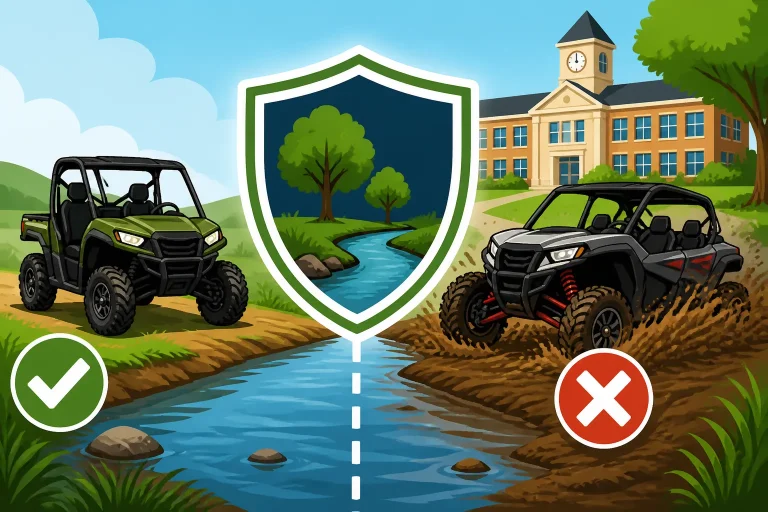
Public ownership does not automatically mean public riding access. A wildlife area, state park, reservoir property, or other public land may allow only certain types of vehicle use, on designated roads or in specified areas. A location can be open for hiking, fishing, or camping while still prohibiting off-road riding. Do not assume that an unmarked dirt track is an authorized trail.
Kansas state parks are not a general OHV trail system. Some vehicle use may be allowed on roads under applicable rules, but that is not the same as permission to leave the road and ride cross-country. Ask the park office what applies to your machine and destination. Kansas State Parks Have No OHV Trails and Kansas Department Road Riding Rules are useful context before choosing a state park.
Some Corps of Engineers areas have designated OHV opportunities. Access depends on the specific riding area, its rules, and whether it is open when you arrive. Confirm the current operating status and machine restrictions with the local office or area manager. A Corps riding area is not a blanket authorization to ride around the entire reservoir or on other Corps land. Kansas Corps of Engineers Riding Areas can help you understand the difference between an authorized area and surrounding property.
Private off-road parks are another option, but their rules can differ substantially. One may allow side-by-sides while another limits width or excludes certain machine types. Parks can set their own requirements for helmets, passengers, age, insurance, noise, spark arrestors, camping, and admission. Check the park’s rules directly before driving a long distance. A rider who arrives with the wrong machine or missing safety equipment may be turned away even though Kansas does not require a statewide OHV sticker.
Landowner permission is essential on private ground. A field road, pasture lane, hunting property, or farm track does not become open to visitors just because it appears on a map or because other riders have used it. Get clear permission from the person who controls the property and confirm where you may ride. Kansas Landowner Permission Rules and Kansas Trespass Law for Riders address the access issue.
Road use is a separate question again. Kansas has rules that distinguish ATVs, UTVs, golf carts, and other vehicle classes, and local ordinances can affect use on city streets. A public road may be closed to your machine even if the land on either side is open to riding. Never infer that a route is legal just because another rider is using it, or because your home state allows similar road use. See Kansas ATV Road Rules Under 8-15,100 and Kansas UTV Street Legal Rules by City before planning a road connection between riding areas.
What to Check Before You Cross the Kansas Line
A little preparation can prevent wasted travel and avoidable disputes. Start with the riding destination, not the sticker question. Call or check the destination’s official information to confirm that it is open and that your machine is allowed. Ask about any permit, pass, waiver, equipment rule, or age restriction that applies to visitors.
Use this checklist:
- Confirm the site and its boundaries. Find out exactly where riding is allowed. A park entrance or public-land boundary does not mean all nearby roads and trails are open.
- Check the machine limit. Ask whether the area allows ATVs, dirt bikes, and side-by-sides, and whether it has width, tire, or other vehicle restrictions.
- Ask about current conditions. Closures, weather, maintenance, events, or seasonal rules can affect access. Confirm before towing to the site.
- Ask what the fee or permit covers. Determine whether it is for admission, a park road, camping, or another use. Do not treat one pass as permission for a different activity.
- Review safety and equipment rules. Check helmet, passenger, lighting, noise, spark-arrester, and age requirements with the land manager or park.
- Carry proof of ownership and permission where appropriate. A title or bill of sale can help establish ownership, while a landowner’s permission or site admission record can help show authorized access. They serve different purposes.
- Plan legal travel to the riding area. A trailer is often the straightforward way to move a machine between a lodging location and an off-road site. Do not ride on a road unless that route is authorized for your machine.
- Check the return route as well as the destination. A legal riding area does not make the connecting road legal, and a route that crosses private property still requires permission.
If a site tells you that it requires a sticker, ask what the sticker is for and who issues it. It may be a park-specific decal, a private park pass, or a local road-use tag rather than a Kansas statewide OHV sticker. Clarifying the issuer and the area covered can prevent buying a pass that does not apply to your trip.
For an out-of-state machine, keep your paperwork organized. Bring the ownership document you have, such as a title or other relevant proof, and make sure the vehicle identification number is legible. A riding-area employee or law enforcement officer may have a reason to ask about ownership or lawful use, but that is not the same as a Kansas visitor sticker requirement. If you are unsure what proof is appropriate for your situation, contact the site or a Kansas county treasurer before traveling. Kansas Proof of Ownership on the Trail has more on what to keep available.
If you plan to ride on roads, research the exact vehicle classification and local rules in advance. Kansas road access can depend on the machine’s class, the type of road, and the local jurisdiction. A vehicle that is permitted on a particular city street may still be prohibited on a county road, state highway, or another city’s streets. Four Off-Road Classes Kansas Law Treats Differently explains why the machine’s legal class can matter.
Common Visitor Mistakes to Avoid
The most frequent misunderstanding is thinking that “no Kansas sticker” means “no rules.” It only answers whether the state requires a general OHV sticker from a visitor. It does not establish that a trail exists, that a road is open, or that a landowner has granted permission.
Another mistake is assuming a home-state sticker gives reciprocal access. Kansas does not require visitors to present an out-of-state sticker in place of a Kansas one, because there is no general Kansas statewide OHV sticker to replace. But your home-state decal does not grant special rights in Kansas. Follow the rules of the specific property and route.
Visitors also sometimes confuse a title with a registration. Kansas’s nonhighway title system is about ownership records. A title does not authorize road riding, supply a park pass, or prove that a machine meets a local road-use requirement. Similarly, an out-of-state registration does not itself override Kansas restrictions. If you are transporting a machine rather than riding it on public roads, the title and ownership documents can still be useful, but they do not substitute for access permission.
Do not rely solely on a map app or an old forum post to identify trails. Maps may show roads that are closed to off-highway vehicles, private tracks, or routes that are not maintained for riding. Check with the property manager or landowner, and verify any current notices before departure. This matters particularly when a planned route crosses multiple jurisdictions or connects a public area to a private park.
Finally, avoid treating a state park permit as an OHV trail pass. A permit tied to park-road use is limited to that activity, and a park may restrict where an unconventional vehicle can travel. If the purpose of your trip is trail riding, choose a site that explicitly allows it. If the purpose is to use a machine on a park road, confirm the permit and route rules with that park.
A simple rule of thumb keeps the planning clear: Kansas does not require a statewide OHV sticker from visiting riders, but the destination controls access. Confirm the place, the machine, and the permitted use before you load the trailer.
Frequently Asked Questions
Do visitors need a Kansas ATV or UTV sticker?
No general Kansas statewide OHV sticker is required for visitors. A particular park, private riding area, or local jurisdiction may have separate requirements, so check the rules for your destination.
Does Kansas accept my home-state OHV sticker?
A home-state sticker is not needed as a substitute for a Kansas statewide sticker. It also does not grant access to Kansas land or roads. Follow the requirements set by the riding area and the applicable Kansas rules.
Can I ride on Kansas public land without a sticker?
Not automatically. Public land may be closed to off-road riding or may permit vehicles only on designated roads or in particular areas. Check with the land manager before riding.
Does a Kansas park permit let me ride trails?
Not necessarily. A permit may cover a specific type of use, such as vehicle travel on park roads, rather than off-road trails. Confirm exactly what the permit covers with the park office.
Should I carry ownership documents while riding?
It is sensible to keep relevant ownership documents available, especially when traveling with an out-of-state machine. Documents can help establish ownership, but they are not a trail pass or permission to ride on restricted land.
Disclaimer
This article is for general informational purposes only and does not constitute professional advice. Laws, prices and regulations vary by location and change over time. Consult a qualified professional for guidance on your specific situation.