Kansas Trails With Rock Sections
A Kansas ride can change from packed dirt to exposed limestone, ledges, and loose rock faster than you expect—especially after rain or heavy traffic. That matters when you’re choosing a trail, setting up an ATV or UTV, and deciding whether your group has the right experience. This guide explains where rocky riding is worth seeking out and how to prepare for it.
Where to Find Rocky Riding in Kansas
Kansas has fewer public off-road options than many riders expect, so it helps to distinguish a dedicated rock park from a riding area that simply has rough or stony ground. For rock-focused riding, Kansas Rocks Recreation Park near Mapleton is the clearest place to start. Perry Lake Spillway is another area riders may consider for uneven, rocky terrain, but the experience and access rules are different.
Kansas Rocks Recreation Park near Mapleton
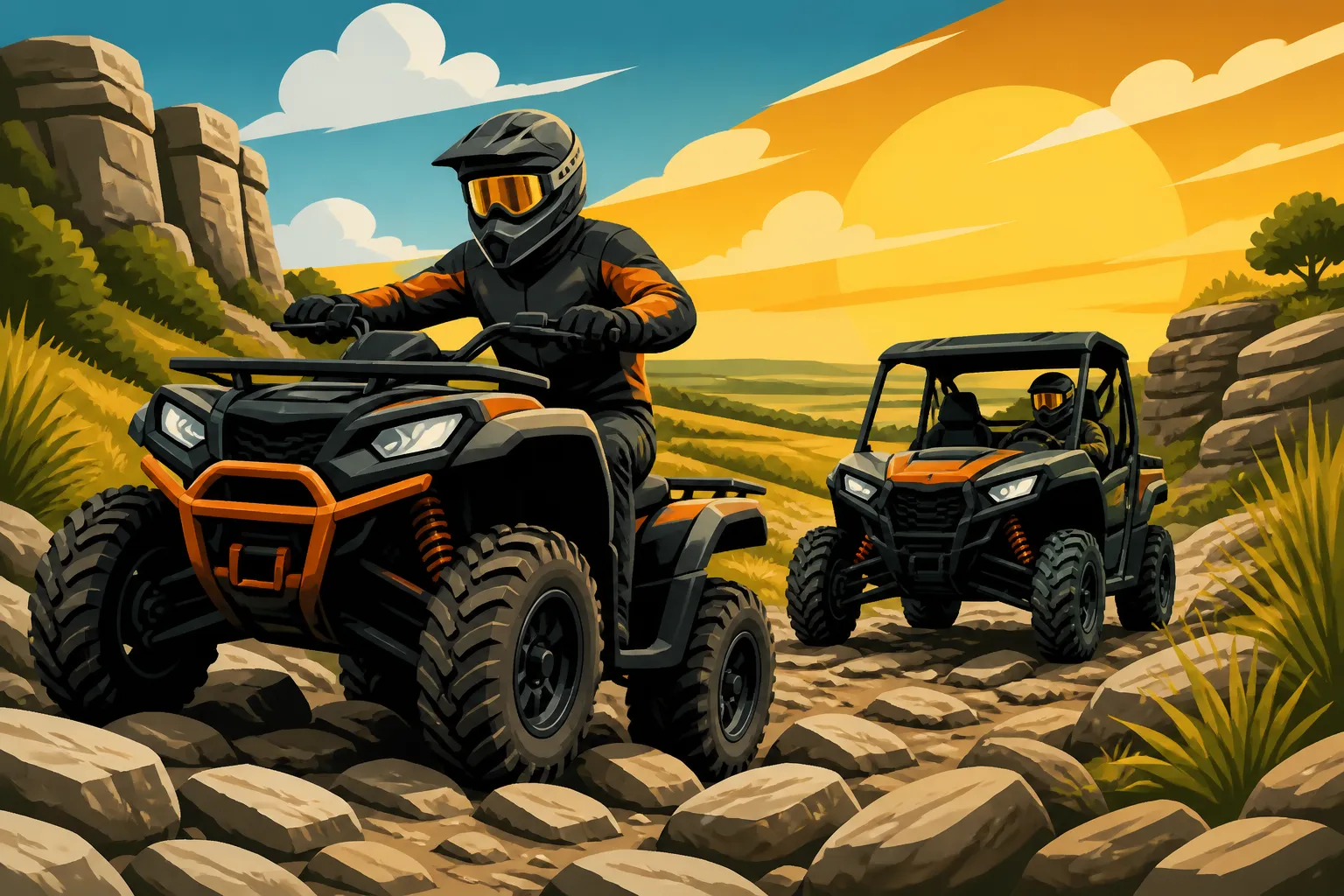
Kansas Rocks Recreation Park is a private riding area in Bourbon County, near Mapleton. Its terrain is known for rock features and challenging sections, making it a better fit for riders who want to practice picking lines over rocks than for someone seeking only a smooth, flat trail. The park’s route options can make it possible for a group with mixed abilities to ride together, but “beginner-friendly” should not be treated as “risk-free.” A short rock ledge can still be difficult if you approach it with too much speed, the wrong line, or a machine that lacks suitable clearance.
Think about your group before you unload. A rider on a small ATV may be comfortable on a route that feels awkward for a long, wide side-by-side. Conversely, a UTV with a long wheelbase may have difficulty cresting a sharp breakover point even if it has plenty of power. If the park’s current route descriptions or rules are not clear, ask staff which sections suit your machine and experience level before choosing a loop. Start conservatively; it is much easier to move to a harder route than to recover a machine from an obstacle that exceeds your ability.
The park is private, so its own operating schedule, admission process, age rules, equipment requirements, and trail conditions matter. Confirm those details before towing from Kansas City, Wichita, or farther away. Private parks can set rules that differ from rules for public land, including requirements for helmets, waivers, sound levels, and passengers. For a broader look at the park’s terrain and setting, see Kansas Rocks Recreation Park.
Perry Lake Spillway and Other Rough Terrain
Perry Lake Spillway is a different kind of outing. It is a Corps-area riding location near Perry Lake, and riders may encounter rocky or uneven sections. It is not the same as a private rock-crawling park with a broad network of deliberately challenging obstacles. Expect conditions to vary by route, weather, maintenance, and recent use. Before you head out, check the local riding information and any posted restrictions rather than assuming every visible track is open.
A rough surface can be harder than it looks. Loose stones may move under a tire, and embedded rock can catch a skid plate or sidewall. Water, mud, and fallen leaves can hide the shape of a rock step. A trail that seems manageable while walking it may feel different when you are steering a loaded machine around a tight turn. If you are unsure, stop in a safe spot and inspect the line on foot before committing.
Other Kansas riding destinations may offer uneven ground without being rock-focused. Tuttle Creek and School Creek, for example, are worth evaluating based on their posted rules, trail conditions, and machine restrictions—not on an assumption that they offer the same kind of rock obstacles as Kansas Rocks. School Creek’s width limit can also make it unsuitable for some side-by-sides. Check Kansas Trails With Rock Sections alongside Kansas Trails That Allow Side-by-Sides when narrowing down a destination.
| Riding area | What to expect | Best planning question |
|---|---|---|
| Kansas Rocks Recreation Park near Mapleton | Private riding area known for rock features and varied challenge | Which routes fit your machine, skill level, and group? |
| Perry Lake Spillway | Uneven terrain that may include rocky sections | What routes are open, and what are the current conditions? |
| School Creek ORV Area | A public riding option with machine restrictions, including a width limit | Does your machine meet the posted limit? |
| Tuttle Creek ORV Area | A Corps-area option; confirm the trail character and current access details | Are the routes suitable for your riding goals and machine? |
For a wider overview of local options, compare [Kansas Riding Areas With Rock Sections] with Kansas Trails Open Year-Round. Those listings are a starting point, not a guarantee that a particular obstacle or trail will be open on the day you arrive.
Choose a Trail That Fits Your Machine and Skill
A rocky route is not automatically a good match for every ATV or UTV. Tire size, ground clearance, wheelbase, protection underneath the machine, and the rider’s comfort with slow technical riding all affect how a trail feels. A machine that is capable on paper can still be a poor fit for a particular obstacle if its setup or the rider’s experience does not suit the conditions.
Understand the Difference Between Rough and Technical
“Rocky” can describe anything from scattered stones on a trail to steep ledges and rock gardens that demand careful line choice. Before a ride, ask what the description actually means. Is the trail merely uneven, or does it include climbs, abrupt steps, narrow passages, or places where a rollover could have serious consequences? If park staff or a trail operator uses terms like “advanced,” “technical,” or “rock crawling,” ask what those words mean for your specific machine.
A beginner on a sport ATV may be able to handle a rough trail at a controlled pace but have little experience navigating a ledge. A first-time UTV driver may be surprised by how much a long wheelbase affects approach and departure angles. Even experienced riders can get caught out when rocks are wet or when a rut channels the machine toward an awkward line. Ride to the conditions in front of you, not to the difficulty label you saw online.
A useful way to judge a route is to separate three questions: Can the machine physically clear the obstacle? Can the rider control it at the needed speed? And is there a safe way to stop, turn around, or recover if the attempt does not go as planned? If one answer is uncertain, choose another line or skip the obstacle. A ride is not a test of pride.
Match the ATV or UTV to the Terrain
An ATV is narrow and maneuverable, which can help on tight routes, but the rider must still manage balance and avoid abrupt throttle or steering inputs. A side-by-side offers a seated position and more room for passengers or gear, but its width and wheelbase can make narrow rock sections difficult. The relevant question is not simply whether a park allows your machine; it is whether the specific trail is suitable for its dimensions and turning clearance.
Before leaving home, inspect tires, brakes, steering, and underbody protection. Look for cuts or bulges in tire sidewalls, loose steering components, leaking fluid, and damage to skid plates. Make sure recovery points are usable and that any winch or recovery gear is in working order. A winch can help in some situations, but it does not make every obstacle safe to attempt. Recovery itself can be dangerous if people stand in a cable’s path or if the machine is pulled from an unstable angle.
If you are comparing classes of machines or trying to understand why the same trail feels different in an ATV and a side-by-side, Kansas Trails That Allow Side-by-Sides is a useful companion topic. For a practical overview of rock-specific protection and setup, see [Choosing Tires for the Rock at Mapleton] and [Skid Plates for Rock Park Ledges].
Prepare for Rock Sections Before You Leave
The most stressful part of a rocky ride often begins before the wheels reach the trail: a group is unsure which route to take, a phone has no service, or someone discovers a damaged tire miles from the parking area. A little preparation helps reduce those avoidable problems. It does not remove the risks of off-road riding, but it gives you more options when conditions change.
Plan the Route and Check Access
Confirm the riding area’s access details, hours, machine restrictions, and any closures before you tow. For a private park, review its rules directly. For a public or Corps-area site, check the managing agency’s posted information and local notices. Do not assume that a previous visit, an old map, or a track recorded by another rider means the route is open now.
Use a reliable map and download what you need before leaving home. onX Offroad can help riders review routes and prepare for areas where cell service may be limited, but a navigation app should be one tool in your plan—not the only one. Save offline information when available, carry a backup power source, and bring a paper map or written directions for unfamiliar areas. Mark the meeting point and the route back to the parking area before the group spreads out.
Tell someone who is not riding where you plan to go and when you expect to return. If you change destinations, let that person know. For rides near rural areas such as Mapleton or the roads around Perry Lake, this simple step is especially useful when a breakdown or delayed return prevents you from checking in on time. Kansas Trail Conditions Before You Tow and Kansas ATV Trail Map Downloads can help you build a more complete pre-trip routine.
Pack for a Slow, Demanding Ride
Rock riding can be slow work. Riders may spend more time navigating, stopping to inspect lines, and helping one another than they would on an easy dirt loop. Bring water, food, basic first aid supplies, gloves, eye protection, and weather-appropriate layers. A small repair kit should match your machine and your ability to use it; carrying tools is less helpful if no one knows what they fit.
Pack recovery equipment that suits the group and learn how to use it before you need it. A tow strap, suitable shackles, and a properly mounted winch may be useful, but recovery gear must be compatible with the machine and used with care. Keep bystanders well away from a recovery operation, and never wrap a strap around a component that is not designed as a recovery point. If a machine is unstable or someone is injured, do not turn a routine recovery into a second emergency.
If the route is unfamiliar, ride with someone who knows the area or choose an easier loop first. Keep enough space between machines to avoid being struck by rocks kicked up by the vehicle ahead. Stop in a place where following riders can see you, and do not block a blind approach to an obstacle. For general preparation beyond rocky terrain, [What to Pack for First Aid on a Long Ride] and [Kansas Trail Etiquette Locals Expect] offer helpful planning reminders.
Ride Rock Sections With Control
On rocky terrain, smooth and deliberate riding is usually more useful than speed. A machine can lose traction or make an unexpected movement when a tire climbs a rock, drops into a gap, or slides off a ledge. Staying alert, choosing a line early, and being willing to stop or turn around can help keep a difficult section manageable.
Use a Careful Line and Pace
Approach an obstacle slowly enough to assess it, but avoid stopping where the machine could roll, slide, or block the trail. Look for a route that keeps the machine stable and avoids sharp impacts to tires or underbody components. On an ATV, shift your body as needed to stay balanced and follow the manufacturer’s operating guidance. In a UTV, keep seat belts fastened and hands and arms inside the vehicle. Passengers should not lean out to “help” steer or shift the machine.
If you cannot see where a rock step leads, stop before it and check. A spotter can help describe the route, but establish clear signals before moving. The driver should be able to stop if communication is lost. Keep the spotter out of the vehicle’s path and away from a potential rollover zone. Never let the pressure of a waiting group push you into an obstacle you have not evaluated.
Be especially cautious on wet rock, loose gravel, and steep slopes. Tires may behave very differently on a dry surface than on a slick one. If a climb does not feel controlled, back away only if you can do so safely, or ask for help using an appropriate recovery method. Trying again with more throttle is not always the answer; it can lead to wheelspin, loss of control, or damage.
Know When to Turn Around
Turning around is a sound decision, not a failed ride. You might reach an obstacle that exceeds the machine’s clearance, encounter a trail that has deteriorated after rain, or find that a rider is tired or uncomfortable. In each case, the safest choice may be to take an easier route. Fatigue can make it harder to judge distances, use smooth controls, and notice changing trail conditions.
Keep the group together and check in at planned stops. If one machine develops a problem, avoid leaving its rider alone while everyone else continues. A route that is easy for the first vehicle may become difficult for the last one if the trail is churned up, dusty, or blocked by another group. Leave room for other riders to pass where it is safe, and follow posted signs rather than creating a shortcut around a closed section.
Before booking a trip specifically for rock riding, compare the park’s rules, route options, and machine limits with your group’s abilities. You can also review [Kansas Rocks Park Rules for Riders] and [Kansas Trails for Beginners] to help decide whether to choose a technical day or start with gentler terrain. The best Kansas rock ride is not necessarily the one with the biggest obstacle; it is the one your group can enjoy and finish safely.
Disclaimer
This article is for general informational purposes only and does not constitute professional advice. Laws, prices and regulations vary by location and change over time. Consult a qualified professional for guidance on your specific situation.