Kansas Riding Near Manhattan
Manhattan riders often discover that “nearby trails” in Kansas are not a network of public paths you can simply join from town. The practical choices are designated off-road riding areas around Tuttle Creek and Milford Lake, plus private parks farther away. This guide explains how to compare them, check access before towing, and plan a ride that fits your machine and experience.
Where to ride near Manhattan
Tuttle Creek ORV Area
Tuttle Creek ORV Area, near Randolph and north of Manhattan, is one of the most direct options for a local ride. It is a designated off-road area associated with Tuttle Creek Lake, not a general invitation to ride anywhere on the surrounding public land. Keep your machine within the marked riding area and follow posted directions at the entrance; a nearby shoreline, road, or open-looking field is not automatically part of the riding zone.
The site is commonly described as a roughly 310-acre riding area. That gives riders room to explore, but it does not mean every acre will suit every machine or skill level. A route that feels straightforward on a light quad can be more demanding in a wide side-by-side, especially where the ground is uneven, rutted, or affected by recent rain. For more planning detail, see [Tuttle Creek ORV Area in Kansas] and [Tuttle Creek's 310 Acres in Kansas].
Before leaving Manhattan, check the managing agency’s current information for access, operating hours, closures, and any posted restrictions. Conditions can change after heavy rain, maintenance work, or seasonal impacts. If you are planning your first visit, arrive with enough daylight to locate the entrance, review signs, and get familiar with the area before you start exploring. The riding window is not something to assume from an old trip report or a map listing.
School Creek ORV Area
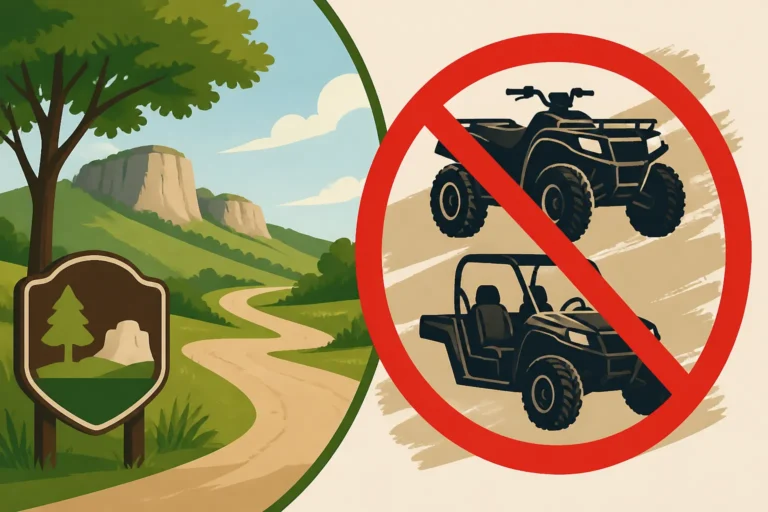
School Creek ORV Area, at Milford Lake west of Manhattan, is another regional option to investigate. It is often presented as a more restricted choice for machine size: information associated with the area describes a 50-inch limit and use by dirt bikes and quads rather than wider side-by-sides. Because equipment rules can determine whether you can unload at all, confirm the restriction with the managing agency before making the drive.
That limit matters in practical terms. A machine’s advertised category or model name may not tell you whether it meets a width rule. If the posted rule is based on vehicle width, measure the machine as directed by the park or managing agency instead of estimating from the owner’s manual, tire spacing, or a quick look at the fenders. The guide [Kansas's 50-Inch Limit at School Creek] can help you understand why this detail deserves attention.
School Creek may suit riders with compatible machines who want a designated place to ride near Milford Lake. It is not a substitute for checking trail availability, terrain, and access before departure. Confirm that the area is open, that your machine type is permitted, and that any rules about passengers, protective gear, or designated routes are clear. For location-specific preparation, start with [School Creek ORV Area in Kansas].
Comparing the closest options
The most useful comparison is not simply which riding area is closest to Manhattan. It is whether your vehicle is allowed, whether the area is open, and whether the terrain matches your group. A family taking youth quads may need a different setup from a group arriving in full-width utility side-by-sides.
| Riding area | General location from Manhattan | Best first check | Practical consideration |
|---|---|---|---|
| Tuttle Creek ORV Area | Near Randolph, north of Manhattan | Current access, hours, and marked boundaries | Designated riding area; do not assume nearby land is open to riding |
| School Creek ORV Area | Milford Lake area, west of Manhattan | Machine width and permitted vehicle types | Commonly described as limited to machines under 50 inches |
| Kansas Rocks Recreation Park | Near Mapleton, farther from Manhattan | Current park rules, reservations, and trail conditions | A longer trip that may suit riders seeking a private riding park |
Use the table as a starting point, not a guarantee of current admission or access. Riding areas can change their operating conditions, and a place that was open during one visit may be closed or restricted later. Check the managing agency or park directly before loading the trailer.
If you are comparing additional options around Kansas, [Kansas Corps of Engineers Riding Areas] explains the broader role of Corps-managed land, while [Kansas Private Off-Road Parks] is useful when you are willing to travel beyond the Manhattan area for a privately managed facility.
Match the riding area to your machine and group
Check vehicle fit before you leave
Machine compatibility can be the difference between a smooth outing and a wasted drive. A sport quad, youth ATV, dirt bike, and side-by-side do not necessarily have the same access at a given site. At School Creek, the reported width limit makes this especially important for side-by-side owners. At any designated riding area, look for the rules that apply to the exact class and dimensions of your vehicle.
Measure before the trip if the site uses a width threshold. Follow the area’s instructions about how width is measured, including whether the measurement is taken at the tires or another point. Do not assume that a machine advertised as “compact” qualifies. Aftermarket wheels, tires, spacers, or accessories can change its actual width, and a tape measure in the garage is easier than discovering a mismatch at the entrance.
For wider vehicles, check [Kansas Trails That Allow Side-by-Sides] before choosing a destination. If your group has a mix of machines, make the call based on the least compatible vehicle, not the smallest ATV. It is frustrating to organize a convoy, arrange a trailer, and then learn that one machine is not allowed. A quick confirmation can also reveal whether the area has separate rules for passenger capacity or particular types of off-road vehicles.
Choose terrain for your actual experience
A trail’s difficulty is not just a matter of whether it looks steep. Loose soil, deep ruts, sharp turns, exposed roots, slick clay, and changing visibility can make a short section demanding. Riders new to off-road terrain often do better by starting slowly, keeping space between vehicles, and turning around when conditions become uncomfortable rather than treating every obstacle as a test.
This is especially helpful for mixed-experience groups. A confident adult may be comfortable crossing a rough patch that overwhelms a younger rider or a first-time passenger. Agree in advance that anyone can pause or turn back without pressure. Before riding, talk through basic signals, where to stop safely, and what to do if the group becomes separated. Those small conversations reduce the stress of managing different speeds once engines are running.
Families looking for a suitable outing can also review [Kansas Trails for Kids]. That does not remove the need to judge your own child’s comfort, vehicle size, and supervision needs. A beginner-friendly route still calls for a properly sized machine, protective equipment, and an adult who can stay attentive rather than riding far ahead.
Know what the title and tag do not tell you
A machine’s title does not automatically give you permission to ride it on every road or public parcel. Ownership paperwork and riding access answer different questions. A titled ATV or UTV may still be restricted to designated areas, private property with permission, or locations where local rules specifically allow its use. Likewise, finding an unpaved road on a map does not mean it is an authorized trail.
Kansas does not have a statewide OHV registration tag in the way some riders may expect, but that does not mean all riding areas have no rules, permits, or entry requirements. For the state-level distinction, see [Kansas Has No State OHV Permit]. A park or land manager may still set its own conditions, and private riding areas can establish rules for machine types, riders, safety equipment, waivers, and conduct.
Treat every site’s posted information as separate from your title documents and any city street tag. If a route leaves the designated riding area or uses a public road, stop and confirm that the use is lawful. The guide [Kansas State Parks Have No OHV Trails] is a useful reminder that a state park’s existence does not itself establish that OHV trail riding is available there.
Plan a dependable ride from Manhattan
Verify access, hours, and closures
Before you load, check the riding area’s official information for current hours, access restrictions, road conditions, and closures. If anything is unclear, contact the agency or park directly. This is particularly important after storms, when low spots and clay sections may become difficult or damage-prone, and during maintenance periods or seasonal changes.
Do not rely on an old social media post as your only confirmation. A rider may be describing a previous visit, a different entrance, or a limited event rather than ordinary access. When you call or check the managing agency’s page, ask specific questions: Is the riding area open on the day you plan to go? Are there machine-width or vehicle-type restrictions? Are there closures or special instructions for the entrance?
It is also worth checking the last stretch of the drive. A place can be open while a route to its entrance is affected by construction, flooding, or poor conditions. If your towing setup is long or heavy, confirm that the approach is appropriate before committing to a narrow or muddy road. For broader preparation, [Kansas Trail Conditions Before You Tow] covers the kind of checks that can save a frustrating trip.
Prepare navigation and a fallback plan
Save the destination and entrance location before leaving Manhattan, and keep a written note of the address or directions. Cellular service may be inconsistent once you leave town or move into a more rural area. A mapping app such as onX Offroad can be useful as a planning reference, but an app display is not proof that a road or parcel is open to motorized riding. Verify access with the land manager and obey signs on site.
It helps to mark a return point, identify where the trailer is parked, and tell everyone what to do if they lose sight of the group. If you use onX Offroad or another map tool, review it before the ride rather than trying to troubleshoot it while driving. Keep a charged phone and, where appropriate, a paper map or saved directions as a backup. Riders should not assume that a digital map will show temporary closures or every local restriction.
Have a backup destination or a no-ride plan. If the area is closed, flooded, or unsuitable for your machine, do not improvise by entering an unmarked field or following tire tracks beyond the boundary. You might instead reschedule, visit a confirmed private park, or use the day for maintenance. Mentioning onX Offroad as a navigation aid is useful only when it supports the basic rule: map information does not replace permission.
Pack for the drive and the ride
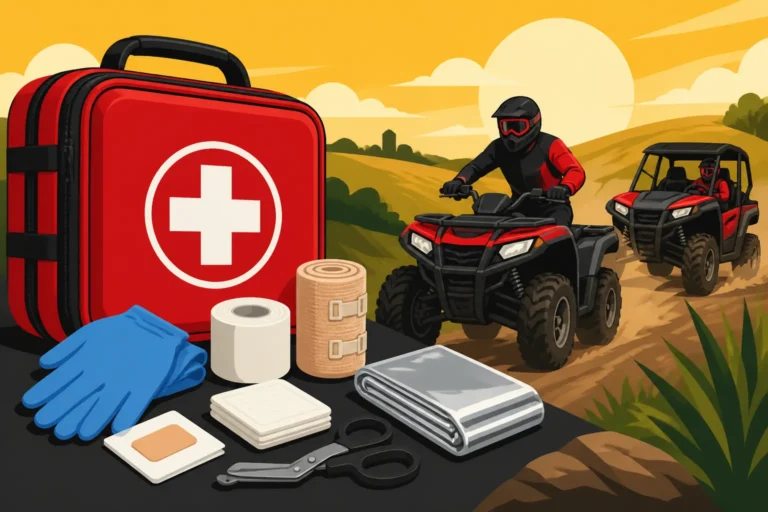
A Manhattan-area ride may be a short local outing or a longer day that includes towing, unloading, and time on the trail. Bring drinking water, basic first-aid supplies, eye protection, gloves, and protective gear suitable for the machine and conditions. For a group, agree who is carrying tools, a tire repair kit, and a way to contact help if a machine breaks down.
Inspect the ATV or UTV before departure. Check tires, brakes, lights, fluid levels, fuel, and any safety equipment your vehicle requires. Secure machines properly on the trailer and confirm that the trailer is ready for the road. It is much easier to discover a loose tie-down or low tire at home than beside a rural highway.
Once you arrive, take a moment to review signs and conditions before riding. Look for posted routes, closed sections, speed limits, and any instructions about parking or unloading. If a route looks newly washed out or more difficult than expected, turn around rather than pushing through just because you drove there. A good day does not require riding every available section.
Ride responsibly on public and private land
Stay within designated boundaries
Near a lake, it can be tempting to assume that open ground or an unpaved access road is available for riding. Do not make that assumption. At designated ORV areas, stay within the marked boundary and use approved routes. On other public land, only ride where motorized use is allowed. On private property, get permission from the landowner before unloading.
This matters around Manhattan because recreation areas may have different purposes and managers. A boat ramp, campground, wildlife area, shoreline, or maintenance road is not automatically an OHV route. Follow barriers and signs even when a route looks passable, and do not create a new track around a closure. A shortcut can damage soil and vegetation, disturb other visitors, and put the rider in an area where access is prohibited.
If you are visiting a private riding park, read its rules before arrival. Private facilities set their own requirements, which may include sign-in procedures, waivers, age limits, safety gear, and vehicle restrictions. The rules at one park do not necessarily apply at another, so do not assume that a previous visit tells you what to expect elsewhere.
Respect weather, soil, and other visitors
Rain can change an area quickly. A route that was firm in the morning may become slick or deeply rutted after a storm, while repeated riding on saturated ground can worsen erosion. Check conditions before towing and be willing to postpone if the site is muddy or closed. That can feel disappointing after a planned weekend, but it protects the riding area and can prevent a recovery problem.
Keep noise and speed under control, especially near parking areas, other recreation users, and nearby homes. Give riders ahead of you room, slow down when visibility is limited, and avoid spraying dirt or water toward people. If you encounter hikers, maintenance crews, or other visitors, reduce speed and pass only when it is safe and permitted.
Take out what you bring in. Do not leave damaged parts, food wrappers, fuel containers, or broken straps at the trailhead. If you see a closure or a hazard, report it to the managing agency rather than trying to repair a public route yourself. A considerate visit helps preserve access for the next Manhattan-area riding group.
Build a safer group routine
Before starting, count the riders and machines, agree on a meeting point, and choose a leader and a sweep rider if the group is large. The leader should know the planned route and keep the pace appropriate for the least experienced person. The sweep rider stays behind the group and can stop if someone has a mechanical issue or needs help.
Set simple expectations about passing, stopping, and regrouping. For example, agree that riders will wait at major intersections or route changes rather than continuing until they reach an arbitrary distance. Make sure passengers are seated in positions designed for passengers, and do not exceed the machine’s intended capacity. A side-by-side’s additional seats do not eliminate the need for helmets or other suitable protection.
Use extra care with children and new riders. Match the vehicle to the rider’s size and ability, supervise closely, and keep the first outing short enough that fatigue does not become a safety problem. Kansas has multiple machine classes and different rules can apply depending on the vehicle and where it is being used. If you are unsure whether a road, park, or route is open to your machine, ask the managing authority before riding.
Make the most of a Manhattan-area riding day
Pick a destination based on the whole group
For a nearby outing, begin by comparing Tuttle Creek and School Creek against your machine, riding experience, and preferred terrain. If the group is riding wide side-by-sides, confirm dimensions and access before considering School Creek. If you are taking smaller quads or dirt bikes, still verify the area’s current rules and condition instead of relying on general descriptions.
For a mixed group, a destination with the right vehicle access and a manageable route is usually a better choice than the one with the most dramatic reputation. A rider who is comfortable on technical terrain may have a great day at one site, while a family with younger riders may prefer a shorter outing with easy access to the trailer and a clear way to regroup. Make the plan around the least experienced rider, not the most adventurous one.
If you are willing to travel farther, consider a private park as a separate day-trip option rather than treating it as a local trail. Kansas Rocks Recreation Park near Mapleton, for example, is a farther destination from Manhattan and has its own operating rules. Check the park directly for current access and conditions before making the longer drive.
Use a simple pre-trip checklist
A short checklist can prevent the most common problems: arriving with a machine that is too wide, finding a closure after a long tow, or discovering that a key part of the group has no protective gear. Run through these steps the day before and again before leaving:
- Confirm the riding area is open and check its current access instructions.
- Verify that each machine type and width is permitted.
- Review the route to the correct entrance and save directions.
- Check weather and recent trail conditions.
- Inspect machines, trailer tires, tie-downs, and required safety equipment.
- Pack water, first aid, basic tools, and a charged phone.
- Tell the group where to meet and what to do if someone gets separated.
- Recheck posted signs when you arrive and stay within the designated area.
This routine does not need to turn a fun day into a paperwork exercise. Once you have checked a site’s rules, saved its location, and prepared the machines, the rest of the day can be about riding. When rules or conditions are unclear, making one more call is almost always less frustrating than learning the answer at the trailhead.
Keep a record of what worked
After the ride, note the entrance used, the route that suited your group, any restrictions you encountered, and whether the terrain was manageable for your machines. A quick note can make the next trip easier, especially if you rotate between Tuttle Creek, Milford Lake, and a farther private park.
Treat those notes as personal experience, not a permanent guide to access. Hours, closures, and rules can change, so confirm them again before the next visit. If you use onX Offroad to organize your route, make a note of which details came from your own ride and which need official confirmation. That distinction helps prevent an old map mark from being mistaken for current permission.
The best rides near Manhattan tend to start with modest expectations and solid preparation: choose a place that allows your machine, stay within its boundaries, and leave room in the plan for weather or closures. With that groundwork handled, Tuttle Creek and School Creek can be useful starting points for exploring the region’s designated off-road options.
Disclaimer
This article is for general informational purposes only and does not constitute professional advice. Laws, prices and regulations vary by location and change over time. Consult a qualified professional for guidance on your specific situation.